
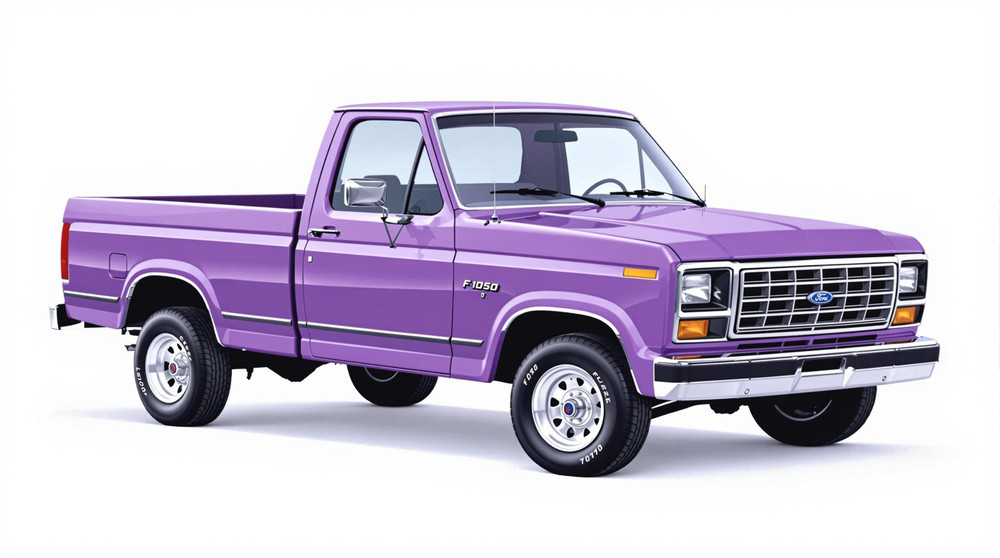
Image of 1986 Ford F-150, Note: These illustrations use artistic license and may differ from actual historical models.
Performance Metrics
Fundamental Metrics
Emotional Appeal
MMP Rating
| Engine Specifications | |
|---|---|
| Engine: | 4.9L 6-cylinder, 5.0L V8, 5.8L V8, 6.9L V8 Diesel |
| Displacement: | 4.9L - 6.9L |
| Horsepower: | 120-210 hp (approximately) |
| Torque: | 245-315 lb-ft (approximately) |
| Compression Ratio: | 8.8:1 - 21.5:1 (approximately) |
| Ignition System: | Electronic |
| Cooling System: | Liquid-cooled |
| Performance Specifications | |
| 0-60 Time: | 10-15 seconds (approximately) |
| 1/4 Mile Time: | 17-20 seconds (approximately) |
| Top Speed: | 85-100 mph (approximately) |
| Transmission and Drive | |
| Drive Type: | Rear-wheel drive (RWD), Four-wheel drive (4WD) |
| Transmission Type: | 3-speed automatic, 4-speed manual |
| Fuel and Efficiency | |
| Fuel System Type: | Carburetor, Fuel Injection |
| MPG: | 10-15 mpg (approximately) |
| Dimensions and Brakes | |
| Brakes: | Front Disc/Rear Drum |
| Wheelbase: | 133.0 in (approximately) |
| Weight: | 4,000-5,000 lbs (approximately) |
Note: Specifications for classic cars are given to the best of our ability, considering the limited and variant data available.
1986 Ford F-150: The Last of the Square-Body Sixth Generation
The 1986 Ford F-150 is a full-size pickup with the sort of honest, no-nonsense character that made the F-Series a fixture on American roads. Built by Ford Motor Company, it belongs to the sixth generation of F-Series trucks, introduced for 1980. The F-150 name itself arrived in 1975, filling the gap between Ford’s lighter F-100 and heavier F-250.
In 1986, the F-150 was nearing the end of an era. It was the final model year of this generation’s distinctly square styling, before Ford gave the F-Series a more aerodynamic redesign for 1987. That makes the ’86 a useful dividing line for enthusiasts: it has the sturdy, upright look of an older work truck, paired with a more modern cab and equipment than many earlier pickups.
Here’s a detail that makes the year especially appealing to collectors: the 1986 F-150 is the last of its generation, but it is not a one-off commemorative model. It was built to work. Today, its appeal comes from that combination of everyday usefulness, recognizable styling, and growing old-truck nostalgia.
Square Shoulders and Work-Ready Cabins
The 1986 F-150 wears crisp, angular bodywork, a broad grille, flat hood, upright windshield, and rectangular headlamps. Its proportions are unmistakably pickup-truck practical, with a tall stance and generous glass area. Depending on trim and equipment, chrome brightwork, grille details, wheel designs, and side moldings could give the truck either a basic work-truck appearance or a more polished look.
Ford offered two main bed treatments: Styleside, with flat-sided bed panels, and Flareside, with pronounced rear fenders and a narrower cargo box. Styleside trucks are the more familiar sight and generally the more practical choice for hauling wide loads. Regular-cab and extended-cab SuperCab versions were available, along with rear-wheel-drive and four-wheel-drive configurations. The regular-cab Styleside is the classic work-truck profile, while a four-wheel-drive SuperCab has become a particularly desirable combination among enthusiasts.
Trim levels ranged from straightforward work-oriented models to better-equipped versions such as the XLT Lariat. Basic cabins used durable, easy-to-clean materials and simple controls. Higher trims could add more comfortable upholstery, carpeting, upgraded door trim, and convenience features. The design was not luxurious by modern standards, but the large windows, upright seating position, and uncluttered dashboard made the cabin easy to live with.
Available paint depended on trim and production details, but the palette included practical solid colors as well as more striking metallic and two-tone combinations. White, red, blue, and dark neutral shades are common sights today. Period-correct two-tone paint is especially popular with collectors because it emphasizes the truck’s straight body lines. As with any classic pickup, original paint and trim combinations are worth checking against the truck’s door-jamb information and build records.
Useful Technology, Not Gadgets
The sixth-generation F-Series was designed around durability and straightforward operation. Two-wheel-drive models used Ford’s Twin I-Beam front suspension, an independent arrangement that gave the truck a more compliant ride than a traditional solid front axle. Four-wheel-drive models used Twin Traction Beam front suspension, Ford’s independent-front-end approach to four-wheel drive. These systems helped distinguish the F-150 from many conventional pickups of the period.
Depending on engine and equipment, buyers could get power steering, power brakes, air conditioning, cruise control, and an automatic transmission. Engine-management equipment also varied by configuration. Some trucks used carburetors, while selected engine versions used electronic fuel injection. That variety is part of the model’s appeal, but it also means buyers should verify a specific truck’s engine, emissions equipment, and original specification rather than assuming all 1986 F-150s are alike.
Why the 1986 F-150 Still Matters
The F-150’s significance is bigger than one model year. Ford refined the full-size pickup into a vehicle that could serve a contractor during the week, tow or haul on the weekend, and handle family transportation in between. The 1986 model reflects that shift. It remained a serious work truck, but its range of cab, bed, drivetrain, and trim choices made it adaptable to a much wider group of owners.
Its independent front suspension on two-wheel-drive models was another important part of the package. Twin I-Beam gave the F-150 a distinctive balance of load capacity and everyday road manners. The system was robust, though it could develop uneven tire wear if alignment, worn components, or hard use were neglected. On four-wheel-drive trucks, Twin Traction Beam delivered a different approach from the solid front axles used by many rivals.
What sets the 1986 apart today is its position between old-fashioned simplicity and later, more polished pickups. It has more comfort and convenience than a bare-bones vintage truck, but it still offers mechanical systems that are familiar to many home mechanics. Its upright styling also helped establish the tough, squared-off Ford truck look that remains central to the brand’s image.
Engines, Acceleration, and Road Manners
Engine availability varied with configuration and market, but the 1986 F-150 could be equipped with Ford’s 4.9-liter inline-six, 5.0-liter V8, 5.8-liter V8, or 7.5-liter V8. The inline-six is prized for its straightforward design and low-speed pulling character. The smaller V8s offer a traditional V8 feel, while the 7.5-liter engine was the choice for buyers who wanted stronger output for heavy work. Manual and automatic transmissions were available, with exact combinations dependent on engine and drivetrain.
Performance figures are best treated as estimates because a truck’s engine, axle ratio, transmission, cab, bed, tires, and present mechanical condition make a major difference. A healthy F-150 might reach 60 mph in roughly 12 to 18 seconds, with heavier four-wheel-drive versions generally slower. Top speed is not a meaningful strength of the truck, but many examples could reach approximately 85 to 100 mph under suitable conditions. These are broad estimates, not guaranteed factory figures, and an old truck should never be tested at its maximum speed simply to check a number.
On the road, the F-150 feels substantial and upright. Twin I-Beam-equipped two-wheel-drive models tend to ride more comfortably over ordinary pavement than their work-truck appearance suggests, though a stiff rear leaf-spring setup can bounce when the bed is empty. Four-wheel-drive trucks feel heavier and more rugged, particularly over rough ground. On winding roads, the high center of gravity and truck-oriented tires call for measured steering inputs. In crosswinds, the tall body can move around more than a modern pickup.
The driving experience is part of the charm. The inline-six has a steady, workmanlike note, while the V8s bring the deeper exhaust rumble many truck fans expect. Steering and braking feel less precise than in a contemporary vehicle, and cabin noise is more apparent at highway speed. In return, the driver gets a clear view over the hood, simple controls, and the satisfying sense of operating a machine built for a job rather than optimized for isolation.
Living With a Classic Ford Pickup
A 1986 F-150 can be a daily driver, a farm or ranch truck, a weekend hauler, or a restoration project. Clean, original examples increasingly show up at car gatherings and classic-truck shows, while four-wheel-drive versions are often used for light trail duty. They are not generally sought as racing vehicles, although their sturdy engines and strong aftermarket support have made many older F-Series trucks popular platforms for custom builds.
Routine service is generally approachable for an owner with basic mechanical experience. The engine bay is relatively accessible, common maintenance parts remain available, and the truck’s mechanical systems are well understood by independent repair shops. Parts availability varies by component and trim, however. Ordinary service items are usually easier to source than pristine original interior pieces, model-specific exterior trim, or correct details for a rare configuration.
Rust deserves close inspection. Check the cab corners, floorboards, rocker panels, wheel arches, bed seams, and frame, especially around areas that trap moisture or road debris. On Twin I-Beam trucks, look for uneven tire wear and evidence of alignment problems. On four-wheel-drive models, inspect the front suspension and driveline carefully. A truck that starts easily and drives straight is a good beginning, but a detailed inspection matters more than a shiny coat of paint.
F-150 Facts and Common Complaints
The most useful bit of 1986 trivia is also the simplest: it marks the last year of the sixth-generation F-Series body style. The following model year brought the next major redesign, giving the 1986 truck a clear place in Ford history. The broader F-Series has been one of America’s most enduring and successful vehicle lines, but that popularity does not mean every individual 1986 configuration is rare.
Ford did not make every engine, cab, bed, trim, and drivetrain combination in equal numbers, and a reliable public production total for the 1986 F-150 alone is difficult to pin down. A reasonable estimate is several hundred thousand F-150s built for the model year, perhaps in the range of 300,000 to 500,000. That is an informed estimate rather than a verified model-specific factory total. Individual versions can be much harder to find, particularly when they combine a desirable engine, four-wheel drive, a certain cab and bed, and original equipment.
Common criticisms are familiar to anyone who has driven an older full-size pickup: fuel consumption can be high, highway noise is noticeable, and the ride can be choppy when the truck is unloaded. Rust, worn suspension parts, aging wiring, and decades of improvised repairs can also turn a bargain into an expensive project. Safety equipment and crash protection are limited by modern standards, so the truck should be driven with an understanding of its age.
1986 Ford F-150 Values and Collectibility
Prices vary widely with condition, originality, engine, cab style, drivetrain, and location. As a broad U.S. market guide for 2026, a rough or incomplete project may sell for about $2,000 to $7,000. A usable driver in fair to good condition might bring roughly $8,000 to $20,000. Clean, well-preserved examples can reach $20,000 to $30,000, while exceptional restorations or especially desirable four-wheel-drive and uncommon configurations may exceed $30,000 and occasionally approach $40,000 or more.
These ranges are estimates, not a formal appraisal. A solid, unmodified truck with documented history is often a better buy than a freshly painted example with hidden rust or questionable mechanical work. Originality, matching equipment, a sound frame, and quality restoration records can make a significant difference. Flareside trucks and distinctive two-tone versions attract attention, while clean four-wheel-drive trucks tend to have a strong enthusiast following.
The 1986 F-150 is not rare in the broad sense, but good examples are becoming less common as work trucks are used up, modified, or left to deteriorate. Values have generally strengthened for clean classic pickups, particularly for desirable and original examples. The market is selective: rough trucks remain affordable, while properly restored or unusually well-kept examples can command a premium.
A Square-Shouldered Ford With Staying Power
The 1986 Ford F-150 brings together practical engineering, a choice of proven engines, flexible body styles, and the unmistakable shape of a classic American pickup. It was the final year of its generation, yet it never depended on a special-edition badge to make its case. Its Twin I-Beam heritage, useful cabin, and range of work-ready configurations helped make it relevant to generations of owners.
For collectors, it offers an appealing balance: old-school looks and mechanical character without being impossibly obscure or difficult to maintain. For drivers, it remains a capable truck when properly inspected and cared for. The 1986 F-150 is more than a nostalgic square-body. It is a snapshot of the full-size pickup becoming an everyday American institution.
1986 Ford F-150 Catalog of Parts
 1986 Ford F-150 Brake Pedal Pad. 4-3/4" wide X 2-1/4" long-CB 111-NBrake Pedal Pad. 4-3/4" wide X 2-1/4" long. Replaces OEM #'s BC3Z2457B, D3TZ2457A, D3TZ2457B. Each
 1986 Ford F-150 Door Seal (Imported). 154" Long-IS-LM 110Door Seal (Imported). 154" Long. Fits right or left, front and rear doors. Each
 1986 Ford F-150 Flocked Window Channel (Imported). Fits left and right side-IS-WC 6600-23Flocked Window Channel (Imported). Fits left and right side. Each
 1986 Ford F-150 Window sweeper kit. Fits 80-87 Ford Bronco and Truck 2 Door Extended/Standard-WC 6600-12This four piece set includes the inner and outer window felt beltline weatherstrips for each door side window. These strips wipe the side windows when the glass is lowered.
Why Choose Metro?
For over 100 years, Metro Moulded Parts has been the pinnacle of quality in classic car restoration parts. Our commitment to precision and authenticity in every component ensures a perfect fit and an OEM-level appearance.
- Expert Craftsmanship & Quality: Each part is a testament to our dedication to reliability and perfection, crafted from original designs and thoroughly tested.
- Advanced Technology: We use cutting-edge techniques to create flawless, long-lasting parts that surpass others in performance.
- SuperSoft Sponge – The Ultimate Door Seal: Not only are our door seals 30% softer than competitors', but they're also guaranteed to never leak. They effectively reduce wind and road noise, enhancing your classic car's comfort and driving experience.
- Proudly American: Our parts are a product of American craftsmanship, made in the USA with a spirit of excellence and heritage.
- Unrivaled Warranty: We back our products with a 30-year industry-leading warranty, a testament to our confidence in their quality.
Join us in preserving the legacy of classic cars with parts that are crafted for perfection, not just made.