
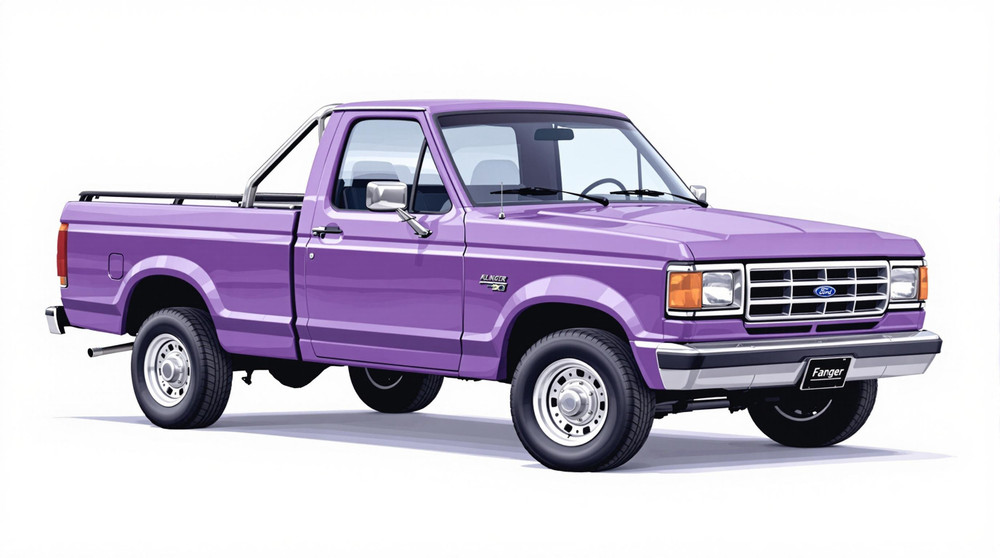
Image of 1987 Ford Ranger, Note: These illustrations use artistic license and may differ from actual historical models.
Performance Metrics
Fundamental Metrics
Emotional Appeal
MMP Rating
| Engine Specifications | |
|---|---|
| Engine: | 2.0L 4-cylinder, 2.3L 4-cylinder, 2.9L V6 |
| Displacement: | 122-177 cu in. |
| Horsepower: | 73-140 hp |
| Torque: | 86-170 lb-ft |
| Compression Ratio: | 8.7:1 - 9.0:1 |
| Ignition System: | Electronic |
| Cooling System: | Liquid-cooled |
| Performance Specifications | |
| 0-60 Time: | 10-15 seconds |
| 1/4 Mile Time: | 17-20 seconds |
| Top Speed: | 100-110 mph |
| Transmission and Drive | |
| Drive Type: | Rear-wheel drive (RWD), Four-wheel drive (4WD) |
| Transmission Type: | 4-speed manual, 5-speed manual, 3-speed automatic |
| Fuel and Efficiency | |
| Fuel System Type: | Carburetor, Fuel Injection |
| MPG: | 17-22 mpg |
| Dimensions and Brakes | |
| Brakes: | Front disc, rear drum |
| Wheelbase: | 107.9 in. |
| Weight: | 3,000-3,500 lbs |
Note: Specifications for classic cars are given to the best of our ability, considering the limited and variant data available.
1987 Ford Ranger: A Compact Truck With Big Staying Power
The 1987 Ford Ranger made a strong case for a simple idea: a pickup did not need a full-size footprint to be genuinely useful. Compact on the outside, adaptable underneath, and offered with everything from an economical four-cylinder to a V6 and four-wheel drive, it became one of the defining small trucks of its era.
Ford introduced the Ranger for the 1983 model year, replacing the imported Mazda-built Ford Courier with a compact pickup developed specifically for Ford’s North American lineup. By 1987, the Ranger was an established bestseller. It offered truck buyers a more manageable alternative to full-size pickups without giving up an open bed, available 4x4 capability, or the familiar feel of a traditional body-on-frame truck.
One interesting piece of Ranger history is how much company the truck kept. Its first-generation cab and engineering were closely related to the Ford Bronco II, giving Ford a shared compact-truck and compact-SUV family. The 1987 Ranger sits within that original generation, before the more extensive exterior update that arrived later in the decade.
Square-Jawed Styling and Practical Choices
The 1987 Ranger wore the purposeful, squared-off styling that now defines many classic compact pickups. Its upright grille, rectangular headlamps, flat hood, straight body sides, and sharply drawn wheel openings gave it a clean, work-ready appearance. The proportions were notably tidy: a short nose and compact cab made the Ranger easier to park and maneuver than a full-size truck, while the long bed kept it useful for hauling.
Buyers could choose a regular cab or the roomier SuperCab, which added space behind the front seats for occasional passengers or enclosed storage. Bed configurations and equipment depended on cab and trim, with both standard pickup styling and different bed lengths available. The regular-cab truck became the classic, uncomplicated workhorse; the SuperCab was the more versatile choice for owners who wanted extra cabin space.
Trim levels included practical versions such as XL and better-equipped choices such as XLT, while the STX package gave the Ranger a sportier look and was particularly appealing when paired with four-wheel drive. Equipment varied by configuration, but trim and option packages could add upgraded interior details, exterior graphics, wheel choices, and convenience features.
Ford offered the Ranger in a broad palette of solid colors, including familiar truck shades such as white, black, red, blue, silver, and earth tones. Exact color names and availability depended on trim and production details. Two-tone paint and decals gave some STX trucks extra visual punch. White, red, and blue examples are especially recognizable today, though originality and condition matter more to most buyers than a particular color.
A Work-Truck Cabin With Useful Technology
Inside, the Ranger was built around function. The dashboard was straightforward and upright, with large, readable gauges and controls positioned for easy reach. Materials were appropriate to a compact pickup of the period: hard-wearing plastics, vinyl in many basic configurations, and cloth or upgraded trim in better-equipped models. It was not a luxury cabin, but it was designed to take everyday use in stride.
Available equipment could include air conditioning, power steering, an automatic transmission, and upgraded audio or interior trim. The SuperCab provided useful extra room, though its rear seating was best treated as occasional-use space rather than a full-size crew-cab alternative. The compact dimensions also meant the cabin felt snug by modern standards, especially for taller occupants.
For its time, the Ranger’s most meaningful technology was often under the hood and beneath the chassis. Electronic engine controls and fuel injection were available on many configurations, improving the balance of drivability, emissions control, and fuel delivery compared with older carbureted setups. Buyers could also select four-wheel drive, giving the compact truck real capability on snow-covered roads, gravel, and light trails.
Engines, Transmissions, and 4x4 Choices
Engine availability varied with configuration and market, but the 1987 Ranger lineup included four-cylinder and V6 choices. The 2.3-liter four-cylinder was a familiar, practical option, while the 2.9-liter Cologne V6 delivered stronger low-speed pull and a more relaxed feel when carrying a load. Some configurations also used the smaller 2.0-liter four-cylinder. Exact output figures differed by engine, emissions setup, and transmission.
Manual gearboxes were a natural fit for the Ranger’s straightforward character, with automatic transmission available for drivers who preferred easier stop-and-go use. Two-wheel drive kept costs and fuel consumption down. Four-wheel-drive versions added traction and ground clearance for more demanding conditions, making them especially attractive in regions with winter weather or rough access roads.
The Ranger’s chassis helped distinguish it from a car-based utility vehicle. Two-wheel-drive models used Ford’s Twin I-Beam front suspension, while four-wheel-drive versions used a related Twin Traction Beam arrangement. A leaf-sprung rear axle gave the truck the load-carrying character buyers expected. The design was rugged and capable, though alignment and front-end condition are important inspection points on old examples.
How the 1987 Ranger Drives
Performance depended heavily on engine, transmission, axle ratio, and equipment. As a broad period-style estimate, a V6 Ranger in good condition may reach 60 mph in roughly 10 to 12 seconds, while four-cylinder versions are generally slower, often landing in the 13- to 15-second range. Top speed is similarly configuration-dependent, but a healthy Ranger might manage approximately 90 to 100 mph. These are estimates rather than one universal factory figure, and the truck is far happier cruising at sensible speeds than being pushed to its limit.
On the road, the Ranger feels light and direct compared with a full-size pickup. The steering is manageable, the view over the hood is excellent, and the compact body is easy to place on narrow streets or trails. The Twin I-Beam setup gives two-wheel-drive models a distinctive front-end feel over uneven pavement. With an empty bed, the rear leaf springs can hop or bounce over sharp bumps, as they do in many pickups designed to carry weight.
On winding roads, a Ranger rewards smooth inputs rather than aggressive cornering. Its tall stance and truck suspension make it less composed than a modern crossover, but the small dimensions and relatively low mass give it an approachable, honest feel. A four-wheel-drive model adds confidence on loose or slippery surfaces, though it remains a part-time truck system, not an invitation to drive carelessly.
The engine character is part of the appeal. The four-cylinder delivers a steady working sound and asks for patience when accelerating. The V6 has a fuller, more substantial note and makes the truck feel less strained with passengers or cargo. From the driver’s seat, the experience is mechanical and uncomplicated: a clear view, familiar controls, and a solid connection to the road through the steering wheel and manual shifter, when fitted.
Why the Ranger Mattered
The Ranger helped establish the compact pickup as a serious mainstream vehicle rather than merely a stripped-down alternative to a full-size truck. It offered buyers a useful bed and genuine truck construction in a package that cost less to buy, park, and operate. Its combination of regular and extended cabs, multiple engines, two- and four-wheel drive, and varied trim levels showed how broadly a compact pickup could serve different needs.
That flexibility set the Ranger apart from many contemporaries. A basic two-wheel-drive model could be an economical work truck, while an STX 4x4 could take on snow, dirt roads, and recreational use. The Ranger also helped Ford develop a durable compact-truck platform that supported related vehicles, including the Bronco II. Its long-running nameplate continued in North America through 2011 and later returned, a sign of how much recognition the Ranger name had earned.
Ownership, Maintenance, and Common Checks
Today, a 1987 Ranger can serve as a light-duty daily driver, a farm or property truck, a weekend project, or a period-correct show vehicle. It is not ideal for modern heavy towing or hauling, and its safety equipment, cabin space, and highway refinement are modest by current standards. But its size and straightforward mechanical layout make it appealing to owners who want a usable vintage truck rather than a vehicle that must stay under a cover.
Many routine repairs are accessible to a home mechanic with basic tools. The Ranger’s conventional body-on-frame construction, widely used Ford components, and plentiful parts support are advantages. Before buying, inspect the frame and body for rust, especially around the frame rails, suspension mounting areas, cab corners, bed, and lower body panels. Also check for worn steering and suspension components, leaks, tired brakes, and evidence of poor-quality previous repairs.
The 2.3-liter four-cylinder has a reputation for being a durable, serviceable engine when maintained. The 2.9-liter V6 offers better performance, but a prospective owner should pay close attention to cooling-system condition, signs of overheating, and any history of engine repairs. As with any nearly 40-year-old truck, service records and the quality of maintenance matter more than mileage alone. Four-wheel-drive hardware, manual hubs, transfer-case operation, and front suspension wear deserve particular attention on 4x4 examples.
Ranger Trivia and Common Criticisms
The STX 4x4 is among the most visually distinctive 1987 Rangers, thanks to its sport-oriented trim and off-road-ready configuration. SuperCab models are also appealing because they combine the Ranger’s compact exterior with extra enclosed storage. There is no single universally recognized 1987 special edition that defines the model year, so original equipment, condition, and configuration tend to drive enthusiast interest.
The Ranger’s notable achievement was not a one-off speed or endurance record. Its larger accomplishment was sustained popularity: it became one of America’s best-known compact pickups and helped make the segment a regular part of the new-truck market. Exact 1987 production totals by trim and drivetrain are difficult to establish from readily available public summaries. A reasonable broad estimate is that Ford built several hundred thousand Rangers for the U.S. market that model year, perhaps in the range of roughly 300,000 to 350,000. That is an estimate, not a verified model-year production count.
Common criticisms are familiar to vintage-truck owners. The cabin is narrow, the ride can be choppy when the bed is empty, and four-cylinder models are not quick. A basic Ranger also lacks the comfort, crash protection, and convenience equipment expected in a modern pickup. For collectors, rust and neglected maintenance are more serious concerns than any one original design limitation.
1987 Ford Ranger Values and Collectibility
The Ranger is collectible, but it remains an accessible classic compared with many vintage pickups. As a general U.S. market estimate, a rough project or heavily worn driver may sell for about $1,500 to $4,000. A usable, reasonably solid truck often falls around $4,000 to $8,000. Clean, original examples can bring roughly $8,000 to $15,000, while exceptional, low-mileage, well-documented trucks or especially desirable 4x4 and STX examples may reach $15,000 to $20,000 or more.
These ranges are broad estimates, not guaranteed sale prices. Rust-free condition, originality, drivetrain, trim, documentation, and location can move the price substantially. Modified trucks may appeal to particular buyers, but tasteful, well-executed changes generally matter less to collectors than a complete, sound, largely original example.
Production in the hundreds of thousands means the 1987 Ranger is not rare in the absolute sense. The challenge is finding one that has survived work use, weather, and decades of repairs in good condition. Values for clean compact pickups have strengthened as buyers seek affordable vintage trucks, especially four-wheel-drive models. The trend is positive for the best examples, but ordinary base trucks remain relatively affordable, and the market can vary sharply by region.
A Compact Classic With Lasting Appeal
The 1987 Ford Ranger brought together practical dimensions, honest truck engineering, multiple powertrain choices, and genuine everyday usefulness. Its square styling and no-nonsense cabin place it firmly in the 1980s, while its adaptable platform explains why the Ranger became such a lasting name in Ford’s lineup.
For today’s enthusiast, the best example is not necessarily the rarest or most powerful. It is the solid, well-maintained truck that still does what a Ranger was built to do: carry its share of the load, go where the road gets rough, and make compact-truck capability feel like the smart choice.
1987 Ford Ranger Catalog of Parts
 1987 Ford Ranger Brake Pedal Pad. 4-3/4" wide X 2-1/4" long-CB 111-NBrake Pedal Pad. 4-3/4" wide X 2-1/4" long. Replaces OEM #'s BC3Z2457B, D3TZ2457A, D3TZ2457B. Each
 1987 Ford Ranger Door Seal. Fits either side. Each-LM 110-TDoor Seal. Fits either side. Each
Why Choose Metro?
For over 100 years, Metro Moulded Parts has been the pinnacle of quality in classic car restoration parts. Our commitment to precision and authenticity in every component ensures a perfect fit and an OEM-level appearance.
- Expert Craftsmanship & Quality: Each part is a testament to our dedication to reliability and perfection, crafted from original designs and thoroughly tested.
- Advanced Technology: We use cutting-edge techniques to create flawless, long-lasting parts that surpass others in performance.
- SuperSoft Sponge – The Ultimate Door Seal: Not only are our door seals 30% softer than competitors', but they're also guaranteed to never leak. They effectively reduce wind and road noise, enhancing your classic car's comfort and driving experience.
- Proudly American: Our parts are a product of American craftsmanship, made in the USA with a spirit of excellence and heritage.
- Unrivaled Warranty: We back our products with a 30-year industry-leading warranty, a testament to our confidence in their quality.
Join us in preserving the legacy of classic cars with parts that are crafted for perfection, not just made.