
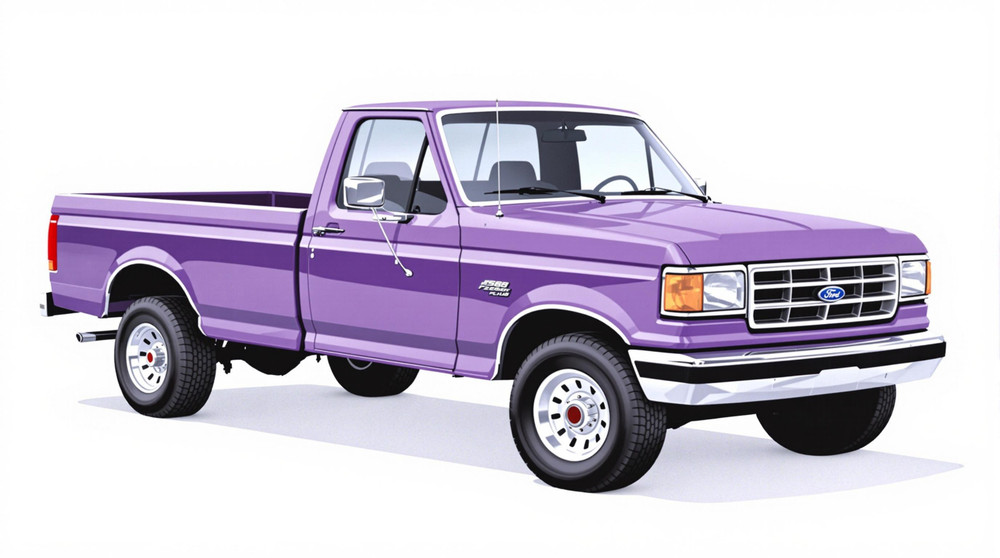
Image of 1988 Ford F-250, Note: These illustrations use artistic license and may differ from actual historical models.
Performance Metrics
Fundamental Metrics
Emotional Appeal
MMP Rating
| Engine Specifications | |
|---|---|
| Engine Options: | 4.9L I6, 5.8L V8, 7.5L V8 |
| Displacement Range: | 4.9L - 7.5L |
| Horsepower Range: | 145-230 hp (estimated) |
| Torque: | 265-388 lb-ft (estimated) |
| Compression Ratio: | 8.8:1 - 8.9:1 (estimated) |
| Ignition System: | Electronic |
| Cooling System: | Liquid-cooled |
| Performance Specifications | |
| 0-60 Time: | 10-15 seconds (estimated) |
| 1/4 Mile Time: | 17-20 seconds (estimated) |
| Top Speed: | 85-100 mph (estimated) |
| Transmission and Drive | |
| Drive Type: | Rear-wheel drive (RWD) or Four-wheel drive (4WD) |
| Transmission Type: | 3-speed automatic, 4-speed automatic, 4-speed manual, 5-speed manual |
| Fuel and Efficiency | |
| Fuel System Type: | Carburetor or Fuel Injection |
| MPG: | 10-15 mpg (estimated) |
| Dimensions and Brakes | |
| Brakes: | Front Disc / Rear Drum |
| Wheelbase: | 133.0 in - 155.0 in |
| Weight: | 4,200-5,600 lbs (estimated) |
Note: Specifications for classic cars are given to the best of our ability, considering the limited and variant data available.
1988 Ford F-250: A Workhorse at the Dawn of a New Era
The 1988 Ford F-250 was built for jobs that asked more of a pickup than hauling groceries. Part of Ford’s eighth-generation F-Series, it combined a tough, body-on-frame chassis with a more modern cab and cleaner styling than the trucks that came before it. Buyers could choose gasoline or diesel power, two- or four-wheel drive, and several cab and trim configurations, making the F-250 equally at home on a ranch, at a construction site, or towing a substantial trailer.
Ford had been building trucks since the early days of the company, and the F-Series had become a cornerstone of its lineup. The 1987 redesign carried into 1988 with a more aerodynamic front end, revised bodywork, and fuel-injected gasoline engines. It marked a useful middle ground: old-school truck toughness with technology and comfort that made long days behind the wheel easier.
One detail that makes 1988 especially interesting is the arrival of Ford’s 7.3-liter indirect-injection diesel, which replaced the earlier 6.9-liter diesel. The change gave buyers a larger-displacement diesel option at a time when diesel pickups were becoming increasingly popular for towing and heavy work.
Square-Shouldered Style, Practical Cab
The F-250’s exterior is straightforward and purposeful. A broad hood, upright windshield, squared-off fenders, and prominent rectangular headlamps give it the unmistakable look of a late-1980s Ford truck. The 1987 redesign smoothed the front end compared with earlier generations, but it did not disguise the truck’s working credentials. The proportions are especially appealing on a four-wheel-drive model, where the taller stance and chunky tires underline its heavy-duty character.
Depending on configuration, buyers could choose a regular cab, SuperCab, or crew cab, along with different bed lengths. Styleside beds were the familiar choice, while 4x2 and 4x4 drivetrains let customers match the truck to their work and terrain. Trim levels ranged from basic work-truck equipment to the better-appointed XLT Lariat. The regular-cab long-bed 4x4 is a particularly recognizable, classic-looking setup, while crew-cab trucks offer a practical blend of passenger space and hauling ability.
Inside, the F-250 favored durability over luxury. Base models commonly used hard-wearing vinyl and simple, easy-to-clean surfaces. Higher trims could bring more inviting cloth upholstery, upgraded door trim, carpeting, and additional convenience equipment. The dashboard is broad and functional, with large controls and clear instrumentation. It feels decidedly truck-like, but the cab is more finished than the bare-bones interiors of earlier work pickups.
Available paint colors varied by trim and equipment, but the palette included practical whites and grays as well as stronger blues, reds, and two-tone combinations. White was a popular fleet and work-truck choice, while two-tone paint and richer colors give surviving personal-use examples extra visual appeal. As with any vintage truck, the exact color and trim combination should be confirmed against the vehicle’s factory information rather than inferred from current paint.
Technology for a Working Truck
Fuel injection was a significant everyday improvement. The gasoline engines used electronic fuel injection, which helped with cold starts and generally made them more consistent than older carbureted truck engines. The 1988 F-250 could be ordered with a 4.9-liter inline-six, a 5.8-liter V8, or a 7.5-liter V8, depending on configuration. The 7.3-liter diesel provided a different kind of appeal, emphasizing low-speed pulling power and long-distance work.
Transmission choices varied with engine and drivetrain. Manual gearboxes suited buyers who wanted direct control, while automatics made stop-and-go work and towing less demanding. Equipment such as air conditioning, cruise control, power accessories, and upgraded audio was available depending on trim and options. Rear-wheel anti-lock braking technology was also part of the period’s move toward better braking control, although equipment details can vary by truck and specification.
Why the 1988 F-250 Matters
The F-250 helped define what a modern heavy-duty pickup could be: a vehicle with genuine work capacity that could still serve as family transportation. Its combination of multiple cab styles, bed choices, engine options, and two- or four-wheel drive made it adaptable to a broad range of jobs. That flexibility became a lasting formula for the pickup market.
Compared with many contemporary trucks, the F-250’s appeal lay in its breadth rather than one headline-grabbing innovation. It offered a choice of gasoline engines for different budgets and workloads, plus a diesel option for owners who prioritized torque and towing. The 1987-to-1991 generation also benefits from a useful balance of straightforward mechanical systems and more modern fuel delivery. It is old enough to feel mechanical and direct, but new enough to be usable for regular driving when properly maintained.
Its influence is easy to see in later pickups. Buyers came to expect a truck to be more than a basic cab attached to a chassis. Comfort, multiple cab configurations, improved drivability, and serious towing capability all became part of the package. The 1988 F-250 was a sturdy example of that transition.
Engines, Speed, and Road Manners
Performance depends heavily on engine, gearing, transmission, axle ratio, drivetrain, and load. Ford did not make every F-250 a quick truck, and a heavy-duty pickup from 1988 should not be judged by modern sports-car standards. As broad real-world estimates, gasoline models might reach 0 to 60 mph in roughly 10 to 16 seconds, while a diesel or a heavily loaded truck could take considerably longer. Top speed is likewise configuration-dependent, but an approximate range of 80 to 95 mph is reasonable for many examples. These are estimates, not universal factory figures, and a vintage truck should never be pushed to its limit simply to test them.
The 4.9-liter inline-six is known for steady, uncomplicated power. The V8s deliver a deeper exhaust note and more authority under load, especially the 7.5-liter. The 7.3-liter diesel has a distinct clatter at idle and a low-speed pull that suits towing. None of these engines makes the F-250 feel delicate or refined. Instead, the driver gets a substantial steering wheel, a high seating position, and a clear sense of the truck’s weight and mechanical connection.
On rough roads, the heavy-duty suspension is designed to carry weight, not to isolate occupants like a modern luxury SUV. An unloaded truck can feel firm, and the rear end may hop over sharp bumps. Add cargo or a trailer within the truck’s ratings and the chassis often feels more settled. On a winding road, the F-250 rewards measured inputs. Its size, solid-axle configurations, and work-oriented suspension mean it is not a nimble corner-carver. In crosswinds, a tall body and large side area can require steady steering corrections, particularly when towing or carrying a load.
Living With a Classic F-250
Today, a 1988 F-250 can serve as a weekend hauler, farm truck, tow rig, restoration project, or period-correct show vehicle. Some owners use them regularly, but a clean, original example is increasingly likely to be preserved for occasional use. Four-wheel-drive models are popular for rural work and recreation, while two-wheel-drive trucks can make economical project vehicles or useful shop trucks.
Mechanical simplicity is one of the F-250’s strengths. Many routine jobs are within reach of a capable home mechanic, and replacement parts for common service items remain available. The gasoline engines are generally approachable to work on, while diesel-specific repairs can require more specialized knowledge. Age, rather than basic design, is often the biggest reliability challenge. Before buying, inspect the frame, cab mounts, floors, bed supports, brake lines, steering components, cooling system, and transmission. On diesel trucks, check cold starting, smoke, blow-by, charging components, and evidence of overheating or neglected maintenance.
Fuel economy is a common drawback. A large gasoline engine, four-wheel drive, low gearing, or heavy towing can produce substantial fuel consumption by modern standards. Other complaints include a firm ride when empty, dated cabin ergonomics, and rust in regions where road salt is used. These are normal compromises for a nearly four-decade-old heavy-duty truck, not reasons to dismiss a well-maintained example.
F-250 Trivia and Buying Notes
The change from the 6.9-liter to the 7.3-liter IDI diesel makes the 1988 model year a small milestone for Ford diesel-truck fans. The later engine retained the indirect-injection approach, using a prechamber rather than direct injection, and became closely associated with Ford’s work-truck reputation. The F-250 was also part of the broader F-Series family, which went on to become one of America’s most enduring and successful truck lines.
There is no dependable, widely cited production figure for every 1988 F-250 combination by cab, engine, trim, and drivetrain. A reasonable broad estimate is that Ford built somewhere in the low hundreds of thousands of F-250s for the model year, perhaps around 100,000 to 200,000 units. That is an informed estimate, not an audited count. Individual configurations can be much harder to find than the overall model-year number suggests, especially clean diesel 4x4s, crew cabs, and trucks with desirable factory options.
There is no single celebrity ownership story or famous speed record that defines the 1988 F-250. Its historical footprint is more practical: these trucks spent decades hauling equipment, pulling trailers, and working in places where reliability mattered more than publicity. Common criticisms include poor fuel economy, a firm ride, and rust susceptibility. On the plus side, the truck’s straightforward construction and useful parts supply make it far less intimidating to maintain than many more complicated vintage vehicles.
Collector Values and Market Outlook
Prices vary sharply with condition, originality, engine, cab, drivetrain, and documentation. As a broad 2026 guide, a rough project truck may sell for about $2,000 to $5,000. A usable driver in fair-to-good condition often falls around $6,000 to $15,000, while a clean, well-kept example can bring roughly $15,000 to $25,000. Exceptional restorations and especially desirable configurations, such as a clean diesel 4x4 crew cab, may reach $25,000 to $40,000 or more. These are estimated ranges, not guaranteed appraisals, and local supply can make a substantial difference.
The market has generally rewarded clean, original, rust-free trucks more than heavily modified or poorly repaired ones. Values for ordinary examples can be steady, while the best diesel and four-wheel-drive combinations have shown stronger collector interest. The 1988 F-250 is not rare in the broad sense, but condition and specification create meaningful scarcity. A sound frame, correct drivetrain, documented history, and unspoiled interior usually matter more than flashy accessories.
A Heavy-Duty Classic With Staying Power
The 1988 Ford F-250 brings together the qualities that made the F-Series a fixture of American roads: practical engineering, multiple configurations, dependable work-oriented powertrains, and a design that looks ready to get something done. It is not fast, quiet, or especially gentle when empty, but it offers a direct and satisfying driving experience that modern trucks often soften.
For collectors, the best examples are useful classics rather than untouchable museum pieces. For owners, they remain honest tools with enough character to make every trip feel a little more mechanical. The 1988 F-250’s significance is simple: it was built to work, and nearly four decades later, that purpose is exactly what makes it memorable.
1988 Ford F-250 Catalog of Parts
 1988 Ford F-250 Brake Pedal Pad. 4-3/4" wide X 2-1/4" long-CB 111-NBrake Pedal Pad. 4-3/4" wide X 2-1/4" long. Replaces OEM #'s BC3Z2457B, D3TZ2457A, D3TZ2457B. Each
 1988 Ford F-250 Door Seal (Imported). 154" Long-IS-LM 110Door Seal (Imported). 154" Long. Fits right or left, front and rear doors. Each
 1988 Ford F-250 Flocked Window Channel (Imported). Fits left and right side-IS-WC 6600-23Flocked Window Channel (Imported). Fits left and right side. Each
Why Choose Metro?
For over 100 years, Metro Moulded Parts has been the pinnacle of quality in classic car restoration parts. Our commitment to precision and authenticity in every component ensures a perfect fit and an OEM-level appearance.
- Expert Craftsmanship & Quality: Each part is a testament to our dedication to reliability and perfection, crafted from original designs and thoroughly tested.
- Advanced Technology: We use cutting-edge techniques to create flawless, long-lasting parts that surpass others in performance.
- SuperSoft Sponge – The Ultimate Door Seal: Not only are our door seals 30% softer than competitors', but they're also guaranteed to never leak. They effectively reduce wind and road noise, enhancing your classic car's comfort and driving experience.
- Proudly American: Our parts are a product of American craftsmanship, made in the USA with a spirit of excellence and heritage.
- Unrivaled Warranty: We back our products with a 30-year industry-leading warranty, a testament to our confidence in their quality.
Join us in preserving the legacy of classic cars with parts that are crafted for perfection, not just made.