
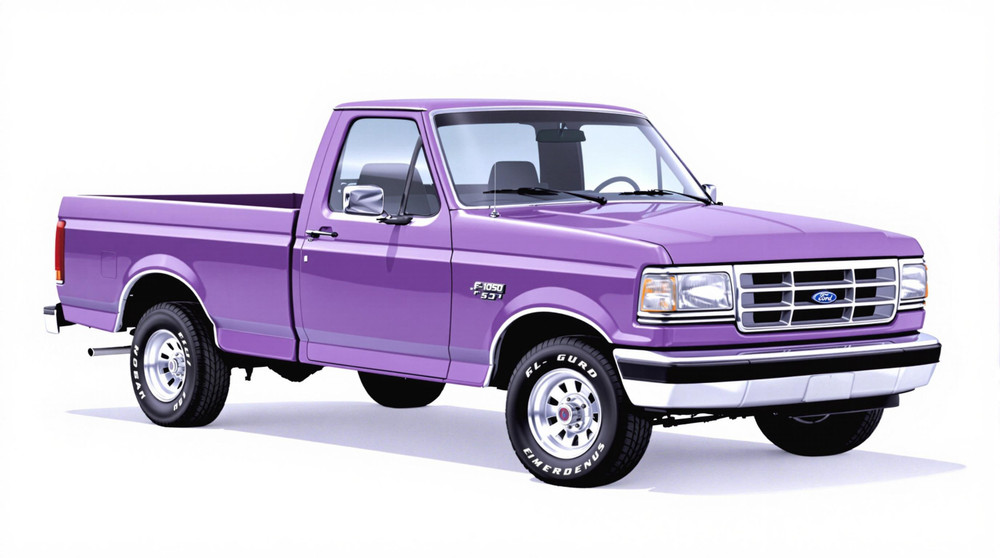
Image of 1991 Ford F-150, Note: These illustrations use artistic license and may differ from actual historical models.
Performance Metrics
Fundamental Metrics
Emotional Appeal
MMP Rating
| Engine Specifications | |
|---|---|
| Engine Options: | 4.9L 6-cylinder, 5.0L V8, 5.8L V8, 7.5L V8 |
| Displacement Range: | 4.9L - 7.5L |
| Horsepower Range: | 145-210 hp |
| Torque: | 265-390 lb-ft |
| Compression Ratio: | 8.8:1 - 9.0:1 |
| Ignition System: | Electronic |
| Cooling System: | Liquid-cooled |
| Performance Specifications | |
| 0-60 Time: | 9.0 - 11.0 seconds |
| 1/4 Mile Time: | 16.5 - 17.5 seconds |
| Top Speed: | 100 - 110 mph |
| Transmission and Drive | |
| Drive Type: | Rear-wheel drive (RWD), Four-wheel drive (4WD) |
| Transmission Type: | 4-speed automatic, 5-speed manual |
| Fuel and Efficiency | |
| Fuel System Type: | Fuel injection |
| MPG: | 12-15 city / 16-20 highway |
| Dimensions and Brakes | |
| Brakes: | Front disc / rear drum |
| Wheelbase: | 133.0 - 155.0 inches |
| Weight: | 4,000 - 5,000 lbs |
Note: Specifications for classic cars are given to the best of our ability, considering the limited and variant data available.
1991 Ford F-150: The Last Year of an Iconic Shape
The 1991 Ford F-150 made hard work look easy, with a squared-off profile, a broad hood and the kind of straightforward toughness that helped make Ford’s F-Series America’s best-selling truck line. Built by Ford Motor Company, it belongs to the F-Series generation introduced for 1987, a major redesign that brought smoother styling and fuel-injected engines to a familiar, work-ready platform.
For truck fans, 1991 is a particularly appealing year: it was the final model year of this body design before a more aerodynamic F-Series arrived for 1992. Enthusiasts often call these trucks “OBS” Fords, short for “Old Body Style,” although that is a nickname rather than Ford’s official terminology. One intriguing detail is that Ford offered the F-150 Nite, a factory special edition with a dark, coordinated appearance that anticipated the modern popularity of monochrome trucks.
Classic Ford Truck Styling and Options
The 1991 F-150 wears its shape with confidence. Its upright grille, rectangular headlamps, flat hood and nearly vertical windshield give it a purposeful, easy-to-recognize face. The broad body sides and substantial wheel arches reinforce its working-truck character, while trim levels and exterior details could make the same basic design look either plain and practical or notably upscale.
Buyers could choose a Regular Cab or a larger SuperCab, along with Styleside or Flareside bed configurations. Bed lengths and availability depended on cab and drivetrain combinations. The Regular Cab Styleside was a common, versatile choice, while the SuperCab offered extra space behind the front seats for passengers, tools or gear. Four-wheel drive was available for buyers who needed extra traction, and two-wheel-drive versions suited work and everyday use on paved roads.
Trim ranged from straightforward work-truck equipment to more comfort-focused versions such as XLT Lariat. Depending on configuration, the cabin could include cloth or vinyl seating, a front bench or bucket seats, carpeting, power accessories, air conditioning and upgraded audio. Materials were durable rather than luxurious: hard-wearing plastics, practical door panels and sturdy upholstery were designed to tolerate work clothes, muddy boots and years of use.
Ford offered the truck in a broad palette of solid and two-tone colors. White, black, red, blue, silver and earthy tones all appeared in the range, though exact paint names and availability varied by trim and production configuration. White and black remain especially recognizable choices among surviving trucks. The Nite package is the standout for buyers who want a more distinctive look, with blacked-out styling and special graphics.
Technology for Work and Everyday Driving
By 1991, the F-150 had moved well beyond the purely mechanical simplicity of earlier pickups. Its gasoline engines used electronic fuel injection, managed by Ford’s EEC-IV engine-control system. That setup helped improve starting, drivability and emissions control compared with older carbureted trucks, while remaining relatively approachable for a competent home mechanic.
Available equipment could include automatic transmission, power steering, power brakes, cruise control, air conditioning and four-wheel drive. Exact features depended on trim and options, so two 1991 F-150s can differ considerably. It was not a modern technology showcase, but its combination of fuel injection, familiar controls and optional comfort equipment made it a useful daily vehicle as well as a work tool.
Why the 1991 F-150 Matters
The 1991 F-150 did not reinvent the pickup. Its significance lies in how effectively it brought together traditional truck utility and the more refined expectations of late-1980s and early-1990s buyers. The 1987-generation redesign had softened the truck’s exterior without abandoning its ladder-frame construction, solid work ethic or recognizable Ford identity.
That balance helped the F-Series remain a dominant name in the American truck market. Buyers could get a basic hauler, a family-friendly SuperCab or a well-equipped pickup without moving to a completely different vehicle. The F-150 also helped establish a template that still shapes the segment: a truck expected to tow and haul, but also to commute, carry passengers and serve as a personal vehicle.
Its influence is visible in today’s collector interest. The 1991 model is old enough to have a distinct period character, yet modern enough to offer fuel injection and everyday usability. Its final-year status adds appeal, though it does not make every example rare. Condition, configuration and originality matter much more than the model year alone.
Engines, Speed and Road Manners
The main engine choices included Ford’s 4.9-liter inline-six, commonly known as the 300, and V8 options such as the 5.0-liter and 5.8-liter. Output varied with engine, equipment and rating method, but approximate figures are around 150 horsepower and 260 lb-ft of torque for the inline-six, about 185 horsepower and 270 lb-ft for the 5.0-liter V8, and roughly 210 horsepower and 315 lb-ft for the 5.8-liter V8. Availability depended on drivetrain and configuration.
Acceleration and top speed were not defining features of a full-size pickup from this era. As a broad estimate, a lightly loaded F-150 might reach 60 mph in roughly 10 to 13 seconds, with the engine, transmission, axle ratio, cab, tires and vehicle condition making a substantial difference. A practical top-speed estimate is around 90 to 105 mph for many versions, but that is not a recommended cruising speed. These figures are estimates, not a single official specification for every truck.
On the road, the F-150 feels like a substantial truck rather than a car-based vehicle. Two-wheel-drive models use Ford’s Twin I-Beam front suspension, a design known for durability and long travel. Four-wheel-drive versions use Twin Traction Beam front suspension. Both help the truck cope with rough roads, although worn bushings, joints, shocks or incorrect alignment can make an old example wander or ride harshly.
On pavement, the steering is slower and less precise than that of a modern pickup, and the body can lean noticeably through corners. Crosswinds and uneven roads require a steady hand, especially with a high-sided load or an empty bed. The ride is firm when unloaded, as expected from a vehicle built to carry weight. Add cargo and the suspension settles into its intended working rhythm.
The engine note is part of the charm. The inline-six delivers a low, steady mechanical rumble, while the V8s add a deeper exhaust note and more relaxed power under load. The driver sits high, looks out over the long hood and works with large, uncomplicated controls. It is a physical, communicative driving experience, not a quiet or isolated one.
Living With a 1991 Ford F-150
These trucks serve many roles today. Some remain working pickups for farms, workshops and property maintenance. Others are weekend drivers, camping rigs, restoration projects or show vehicles. Their simple layout and strong parts support make them appealing to owners who want a classic truck they can actually use.
Routine maintenance is familiar territory for most independent mechanics and experienced home owners. Oil and filter changes, brakes, ignition components and many suspension jobs are straightforward compared with work on a modern truck. Replacement and used parts are widely available, although trim pieces, clean interior components and model-specific body details can take more effort to find.
Age is the main reliability challenge. Check for rust in the cab corners, rocker panels, floor pans, wheel arches, bed and frame, particularly around mounting points. Inspect the Twin I-Beam or Twin Traction Beam front end for worn joints and bushings, and look for oil leaks, tired cooling components, transmission problems and electrical repairs performed over decades of ownership. A well-maintained example can be dependable, but a cheap truck with hidden corrosion can quickly become an expensive project.
Fuel economy is another common criticism. An older, full-size pickup with a gasoline engine is not miserly, and real-world consumption varies widely with engine, axle ratio, tires, load and driving style. Buyers should also remember that its braking performance, crash protection and handling cannot match a contemporary truck.
Notable Editions and F-Series Trivia
The F-150 Nite is one of the most distinctive versions to look for. Its dark visual treatment gives the conventional pickup a factory-custom appearance, making it a favorite with enthusiasts. The later SVT Lightning is sometimes mentioned in conversations about special Ford pickups, but it began with the 1993 model year, so a 1991 truck is not a Lightning.
The F-Series’ larger claim to fame is its remarkable sales history. Ford has repeatedly described the F-Series as America’s best-selling truck, a position it has held for decades. That achievement reflects the entire F-Series range, not the 1991 F-150 alone, and it does not mean every individual trim or body style was produced in equal numbers.
Exact production totals for each 1991 F-150 combination are not readily available in a simple, dependable public breakdown. As a rough estimate, several hundred thousand F-Series trucks may have been built or sold during the model year, with the F-150 accounting for a large share. Treat that as a broad estimate rather than a verified F-150 production figure. No single 1991 configuration is automatically rare simply because it is an F-150; special equipment, engine, drivetrain, cab and condition determine how unusual a particular example is.
1991 Ford F-150 Values and Collectability
Values vary sharply by region, rust, mechanical condition, originality and configuration. As a general current-market guide, a rough project or heavily worn driver may sell for about $2,000 to $6,000. A solid, usable example often falls around $8,000 to $18,000, while an exceptionally clean, low-mileage or carefully restored truck can reach $20,000 to $35,000 or more. Unusual factory packages and highly original examples may command a premium, but asking prices are not the same as completed sale prices.
Availability is still reasonable compared with many classic pickups, although clean, unmodified trucks are becoming harder to find. The broad supply of F-150s keeps ordinary examples within reach, while rust-free trucks, desirable SuperCabs, well-preserved 4x4s and Nite editions attract more attention. Values for the best examples have generally strengthened as buyers seek usable vintage trucks, but worn examples remain governed by repair costs and local demand.
For collectors, the smartest purchase is usually the soundest truck rather than the one with the most dramatic engine or trim badge. A solid frame, healthy drivetrain and complete interior can be worth far more than a low asking price on a rusty project.
The Lasting Appeal of the 1991 F-150
The 1991 Ford F-150 captures a pivotal kind of American pickup: rugged in construction, increasingly refined in equipment and still simple enough to understand. Its squared-off styling, useful body choices and fuel-injected engine lineup explain why it remains popular with drivers and collectors alike.
It is not quick, especially economical or polished by modern standards. Its appeal is more honest than that. A good 1991 F-150 is a working piece of Ford history, ready to haul, cruise or turn heads at a weekend meet, and a reminder of how much character can fit beneath a broad, unmistakably classic hood.
1991 Ford F-150 Catalog of Parts
 1991 Ford F-150 Brake Pedal Pad. 4-3/4" wide X 2-1/4" long-CB 111-NBrake Pedal Pad. 4-3/4" wide X 2-1/4" long. Replaces OEM #'s BC3Z2457B, D3TZ2457A, D3TZ2457B. Each
 1991 Ford F-150 Door Seal (Imported). 154" Long-IS-LM 110Door Seal (Imported). 154" Long. Fits right or left, front and rear doors. Each
 1991 Ford F-150 Flocked Window Channel (Imported). Fits left and right side-IS-WC 6600-23Flocked Window Channel (Imported). Fits left and right side. Each
Why Choose Metro?
For over 100 years, Metro Moulded Parts has been the pinnacle of quality in classic car restoration parts. Our commitment to precision and authenticity in every component ensures a perfect fit and an OEM-level appearance.
- Expert Craftsmanship & Quality: Each part is a testament to our dedication to reliability and perfection, crafted from original designs and thoroughly tested.
- Advanced Technology: We use cutting-edge techniques to create flawless, long-lasting parts that surpass others in performance.
- SuperSoft Sponge – The Ultimate Door Seal: Not only are our door seals 30% softer than competitors', but they're also guaranteed to never leak. They effectively reduce wind and road noise, enhancing your classic car's comfort and driving experience.
- Proudly American: Our parts are a product of American craftsmanship, made in the USA with a spirit of excellence and heritage.
- Unrivaled Warranty: We back our products with a 30-year industry-leading warranty, a testament to our confidence in their quality.
Join us in preserving the legacy of classic cars with parts that are crafted for perfection, not just made.