
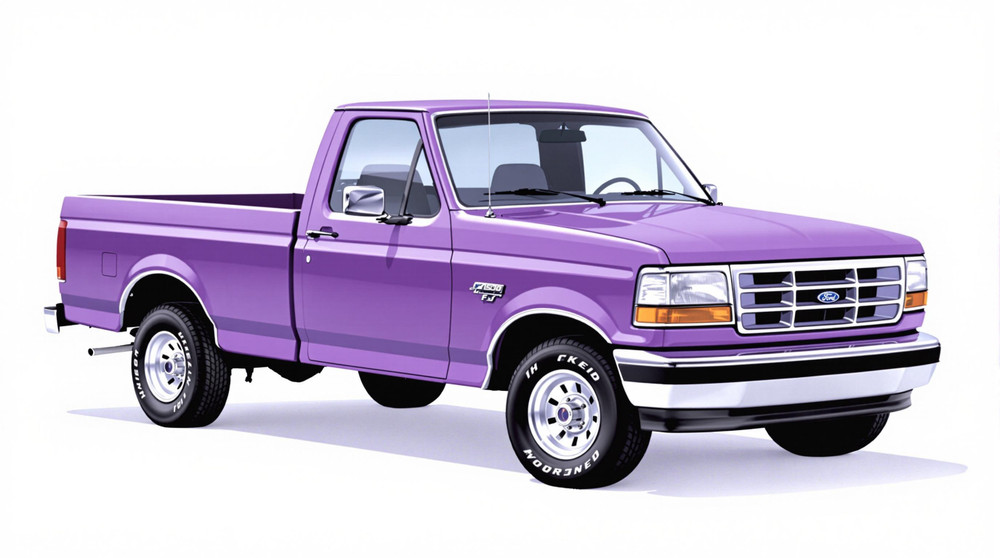
Image of 1993 Ford F-150, Note: These illustrations use artistic license and may differ from actual historical models.
Performance Metrics
Fundamental Metrics
Emotional Appeal
MMP Rating
| Engine Specifications | |
|---|---|
| Engine Options: | 4.9L I6, 5.0L V8, 5.8L V8 |
| Displacement Range: | 4.9L - 5.8L |
| Horsepower Range: | 145-210 hp |
| Torque: | 265-325 lb-ft |
| Compression Ratio: | 8.8:1 - 9.0:1 |
| Ignition System: | Electronic |
| Cooling System: | Liquid-cooled |
| Performance Specifications | |
| 0-60 Time: | 8.0 - 10.0 seconds |
| 1/4 Mile Time: | 16.0 - 18.0 seconds |
| Top Speed: | 100 - 110 mph |
| Transmission and Drive | |
| Drive Type: | Rear-wheel drive (RWD), Four-wheel drive (4WD) |
| Transmission Type: | 4-speed automatic, 5-speed manual |
| Fuel and Efficiency | |
| Fuel System Type: | Fuel injection |
| MPG: | 12-17 mpg |
| Dimensions and Brakes | |
| Brakes: | Front disc / rear drum |
| Wheelbase: | 133.0 - 155.0 inches |
| Weight: | 4,000 - 5,000 lbs |
Note: Specifications for classic cars are given to the best of our ability, considering the limited and variant data available.
1993 Ford F-150: A Guide to Ford’s Full-Size Pickup
The 1993 Ford F-150 made everyday truck ownership feel a little more modern without losing the sturdy, straightforward character that had made Ford pickups a fixture on American roads. Its rounded bodywork softened the look of earlier square-edged trucks, while a choice of proven engines, cab styles, and two- or four-wheel drive kept it ready for work, family duties, or weekend adventures.
Built by Ford as part of the ninth-generation F-Series, the 1993 F-150 was one member of a lineup that also included the heavier-duty F-250 and F-350. The F-Series had been America’s best-selling truck since 1977, and its popularity helped establish the full-size pickup as more than a worksite tool. By the early 1990s, buyers increasingly expected a truck to serve as a daily driver too.
One intriguing detail: the 1993 model sits just before a significant safety change. Ford introduced a driver-side airbag to the F-Series for the 1994 model year, making the 1993 truck part of the final run of this generation without that feature.
Rounded Lines, Practical Cabin
The ninth-generation F-150 traded the previous generation’s boxy profile for smoother, more aerodynamic styling. The hood and front fenders flowed into a broad grille, while the windshield and cab corners were more rounded. It still looked unmistakably like a Ford truck, but the softened edges gave it a more contemporary presence. Depending on trim and equipment, details such as grille finish, brightwork, wheels, and exterior graphics could give the truck a work-ready or more polished appearance.
Buyers could choose a regular cab or an extended SuperCab, along with different bed lengths. The traditional Styleside bed had flat outer panels, while the less common Flareside used pronounced rear fenders and a narrower cargo box. Styleside trucks were the common, practical choice. Four-wheel drive was available for buyers who needed extra traction, while two-wheel-drive versions suited many work and everyday applications.
Trim levels included XL and XLT, with equipment varying by configuration. The cabin was designed around durability rather than luxury. Hard-wearing plastics, vinyl or cloth upholstery, and straightforward switchgear were typical, with carpet and more comfort features available on better-equipped trucks. Options could include air conditioning, power windows and locks, tilt steering, cruise control, and upgraded audio. The broad bench seat and upright driving position gave the F-150 a distinctly old-school pickup feel.
Factory paint choices varied with trim and production details. White, red, blue, black, and several metallic or two-tone combinations were among the colors buyers could encounter. White and red remain especially familiar sights, while clean examples in darker or less common combinations can stand out at shows and truck meets.
Technology Built for the Early ’90s
The 1993 F-150 was not packed with screens or driver-assistance systems, but it had useful technology for its time. Electronic fuel injection was used across the available gasoline engine range, improving cold starts and day-to-day drivability compared with older carbureted setups. Depending on engine and configuration, buyers could pair their truck with a manual or automatic transmission.
Available convenience equipment helped the F-150 work as a personal vehicle as well as a commercial one. Power accessories, cruise control, and air conditioning were meaningful upgrades for a pickup in this era. Yet the overall design remained refreshingly direct: essential controls were easy to reach, and there was little to distract the driver from the road or the job at hand.
Engines and Road Performance
Engine availability depended on the truck’s configuration, but the main gasoline choices included Ford’s 4.9-liter inline-six, 5.0-liter V8, 5.8-liter V8, and, in certain F-150 configurations, the larger 7.5-liter V8. Approximate output figures were 150 horsepower and 260 lb-ft of torque for the 4.9-liter, 185 horsepower and 270 lb-ft for the 5.0-liter, 210 horsepower and 325 lb-ft for the 5.8-liter, and around 230 horsepower and 385 lb-ft for the 7.5-liter. Exact specifications could vary with equipment and rating conventions.
The 4.9-liter inline-six earned a reputation for simplicity and durability, making it a sensible choice for owners who valued dependable, uncomplicated service. The V8s offered more power and a familiar, deep exhaust note. For towing or hauling, the larger engines provided more useful low-speed pulling force, though the final capability depended on axle ratio, transmission, cab, drivetrain, and factory ratings.
There is no single meaningful 0-to-60-mph time or top speed for every 1993 F-150. Engine, gearing, transmission, drivetrain, and load all make a difference. As a broad guide, many V8 examples could reach 60 mph in roughly 9 to 13 seconds, while six-cylinder or heavily optioned trucks could be slower. Unladen highway top speeds were generally in the neighborhood of 90 to 100 mph, but the F-150 was engineered for utility, not high-speed performance. These are estimates, not official figures for every configuration.
How It Drives
On the road, the F-150 feels substantial and straightforward. The steering is less precise than that of a modern pickup, and its size is noticeable in tight parking lots. On two-wheel-drive models, Ford’s Twin I-Beam front suspension helped deliver durable, work-oriented handling. Four-wheel-drive versions used a Twin-Traction-Beam front suspension. Both setups favor toughness over sports-car sharpness.
Over broken pavement, an empty truck can feel firm and sometimes bouncy, particularly at the rear. Add cargo or towing weight within the truck’s limits, and the ride often settles down. On winding roads, the F-150’s height and body movement encourage a measured pace. In return, the driver gets a commanding view and a reassuring sense of size. The inline-six sounds purposeful, while the V8s bring a more pronounced rumble under acceleration. The overall experience is mechanical and uncomplicated, with a clear connection between the driver, the throttle, and the truck.
Why the 1993 F-150 Matters
The 1993 F-150 represents an important middle ground in pickup design. It brought smoother styling and more everyday comfort to a proven truck format, without abandoning the practical construction that traditional buyers expected. The rounded body was a visible sign of the industry’s move toward more aerodynamic, modern-looking pickups, while the broad range of engines and configurations kept the F-Series useful to a wide range of owners.
Its significance also comes from the F-Series’ larger story. Ford’s long-running sales success helped make the full-size pickup a central part of American automotive culture. Trucks like the 1993 F-150 helped bridge the gap between the bare-bones work vehicle and the comfortable personal pickup that would become increasingly popular in the years ahead.
Living With One Today
A 1993 F-150 can serve as a weekend hauler, farm or job-site truck, project vehicle, or nostalgic daily driver. Some owners restore them to factory-style condition; others keep them as useful, honest old pickups. The regular-cab Styleside is a classic work-truck configuration, while a clean SuperCab or Flareside can draw extra attention for its distinctive proportions.
Routine repairs are generally approachable for a mechanically minded owner. The engine bay is relatively accessible, the mechanical systems are familiar to many independent shops, and replacement parts remain available for common service needs. Age is the bigger challenge. Buyers should inspect the frame and body for corrosion, check the condition of brake and fuel lines, and look for worn suspension components, tired rubber seals, electrical faults, and signs of neglected maintenance. On four-wheel-drive trucks, the front suspension and drivetrain deserve particular attention.
Reliability depends heavily on care and condition. The engines can be durable, but no three-decade-old truck should be bought on reputation alone. Service records, a cold start, a thorough road test, and an inspection underneath can reveal more than a shiny paint job.
F-150 Facts and Common Complaints
The 1993 F-150 was part of a model family that remained hugely popular across the United States. Ford’s reported F-Series sales for 1993 were roughly 480,000 trucks, a figure covering the F-150, F-250, and F-350 rather than the F-150 alone. A precise public production total for the 1993 F-150 by itself is difficult to pin down, but it was a mass-market vehicle built in substantial numbers, not a limited-production collectible.
There is no headline speed or endurance record associated specifically with the 1993 F-150. Its claim to fame is more everyday: helping sustain the F-Series’ long run as America’s leading truck. The model also belongs to a generation whose styling marked a clear departure from the sharper-edged pickups of the 1980s.
Common criticisms include fuel consumption, especially with a larger V8 or four-wheel drive, a firm ride when the bed is empty, and steering that feels loose or slow by modern standards. Cabin materials are basic, and safety equipment is limited compared with newer trucks. Those drawbacks are part of the ownership calculation, but they are also why many enthusiasts appreciate the truck’s simplicity.
Collector Values and Availability
The 1993 F-150 is generally an accessible classic rather than a rare collectible. Clean examples appear regularly in the used-truck market, though condition, rust, drivetrain, cab style, and originality can make a major difference in price. As a broad 2026 estimate in the U.S. market, a project truck may sell for about $2,000 to $5,000. A running, usable example commonly falls around $5,000 to $10,000, while a particularly clean, well-kept truck may bring $10,000 to $20,000 or more. Exceptional low-mileage examples or especially desirable configurations can exceed that range.
Prices have generally strengthened for clean, original older pickups as buyers seek simpler vehicles with recognizable styling. Still, most 1993 F-150s are not rare enough to guarantee rapid appreciation. Rust-free condition, documentation, originality, and a desirable configuration matter far more than the model year alone. Since exact F-150-only production figures are not readily available, it is more accurate to describe the truck as plentiful overall, with well-preserved examples becoming increasingly scarce.
A Classic Pickup With Everyday Credibility
The 1993 Ford F-150 combines durable mechanical choices, practical configurations, and the more rounded design language that shaped the next era of full-size pickups. It is not a high-performance truck or a scarce collector special, but it offers something more enduring: an honest, useful pickup with a strong place in Ford’s history. For enthusiasts who want a classic truck they can still drive, work on, and enjoy, the 1993 F-150 remains a compelling choice.
1993 Ford F-150 Catalog of Parts
 1993 Ford F-150 Brake Pedal Pad. 4-3/4" wide X 2-1/4" long-CB 111-NBrake Pedal Pad. 4-3/4" wide X 2-1/4" long. Replaces OEM #'s BC3Z2457B, D3TZ2457A, D3TZ2457B. Each
 1993 Ford F-150 Door Seal (Imported). 154" Long-IS-LM 110Door Seal (Imported). 154" Long. Fits right or left, front and rear doors. Each
 1993 Ford F-150 Flocked Window Channel (Imported). Fits left and right side-IS-WC 6600-23Flocked Window Channel (Imported). Fits left and right side. Each
Why Choose Metro?
For over 100 years, Metro Moulded Parts has been the pinnacle of quality in classic car restoration parts. Our commitment to precision and authenticity in every component ensures a perfect fit and an OEM-level appearance.
- Expert Craftsmanship & Quality: Each part is a testament to our dedication to reliability and perfection, crafted from original designs and thoroughly tested.
- Advanced Technology: We use cutting-edge techniques to create flawless, long-lasting parts that surpass others in performance.
- SuperSoft Sponge – The Ultimate Door Seal: Not only are our door seals 30% softer than competitors', but they're also guaranteed to never leak. They effectively reduce wind and road noise, enhancing your classic car's comfort and driving experience.
- Proudly American: Our parts are a product of American craftsmanship, made in the USA with a spirit of excellence and heritage.
- Unrivaled Warranty: We back our products with a 30-year industry-leading warranty, a testament to our confidence in their quality.
Join us in preserving the legacy of classic cars with parts that are crafted for perfection, not just made.