
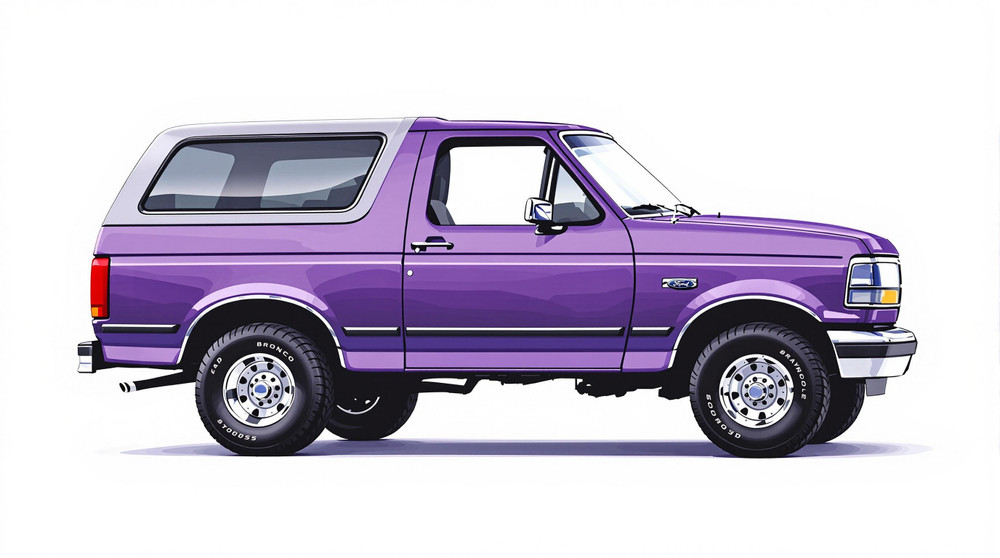
Image of 1995 Ford Bronco, Note: These illustrations use artistic license and may differ from actual historical models.
Performance Metrics
Fundamental Metrics
Emotional Appeal
MMP Rating
| Engine Specifications | |
|---|---|
| Engine Options: | 4.9L I6, 5.0L V8, 5.8L V8 |
| Displacement Range: | 4.9L - 5.8L |
| Horsepower Range: | 145-210 hp |
| Torque: | 265-325 lb-ft |
| Compression Ratio: | 8.8:1 - 9.0:1 |
| Ignition System: | Electronic |
| Cooling System: | Liquid-cooled |
| Performance Specifications | |
| 0-60 Time: | 10-12 seconds |
| 1/4 Mile Time: | 17-18 seconds |
| Top Speed: | 100-105 mph |
| Transmission and Drive | |
| Drive Type: | Rear-wheel drive (RWD) with optional 4-wheel drive (4WD) |
| Transmission Type: | 4-speed automatic, 5-speed manual |
| Fuel and Efficiency | |
| Fuel System Type: | Fuel injection |
| MPG: | 12-15 mpg city, 15-18 mpg highway |
| Dimensions and Brakes | |
| Brakes: | Front disc, rear drum |
| Wheelbase: | 104.7 inches |
| Weight: | 4,500-5,000 lbs |
Note: Specifications for classic cars are given to the best of our ability, considering the limited and variant data available.
1995 Ford Bronco: The Full-Size SUV With a Removable Roof
The 1995 Ford Bronco brought old-school truck hardware to a fast-changing SUV market: it was tough, roomy, unmistakably American, and still offered a removable rear hardtop. Built by Ford and derived from the F-Series pickup, the Bronco combined a body-on-frame chassis with V8 power and available four-wheel drive. It was not the final Bronco, but it was part of the last generation before the nameplate gave way to Ford’s newer, four-door Expedition.
There is a famous piece of Bronco trivia with an important model-year distinction. The white Bronco involved in the widely televised 1994 police pursuit was a 1993 model, not a 1995. That moment made the Bronco an enduring part of American popular culture, adding an unusual layer to the history of an SUV already known for its rugged, distinctive design.
Fifth-Generation Bronco Design
The 1995 Bronco belonged to the fifth generation, introduced for 1992 and produced through 1996. Its shape was broad and upright, with a long hood, squared-off wheel openings, a tall windshield, and a blunt front end. The styling was softened compared with earlier Broncos, but it still looked like a truck first and a family vehicle second. Its compact-for-a-full-size-SUV, two-door layout gave it a distinctive profile beside the increasingly popular four-door sport-utility vehicles of the era.
The signature feature was the removable fiberglass rear hardtop. With the top installed, the Bronco was an enclosed, weather-resistant SUV. Remove it, and the rear cabin opened to the sky, giving the truck a character that few mainstream SUVs could match. The power rear window could be lowered into the tailgate, a clever feature that preserved an open-air feel without requiring a separate, easy-to-lose rear window.
Inside, the Bronco was practical rather than luxurious. Its wide seats, large controls, and straightforward dashboard suited a vehicle expected to see work, travel, and outdoor use. Depending on trim, buyers could get cloth or more upscale upholstery, air conditioning, power windows and locks, cruise control, and upgraded audio equipment. Materials were durable and generally easy to clean, though they do not have the soft-touch feel of a modern luxury SUV.
Ford offered the Bronco in several trims, including XL, XLT, and Eddie Bauer, with equipment varying by configuration. The Eddie Bauer was the best-known upscale choice, often recognized by its coordinated two-tone paint and more comfortable interior appointments. Available colors varied by trim and order, but included familiar truck shades such as white, black, red, blue, green, and metallic finishes. Two-tone Eddie Bauer combinations remain especially popular with collectors.
Engines, Four-Wheel Drive, and Technology
The 1995 Bronco’s engine range centered on two fuel-injected V8s. The standard 5.0-liter V8 produced about 205 horsepower and 275 lb-ft of torque. Buyers wanting more low-speed pulling power could choose the 5.8-liter V8, rated at roughly 210 horsepower and 325 lb-ft of torque. Both engines were paired with a four-speed automatic transmission in typical 1995 configurations.
Many Broncos were equipped with part-time four-wheel drive and a two-speed transfer case. Depending on equipment, drivers could select four-wheel drive from inside the cabin rather than stopping to lock manual hubs. That was a useful convenience for changing weather and rough roads, though four-wheel drive was intended for slippery or loose surfaces, not continuous use on dry pavement.
For its time, the Bronco offered a helpful mix of truck capability and everyday convenience. Fuel injection improved cold starts and drivability compared with older carbureted engines. Available power accessories, cruise control, and air conditioning made highway trips easier, while anti-lock braking equipment provided added control. The Bronco’s approach to innovation was less about futuristic electronics than making a traditional truck more comfortable and manageable.
Why the Bronco Mattered
The Bronco helped establish the full-size two-door SUV as a versatile alternative to a pickup. Its combination of a truck frame, V8 power, available four-wheel drive, and enclosed passenger space made it useful for towing, camping, rural driving, and family travel. The removable roof gave it a distinctive recreational appeal that set it apart from more conventional SUVs.
By the mid-1990s, however, the market was shifting. Buyers increasingly wanted four doors, easier rear-seat access, and the comfort of a family wagon. Ford responded with the Expedition, which arrived for 1997 and took over the role of the company’s large SUV. The Bronco’s two-door format became less practical for many households, but its simplicity and open-air option helped preserve its appeal among enthusiasts. Its influence is visible in the continuing popularity of SUVs that combine off-road hardware with everyday usability.
1995 Bronco Performance and Road Manners
Ford did not market the Bronco as a high-speed performance vehicle, and period acceleration figures vary by engine, gearing, equipment, and testing conditions. As a general guide, expect a 0-to-60-mph time in the neighborhood of 9 to 11 seconds. A healthy 5.8-liter example may feel more forceful at low speeds, especially when towing, but the Bronco’s weight and truck gearing limit its quickness. Top speed is not a defining specification; estimates commonly fall around 100 mph, and the vehicle feels most at home well below that pace.
On the road, the Bronco has the firm, substantial feel of a body-on-frame truck. Its suspension can take broken pavement and gravel roads in stride, but sharp bumps may produce noticeable body movement. The tall stance and relatively boxy shape also make it more sensitive to crosswinds than a lower passenger car. On winding roads, it rewards a relaxed driving style: steer smoothly, leave room for the body to settle, and remember that it is a heavy SUV rather than a sports utility vehicle in the literal sense.
The V8 soundtrack is part of the appeal. At idle, the engine has a familiar low rumble; under acceleration, it builds into a steady, workmanlike growl. The automatic transmission and broad torque delivery suit relaxed cruising and low-speed trail work. From behind the wheel, the high seating position gives a commanding view, while the large steering wheel and truck-like controls reinforce the Bronco’s straightforward character.
Living With a 1995 Ford Bronco
A 1995 Bronco can serve as a weekend driver, tow vehicle, camping companion, off-road project, or classic-SUV showpiece. Some owners use them regularly, but fuel economy is modest by modern standards, and the two-door cabin can be less convenient for passengers climbing into the rear seat. The removable top is a major attraction, although it is best treated as a careful project rather than a quick, casual change. Seals, trim, wiring, and the top itself need attention to avoid leaks and damage.
The mechanical package is familiar to many Ford truck specialists, and routine jobs are generally accessible to a capable home mechanic. Parts for common service items and mechanical components remain available, though trim pieces, body parts, and correct interior details can take more hunting. Before buying, inspect the frame and body closely for rust, particularly around the frame, floor pans, rocker areas, wheel openings, and tailgate. Also test the power rear window, since its motor and regulator are essential to opening the tailgate normally.
Other checks include transmission shifting, four-wheel-drive engagement, cooling-system condition, oil leaks, suspension wear, and the integrity of the hardtop seals. A Bronco that has spent years off-road or in a salted-road region may need substantial work. A well-maintained example, on the other hand, can be a durable and rewarding truck when its age-related needs are handled promptly.
Bronco Trivia and Common Criticisms
The Bronco’s retractable rear glass is more than a styling flourish: it lowers into the tailgate, allowing the tailgate to open after the window is down. This arrangement is convenient when it works, but it also makes the window mechanism a key item to inspect on any used example.
The 1995 model is sometimes mistaken for the Bronco involved in the 1994 televised pursuit. That vehicle was a 1993 Bronco, a distinction worth remembering when the famous event comes up. The 1995 itself was not a record-setting performance truck. Its lasting appeal comes instead from its recognizable shape, V8 character, off-road usefulness, and place near the end of the classic full-size Bronco era.
Common criticisms are familiar: thirsty engines, a bouncy truck ride, limited rear-seat access, and the potential for rust and aging electrical components. Those drawbacks are part of the ownership calculation. For enthusiasts, however, the same qualities that make it less polished than a modern SUV are also what give it personality.
1995 Ford Bronco Collector Values
Production estimates for the 1995 model year are roughly 37,000 Broncos, making it a regular-production vehicle rather than a rare limited edition. That estimate is best treated as approximate, and surviving examples vary widely in condition. Broncos are still available through private sellers, used-car listings, and auctions, but clean, unmodified trucks are becoming harder to find.
As a broad current-market guide, a Bronco needing significant work may sell for about $5,000 to $10,000. Usable drivers often fall around $10,000 to $18,000, while clean, well-kept examples can bring roughly $18,000 to $30,000 or more. Exceptional, carefully restored, or especially desirable Eddie Bauer examples may exceed that range. Rust-free bodywork, a working rear window, original equipment, documented maintenance, and a sound hardtop can all have a meaningful effect on value.
Values have generally strengthened as buyers have rediscovered classic SUVs, particularly clean examples with original V8s and unmodified interiors. Condition matters more than mileage alone: a high-mileage Bronco with solid metal and consistent maintenance may be a better buy than a low-mileage truck with hidden corrosion or deferred repairs. Prices can vary by region and market conditions, so these figures are useful guideposts rather than guaranteed sale prices.
The Lasting Appeal of the 1995 Bronco
The 1995 Ford Bronco blends the capability of a full-size pickup with the comfort of an enclosed SUV and the uncommon freedom of a removable rear roof. Its V8 engines, practical four-wheel-drive hardware, and memorable design make it a distinctive member of the classic Ford lineup. It asks for more fuel and patience than a modern crossover, but rewards its owner with character, utility, and a direct connection to an era when SUVs were still built like trucks.
For collectors and drivers alike, the 1995 Bronco is not just an old off-roader. It is a rolling reminder of how much personality a practical vehicle can have, and why the Bronco name continues to command attention.
1995 Ford Bronco Catalog of Parts
 1995 Ford Bronco Brake Pedal Pad. 4-3/4" wide X 2-1/4" long-CB 111-NBrake Pedal Pad. 4-3/4" wide X 2-1/4" long. Replaces OEM #'s BC3Z2457B, D3TZ2457A, D3TZ2457B. Each
 1995 Ford Bronco Door Seal (Imported). 154" Long-IS-LM 110Door Seal (Imported). 154" Long. Fits right or left, front and rear doors. Each
 1995 Ford Bronco Flocked Window Channel (Imported). Fits left and right side-IS-WC 6600-23Flocked Window Channel (Imported). Fits left and right side. Each
Why Choose Metro?
For over 100 years, Metro Moulded Parts has been the pinnacle of quality in classic car restoration parts. Our commitment to precision and authenticity in every component ensures a perfect fit and an OEM-level appearance.
- Expert Craftsmanship & Quality: Each part is a testament to our dedication to reliability and perfection, crafted from original designs and thoroughly tested.
- Advanced Technology: We use cutting-edge techniques to create flawless, long-lasting parts that surpass others in performance.
- SuperSoft Sponge – The Ultimate Door Seal: Not only are our door seals 30% softer than competitors', but they're also guaranteed to never leak. They effectively reduce wind and road noise, enhancing your classic car's comfort and driving experience.
- Proudly American: Our parts are a product of American craftsmanship, made in the USA with a spirit of excellence and heritage.
- Unrivaled Warranty: We back our products with a 30-year industry-leading warranty, a testament to our confidence in their quality.
Join us in preserving the legacy of classic cars with parts that are crafted for perfection, not just made.