
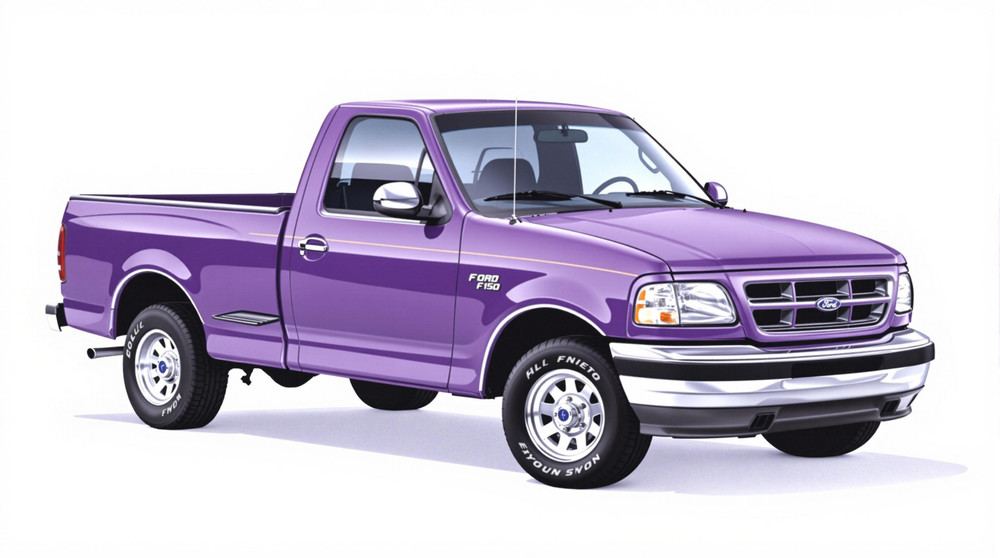
Image of 1997 Ford F-150, Note: These illustrations use artistic license and may differ from actual historical models.
Performance Metrics
Fundamental Metrics
Emotional Appeal
MMP Rating
| Engine Specifications | |
|---|---|
| Engine Options: | 4.2L V6, 4.6L V8, 5.4L V8 |
| Displacement Range: | 256-330 cu in. |
| Horsepower Range: | 202-235 hp |
| Torque: | 252-330 lb-ft |
| Compression Ratio: | 9.0:1 - 9.4:1 |
| Ignition System: | Electronic |
| Cooling System: | Liquid-cooled |
| Performance Specifications | |
| 0-60 Time: | 7.6-8.5 seconds |
| 1/4 Mile Time: | 15.9-16.8 seconds |
| Top Speed: | 105 mph |
| Transmission and Drive | |
| Drive Type: | Rear-wheel drive (RWD), Four-wheel drive (4WD) |
| Transmission Type: | 4-speed automatic, 5-speed manual |
| Fuel and Efficiency | |
| Fuel System Type: | Sequential multi-port fuel injection |
| MPG: | 13-17 city / 17-22 highway |
| Dimensions and Brakes | |
| Brakes: | Front disc / rear drum |
| Wheelbase: | 119.9-138.5 inches |
| Weight: | 4,000-5,000 lbs |
Note: Specifications for classic cars are given to the best of our ability, considering the limited and variant data available.
1997 Ford F-150: The Truck That Changed Its Shape
The 1997 Ford F-150 traded the square shoulders of its predecessors for a smooth, rounded profile, and in doing so announced that America’s best-selling pickup could evolve without giving up its working-truck roots. Built by Ford Motor Company, the 1997 model was the first year of a major F-150 redesign and the opening chapter of the truck’s tenth generation.
The F-150 name had been part of Ford’s lineup since 1975, positioned between the lighter F-100 and the heavier-duty F-250. By the mid-1990s, Ford was preparing a new generation of pickups with a more aerodynamic shape, updated engines, and a more comfortable cabin. The 1997 F-150 was the result. One striking piece of history is that Ford kept the older, boxier truck design in production for its heavier F-250 and F-350 models, while the F-150 moved to its own, distinctly modern body. That visual split made the 1997 F-150 a clear turning point in the family tree.
Rounded Styling, Built for Work
The 1997 F-150’s exterior was a dramatic departure from the upright, slab-sided pickups of the previous generation. Its curved hood flowed into a rounded grille and swept-back headlamps, while the windshield and cab corners softened the overall silhouette. The result looked more at home in a suburban driveway than an older work truck, but it still had the broad stance and practical proportions buyers expected.
Ford offered the F-150 in Regular Cab and SuperCab configurations, with two- or four-wheel drive. Buyers could choose a Styleside bed, with conventional straight-sided box panels, or the more distinctive Flareside bed, whose raised rear fenders gave the truck a sportier, custom look. Bed lengths varied by cab and configuration, with 6.5-foot and 8-foot options among the common choices. The SuperCab was especially popular with owners who wanted extra interior space without stepping up to a larger truck.
Paint choices varied by trim and equipment, but the palette included familiar work-truck whites, blacks, reds, blues, greens, and metallic finishes. Oxford White and black were enduring favorites, while brighter reds and two-tone combinations suited buyers looking for more personality. The Flareside, often paired with a sport-oriented appearance package, remains one of the most recognizable versions today.
A More Comfortable Pickup Cabin
Inside, the redesign brought a roomier, more carlike dashboard and a more relaxed seating position. Materials were practical rather than luxurious: hard-wearing plastics, durable cloth on many trims, and vinyl on work-focused models. Higher trims such as the XLT and Lariat could add more attractive upholstery and convenience equipment, but the cabin’s main strength was usability. Controls were straightforward, visibility was good, and the broad front bench offered the familiar pickup-truck seating experience.
For its time, the F-150 also brought important safety and convenience features into a mainstream truck. Driver and passenger airbags were part of the updated safety package, and anti-lock braking technology was available, with equipment varying by configuration. Power windows, power locks, air conditioning, cruise control, and upgraded audio systems could be added, depending on trim and options. It was not a modern touchscreen truck, of course, but it offered a substantial comfort upgrade over older work-oriented pickups.
Engines and Mechanical Choices
The 1997 engine lineup reflected Ford’s move toward newer powerplants. The base engine was a 4.2-liter Essex V6. V8 buyers could choose a 4.6-liter Modular V8, while the available 5.4-liter Triton V8 delivered stronger low-speed pulling power in suitably equipped trucks. Availability depended on trim, drivetrain, and configuration, so original window stickers and VIN-based parts references are useful when identifying a specific truck.
Depending on the engine and equipment, trucks were paired with manual or automatic transmissions. Rear-wheel drive and four-wheel drive were both available. The new F-150 also benefited from updated suspension engineering, which helped it feel more composed on the road than the older, more overtly trucklike design. As always, payload and towing capability varied considerably with engine, axle ratio, cab, drivetrain, and factory equipment. Buyers should check the door-jamb certification label and original specifications rather than rely on a single headline capacity.
How the 1997 F-150 Drives
Performance depends heavily on the engine and gearing. As a general guide, a V8-equipped F-150 could reach 0 to 60 mph in roughly 8 to 10 seconds, while a V6 version was typically slower, especially when carrying a load. Top speed was not a defining feature of the truck and could vary with tires, axle ratio, condition, and any speed-limiting equipment. Around 100 to 110 mph is a reasonable broad estimate for many stock examples, but it should not be treated as a factory guarantee or a recommendation for testing an older pickup.
Behind the wheel, the 1997 model feels more rounded and less agricultural than its predecessor. The V6 is adequate for everyday use, while the V8s provide a deeper exhaust note and more confident acceleration. The cabin is relatively quiet by older-truck standards, though wind and tire noise are still part of the experience. On ordinary roads, the suspension absorbs rough pavement with the deliberate, slightly bouncy feel of a pickup. A short-bed truck can feel more nimble, while a long-bed or heavily loaded example has a steadier, more work-focused character.
On winding roads, the F-150 behaves like a full-size truck, not a sports car. Its height and mass call for measured steering inputs, especially when empty or carrying cargo. Four-wheel-drive models provide useful traction on slippery surfaces and rough access roads, but they are not a substitute for appropriate tires, careful driving, or sound mechanical condition.
Why the Redesign Mattered
The tenth-generation F-150 helped make aerodynamic styling and everyday comfort central to the full-size pickup formula. Its rounded body was more than a cosmetic experiment: it marked a shift in how manufacturers thought about trucks that served as both work equipment and personal transportation. Buyers increasingly wanted a pickup that could haul materials during the week, tow on weekends, and still feel comfortable on a long commute.
Ford’s decision to give the F-150 a new design while keeping the older body for the heavier F-Series models also made the model hierarchy easier to see. The 1997 F-150 stood apart from the more traditional-looking heavy-duty trucks, while retaining the familiar range of cab, bed, engine, and drivetrain choices. Its influence can be seen in the later evolution of pickups toward more refined interiors and smoother, more aerodynamic exterior shapes.
Everyday Ownership and Maintenance
Today, the 1997 F-150 is commonly used as an affordable daily driver, a farm or property truck, a light-duty hauler, or a restoration project. Clean examples also appear at classic-truck gatherings, where the first-year styling gives them a distinct place between the square-bodied trucks of the early 1990s and the more familiar pickups that followed.
Routine maintenance is generally approachable for a mechanically capable owner. Oil changes, brake work, suspension repairs, and many common service jobs are familiar tasks for independent shops, and parts availability remains a strong point. The vehicle’s age is now the bigger concern than its basic design. Check carefully for frame and body corrosion, worn steering and suspension components, transmission problems, cooling-system issues, and neglected maintenance. On V8 models, service history matters, and a pre-purchase inspection is worthwhile even if the truck appears tidy.
As with any nearly 30-year-old vehicle, condition varies enormously. A truck that has spent years working in harsh weather may need significant structural repairs, while a carefully maintained example can still be useful transportation. Four-wheel-drive components, electrical accessories, and the condition of the bed and cab corners deserve particular attention.
1997 F-150 Facts and Misconceptions
The 1997 F-150 was not an SVT Lightning model. Ford’s first-generation Lightning had ended before this model year, and the next Lightning did not arrive until 1999. That distinction matters to collectors, since a 1997 truck advertised as a factory Lightning deserves careful verification.
The F-150’s greatest record is its place in the broader Ford F-Series story. The F-Series has repeatedly ranked among America’s top-selling vehicle lines, helping make the pickup a defining part of the country’s automotive culture. Exact production totals for the 1997 F-150 alone are not consistently reported in the way enthusiasts might hope. As a broad estimate, several hundred thousand F-150s were likely built for the model year, but that should not be confused with a verified production figure for a particular cab, engine, or trim combination.
Common criticisms include the rounded styling, which some traditionalists found too soft, and the ordinary-truck reality of fuel consumption, especially with a V8 and four-wheel drive. Ride quality is also subjective: the truck is more comfortable than many older pickups, but it still rides and handles like a full-size body-on-frame vehicle. Those traits are part of its character, not surprises to discover after purchase.
Collector Values and Availability
The 1997 F-150 is not generally rare in standard form. It was a high-volume pickup, and used examples remain available across the country. What is becoming less common is an unmodified truck with low mileage, clean bodywork, documented history, and desirable equipment. Flareside models, well-preserved SuperCabs, and clean V8 trucks often attract more attention than basic, heavily used work versions.
As a broad 2026 market estimate, a rough driver may sell for about $2,000 to $5,000, while a cleaner, well-maintained example can fall in the $6,000 to $12,000 range. Exceptional, original trucks may bring more, particularly when they have low mileage, desirable options, or unusually good documentation. These are general ranges, not appraisals: regional demand, rust, mechanical condition, and title history can move a price substantially.
Values have generally been driven more by condition and usefulness than by speculative collector demand. The 1997 model’s first-year redesign gives it historical interest, but ordinary examples are still affordable. Well-kept trucks may gradually appreciate as clean survivors become harder to find, while worn examples are likely to remain priced primarily as practical transportation or project vehicles.
A Turning Point in the F-Series Story
The 1997 Ford F-150 brought a new shape, updated powertrains, and a more comfortable driving experience to one of America’s most important pickup lines. It remained a useful, durable truck, but it also reflected changing expectations: a pickup could be a serious tool and a comfortable everyday vehicle at the same time.
That balance is why the 1997 F-150 still matters. It was not simply a rounded redesign; it was the beginning of a new idea of what a full-size Ford pickup could be.
1997 Ford F-150 Catalog of Parts
 1997 Ford F-150 Brake Pedal Pad. 4-3/4" wide X 2-1/4" long-CB 111-NBrake Pedal Pad. 4-3/4" wide X 2-1/4" long. Replaces OEM #'s BC3Z2457B, D3TZ2457A, D3TZ2457B. Each
 1997 Ford F-150 Door Seal (Imported). 154" Long-IS-LM 110Door Seal (Imported). 154" Long. Fits right or left, front and rear doors. Each
 1997 Ford F-150 Door Seal (Imported). Fits driver's (left) side door. Extended Cab Only.-IS-LM 110-CDoor Seal (Imported). Fits driver's (left) side door. Each Extended Cab Only.
 1997 Ford F-150 Door Seal (Imported). Fits passenger (right) side door-IS-LM 110-DDoor Seal (Imported). Fits passenger (right) side door. Does not fit any extended cab models. 160" Long. Each
 1997 Ford F-150 Flocked Window Channel (Imported). Fits left and right side-IS-WC 6600-23Flocked Window Channel (Imported). Fits left and right side. Each
 1997 Ford F-150 Door Seal For Quad Cab-LM 110-JDoor Seal For Quad Cab. Fits front left and right side on the body. Each
 1997 Ford F-150 Front Door Seal-LM 110-KFront Door Seal. Fits extended cab, on body, front left and right side. Each
Why Choose Metro?
For over 100 years, Metro Moulded Parts has been the pinnacle of quality in classic car restoration parts. Our commitment to precision and authenticity in every component ensures a perfect fit and an OEM-level appearance.
- Expert Craftsmanship & Quality: Each part is a testament to our dedication to reliability and perfection, crafted from original designs and thoroughly tested.
- Advanced Technology: We use cutting-edge techniques to create flawless, long-lasting parts that surpass others in performance.
- SuperSoft Sponge – The Ultimate Door Seal: Not only are our door seals 30% softer than competitors', but they're also guaranteed to never leak. They effectively reduce wind and road noise, enhancing your classic car's comfort and driving experience.
- Proudly American: Our parts are a product of American craftsmanship, made in the USA with a spirit of excellence and heritage.
- Unrivaled Warranty: We back our products with a 30-year industry-leading warranty, a testament to our confidence in their quality.
Join us in preserving the legacy of classic cars with parts that are crafted for perfection, not just made.