
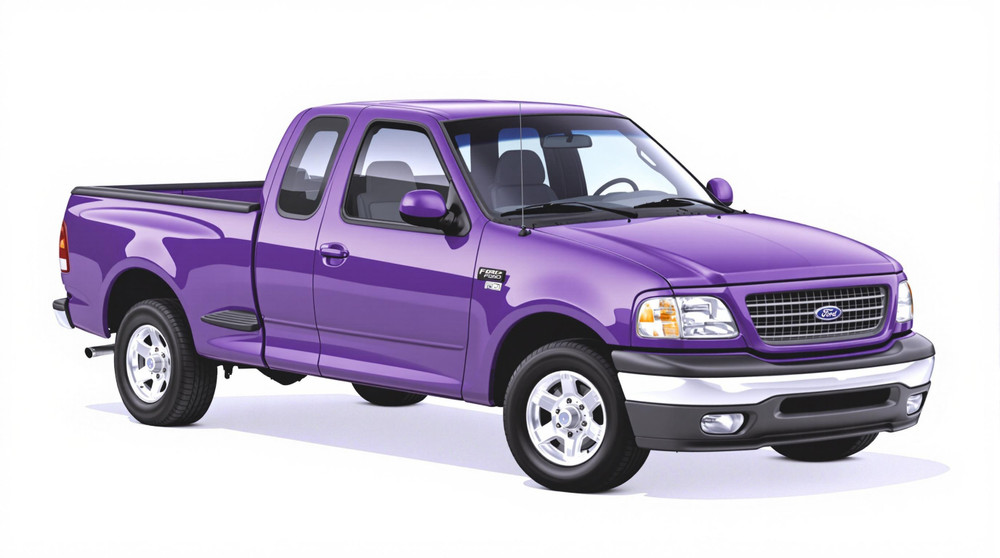
Image of 2002 Ford F-150, Note: These illustrations use artistic license and may differ from actual historical models.
Performance Metrics
Fundamental Metrics
Emotional Appeal
MMP Rating
| Engine Specifications | |
|---|---|
| Engine Options: | 4.2L V6, 4.6L V8, 5.4L V8 |
| Displacement Range: | 256-330 cu in |
| Horsepower Range: | 202-260 hp |
| Torque: | 252-350 lb-ft |
| Compression Ratio: | 9.0:1 - 9.3:1 |
| Ignition System: | Electronic |
| Cooling System: | Liquid-cooled |
| Performance Specifications | |
| 0-60 Time: | 7.2 - 9.1 seconds |
| 1/4 Mile Time: | 15.6 - 17.1 seconds |
| Top Speed: | 105-108 mph |
| Transmission and Drive | |
| Drive Type: | Rear-wheel drive (RWD), Four-wheel drive (4WD) |
| Transmission Type: | 4-speed automatic, 5-speed manual |
| Fuel and Efficiency | |
| Fuel System Type: | Sequential multi-port fuel injection |
| MPG: | 12-17 city / 16-21 highway |
| Dimensions and Brakes | |
| Brakes: | Front disc / rear drum |
| Wheelbase: | 119.9 - 138.5 inches |
| Weight: | 4,200 - 5,200 lbs |
Note: Specifications for classic cars are given to the best of our ability, considering the limited and variant data available.
2002 Ford F-150: A Modern Classic Pickup
The 2002 Ford F-150 proved that a full-size pickup could be a hard-working tool, a comfortable family vehicle, and even a performance machine. Built by Ford Motor Company, it belongs to the F-150’s 10th generation, introduced for 1997 with a thoroughly updated chassis and a rounded, aerodynamic look that marked a sharp departure from the squared-off trucks before it.
By 2002, the F-150 was a familiar sight on job sites, highways, and driveways across America. Ford’s F-Series had been the country’s best-selling truck for decades, and the F-150’s broad lineup helped explain why: buyers could choose a basic work truck, a richly equipped King Ranch, or the supercharged SVT Lightning. One notable twist in the model’s history is that the rounded styling of this generation initially divided truck buyers. Over time, its distinctive shape became part of the appeal.
Rounded Styling, Built to Work
The 2002 F-150 wears soft, swept-back lines that look more modern than the boxy pickups of the early 1990s. Its tall hood, broad grille, large headlamps, and pronounced wheel arches give it a substantial stance, while the cab’s curved windshield and rounded roofline soften the profile. Depending on trim and equipment, the truck could look plain and purposeful or dressed up with chrome, alloy wheels, body-color details, and special badging.
Inside, the design favors practicality. The dashboard is broad and straightforward, with large controls that are easy to operate while wearing work gloves. Materials are mostly durable molded plastics, with cloth upholstery common on everyday models. Higher trims added more comfortable seating, nicer trim details, power accessories, and a more polished cabin. The King Ranch stood out with its western-inspired styling and distinctive leather upholstery, while the Harley-Davidson edition offered a darker, more street-focused look.
For its time, the F-150 offered useful convenience and safety equipment rather than cutting-edge electronics. Available features included power windows and locks, cruise control, air conditioning, a CD player, remote keyless entry, and four-wheel drive with electronic shift controls on selected models. The truck also came with dual front airbags and anti-lock braking equipment. Its technology feels simple today, but that simplicity is part of the appeal for owners who prefer physical controls and systems that are easier to understand and service.
Color availability varied by trim and body style. Popular choices included Oxford White, black, silver, red, and several shades of blue and green. White and silver were common fleet and work-truck colors, while black and darker metallic finishes suited upscale Lariat, King Ranch, and Harley-Davidson models.
Cab and Bed Choices
Ford offered the 2002 F-150 in Regular Cab, SuperCab, and SuperCrew configurations. Regular Cab trucks focused on straightforward utility. SuperCab models added rear-hinged access doors and a small back seat, while the four-door SuperCrew provided a genuinely roomy rear passenger area. The SuperCrew was especially popular with buyers who wanted pickup capability without giving up everyday passenger comfort.
Bed choices included the Styleside, with conventional smooth-sided bed panels, and the more distinctive Flareside, whose rear fenders bulged outward and whose bed was narrower. Bed length depended on cab and configuration. The SuperCrew’s short bed created a balanced, easy-to-live-with package, while Regular Cab models could be ordered with longer beds for hauling equipment and materials.
Trim levels ranged from work-minded XL and popular XLT models to the more comfort-focused Lariat and western-themed King Ranch. At the performance end, the SVT Lightning brought a supercharged V8 and a lowered, sport-tuned chassis. The Harley-Davidson edition added special trim and equipment for buyers after a more luxurious, custom-inspired pickup.
Why the 10th-Generation F-150 Matters
The 1997 redesign helped reset expectations for what a full-size pickup could feel like. Its rounded cab and more contemporary interior made it less truck-like in daily use, while the updated chassis and independent front suspension gave it a more composed road feel than older F-150s. Ford kept the model’s essential strengths, including a strong frame, useful bed, multiple cab and drivetrain combinations, and a wide range of engines.
That combination helped establish the modern full-size pickup as both a work vehicle and a personal vehicle. The F-150 no longer had to be purchased solely for hauling or towing. A buyer could select a comfortable daily driver, a family-friendly four-door truck, or a specialized performance model from the same nameplate. Later pickups across the industry continued to develop this blend of utility, comfort, and personality.
The 2002 truck also represents an important point in Ford’s product strategy. The F-150 served light-duty buyers, while Ford’s Super Duty range handled heavier commercial work. That clearer division allowed the F-150 to prioritize ride comfort, cabin space, and everyday usability without abandoning its towing and hauling role.
Engines, Speed, and Road Manners
Engine choices included a 4.2-liter V6, a 4.6-liter Triton V8, and a 5.4-liter Triton V8. Output varied by engine and configuration, with the V6 making roughly 202 horsepower, the 4.6-liter V8 about 231 horsepower, and the standard 5.4-liter V8 around 260 horsepower. Depending on engine, transmission, drivetrain, and trim, trucks were paired with manual or automatic transmissions. Rear-wheel drive and four-wheel drive were both available.
Performance figures depend heavily on the exact truck. As a broad guide, a standard 2002 F-150 typically reached 0 to 60 mph in roughly 8 to 11 seconds. A typical road-going top speed is around 100 to 110 mph, though tire ratings, gearing, load, and any speed limiter can change that figure. These are estimates, not one universal factory specification. The SVT Lightning is in another league: its supercharged 5.4-liter V8 was rated at 380 horsepower and 450 lb-ft of torque, and period tests commonly put 0-to-60 times in the low five-second range.
On the road, the F-150 feels substantial without being unwieldy. Its suspension absorbs ordinary pavement imperfections well, though an unloaded pickup can bounce over sharper bumps, especially at the rear. The steering is light enough for parking and daily errands, but the truck’s height and mass are noticeable on tight, windy roads. Four-wheel-drive models offer extra traction on slippery surfaces, while proper tires and cautious driving remain important in snow, mud, or heavy rain.
The engine character depends on what is under the hood. The V6 is practical and steady, while the V8s deliver the deeper growl and stronger low-speed pull many truck buyers expect. The standard 5.4-liter V8 feels best when asked to move a load or merge with authority. The Lightning’s supercharger adds a distinctive whine over the V8 exhaust note. From behind the wheel, the high seating position, broad hood, and simple controls create a familiar, confident pickup experience.
Living With a 2002 F-150
These trucks still make capable daily drivers, work trucks, tow vehicles, and weekend project rigs. SuperCrew models are particularly useful for family duty, while Regular Cab and long-bed configurations remain practical for contractors and outdoor enthusiasts. The SVT Lightning is more often treated as a collectible performance truck than a routine workhorse, though it retains the basic utility of a pickup.
Routine maintenance is straightforward for a mechanically minded owner. Oil changes, brakes, filters, belts, and many suspension repairs are familiar jobs, and parts availability remains strong. A 2002 F-150 also uses standard OBD-II diagnostics, so a modern code reader can help identify many engine and emissions faults. Access can be tight in places, particularly around V8 components, but the platform is well understood by independent repair shops.
Age and maintenance history matter more than the badge on the tailgate. Check carefully for frame and body corrosion, worn suspension parts, transmission problems, coolant leaks, and signs of hard towing or neglected service. The 4.2-liter V6 has a reputation for head-gasket and cooling-system concerns. Some 4.6- and 5.4-liter Triton V8s can suffer spark-plug thread problems, so look for evidence of previous repairs and pay attention to rough running or misfires. A thorough inspection is a smart investment before purchase.
Trivia, Special Editions, and Criticisms
The SVT Lightning is the standout performance version of the 2002 range. Ford’s Special Vehicle Team turned the F-150 into a rear-wheel-drive sport truck with a supercharged V8, a lowered suspension, and distinctive exterior details. Production figures commonly cited for the 2002 Lightning are about 4,700 trucks, making it far less common than a regular F-150, though not impossibly rare by collector standards.
The King Ranch and Harley-Davidson editions show how widely the F-150’s character could vary. One leaned into western luxury, while the other borrowed visual cues from the motorcycle brand and offered a more street-oriented personality. The broader F-150 line sold in very large numbers, but exact production totals for every 2002 cab, engine, trim, and drivetrain combination are not consistently published. A reasonable broad estimate is several hundred thousand F-150s for the model year, perhaps around 700,000 to 800,000, but that should be treated as an estimate rather than a verified model-specific count.
Common criticisms include fuel consumption, the truck’s size in tight urban spaces, and the bouncy ride that can come with an unloaded rear axle. Some enthusiasts also prefer the more traditional, square styling of earlier F-150s. On older examples, rust, worn interiors, and deferred maintenance can be bigger concerns than the original design. There is no single headline speed or endurance record attached to the ordinary 2002 F-150; its notable achievement is its role in a long-running, high-volume truck family that became a fixture of American roads and worksites.
2002 Ford F-150 Values and Collectibility
Most 2002 F-150s remain affordable used trucks rather than high-dollar collectibles. In the current market, a high-mileage or rough example might sell for roughly $2,000 to $5,000, while a sound driver with service records could fall around $5,000 to $12,000. Clean, low-mileage trucks in desirable configurations may bring about $12,000 to $20,000 or more. These are broad U.S. price estimates; region, condition, rust, mileage, and equipment can shift values considerably.
Special models command a different level of attention. A clean SVT Lightning may sell in the approximate range of $25,000 to $50,000, with exceptional, original, low-mileage examples potentially exceeding that range. King Ranch and Harley-Davidson trucks can also earn a premium when well preserved. Modified vehicles may appeal to particular buyers, but tasteful, documented, near-original examples are usually easier to value as collectibles.
Ordinary F-150s have generally depreciated over their working lives, but many clean examples appear to have reached a value floor as older trucks become harder to find in unmodified condition. The Lightning has stronger collector demand and better appreciation potential. Overall availability remains plentiful compared with genuinely rare classic trucks, although rust-free, well-maintained examples are becoming less common.
A Pickup With More Than One Personality
The 2002 Ford F-150 brings together the strengths that made the nameplate so successful: useful configurations, sturdy V8 options, a comfortable-for-its-era cabin, and enough variety to suit both work and leisure. Its rounded 10th-generation design helped move the full-size pickup toward a more refined, everyday role, while the SVT Lightning proved that a truck could deliver serious performance too.
Whether you want a dependable project, a practical old pickup, or a collectible sport truck, the 2002 F-150 has a version worth seeking out. Its significance is not just in how many Ford built, but in how convincingly it made work-truck usefulness and everyday comfort belong in the same package.
2002 Ford F-150 Catalog of Parts
 2002 Ford F-150 Brake Pedal Pad. 4-3/4" wide X 2-1/4" long-CB 111-NBrake Pedal Pad. 4-3/4" wide X 2-1/4" long. Replaces OEM #'s BC3Z2457B, D3TZ2457A, D3TZ2457B. Each
 2002 Ford F-150 Door Seal (Imported). Fits driver's (left) side door. Extended Cab Only.-IS-LM 110-CDoor Seal (Imported). Fits driver's (left) side door. Each Extended Cab Only.
 2002 Ford F-150 Door Seal (Imported). Fits passenger (right) side door-IS-LM 110-DDoor Seal (Imported). Fits passenger (right) side door. Does not fit any extended cab models. 160" Long. Each
 2002 Ford F-150 Door Seal For Quad Cab-LM 110-JDoor Seal For Quad Cab. Fits front left and right side on the body. Each
 2002 Ford F-150 Front Door Seal-LM 110-KFront Door Seal. Fits extended cab, on body, front left and right side. Each
 2002 Ford F-150 Door Seal-Rear, 99-04 Ford F150, 99 F250 LD Extended Cab, Left Side, Each-LM 110-PInstalls on the extended 3rd door and fits left hand side only. Seals the top, side and bottom of the door. This product is made from the original specs and with high quality ozone resistant EPDM rubber for a great fit and long life.
Why Choose Metro?
For over 100 years, Metro Moulded Parts has been the pinnacle of quality in classic car restoration parts. Our commitment to precision and authenticity in every component ensures a perfect fit and an OEM-level appearance.
- Expert Craftsmanship & Quality: Each part is a testament to our dedication to reliability and perfection, crafted from original designs and thoroughly tested.
- Advanced Technology: We use cutting-edge techniques to create flawless, long-lasting parts that surpass others in performance.
- SuperSoft Sponge – The Ultimate Door Seal: Not only are our door seals 30% softer than competitors', but they're also guaranteed to never leak. They effectively reduce wind and road noise, enhancing your classic car's comfort and driving experience.
- Proudly American: Our parts are a product of American craftsmanship, made in the USA with a spirit of excellence and heritage.
- Unrivaled Warranty: We back our products with a 30-year industry-leading warranty, a testament to our confidence in their quality.
Join us in preserving the legacy of classic cars with parts that are crafted for perfection, not just made.