
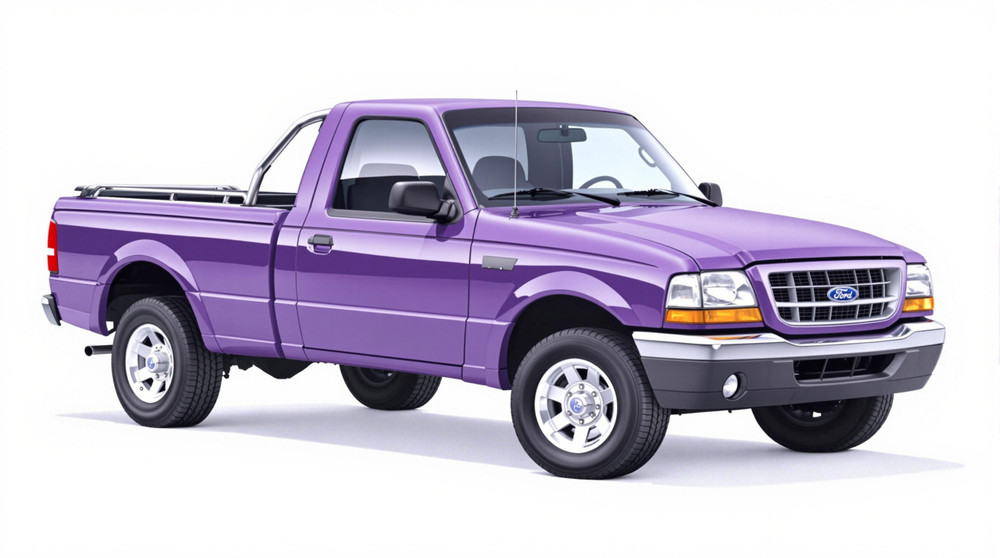
Image of 2003 Ford Ranger, Note: These illustrations use artistic license and may differ from actual historical models.
Performance Metrics
Fundamental Metrics
Emotional Appeal
MMP Rating
| Engine Specifications | |
|---|---|
| Engine Options: | 2.3L I4, 3.0L V6, 4.0L V6 |
| Displacement Range: | 140-245 cu in. |
| Horsepower Range: | 143-207 hp |
| Torque: | 154-238 lb-ft |
| Compression Ratio: | 9.4:1 for the 2.3L I4, 9.3:1 for the 3.0L V6, and 9.7:1 for the 4.0L V6 |
| Ignition System: | Electronic |
| Cooling System: | Liquid-cooled |
| Performance Specifications | |
| 0-60 Time: | 7.5-10 seconds |
| 1/4 Mile Time: | 15.5-17 seconds |
| Top Speed: | 108 mph |
| Transmission and Drive | |
| Drive Type: | Rear-wheel drive (RWD) or four-wheel drive (4WD) |
| Transmission Type: | 5-speed manual or 5-speed automatic |
| Fuel and Efficiency | |
| Fuel System Type: | Sequential multi-port fuel injection |
| MPG: | 15-22 city / 19-26 highway |
| Dimensions and Brakes | |
| Brakes: | Front disc / rear drum |
| Wheelbase: | 111.6 in. |
| Weight: | 3,030-3,606 lbs |
Note: Specifications for classic cars are given to the best of our ability, considering the limited and variant data available.
2003 Ford Ranger: A Compact-Truck Favorite
The 2003 Ford Ranger is the kind of pickup that earned its reputation one useful day at a time. Compact enough to fit into a city parking space, sturdy enough for weekend hauling, and available with real off-road hardware, it represented the practical heart of Ford’s small-truck lineup.
Built by Ford Motor Company, the Ranger traces its name to a trim package introduced in the 1960s, but the Ranger became a standalone compact pickup for the 1983 model year. The 2003 truck belongs to the model’s third generation, introduced in 1998 and refreshed for 2001. By this point, the Ranger was a familiar sight on worksites, suburban driveways, and trails across North America.
Its timing is part of its story. In the early 2000s, compact pickups still offered a useful alternative to increasingly large and expensive full-size trucks. The Ranger was also a major sales success: Ford sold roughly 348,000 Rangers in the United States during 2003. That figure is a useful measure of its popularity, though it should not be confused with a definitive worldwide production total.
Rugged Styling and Useful Configurations
The 2003 Ranger wore a straightforward, purposeful design. Its upright grille, rectangular headlamps, squared-off hood, and high beltline gave it a sturdy look without disguising its compact dimensions. Ford’s 2001 refresh had brought revised front-end styling, and the 2003 model carried that cleaner, more contemporary face. Sportier versions added body-color trim and a more assertive stance, while 4x4 models looked ready for work even before their tires left the pavement.
Buyers could choose a Regular Cab or an extended SuperCab with small rear-hinged access doors. Most Rangers had a six-foot cargo bed, while certain Regular Cab configurations could be ordered with a longer bed. The SuperCab paired its extra passenger space with a six-foot bed, making it a popular compromise for owners who needed occasional rear seating without moving up to a full-size pickup.
Trim choices included XL, XLT, Edge, and off-road-oriented FX4 models. The Edge emphasized a sportier appearance, while the FX4 added equipment for rougher terrain. The FX4 Level II package is especially sought after today. Depending on configuration, it could include heavy-duty off-road components such as Bilstein shocks, skid plates, all-terrain tires, and a limited-slip rear differential. For many enthusiasts, a well-kept FX4 Level II is the most distinctive 2003 Ranger to find.
Paint choices varied by trim and production year, but buyers could commonly find colors such as Oxford White, black, red, silver, blue, and gray. Neutral shades remain popular with used-truck shoppers, while bright red and blue Rangers have extra curb appeal among fans looking for a more memorable period look.
A Work-Truck Cabin with Everyday Comfort
Inside, the Ranger favored durability and easy operation over luxury. The dashboard was upright and logically arranged, with large controls that were simple to use while wearing work gloves. Depending on trim, the cabin came with vinyl or cloth upholstery, practical storage spaces, and a bench or bucket-seat layout. Materials were generally hard-wearing plastics rather than soft-touch finishes, but that suited a truck expected to carry tools, muddy gear, or a dog in the back.
Higher trims and option packages could add air conditioning, power windows and locks, cruise control, a CD player, and upgraded audio. Safety and convenience equipment varied by configuration, but the Ranger offered features such as front airbags and anti-lock braking. Four-wheel-drive versions added a selectable transfer case, giving drivers a way to engage four-wheel drive when conditions called for it.
By modern standards, the technology is simple. There was no large touchscreen, smartphone integration, or driver-assistance suite. That simplicity is part of the appeal: fewer complicated systems to learn, and fewer modern electronic features to troubleshoot as the truck ages.
Why the Ranger Mattered
The 2003 Ranger did not introduce a dramatic new chassis or a headline-grabbing technology breakthrough. Its significance was more practical. It helped keep the compact pickup formula relevant in a period when many manufacturers were shifting attention toward larger trucks and sport-utility vehicles. The Ranger delivered useful payload and towing capability in a smaller, generally less intimidating package.
Its body-on-frame construction, rear-wheel-drive layout, available four-wheel drive, and broad range of cab and bed combinations gave buyers a straightforward tool that could be tailored to different jobs. That versatility helped the Ranger serve as a fleet vehicle, a first truck, a commuter, and a trail rig. Its long production run in North America, which ended after the 2011 model year, cemented its place as one of the defining compact pickups of its era.
The Ranger also shared its basic platform and many components with the Mazda B-Series sold during the same period. That relationship gave shoppers another badge to consider while reinforcing how established and widely used the underlying truck design had become.
Engines, Acceleration, and Road Manners
Three engines were available for 2003. The base 2.3-liter four-cylinder produced about 143 horsepower and 154 lb-ft of torque. A 3.0-liter V6 delivered approximately 154 horsepower and 180 lb-ft, while the stronger 4.0-liter SOHC V6 made about 207 horsepower and 238 lb-ft. Depending on engine and equipment, buyers could choose a manual or automatic transmission, along with rear-wheel drive or four-wheel drive.
Ford did not publish one universal top-speed or 0-to-60-mph figure for every Ranger configuration, and test results vary with cab, axle ratio, transmission, tires, and drivetrain. As a general period-performance estimate, a 4.0-liter Ranger could reach 60 mph in roughly eight to nine seconds. A 3.0-liter V6 was more often in the ten-second neighborhood, while the four-cylinder typically needed around ten to twelve seconds. Approximate top speeds commonly fall in the 90-to-105-mph range, depending on engine and any speed limiter. These are representative estimates, not guaranteed specifications for every truck.
On the road, the Ranger feels like a traditional compact pickup: relatively narrow, easy to place, and more maneuverable than a full-size truck. The four-cylinder is best suited to light-duty use and steady commuting. The V6 engines provide stronger passing power and are better choices for towing or carrying heavier loads, although acceleration still feels modest beside a modern pickup.
The suspension is tuned for truck duties, so an unloaded Ranger can bounce over sharp pavement breaks and feel firm on rough roads. Add cargo, and the ride settles down. On winding roads, its compact size makes it feel more nimble than a larger pickup, but the solid rear axle and truck-oriented tires remind the driver that this is not a sports car. In crosswinds, a tall or lightly loaded truck can require a little more steering correction.
There is a satisfying old-school character to the driving experience. The four-cylinder has a busy, mechanical note when pushed, while the V6 produces a deeper growl under acceleration. Steering and controls feel direct and uncomplicated. The Ranger rewards smooth inputs, sensible speeds, and an appreciation for a truck that communicates its work-focused nature rather than trying to hide it.
Everyday Ownership and Maintenance
Rangers are commonly used as daily drivers, small-business work trucks, property vehicles, hunting and camping rigs, and affordable project trucks. Their size makes them easier to park and maneuver than a full-size pickup, while the bed remains useful for lumber, yard supplies, bicycles, and weekend equipment. Clean FX4 examples also attract off-road enthusiasts and collectors, though most Rangers are still valued primarily for their utility.
Routine maintenance is generally approachable for a home mechanic. Oil changes, brakes, batteries, belts, and many suspension repairs are familiar jobs, and parts availability remains good because the Ranger was produced in large numbers. A basic tool set and a repair manual go a long way. Four-wheel-drive components, automatic transmissions, and rust repair can require more time, experience, or expense.
When inspecting one, pay close attention to frame and body corrosion, especially in regions where winter road salt is used. Check the transmission for clean, consistent shifts, listen for suspension or driveline clunks, and test the four-wheel-drive system rather than assuming it works. As with any vehicle more than two decades old, maintenance history and condition matter more than a low odometer reading alone.
Ranger Trivia and Common Complaints
The 2003 Ranger’s most notable “rare” versions are not limited-run collector editions so much as desirable combinations of cab, drivetrain, engine, and package. FX4 Level II trucks are among the most enthusiast-friendly, especially when equipped with the off-road hardware and manual transmission options that buyers seek. Their rarity is relative: they are harder to find than ordinary XL or XLT models, but they were produced as part of a popular truck line rather than as a tiny special-edition run.
There is no widely recognized speed, endurance, or production record attached specifically to the 2003 model year. Its more meaningful claim is mass-market success. Roughly 348,000 U.S. Ranger sales in 2003 point to a truck that was not an obscure niche product but a major part of Ford’s lineup.
Common criticisms include the cramped rear seating in the SuperCab, a firm ride when the bed is empty, and limited power from the four-cylinder when carrying a load. The cabin can feel basic, and the truck’s age means that worn suspension parts, rust, and neglected maintenance are real concerns. On the other hand, those straightforward mechanicals are exactly what many owners appreciate: the Ranger is a practical truck, not a rolling technology showcase.
Collector Value and Market Outlook
The 2003 Ranger is not generally a high-dollar collectible, but its popularity and durable reputation keep good examples in demand. As a broad 2026 U.S. market estimate, a rough or high-mileage truck may sell for about $2,000 to $5,000. A sound, clean driver often falls around $5,000 to $10,000, while an unusually tidy, low-mileage example or a desirable 4x4 can reach roughly $10,000 to $15,000 or more. Exceptional FX4 Level II trucks may exceed that range, particularly when they are original, rust-free, and supported by strong documentation.
These figures are estimates, not a substitute for a local appraisal. Region, rust, mileage, drivetrain, equipment, service records, and overall originality can shift a price substantially. A modified truck may appeal to a specific off-road buyer but can be worth less to someone seeking a factory-correct example.
Exact production totals for the 2003 model year are not consistently published in a form that cleanly separates every cab, engine, and trim combination. As a reasonable scale estimate, U.S. production or sales for the model year was in the neighborhood of 350,000 trucks. That volume means ordinary Rangers remain relatively available, while well-preserved 4x4s and FX4 Level II examples are less common.
Overall, the Ranger is transitioning from inexpensive used transportation to an increasingly appreciated older truck, but the market is selective. Ordinary, worn examples are likely to keep depreciating or remain inexpensive. Clean, original trucks, especially desirable four-wheel-drive versions, have better prospects for gradual appreciation as simple compact pickups become harder to find.
Why the 2003 Ranger Still Works
The 2003 Ford Ranger combined compact dimensions, useful bed space, straightforward engineering, and a range of configurations broad enough to suit commuters, tradespeople, and off-roaders. It was not the most luxurious pickup or the fastest vehicle on the road, but it did its job with little fuss and became one of the best-known small trucks of its generation.
More than two decades later, its appeal is easy to understand: a good Ranger is honest, adaptable, and repairable. In a truck market that has grown ever larger and more complex, the 2003 Ranger stands as a reminder that useful capability does not need to come wrapped in excess.
2003 Ford Ranger Catalog of Parts
 2003 Ford Ranger Brake Pedal Pad. 4-3/4" wide X 2-1/4" long-CB 111-NBrake Pedal Pad. 4-3/4" wide X 2-1/4" long. Replaces OEM #'s BC3Z2457B, D3TZ2457A, D3TZ2457B. Each
 2003 Ford Ranger Door Seal for 2-Door. Fits on body left and right side-LM 110-UDoor Seal for 2-Door. Fits on body left and right side. Each
 2003 Ford Ranger Front Door Seal for 4-Door. Fits on body, left and right side-LM 110-WFront Door Seal for 4-Door. Fits on body, left and right side. Replaces OEM #'s 8L5Z 1320708 A / 8L5Z 1320709 A.
Why Choose Metro?
For over 100 years, Metro Moulded Parts has been the pinnacle of quality in classic car restoration parts. Our commitment to precision and authenticity in every component ensures a perfect fit and an OEM-level appearance.
- Expert Craftsmanship & Quality: Each part is a testament to our dedication to reliability and perfection, crafted from original designs and thoroughly tested.
- Advanced Technology: We use cutting-edge techniques to create flawless, long-lasting parts that surpass others in performance.
- SuperSoft Sponge – The Ultimate Door Seal: Not only are our door seals 30% softer than competitors', but they're also guaranteed to never leak. They effectively reduce wind and road noise, enhancing your classic car's comfort and driving experience.
- Proudly American: Our parts are a product of American craftsmanship, made in the USA with a spirit of excellence and heritage.
- Unrivaled Warranty: We back our products with a 30-year industry-leading warranty, a testament to our confidence in their quality.
Join us in preserving the legacy of classic cars with parts that are crafted for perfection, not just made.