
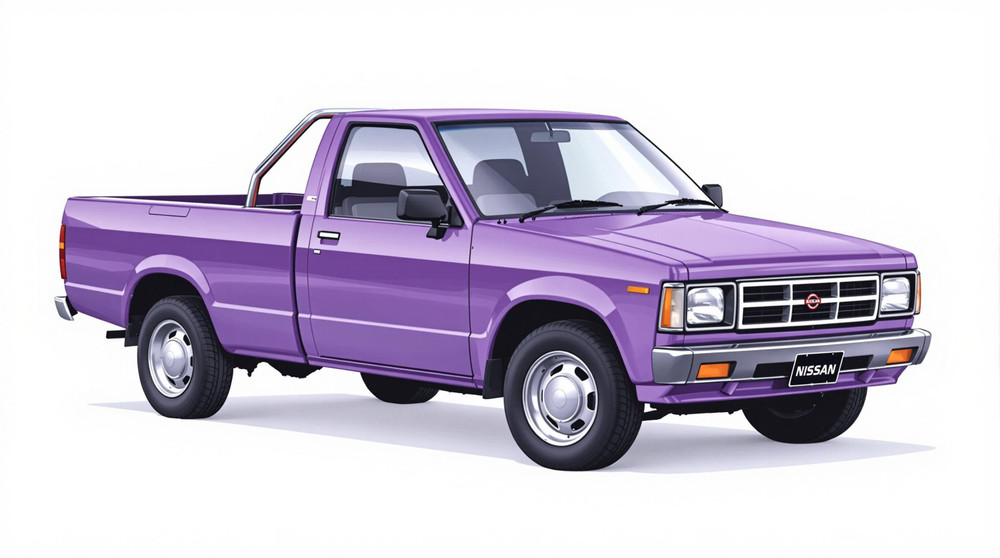
Image of 1994 Nissan D21, Note: These illustrations use artistic license and may differ from actual historical models.
Performance Metrics
Fundamental Metrics
Emotional Appeal
MMP Rating
| Engine Specifications | |
|---|---|
| Engine: | 2.4L KA24E I4, 3.0L VG30E V6 |
| Displacement: | 2389cc (2.4L), 2960cc (3.0L) |
| Horsepower: | 134-153 hp |
| Torque: | 154-180 lb-ft |
| Compression Ratio: | 8.6:1 (2.4L), 9.0:1 (3.0L) |
| Ignition System: | Electronic |
| Cooling System: | Liquid-cooled |
| Performance Specifications | |
| 0-60 Time: | 10-12 seconds |
| 1/4 Mile Time: | 17-19 seconds |
| Top Speed: | 100-105 mph |
| Transmission and Drive | |
| Drive Type: | Rear-wheel drive (2WD), Four-wheel drive (4WD) |
| Transmission Type: | 5-speed manual, 4-speed automatic |
| Fuel and Efficiency | |
| Fuel System Type: | Fuel Injection |
| MPG: | 15-20 mpg |
| Dimensions and Brakes | |
| Brakes: | Front Disc, Rear Drum |
| Wheelbase: | 104.3 inches (2WD), 116.1 inches (4WD) |
| Weight: | 3,200-3,600 lbs |
Note: Specifications for classic cars are given to the best of our ability, considering the limited and variant data available.
1994 Nissan D21 Hardbody: A Compact Truck Built to Work
The 1994 Nissan D21 is the kind of truck that earned its reputation one load, dirt road, and high-mileage commute at a time. Known in North America by the nickname “Hardbody,” it combined compact dimensions with sturdy construction, straightforward mechanicals, and a distinctly squared-off look.
Nissan introduced the D21 generation in the mid-1980s as the successor to its 720 pickup. Built in several countries, including at Nissan’s Smyrna, Tennessee, plant for the North American market, the D21 helped establish the company as a serious contender in the compact-truck segment. It remained on sale in the United States until the Frontier arrived for the 1998 model year.
One detail behind the Hardbody name was its double-wall construction in the cargo bed, designed to make the sides more robust than a simple single-skin panel. The nickname suited a truck whose appeal was less about luxury and more about taking regular use in stride.
Square-Shouldered Design and Useful Choices
The D21 wears its early-1990s character openly. Its upright grille, rectangular headlamps, flat hood, straight beltline, and blocky wheel arches give it a purposeful, almost miniature-work-truck stance. Depending on trim and market, details such as wheel designs, grille finish, graphics, and fender flares could change the look, but the basic shape remained clean and unmistakable.
Buyers could choose a regular cab or the longer King Cab, which added a small rear area with fold-down jump seats. Bed lengths and configurations varied by cab and drivetrain. Two-wheel drive and part-time four-wheel drive were offered, along with work-focused base trims and more generously equipped versions. The King Cab 4x4 became one of the most recognizable combinations, while regular-cab pickups remained popular as practical work trucks.
Inside, the D21 favors function over decoration. The dashboard is upright and plainly laid out, with large, easy-to-read gauges and controls that can be operated without much distraction. Materials are mostly durable plastics, with cloth upholstery available on better-equipped models and vinyl suited to hard use. The King Cab’s rear seats are best treated as occasional seating or extra storage rather than a comfortable place for adults on a long trip.
Equipment depended on trim and options. Air conditioning, power steering, power windows and locks, cruise control, and an AM/FM cassette stereo could be found on better-equipped examples. By modern standards, the truck’s technology is simple: fuel injection, conventional gauges, and familiar mechanical controls rather than screens or advanced driver aids. Paint choices varied by market and trim, but white, red, blue, black, silver, and earthier tones were common. White was a particularly popular fleet and work-truck choice.
Engines, Performance, and Road Manners
For 1994, North American D21s were commonly equipped with Nissan’s 2.4-liter KA24E single-overhead-cam four-cylinder, rated at about 134 horsepower and 154 lb-ft of torque. Some models offered a 3.0-liter VG30E V6, producing roughly 153 horsepower and 180 lb-ft. Availability and exact specifications could vary with trim, drivetrain, and market. A five-speed manual was common, while an automatic was available on selected versions.
There was no single published performance figure that applies to every 1994 D21. As a broad guide, four-cylinder trucks generally took around 10 to 12 seconds to reach 60 mph, with V6 versions often somewhat quicker, depending on transmission, cab, gearing, and whether the truck was two- or four-wheel drive. Top speed is similarly configuration-dependent; roughly 95 to 105 mph is a reasonable estimate for many examples, though these pickups were designed for utility, not sustained high-speed travel.
On the road, the D21 feels compact and direct compared with a full-size pickup. Its front suspension uses independent components, while leaf springs at the rear are built to carry loads. That rear setup can feel firm when the bed is empty, and sharp bumps may send a noticeable jolt through the cabin. Add cargo, and the ride generally settles down.
On winding roads, the truck is easy to place, but its narrow proportions, pickup-style suspension, and older tires mean it should not be driven like a modern sports utility vehicle. Four-wheel-drive versions are useful on loose surfaces and rough tracks, but the part-time system is intended for conditions where extra traction is needed, not dry pavement. Behind the wheel, the experience is pleasantly mechanical: the engine is audible under acceleration, the controls are straightforward, and the driver gets a clear sense of what the truck is doing.
Why the D21 Mattered
The D21 did not invent the compact pickup, but it helped define what buyers expected from one. It brought together manageable exterior dimensions, useful payload and bed space, available four-wheel drive, and engines that suited everyday work. Its square styling also gave it a visual identity distinct from softer, more rounded vehicles that followed.
Compared with many contemporaries, the Nissan’s appeal rested on its combination of rugged construction and relatively simple service needs. It served contractors, small businesses, outdoor enthusiasts, and drivers who wanted a truck that could handle weekday errands as well as weekend hauling. The model’s long production life and wide international presence reflect how adaptable the basic D21 formula proved to be.
Living With a 1994 Nissan Pickup
Today, a D21 can still work as a daily driver, farm or property truck, project vehicle, or vintage mini-truck show build. Its compact footprint is handy in town, and its simple cabin makes it easy to clean after a day of work. King Cab 4x4s are especially popular with enthusiasts, while lowered two-wheel-drive examples have a following in the custom mini-truck scene.
Routine maintenance is approachable for owners with basic mechanical experience. Oil and filter changes, brake work, belts, hoses, and many ignition and cooling-system repairs use familiar components and conventional tools. Parts availability remains generally good for common service items, though trim pieces, rust-free body panels, and model-specific interior parts can take more searching.
Age matters more than the badge when inspecting one. Check the frame and chassis for corrosion, especially around suspension and mounting points, and inspect the bed, cab corners, floor, and wheel arches for rust or old repairs. Also look for cooling-system neglect, worn suspension bushings, tired steering components, transmission issues, and signs that a four-wheel-drive system has not been maintained. A clean, mostly stock truck with service records is usually a better buy than a heavily modified example with uncertain workmanship.
Hardbody Trivia and Common Complaints
The Hardbody’s double-wall bed construction is one of the details that helped give the truck its memorable nickname. Its other lasting claim to fame is cultural: D21s became familiar sights in the 1990s compact-truck and mini-truck scenes, where owners modified them for both show and street use.
There is no widely recognized speed or endurance record that defines the 1994 D21, and exact production totals for that model year are not readily published. Its significance is instead rooted in years of service across personal, commercial, and off-road use. It also appeared in many international markets, where local versions and equipment could differ from North American trucks.
Common criticisms are easy to understand today. The cabin is noisy by modern standards, the rear seats in King Cab models are cramped, and the ride can be choppy without a load. Four-cylinder versions are dependable workhorses but not quick, while V6 trucks offer more power at the cost of greater fuel consumption. Rust, age-related wear, and previous hard use are now bigger concerns than any original design flaw.
Collector Values and Market Outlook
Values vary sharply with condition, mileage, cab style, drivetrain, originality, and location. As a general 2026 North American guide, a rough project truck might sell for about $1,000 to $4,000. A usable driver commonly falls around $5,000 to $12,000, while a clean, well-kept example can reach roughly $12,000 to $20,000. Exceptional, highly original King Cab 4x4 or V6 examples may ask more, sometimes approaching $25,000 or higher when condition and documentation are outstanding.
These figures are broad estimates, not a formal appraisal, and local markets can differ considerably. Exact 1994 production figures are not consistently available in public model-year records. A cautious estimate would put North American production and sales in the tens of thousands, perhaps around 50,000 to 100,000 trucks, but that should not be treated as an official Nissan total. The D21 family was produced across multiple markets and years, so its worldwide numbers were much larger.
Ordinary used examples are still valued primarily as practical older trucks, but the market has become more appreciative of clean, unmodified pickups. Well-preserved 4x4s and desirable cab configurations have the strongest collector interest. The trend is gradually upward for the best examples, while rough work trucks remain more tied to local utility demand than collector enthusiasm.
The Enduring Appeal of the D21
The 1994 Nissan D21 Hardbody brought together purposeful styling, useful configurations, straightforward engineering, and the durability expected of a compact pickup. It was not built to pamper its driver or set performance records. It was built to be useful, and that simple promise is why so many remain on the road and in enthusiasts’ garages.
More than three decades on, a good D21 still feels like a truck in the best sense: honest, practical, and ready to get its hands dirty.
1994 Nissan D21 Catalog of Parts
 1994 Nissan D21 Molded door seals. Exact fit, with clips and mitered ends-LM 132Molded door seals. Exact fit, with clips and mitered ends. Fits '86-'95 Nissan standard 2-door D21 pick-up and Pathfinder models. Pair. R&L.
Why Choose Metro?
For over 100 years, Metro Moulded Parts has been the pinnacle of quality in classic car restoration parts. Our commitment to precision and authenticity in every component ensures a perfect fit and an OEM-level appearance.
- Expert Craftsmanship & Quality: Each part is a testament to our dedication to reliability and perfection, crafted from original designs and thoroughly tested.
- Advanced Technology: We use cutting-edge techniques to create flawless, long-lasting parts that surpass others in performance.
- SuperSoft Sponge – The Ultimate Door Seal: Not only are our door seals 30% softer than competitors', but they're also guaranteed to never leak. They effectively reduce wind and road noise, enhancing your classic car's comfort and driving experience.
- Proudly American: Our parts are a product of American craftsmanship, made in the USA with a spirit of excellence and heritage.
- Unrivaled Warranty: We back our products with a 30-year industry-leading warranty, a testament to our confidence in their quality.
Join us in preserving the legacy of classic cars with parts that are crafted for perfection, not just made.