
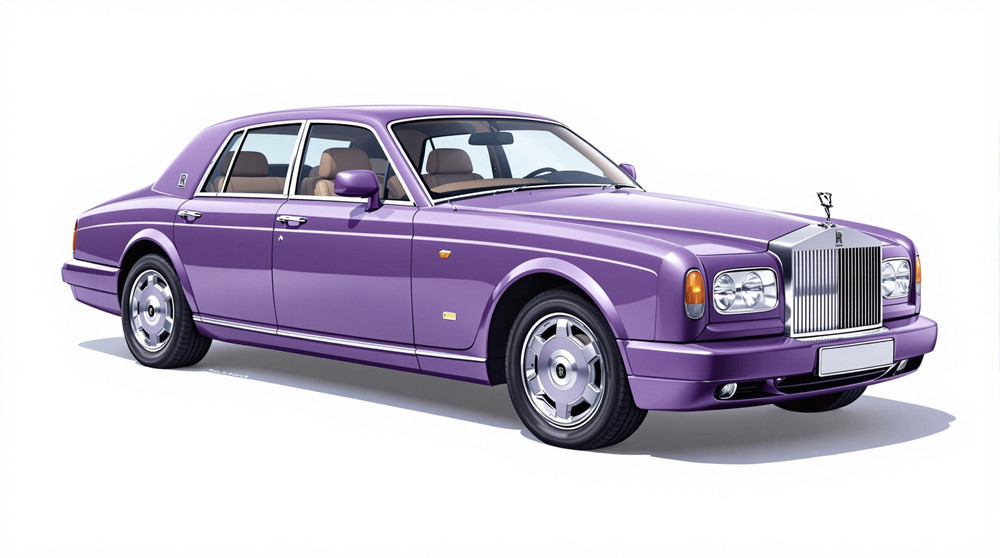
Image of 2002 Rolls-Royce Silver Seraph, Note: These illustrations use artistic license and may differ from actual historical models.
Performance Metrics
Fundamental Metrics
Emotional Appeal
MMP Rating
| Engine Specifications | |
|---|---|
| Engine Options: | 5.4L V12 |
| Displacement Range: | 5,379 cc |
| Horsepower Range: | 322 HP |
| Torque: | 361 lb-ft |
| Compression Ratio: | 10.0:1 |
| Ignition System: | Electronic |
| Cooling System: | Liquid-cooled |
| Performance Specifications | |
| 0-60 Time: | 6.9 seconds |
| 1/4 Mile Time: | Estimated at 15.2 seconds |
| Top Speed: | 140 mph |
| Transmission and Drive | |
| Drive Type: | Rear-wheel drive |
| Transmission Type: | 5-speed automatic |
| Fuel and Efficiency | |
| Fuel System Type: | Fuel injection |
| MPG: | 12 city / 19 highway |
| Dimensions and Brakes | |
| Brakes: | Ventilated disc brakes |
| Wheelbase: | 122.7 inches |
| Weight: | 5,400 lbs |
Note: Specifications for classic cars are given to the best of our ability, considering the limited and variant data available.
2002 Rolls-Royce Silver Seraph: A V12 at the End of an Era
The 2002 Rolls-Royce Silver Seraph makes an extraordinary kind of statement: its presence is unmistakable, but it never needs to raise its voice. Built at the marque’s historic Crewe factory in England, the Silver Seraph was the final generation of Rolls-Royce saloons produced there before the company’s transition to BMW ownership and the launch of the Goodwood-era Phantom.
Introduced in 1998 as the successor to the Silver Spirit, the Seraph was developed during the final years of Rolls-Royce ownership by Vickers. It shared its basic platform with the Bentley Arnage, but the two cars took different mechanical paths. The Bentley used turbocharged V8 power, while the Rolls-Royce received a naturally aspirated BMW V12.
That engine gave the Silver Seraph a special place in the marque’s history. It was the first production Rolls-Royce V12 since the prewar Phantom III, bringing a new kind of smoothness to the brand’s traditional formula. The 2002 model year was also the last for the Silver Seraph, making it a particularly appealing choice for enthusiasts drawn to the final chapter of Crewe-built Rolls-Royce luxury.
Silver Seraph Styling and Craftsmanship
The Silver Seraph’s styling is formal without feeling old-fashioned. Its long bonnet, upright grille, discreet headlamps, and clean, gently rounded bodywork preserve the classic Rolls-Royce silhouette. The Spirit of Ecstasy stands above the grille as the familiar focal point, while restrained chrome details and carefully balanced proportions give the car its quiet authority.
Inside, the emphasis is on materials and workmanship rather than visual flash. Connolly leather, polished burr walnut veneers, thick carpeting, and finely finished switches create a cabin designed to feel calm and substantial. The rear compartment is especially spacious, and the standard-wheelbase saloon was clearly conceived with chauffeured use in mind as well as owner driving.
Equipment reflected the car’s high-end position for its time. Features included automatic climate control, power-adjustable seats, cruise control, anti-lock brakes, and traction control. The V12 also brought modern engine management, while the automatic transmission helped make acceleration and low-speed progress exceptionally smooth. Exact equipment and trim could vary by market and individual specification.
Paint and trim choices were a major part of the Rolls-Royce appeal. Buyers could choose from a broad range of factory colors, order two-tone finishes, and specify personalized details such as a hand-painted coachline. Dark greens, deep blues, silvers, and traditional combinations of black or burgundy with a contrasting upper body suited the car’s formal character, but bespoke orders meant there was no single “correct” Silver Seraph color.
The Silver Seraph was offered as a four-door saloon, not as a coupe or convertible. In 2000, Rolls-Royce added the long-wheelbase Park Ward version, which provided extra rear-seat space and a more chauffeur-focused feel. The standard saloon remains the most commonly encountered form, while the Park Ward is the more distinctive and harder-to-find variant.
Why the Silver Seraph Matters
The Silver Seraph represents a meeting point between traditional British craftsmanship and modern international engineering. Its body, interior, and final assembly carried on the Crewe tradition, while its BMW-sourced V12 introduced a new mechanical chapter for Rolls-Royce. That blend helped the company meet the expectations of a changing luxury-car market without abandoning its established identity.
It also arrived at a pivotal moment. The Rolls-Royce and Bentley brands were moving toward separate ownership and product strategies, with BMW ultimately taking the Rolls-Royce marque and Volkswagen taking Bentley. The Silver Seraph was therefore among the last Rolls-Royce saloons developed and built at Crewe before the brand’s next generation of cars was created at Goodwood.
Against contemporaries such as the Mercedes-Benz S-Class and BMW 7 Series, the Seraph stood apart through its hand-finished cabin, formal styling, and unusually serene power delivery. It was not designed to be a sports sedan or a high-tech showcase. Its lasting influence is subtler: the model demonstrated how modern components could support the traditional Rolls-Royce priorities of refinement, craftsmanship, and effortless progress.
V12 Performance and Road Manners
Under the bonnet is a 5.4-liter BMW M73 V12 producing approximately 322 horsepower and 361 lb-ft of torque. Power is delivered through a four-speed automatic transmission to the rear wheels. Period figures generally put the 0-to-60-mph run at around seven seconds, with a top speed of approximately 140 mph. Those numbers were impressive for a large luxury saloon, but the Seraph’s character is less about outright speed than the ease with which it gathers pace.
The V12 is notably quiet and smooth. At a gentle cruise, engine noise recedes into the background; under harder acceleration, it produces a muted, refined growl rather than a dramatic roar. The transmission shifts unobtrusively, reinforcing the sense that the car is moving forward with little effort from either engine or driver.
Ride comfort is central to the Silver Seraph experience. Its suspension is tuned to absorb broken pavement and smaller bumps with composure, while rear self-levelling helps maintain a settled stance under varying loads. The car’s size and weight are always present, especially on narrow roads, but the steering is suitably measured and the chassis feels composed when driven smoothly through bends.
On a winding road, the Seraph rewards a relaxed approach rather than quick changes of direction. It is most at home cruising on open highways or gliding through town, where its quiet cabin and generous torque make distance feel effortless. The driver’s role is to guide the car with light, deliberate inputs, not to hustle it like a performance sedan.
Living with a 2002 Silver Seraph
Most Silver Seraphs are used as special-occasion cars, weekend tourers, show vehicles, or chauffeur-driven saloons. A well-maintained example can also cover regular miles, but using one as an everyday car requires a realistic budget and access to a specialist familiar with Rolls-Royce and BMW-era systems.
The BMW V12 has a reputation for smoothness, but age and complexity matter more than the engine’s basic design when buying one today. Cooling-system condition, electrical components, automatic transmission behavior, suspension and self-levelling systems, and air-conditioning operation all deserve careful inspection. Leather, wood, and exterior trim can also be costly to restore if neglected.
Routine servicing is not especially mysterious to a professional workshop, but the Silver Seraph is not an easy or inexpensive car for the average owner to repair at home. Some mechanical knowledge and parts crossover with BMW products can be helpful, yet Rolls-Royce-specific components and bespoke interior pieces may be costly or difficult to source. A detailed service history and a pre-purchase inspection by a marque specialist are essential.
Silver Seraph Facts and Common Criticisms
The name “Seraph” refers to a high-ranking angel, an apt choice for a car intended to represent the upper reaches of luxury. Its V12 also links it to the Phantom III of the 1930s, making the engine configuration a notable return after a gap of nearly six decades.
There was no major factory racing program or headline speed record associated with the Silver Seraph. Its significance is instead tied to its timing: it was the last Rolls-Royce saloon built at Crewe before the brand’s move to a new era under BMW. Its sibling, the Bentley Arnage, shared the basic platform but had a different identity and powertrain, underscoring how differently the two marques could interpret the same foundations.
Production is commonly quoted at about 1,570 Silver Seraphs across the model’s 1998-to-2002 run. The long-wheelbase Park Ward is much rarer than the standard saloon. Exact totals for individual versions can vary between sources, so buyers should verify a particular car’s specification and history rather than relying on a broad production figure.
Common criticisms focus on high repair costs, complex electronics, and the possibility of expensive age-related faults. Some drivers also find the car too large and softly tuned for tight roads. These are fair considerations, but they reflect the Silver Seraph’s purpose: it was built for quiet, composed luxury, not low-cost motoring or sharp-edged handling.
Collector Values and Market Outlook
As a broad 2026 estimate, standard Silver Seraphs in usable but imperfect condition may sell for roughly $25,000 to $40,000 in the U.S. Well-maintained examples with strong service records often fall around $40,000 to $70,000, while exceptional, low-mileage, or unusually well-specified cars can exceed that range. The Park Ward may command a premium because of its rarity and extended rear cabin, although condition remains the deciding factor.
Values vary significantly by country, mileage, history, and the quality of recent maintenance. The Silver Seraph is generally more affordable to buy than its original price and prestige might suggest, but purchase price is only one part of ownership. A neglected bargain can quickly become more expensive than a sound car bought at a higher price.
For now, the market is best described as selective rather than booming. The model has reached an age when its historic significance is increasingly appreciated, but maintenance costs and the limited pool of specialist buyers keep values from rising uniformly. The strongest prospects are well-documented cars with original details, excellent interiors, and evidence that major mechanical systems have been properly maintained.
The Final Word on the Silver Seraph
The 2002 Rolls-Royce Silver Seraph combines traditional Crewe craftsmanship with a remarkably smooth BMW V12, generous comfort, and the significance of being the last Rolls-Royce saloon built at the company’s historic home. Its understated design and calm road manners make it a very different proposition from a modern performance luxury car.
Buy one for the right reasons, and the Silver Seraph offers more than old-world polish. It delivers a distinctive slice of Rolls-Royce history: a final, elegant V12 salute from Crewe before the marque began its next chapter.
2002 Rolls-Royce Silver Seraph Catalog of Parts
 2002 Rolls-Royce Silver Seraph Heel Pad. Initials "HJM"-RM 16Heel Pad. Initials "HJM". Made of high quality black rubber. 8" X 16". Each
Why Choose Metro?
For over 100 years, Metro Moulded Parts has been the pinnacle of quality in classic car restoration parts. Our commitment to precision and authenticity in every component ensures a perfect fit and an OEM-level appearance.
- Expert Craftsmanship & Quality: Each part is a testament to our dedication to reliability and perfection, crafted from original designs and thoroughly tested.
- Advanced Technology: We use cutting-edge techniques to create flawless, long-lasting parts that surpass others in performance.
- SuperSoft Sponge – The Ultimate Door Seal: Not only are our door seals 30% softer than competitors', but they're also guaranteed to never leak. They effectively reduce wind and road noise, enhancing your classic car's comfort and driving experience.
- Proudly American: Our parts are a product of American craftsmanship, made in the USA with a spirit of excellence and heritage.
- Unrivaled Warranty: We back our products with a 30-year industry-leading warranty, a testament to our confidence in their quality.
Join us in preserving the legacy of classic cars with parts that are crafted for perfection, not just made.