
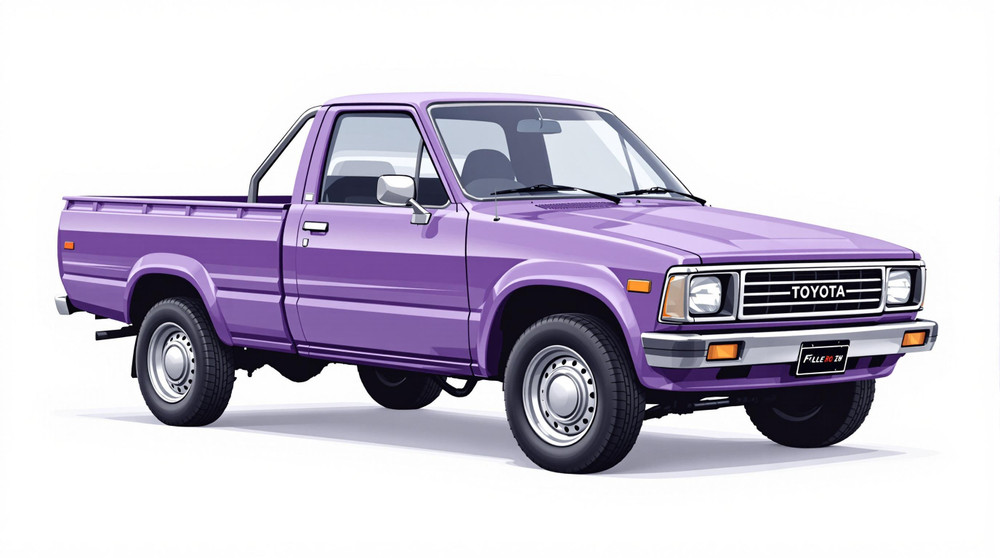
Image of 1980 Toyota Pickup, Note: These illustrations use artistic license and may differ from actual historical models.
Performance Metrics
Fundamental Metrics
Emotional Appeal
MMP Rating
| Engine Specifications | |
|---|---|
| Engine: | 2.2L 20R I4, 2.4L 22R I4 |
| Displacement: | 2189cc - 2366cc |
| Horsepower: | 90-105 hp |
| Torque: | 130-140 lb-ft |
| Compression Ratio: | 8.4:1 (20R), 9.0:1 (22R) |
| Ignition System: | Electronic |
| Cooling System: | Liquid-cooled |
| Performance Specifications | |
| 0-60 Time: | 15-20 seconds |
| 1/4 Mile Time: | 20-25 seconds |
| Top Speed: | 85-95 mph |
| Transmission and Drive | |
| Drive Type: | Rear-wheel drive (RWD), Four-wheel drive (4WD) |
| Transmission Type: | 4-speed manual, 5-speed manual, 3-speed automatic |
| Fuel and Efficiency | |
| Fuel System Type: | Carburetor |
| MPG: | 20-25 mpg |
| Dimensions and Brakes | |
| Brakes: | Front disc, rear drum |
| Wheelbase: | 103.5 inches |
| Weight: | 3000-3500 lbs |
Note: Specifications for classic cars are given to the best of our ability, considering the limited and variant data available.
1980 Toyota Pickup: The Compact Truck That Earned Its Reputation
The 1980 Toyota Pickup was not built to win drag races or pamper its driver. It was built to start, haul, and keep going, and that straightforward approach helped turn Toyota’s small truck into one of the most respected compact pickups of its era.
Known as the Hilux in many markets, the truck was sold in the United States simply as the Toyota Pickup. Toyota Motor Corporation had introduced the Hilux in 1968, and by 1980 the truck had become a familiar sight on farms, worksites, and city streets. The 1980 model belongs to the third-generation Hilux family, produced from the late 1970s into the early 1980s. It arrived at a time when drivers were increasingly interested in smaller, more economical trucks, while the energy crises of the decade made fuel-conscious vehicles especially appealing.
One detail that gives the 1980 Pickup a special place in Toyota history is its available four-wheel drive. Toyota’s compact 4x4 helped bring rugged, practical off-road ability to a smaller and more affordable truck format. It was an early chapter in a tradition that would later continue with the Tacoma, but the 1980 still wore the simple, hardworking character of a classic pickup.
Boxy Styling, Built for Work
The 1980 Toyota Pickup has the clean, upright shape that defines a classic compact truck. Its squared-off cab, flat hood, narrow body, and simple grille give it a purposeful look without unnecessary decoration. The proportions are compact by modern standards, which makes the truck feel nimble and easy to place on narrow roads or crowded job sites.
Depending on configuration, the truck came with a regular cab or an available Xtra Cab, Toyota’s extended-cab layout. The Xtra Cab added a little extra space behind the front seats for storage, rather than the comfortable rear seating of a modern crew cab. Bed lengths and equipment varied by market and drivetrain. The regular-cab 4x4 is especially recognizable today, while an SR5 model typically adds more brightwork and trim for a slightly more polished appearance.
Paint choices varied with market, trim, and production run. Buyers could find colors such as white, red, blue, silver, and earthier shades, with white and red among the familiar favorites. Today, original colors and factory-correct paint can add interest for collectors, particularly when paired with period-correct wheels and trim.
Inside, the Pickup was practical rather than plush. The dashboard was straightforward, with clear instruments and large, easy-to-use controls. Hard-wearing vinyl was common, while trim and upholstery choices varied by version. The materials were simple, but that simplicity suited the truck: there were fewer fragile luxuries to worry about when the cab was dusty, wet, or full of work gear.
Simple Technology, Useful Choices
In 1980, useful technology meant dependable mechanical systems, not touchscreens or a network of computers. The Pickup used a carbureted engine, conventional gauges, and a relatively uncomplicated electrical and mechanical layout. Depending on equipment, buyers could choose a manual transmission or an automatic, though manual gearboxes were a natural match for the truck’s work-oriented character.
Two-wheel-drive versions used a more road-focused suspension setup, while four-wheel-drive models offered a part-time 4WD system with a transfer case. Many 4x4 versions used a solid front axle and leaf springs, a durable arrangement valued for strength and off-road articulation. It could feel firm on pavement, but it was well suited to rough tracks and heavy use.
Why the 1980 Pickup Mattered
The Toyota Pickup helped prove that a compact truck could be both useful and durable without the size and fuel demands of a full-size American pickup. Its appeal was not based on a radical new invention. Instead, Toyota focused on sensible engineering, manageable dimensions, and a reputation for dependability. That combination helped make imported compact trucks a serious part of the North American market.
The truck also offered a different kind of 4x4 experience from many larger off-roaders. It was narrower and lighter, which could be an advantage on tight trails, and its simple mechanical layout appealed to drivers who wanted a vehicle they could understand and maintain. Its influence is visible in the ongoing popularity of compact and midsize pickups, although the modern versions are far larger and more sophisticated.
There is one common piece of Toyota-truck pop-culture trivia worth setting straight: the famous black pickup driven by Marty McFly in Back to the Future is a 1985 Toyota Pickup, not a 1980. The two trucks share the same family resemblance, but the movie helped make the later model especially recognizable.
20R Power and Real-World Performance
Most U.S.-market 1980 Toyota Pickups were powered by the 2.2-liter 20R four-cylinder engine. Output is commonly listed at about 90 horsepower, with roughly 120 lb-ft of torque, though published figures can vary with specification and measurement method. The engine was designed for steady work rather than high-speed performance, and it delivered its power in a relaxed, low-revving manner.
Period performance depended on drivetrain, transmission, gearing, tires, and load. A reasonable estimate for a healthy two-wheel-drive truck is a 0-to-60 mph time in the mid-to-high teens, with four-wheel-drive versions generally slower. Top speed is roughly in the 85-to-95 mph range under favorable conditions, but this is not a truck that feels happiest cruising at the top of its capabilities. These are estimates rather than a single factory figure that applies to every configuration.
On the road, the 1980 Pickup feels compact and mechanical. The steering is straightforward, the controls require more effort than in a modern truck, and the cabin lets in plenty of engine and road noise. The 20R has a distinctive four-cylinder hum that grows more noticeable under acceleration. With a manual transmission, the driver is closely involved in keeping the engine in its useful rev range.
Its suspension is a study in trade-offs. The truck can hop or jostle over sharp bumps, especially when the bed is empty, and its short wheelbase can make rough roads feel busy. On a winding road, its modest size and relatively light feel are appealing, but it is not a sports truck. A 4x4’s solid front axle and leaf springs add toughness off-road but can feel less composed on pavement than a modern independent suspension.
Living With a Classic Toyota Truck
Owners use 1980 Pickups as weekend cruisers, farm and property vehicles, trail rigs, restoration projects, and occasional daily drivers. A well-maintained example can still handle local errands and light hauling, but its age means comfort, crash protection, and highway refinement fall well short of a contemporary pickup.
Maintenance is one of the truck’s strong points. The engine bay and mechanical systems are comparatively accessible, and many routine jobs are within reach of an experienced home mechanic with basic tools. The carburetor, ignition system, cooling system, brakes, and suspension still need regular attention, as they would on any vehicle approaching half a century old. Parts availability is generally workable, although original trim, body panels, and certain drivetrain components can take more searching.
Rust is the major ownership concern. Buyers should inspect the frame, cab corners, floorboards, bed, wheel arches, and areas around the windshield and suspension mounts. A truck that looks tidy in photographs can hide corrosion underneath. A solid frame and honest bodywork are usually more valuable than a shiny paint job covering old repairs.
Trivia and Common Criticisms
The name Hilux is often associated with Toyota’s long-running emphasis on utility and durability, and the Pickup became part of that reputation through decades of hard use around the world. The 1980 model has no widely recognized production speed record or singular endurance title of its own. Its achievement was more practical: Toyota’s compact trucks built a strong reputation across many markets and helped establish the small pickup as a credible alternative to larger trucks.
Its drawbacks are just as clear. The 20R is modestly powered, the ride can be choppy, and the cab is tight by modern standards. A 1980 truck also lacks contemporary safety features such as airbags, stability control, and anti-lock brakes. Those limitations are part of the ownership calculation, especially for anyone considering one as regular highway transportation.
Collector Values and Availability
Values vary sharply with condition, originality, location, and configuration. As a broad U.S. market guide in 2026, a rough project truck may sell for about $2,000 to $6,000. A usable driver in decent condition commonly falls around $8,000 to $15,000, while a carefully restored or unusually original example can reach roughly $20,000 to $35,000 or more. Clean 4x4s, especially well-kept SR5 models, can command a premium, and exceptional examples may exceed those ranges.
Exact production figures for the 1980 model year are not readily available across all Hilux markets and configurations. A cautious estimate would put worldwide production in the broad range of 100,000 to 250,000 trucks, but that is an order-of-magnitude estimate, not a verified factory total. The model itself was not produced in tiny numbers. What is increasingly scarce is a rust-free, original truck with its correct drivetrain and desirable equipment.
Values have generally strengthened as collectors and enthusiasts have rediscovered compact Japanese trucks. The trend is most noticeable for unmodified 4x4s and clean SR5 examples. Ordinary two-wheel-drive trucks remain more affordable, though condition still makes a major difference. Well-executed restorations can attract strong interest, but buyers often prize originality and a solid, documented truck over an over-restored example.
A Small Truck With a Big Legacy
The 1980 Toyota Pickup combines compact dimensions, simple engineering, and a work-ready attitude that helped define Toyota’s reputation in the truck market. It is not fast, quiet, or especially comfortable, but it is understandable, useful, and rewarding to drive in its own uncomplicated way. For collectors, it represents an era when a small pickup could be genuinely tough without needing to be enormous. That honest character is exactly why the 1980 Toyota Pickup still earns a place in the garage, on the trail, and in the conversation about great classic trucks.
1980 Toyota Pickup Catalog of Parts
 1980 Toyota Pickup Molded Door Seals. Pair R&L-LM 134Molded Door Seals. Pair R&L
Why Choose Metro?
For over 100 years, Metro Moulded Parts has been the pinnacle of quality in classic car restoration parts. Our commitment to precision and authenticity in every component ensures a perfect fit and an OEM-level appearance.
- Expert Craftsmanship & Quality: Each part is a testament to our dedication to reliability and perfection, crafted from original designs and thoroughly tested.
- Advanced Technology: We use cutting-edge techniques to create flawless, long-lasting parts that surpass others in performance.
- SuperSoft Sponge – The Ultimate Door Seal: Not only are our door seals 30% softer than competitors', but they're also guaranteed to never leak. They effectively reduce wind and road noise, enhancing your classic car's comfort and driving experience.
- Proudly American: Our parts are a product of American craftsmanship, made in the USA with a spirit of excellence and heritage.
- Unrivaled Warranty: We back our products with a 30-year industry-leading warranty, a testament to our confidence in their quality.
Join us in preserving the legacy of classic cars with parts that are crafted for perfection, not just made.