
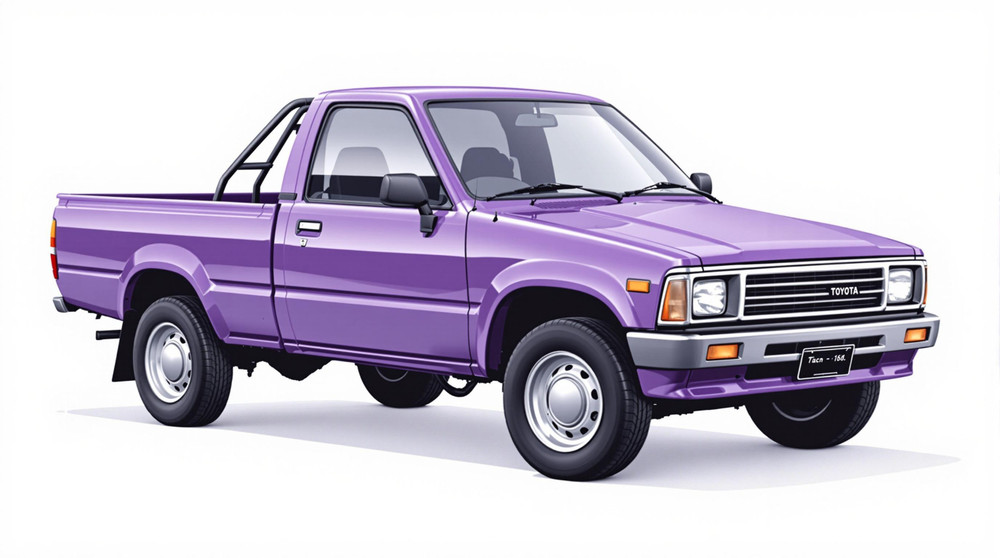
Image of 1987 Toyota Pickup, Note: These illustrations use artistic license and may differ from actual historical models.
Performance Metrics
Fundamental Metrics
Emotional Appeal
MMP Rating
| Engine Specifications | |
|---|---|
| Engine Options: | 2.4L 4-cylinder, 3.0L V6 |
| Displacement Range: | 2.4L - 3.0L |
| Horsepower Range: | 97-150 hp |
| Torque: | 123-180 lb-ft |
| Compression Ratio: | 9.3:1 (2.4L), 9.0:1 (3.0L) |
| Ignition System: | Electronic |
| Cooling System: | Liquid-cooled |
| Performance Specifications | |
| 0-60 Time: | 10-12 seconds |
| 1/4 Mile Time: | 17-18 seconds |
| Top Speed: | 100-105 mph |
| Transmission and Drive | |
| Drive Type: | Rear-wheel drive (RWD), Four-wheel drive (4WD) |
| Transmission Type: | 4-speed automatic, 5-speed manual |
| Fuel and Efficiency | |
| Fuel System Type: | Fuel Injection |
| MPG: | 17-22 mpg |
| Dimensions and Brakes | |
| Brakes: | Front Disc/Rear Drum |
| Wheelbase: | 103-122 inches |
| Weight: | 3,000-3,500 lbs |
Note: Specifications for classic cars are given to the best of our ability, considering the limited and variant data available.
1987 Toyota Pickup: The Compact Truck That Built a Reputation
The 1987 Toyota Pickup made its case without theatrics: it was compact, capable, and famously willing to keep working long after less sturdy trucks had given up. Built by Toyota and descended from the Hilux, it belonged to a generation that helped turn the small pickup from a basic work tool into a popular everyday vehicle. In the United States, Toyota sold it simply as the Toyota Pickup, while many other markets knew the same family of trucks as the Hilux.
By 1987, Toyota’s compact pickup had earned a reputation for durability among tradespeople, outdoor enthusiasts, and drivers who wanted a practical truck without full-size dimensions. One notable detail: the 1987 model was part of the first generation of Toyota’s U.S.-market pickups to use independent front suspension on 4WD versions, replacing the older solid front axle. That change made the truck more comfortable and composed on pavement while preserving useful off-road ability.
Square-Jawed Styling, Practical Cabins
The 1987 Pickup wore the crisp, angular shape typical of mid-1980s trucks. Its upright windshield, broad hood, simple grille, and squared-off wheel arches gave it a purposeful look, while the compact footprint made it easier to maneuver and park than a full-size pickup. Four-wheel-drive models stood taller and had a tougher stance, often with more prominent tires and protective trim. The overall design favored function over ornament, and that simplicity has aged into part of its appeal.
Inside, the cabin was straightforward and hard-wearing. Most surfaces were durable molded plastic, with cloth upholstery available on better-equipped versions. The dashboard arranged the gauges and controls plainly, and the upright seating position gave the driver a clear view of the road and the truck’s corners. It was not a luxury interior, but it was easy to understand, easy to clean, and built for regular use.
Depending on trim and equipment, features could include an AM/FM radio, air conditioning, power steering, and a rear window that opened on some XtraCab models. There was no modern infotainment, stability control, or airbag suite. The period’s technology highlight was the available 22RE engine, which used electronic fuel injection for more consistent fueling than the carbureted 22R. Four-wheel-drive versions also offered a two-speed transfer case for selecting low range when extra control was needed.
Body and equipment choices varied by market and configuration. Buyers could choose a two-wheel-drive or four-wheel-drive chassis, a regular cab or the roomier XtraCab, and different bed lengths and trim levels. The XtraCab became one of the most recognizable versions because its small rear cabin area added storage space without making the truck much larger. Popular SR5 equipment brought a more dressed-up look and additional comfort features. Paint choices differed by region and trim, but white, red, blue, silver, and earthy neutral shades were common; two-tone combinations also suited the era particularly well.
Why the 1987 Pickup Mattered
The Toyota Pickup helped establish that a compact truck could be both a serious work vehicle and a dependable personal vehicle. Its size and efficiency made it practical in cities and on narrow roads, while four-wheel drive opened the door to trails, snow, and job sites where a two-wheel-drive truck might struggle. Toyota’s focus on durability and mechanical simplicity also helped shape the expectations buyers brought to later compact pickups.
Compared with many contemporaries, the 1987 Toyota stood out for its reputation for longevity, efficient packaging, and strong resale demand. It was not the roomiest or most powerful truck in its class, and its modest cabin and payload could be limiting. But it offered a combination of manageable size, useful capability, and proven mechanicals that helped make the Toyota name synonymous with dependable pickups. The formula influenced generations of compact trucks, even as the market later shifted toward larger and more comfort-oriented models.
22R Power and Back-Road Manners
In the United States, the main engine choices were members of Toyota’s 2.4-liter four-cylinder 22R family. The carbureted 22R produced roughly 97 horsepower, while the fuel-injected 22RE was rated at about 105 horsepower. Exact output and equipment could vary with market and specification. Buyers could pair the four-cylinder with a manual transmission, commonly a five-speed, or an automatic in applicable configurations. A 3.0-liter V6 was not part of the 1987 U.S. lineup; it arrived later.
This was a truck built for useful torque and steady work, not quick launches. Performance figures vary with cab, drivetrain, gearing, and test conditions, but a four-wheel-drive 22RE model typically needed roughly 14 to 16 seconds to reach 60 mph. A reasonable estimate for top speed is around 85 to 95 mph, though gearing and vehicle condition make a significant difference. Two-wheel-drive versions could feel livelier because they carried less weight and avoided the added drag of the 4WD system.
On pavement, the Pickup feels compact and easy to place. Its steering is direct by modern standards, and the relatively narrow body is an advantage on tight roads. The trade-off is a firm, lightly loaded ride: the rear leaf springs can hop or skip over sharp bumps when the bed is empty. On winding roads, it is more about steady momentum than sporty cornering. In snow, mud, or rough tracks, four-wheel drive and low range offer reassuring traction, though the independent front suspension is not as articulation-friendly as the solid axle used on earlier 4WD models.
Behind the wheel, the engine’s sound is a familiar four-cylinder rumble rather than a powerful roar. The manual gearbox makes the driver part of the process, with deliberate shifts and a satisfying sense of mechanical connection. The cabin is simple, visibility is good, and the truck communicates what its tires and suspension are doing. That unfiltered experience is part of the charm, though it can feel noisy and basic beside a modern pickup.
Living With a Toyota Pickup
Today, 1987 Pickups serve as daily drivers, work trucks, trail rigs, restoration projects, and occasional show vehicles. Their compact size makes them appealing in places where a large truck feels cumbersome. Well-preserved examples are increasingly treated as collectible classics, but many remain in regular use because their basic design still suits practical jobs.
Routine maintenance is generally approachable for a mechanically inclined owner. The engine bay is relatively accessible, and many common service tasks do not require specialized diagnostic equipment. Parts support remains good for widely used mechanical components, though trim pieces, body panels, and some model-specific details can take more searching. As with any truck approaching four decades old, condition matters more than reputation: inspect the frame, suspension mounting points, bed, cab corners, and floor for rust, and check carefully for poorly repaired collision damage or modifications.
The 22R and 22RE are known for durability when maintained, but neither is immune to age-related wear. A prospective buyer should look for service records, listen for unusual engine or timing-chain noise, check for cooling-system problems, and verify that the 4WD system engages correctly if fitted. A neglected example can still require substantial work, so “Toyota reliability” should never replace a thorough inspection.
Small-Truck Trivia and Common Complaints
The Toyota Pickup’s Hilux lineage is famous for a reputation for toughness that grew across generations and markets. The best-known pop-culture test came later: the British television program Top Gear subjected a Hilux from a later model year to a series of deliberately destructive trials. That episode helped cement the Hilux’s indestructible image, but it was not a test of the 1987 U.S.-market truck specifically.
There is no single, dependable public production figure for every 1987 combination of cab, bed, engine, trim, and drivetrain. Toyota built and sold pickups in many markets, so a precise worldwide total for this model year is difficult to establish. As a broad, non-factory estimate, production across global versions may have reached the low hundreds of thousands, but that should not be mistaken for a verified count. Individual configurations, especially clean, unmodified 4WD XtraCabs, are much less common in today’s market than the overall production volume suggests.
Common criticisms are straightforward: modest acceleration, limited cabin space, a firm ride, road noise, and less payload or towing capacity than a full-size truck. Some owners also prefer the solid-front-axle feel of earlier 4WD models for serious off-roading. The 1987 truck’s independent front suspension, however, was a useful compromise for drivers who split their time between pavement and trails.
Collector Values and Market Outlook
Prices depend heavily on rust, originality, drivetrain, cab style, and documented maintenance. As a broad U.S. guide for the current collector market, a rough or heavily worn example might sell for about $3,000 to $7,000. A usable, reasonably presentable truck often falls around $8,000 to $15,000, while a clean, original 4WD or XtraCab can bring roughly $15,000 to $25,000. Exceptional, low-mileage examples or carefully restored trucks may exceed $25,000, particularly when they have desirable equipment and little corrosion. These are estimates, not guaranteed sale prices.
The 1987 Pickup is no longer just an inexpensive old truck. Interest in analog 1980s vehicles, compact 4x4s, and dependable Japanese classics has pushed the best examples upward in value. Ordinary trucks still trade according to condition and usability, but clean original examples have generally appreciated in recent years. Availability is fair for project trucks and worn drivers; finding a rust-free, unmodified 4WD XtraCab is a more demanding search.
A Compact Classic With Lasting Purpose
The 1987 Toyota Pickup paired simple engineering with useful capability and a size that made sense for everyday life. Its angular styling, durable cabin, available 22RE fuel injection, and choice of two- or four-wheel drive made it adaptable without overcomplicating the formula. It was not fast, plush, or especially quiet, but it earned something more enduring: the trust of owners who needed a truck to keep showing up.
That reputation is why the 1987 Toyota Pickup still draws attention today. It is a practical classic with real work-truck roots, and its best examples remind us that lasting significance does not always come from speed or luxury. Sometimes it comes from building a truck that simply refuses to quit.
1987 Toyota Pickup Catalog of Parts
 1987 Toyota Pickup Door seals. '84-'88 Toyota 4-Runner & pick-up trucks. Pair-LM 135Door seals. '84-'88 Toyota 4-Runner & pick-up trucks. Pair. R&L.
Why Choose Metro?
For over 100 years, Metro Moulded Parts has been the pinnacle of quality in classic car restoration parts. Our commitment to precision and authenticity in every component ensures a perfect fit and an OEM-level appearance.
- Expert Craftsmanship & Quality: Each part is a testament to our dedication to reliability and perfection, crafted from original designs and thoroughly tested.
- Advanced Technology: We use cutting-edge techniques to create flawless, long-lasting parts that surpass others in performance.
- SuperSoft Sponge – The Ultimate Door Seal: Not only are our door seals 30% softer than competitors', but they're also guaranteed to never leak. They effectively reduce wind and road noise, enhancing your classic car's comfort and driving experience.
- Proudly American: Our parts are a product of American craftsmanship, made in the USA with a spirit of excellence and heritage.
- Unrivaled Warranty: We back our products with a 30-year industry-leading warranty, a testament to our confidence in their quality.
Join us in preserving the legacy of classic cars with parts that are crafted for perfection, not just made.