
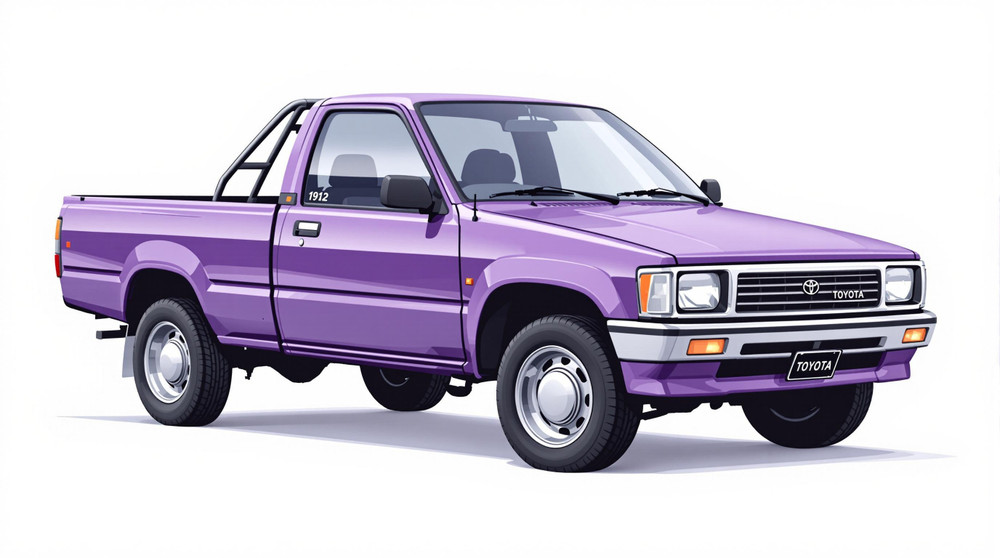
Image of 1992 Toyota Pickup, Note: These illustrations use artistic license and may differ from actual historical models.
Performance Metrics
Fundamental Metrics
Emotional Appeal
MMP Rating
| Engine Specifications | |
|---|---|
| Engine Options: | 2.4L 4-cylinder, 3.0L V6 |
| Displacement Range: | 2.4L - 3.0L |
| Horsepower Range: | 97-150 HP |
| Torque: | 123-180 lb-ft |
| Compression Ratio: | 9.3:1 (2.4L), 9.0:1 (3.0L) |
| Ignition System: | Electronic |
| Cooling System: | Liquid-cooled |
| Performance Specifications | |
| 0-60 Time: | 10-12 seconds |
| 1/4 Mile Time: | 17-18 seconds |
| Top Speed: | 105 mph |
| Transmission and Drive | |
| Drive Type: | Rear-wheel drive (RWD), Four-wheel drive (4WD) |
| Transmission Type: | 5-speed manual, 4-speed automatic |
| Fuel and Efficiency | |
| Fuel System Type: | Fuel Injection |
| MPG: | 17-22 mpg city, 20-26 mpg highway |
| Dimensions and Brakes | |
| Brakes: | Front disc, rear drum |
| Wheelbase: | 103-122 inches |
| Weight: | 3,000-3,500 lbs |
Note: Specifications for classic cars are given to the best of our ability, considering the limited and variant data available.
1992 Toyota Pickup: A Compact Truck Built to Last
The 1992 Toyota Pickup made its case with a simple formula: practical size, tough mechanicals, and very little fuss. Sold in North America as the Toyota Pickup, it belonged to the same global truck family known as the Hilux, a name that had already earned a reputation for durability in work and adventure across the world.
Toyota introduced the Hilux in 1968, and the compact pickup steadily grew into one of the company’s best-known vehicles. By 1992, the U.S.-market truck was in the fifth generation of the Hilux family. It was nearing the end of its run under the Pickup name: Toyota replaced it in North America with the Tacoma for the 1995 model year, while the Hilux name continued in many other markets.
One detail that helps explain the truck’s enduring fame is that the Toyota Pickup and Hilux became shorthand for ruggedness well beyond their original market. Later popular culture would put the Hilux through spectacular abuse tests, but the appeal behind those stunts was already present in trucks like the 1992 model: uncomplicated construction and a willingness to keep working.
Exterior Design and Cab Choices
The 1992 Pickup has the purposeful proportions of a classic compact truck. Its upright cab, flat hood, squared-off front end, and prominent wheel arches give it a clean, functional shape rather than a sculpted, car-like look. The grille and headlamp treatment varies with trim and market, but the overall design is restrained. It looks ready for a job, not dressed up for one.
Buyers could choose two-wheel drive or four-wheel drive, a regular cab or the roomier Xtracab, and different bed lengths depending on configuration. The Xtracab’s small rear seating area was useful for occasional passengers or extra storage, though it was not a substitute for a full-size back seat. The 4x4 models added a higher stance and more off-road-ready hardware, making them especially recognizable today.
Factory paint choices varied by trim, region, and production batch. White, red, blue, black, silver, and several neutral or earth-tone colors were among the types of finishes offered during this era. White and red are particularly familiar on work-oriented examples, while clean factory colors paired with SR5 trim tend to catch collectors’ eyes. Original paint codes and availability should be checked against the truck’s build information rather than assumed from a general color list.
Interior: Straightforward by Design
The cabin is practical and easy to understand. Large, clearly arranged controls, simple gauges, and broad windows make the truck feel approachable even by the standards of older vehicles. Depending on trim, the seating could be covered in durable cloth or more basic vinyl, with the SR5 generally bringing a more finished look and additional convenience features.
Materials were chosen for everyday use, not luxury. Hard-wearing plastics and uncomplicated trim are typical, and a well-preserved interior often shows its age through worn seat bolsters, cracked dash surfaces, or faded upholstery. The payoff is a cabin that is relatively easy to clean and, in many cases, easier to repair than a modern interior packed with integrated electronics.
Technology was modest but appropriate for the period. Features varied by trim and equipment package, and could include a stereo, power accessories, and air conditioning. Fuel injection on the main gasoline engines was a meaningful piece of everyday technology, improving cold starts and drivability compared with older carbureted setups. A 4x4’s transfer case was operated through a direct, mechanical control rather than a menu or touchscreen.
Engines, Gearboxes, and 4x4 Hardware
In the United States, the familiar engine was Toyota’s 2.4-liter 22R-E fuel-injected four-cylinder. Period specifications are commonly listed at about 113 horsepower and 140 lb-ft of torque, though published figures can vary by source and configuration. It was not a high-revving performance engine. Its appeal was a useful spread of low- and mid-range power, straightforward service requirements, and a reputation for lasting when maintained.
A 3.0-liter V6 was also available, generally rated at about 150 horsepower and 180 lb-ft of torque. It gave the truck more passing and hauling confidence, especially in heavier 4x4 and Xtracab configurations, though it added complexity and fuel consumption. Depending on engine and trim, buyers could find a five-speed manual or an automatic transmission. Four-wheel-drive models paired their transmission with a transfer case for selecting the appropriate drive mode.
By 1992, the 4x4 used independent front suspension, a change Toyota had made to the North American Pickup line in the mid-1980s. That design improved on-road ride and steering compared with the older solid-front-axle trucks, while still providing useful trail capability. It is worth noting for enthusiasts: a 1992 4x4 is not the same front-end setup as the earlier solid-axle models that have become favorites among some off-road builders.
Historical Significance: The Pickup Before the Tacoma
The 1992 Toyota Pickup sits at an important point in the evolution of the compact truck. It preserved the smaller dimensions and work-focused character that had made the segment popular, while offering more comfort and refinement than the earliest Toyota pickups. Its mix of useful payload, manageable size, and available four-wheel drive made it equally at home on a job site, a farm track, or a weekend trail.
What separated it from many contemporaries was not a single headline-grabbing innovation. It was the consistency of the package: a compact footprint, proven engines, a robust chassis, and a wide choice of cab and drivetrain configurations. Toyota’s reputation for reliability helped make that combination particularly attractive to buyers who valued long service life over novelty.
The Pickup also helped establish the foundation for the Tacoma, which took over Toyota’s North American compact-truck role in 1995. The 1992 model is therefore both a mature example of the original Toyota compact-pickup idea and one of the final U.S. trucks to wear the Pickup name before Toyota gave the successor its own identity.
Performance and Road Manners
Performance depends heavily on engine, transmission, cab, bed, and drivetrain. A four-cylinder truck is commonly a roughly 11- to 15-second 0-to-60-mph vehicle, with heavier 4x4s generally toward the slower end. The V6 can bring the sprint closer to roughly 10 to 12 seconds in favorable configurations. These are broad period-style estimates, not guaranteed figures for every truck, and decades of wear can change the result substantially.
Top speed is similarly configuration-dependent. A healthy stock example may reach roughly 90 to 105 mph, but this is a truck designed for useful low-speed work, not sustained high-speed driving. Tires, gearing, engine condition, and load all affect the result. Its comfortable cruising pace is well below the number a speedometer might suggest.
On a smooth road, the Pickup feels direct and easy to place. The steering is more communicative and less isolated than that of a modern truck, and the driver sits upright with good visibility. On broken pavement, the unladen rear suspension can feel firm or bouncy, especially in a short-bed truck. Add a sensible load and the ride often settles down.
On winding roads, its compact size is an advantage, but it still behaves like a narrow, upright pickup. Take corners with appropriate care, particularly when the bed is empty or the truck is riding on old tires and worn suspension parts. The 4x4’s independent front suspension helps it feel more composed on pavement than earlier solid-axle versions, though it is not a sports truck.
The four-cylinder produces a purposeful mechanical hum and needs to work harder when climbing hills or accelerating onto a highway. The V6 sounds smoother and feels less strained under load. In either version, the driving experience is refreshingly hands-on: clear engine feedback, straightforward controls, and little distance between the driver and the machine.
Living With a 1992 Toyota Pickup
Owners use these trucks as daily drivers, farm and work vehicles, camping rigs, restorations, and off-road builds. A clean, mostly original example can also make an appealing show vehicle, particularly when it retains its factory wheels, trim, and paint. Serious racing is not the truck’s natural role, although modified examples are used in recreational off-road competition.
Routine maintenance is generally familiar to an experienced home mechanic. Oil and filter service, brakes, belts, hoses, ignition parts, and many suspension jobs are conventional tasks, and the engine bay is less crowded than that of many modern vehicles. The truck’s age is now a bigger concern than its original design, so inspect carefully for rust, neglected maintenance, worn steering and suspension components, and signs of hard off-road use.
Pay particular attention to the frame and body mounts, cab corners, rocker panels, bed seams, and the areas around the windshield and wheel arches. Check the 4x4 system for proper engagement and listen for drivetrain noises. On V6 trucks, service history matters, and buyers should verify that relevant engine maintenance has been performed. A reputation for durability is not a substitute for condition: even a famously tough Toyota can be worn out or poorly repaired.
Fun Facts and Common Criticisms
The Pickup name was specific to Toyota’s North American market. In many other countries, the related truck was sold as the Hilux, a name that became globally recognized for utility and toughness. The 1992 model also represents the later independent-front-suspension era of the U.S. 4x4 Pickup, which makes it distinct from earlier solid-axle trucks prized by some collectors and trail enthusiasts.
There is no dependable, widely published production tally for every 1992 truck across all Hilux markets, factories, cab styles, and drivetrain combinations. As a broad estimate rather than an official count, worldwide production across the related Pickup and Hilux range may have been in the hundreds of thousands for a model year. A precise figure for U.S.-market 1992 trucks is difficult to establish from public model-level records.
Common criticisms are familiar to anyone who has driven an older compact pickup: modest acceleration, a firm ride when empty, limited rear-seat space in the Xtracab, and less crash protection and comfort than a modern truck. The four-cylinder can feel underpowered when carrying a heavy load, while the V6 is thirstier and has more components to maintain. Rust and decades of repairs are often bigger practical drawbacks than the original design.
1992 Toyota Pickup Values and Collectibility
Values vary widely with rust, originality, mileage, engine, drivetrain, cab style, and local demand. As a general U.S. market estimate for 2026, a running but tired example may bring around $3,000 to $8,000. A sound, usable truck often falls in the $8,000 to $15,000 range, while a clean, well-maintained 4x4 or Xtracab may reach roughly $15,000 to $25,000. Exceptional, highly original examples can exceed that range, especially when supported by records and careful restoration work.
These are broad asking and sale-range estimates, not a formal appraisal. Prices can be lower for heavily rusted or mechanically incomplete trucks and higher for unusually clean, low-mileage examples. Four-wheel drive, desirable factory equipment, and a well-preserved body generally strengthen appeal. A modified truck can be excellent for use, but major changes do not always increase collector value.
Most 1992 Pickups were produced as practical vehicles rather than limited editions, so they are not rare in the traditional sense. Good examples are less common than worn or rusty ones, and finding an unmodified truck with clear history is increasingly difficult. Values have generally strengthened as buyers seek older, simpler 4x4s, though condition and regional market swings matter more than a guaranteed upward trend.
Why the 1992 Toyota Pickup Still Matters
The 1992 Toyota Pickup combines compact dimensions, practical configurations, straightforward engineering, and the durable character that helped define Toyota’s truck reputation. It is not fast or luxurious, and its ride can be firm, but it is easy to understand and rewarding to use. For many owners, that honesty is the point.
As one of the last North American Toyota trucks to carry the Pickup name, the 1992 model bridges the classic Hilux heritage and the Tacoma era that followed. Find a sound one, keep up with its maintenance, and this compact truck can still make a convincing case for itself decades after it first left the road.
1992 Toyota Pickup Catalog of Parts
 1992 Toyota Pickup Molded Door Seals. Pair R&L-LM 136Molded Door Seals. Pair R&L
Why Choose Metro?
For over 100 years, Metro Moulded Parts has been the pinnacle of quality in classic car restoration parts. Our commitment to precision and authenticity in every component ensures a perfect fit and an OEM-level appearance.
- Expert Craftsmanship & Quality: Each part is a testament to our dedication to reliability and perfection, crafted from original designs and thoroughly tested.
- Advanced Technology: We use cutting-edge techniques to create flawless, long-lasting parts that surpass others in performance.
- SuperSoft Sponge – The Ultimate Door Seal: Not only are our door seals 30% softer than competitors', but they're also guaranteed to never leak. They effectively reduce wind and road noise, enhancing your classic car's comfort and driving experience.
- Proudly American: Our parts are a product of American craftsmanship, made in the USA with a spirit of excellence and heritage.
- Unrivaled Warranty: We back our products with a 30-year industry-leading warranty, a testament to our confidence in their quality.
Join us in preserving the legacy of classic cars with parts that are crafted for perfection, not just made.