
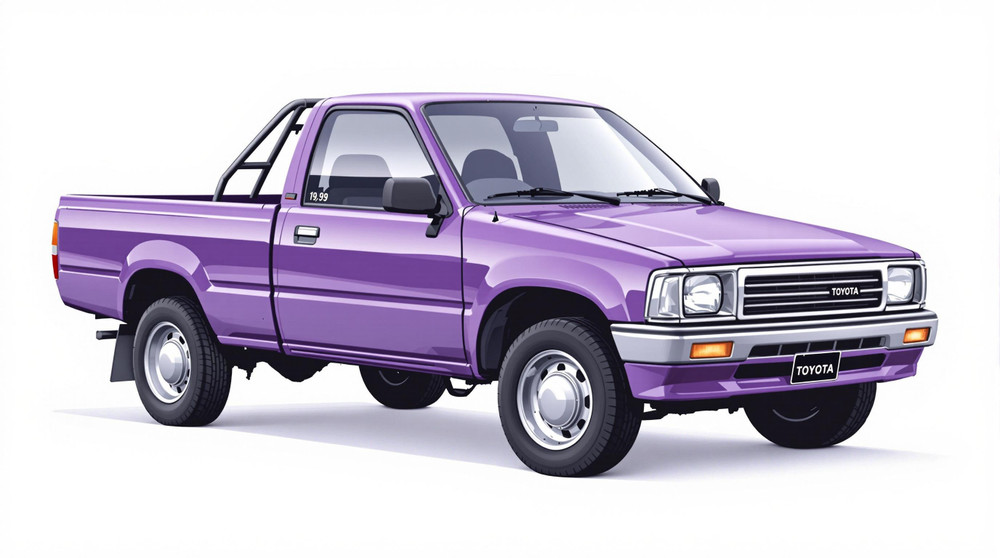
Image of 1993 Toyota Pickup, Note: These illustrations use artistic license and may differ from actual historical models.
Performance Metrics
Fundamental Metrics
Emotional Appeal
MMP Rating
| Engine Specifications | |
|---|---|
| Engine Options: | 2.4L 4-Cylinder, 3.0L V6 |
| Displacement Range: | 2.4L - 3.0L |
| Horsepower Range: | 116-150 HP |
| Torque: | 140-180 lb-ft |
| Compression Ratio: | 9.3:1 (2.4L), 9.0:1 (3.0L) |
| Ignition System: | Electronic |
| Cooling System: | Liquid-cooled |
| Performance Specifications | |
| 0-60 Time: | 10-12 seconds |
| 1/4 Mile Time: | 17-19 seconds |
| Top Speed: | 105 mph |
| Transmission and Drive | |
| Drive Type: | Rear-wheel drive (RWD), Four-wheel drive (4WD) |
| Transmission Type: | 5-speed manual, 4-speed automatic |
| Fuel and Efficiency | |
| Fuel System Type: | Fuel Injection |
| MPG: | 17-22 MPG |
| Dimensions and Brakes | |
| Brakes: | Front Disc/Rear Drum |
| Wheelbase: | 103-122 inches |
| Weight: | 3,000-3,500 lbs |
Note: Specifications for classic cars are given to the best of our ability, considering the limited and variant data available.
1993 Toyota Pickup: The Compact Truck That Earned Its Reputation
The 1993 Toyota Pickup made a simple promise: start reliably, carry a load, and keep going long after more complicated vehicles had called it quits. Built by Toyota Motor Corporation, it belonged to the compact-pickup line known as the Hilux in many markets, though Toyota sold it as the Pickup in North America. It was one of the final generations to wear that name in the United States before the Tacoma arrived for 1995.
By 1993, compact trucks had become more than basic work vehicles. Buyers wanted useful beds, four-wheel drive, and comfort that could handle everyday commuting as well as a job site. Toyota’s pickup answered with a broad range of configurations while retaining the durable, straightforward character that had made the Hilux famous around the world. One intriguing distinction: the truck driven by Marty McFly in Back to the Future was a 1985 Toyota Pickup, not a 1993 model. The movie helped make the earlier truck an icon, and its appeal carried into the later generation.
Boxy Styling, Practical Cab
The 1993 Pickup wears the purposeful shape of a traditional compact truck. Its upright windshield, squared-off cab, broad grille, and simple rectangular lamps give it a clean, functional look. The proportions are compact by modern standards, but the high beltline and sturdy wheel arches make the truck look ready for work. Four-wheel-drive versions typically have a tougher stance, with greater ground clearance and chunkier tires.
Inside, the design favors usefulness over luxury. The dashboard is straightforward, with clear gauges and controls that are easy to operate while wearing work gloves. Depending on trim and equipment, buyers could find durable cloth or vinyl seating, carpeting, and convenience features such as air conditioning, power steering, and power windows. Materials are generally hard-wearing rather than plush, which suits the truck’s purpose. A well-kept interior can feel pleasantly honest, though worn seat fabric, cracked trim, and sun-faded plastics are common on high-mileage examples.
Body styles included a two-door regular cab and the roomier Xtracab, Toyota’s extended cab with small rear seating or storage space. Bed length and equipment varied with cab and drivetrain. Buyers could choose two-wheel drive or part-time four-wheel drive, with trim levels and packages that ranged from basic work-truck specification to the better-equipped SR5. The Xtracab 4x4 is often the most sought-after combination today because it balances usable passenger space, off-road ability, and classic compact-truck proportions.
Factory colors varied by trim and market. White, red, blue, black, silver, and earthy tones such as beige or green were among the kinds of colors buyers could encounter. White remains a particularly recognizable work-truck choice, while red and darker colors tend to stand out at shows and in enthusiast listings. Exact availability depended on the model configuration and sales region.
Engines and Period Technology
In the U.S. market, the 1993 Pickup was commonly offered with a 2.4-liter four-cylinder engine or a 3.0-liter V6, with availability depending on cab, drivetrain, and trim. The fuel-injected 2.4-liter 22RE four-cylinder produced about 116 horsepower. The 3.0-liter 3VZ-E V6 made roughly 150 horsepower and delivered stronger passing power, particularly useful when carrying passengers or cargo. Some configurations and markets differed, so the engine and equipment on an individual truck should be confirmed by its VIN and original documentation.
Technology was modest by current standards, but the truck offered useful equipment for its era. Electronic fuel injection on many versions improved starting and drivability, while four-wheel-drive models provided a transfer case for selecting low-range gearing. Depending on specification, the truck could be ordered with a manual or automatic transmission. It did not have modern stability control, touchscreen navigation, or a long list of driver aids. Its appeal was precisely that the essential systems were relatively easy to understand and service.
Why the Toyota Pickup Mattered
The 1993 Pickup helped define what many buyers expected from a compact truck: manageable dimensions, genuine utility, and the option of four-wheel drive without moving up to a large, fuel-hungry full-size model. It was not the first durable pickup, but Toyota’s reputation for building trucks that could tolerate hard use helped distinguish it from many rivals. Its simple mechanical layout also made it attractive to owners who wanted to maintain a vehicle themselves or keep it working far beyond the usual new-car cycle.
The truck’s lasting influence is visible in the continued popularity of compact and midsize pickups. It helped establish a template that combines everyday road manners with real hauling and trail capability. The Hilux name became especially famous internationally for durability, while the North American Pickup built its own following among commuters, tradespeople, off-roaders, and Toyota loyalists. The 1993 model sits near the end of that original U.S. naming era, giving it a special place between the classic Toyota Truck and the Tacoma that followed.
Road Manners and Performance
Performance depends heavily on engine, transmission, cab, axle ratio, and whether the truck is two- or four-wheel drive. As a broad period-performance estimate, four-cylinder trucks generally took around 11 to 14 seconds to reach 60 mph, while V6 versions could manage roughly 9 to 11 seconds. Top speed was commonly in the neighborhood of 95 to 105 mph, although gearing, tires, condition, and equipment all affect the result. These are practical estimates, not a single factory figure that applies to every configuration.
The four-cylinder engine is not quick, especially with a loaded bed or the extra weight of four-wheel drive, but it suits the truck’s steady, workmanlike character. The V6 feels more relaxed at highway speeds and offers better response when merging. Neither engine turns the Pickup into a performance vehicle. Its job is dependable transportation and useful torque, not rapid acceleration.
On a smooth road, the truck feels direct and compact. The steering is heavier and less isolated than in a modern crossover, and the suspension lets the driver know when the pavement is broken. An empty bed can make the rear end hop over sharp bumps, a familiar trait of traditional leaf-spring pickups. Add cargo and the ride settles down. On winding roads, the relatively narrow body is easy to place, but the truck has more body roll and less grip than a modern car. In four-wheel drive, low range and suitable tires make it capable on dirt, snow, and rough tracks, but four-wheel drive is not a substitute for careful driving or good tires.
From behind the wheel, the experience is mechanical in the best old-truck sense. The four-cylinder has a busy, purposeful note when worked hard, while the V6 sounds fuller under acceleration. You sit upright, look out over a simple hood, and operate controls that feel connected to the vehicle rather than hidden in software menus. It is not quiet or especially refined by modern standards, but many owners value that honest feedback.
Living With a 1993 Pickup
These trucks serve as daily drivers, farm and work vehicles, camping rigs, trail trucks, and restoration projects. A clean, mostly stock example can also make an appealing show vehicle, especially when its original paint, interior, and factory equipment remain intact. Modified trucks are common too, with suspension lifts, larger tires, off-road bumpers, and engine upgrades.
Routine service is generally approachable for a home mechanic with basic tools. Oil changes, brakes, filters, belts, and many suspension repairs are familiar jobs, and parts support remains good because Toyota built large numbers of pickups and shared components across related models. A service manual and careful parts research are still worthwhile, particularly for drivetrain and trim-specific repairs.
Condition matters more than reputation. Inspect the frame and body carefully for rust, especially around the frame rails, suspension mounts, cab mounts, bed, and wheel arches. On the 3.0-liter V6, a history of overheating or head-gasket trouble deserves close attention. Four-cylinder trucks can develop timing-chain and guide wear, while any older example may need attention to worn steering or suspension parts, leaking seals, tired clutch components, and brittle cooling-system hoses. A reliable reputation does not make a 30-year-old truck maintenance-free.
Noteworthy Details and Common Complaints
The 1993 Pickup is part of the broader Hilux family, whose reputation for durability became a global cultural touchstone. The widely discussed “indestructible Hilux” demonstrations on the television program Top Gear involved older Hilux trucks, not this exact model year. Likewise, Toyota pickups have appeared in films and popular culture, but famous examples should not automatically be attributed to the 1993 model.
There is no widely recognized production record or special 1993-only speed milestone associated with the Pickup. Its most notable achievement is less glamorous: Toyota sold trucks that became valued for long service lives, and many remain in use decades later. Exact production totals for the 1993 model year are difficult to state confidently because public figures are not consistently broken down by every cab, engine, drivetrain, and market. A reasonable rough estimate is around 100,000 to 150,000 units sold in the United States for the model year, with worldwide production higher. Treat that as an informed estimate, not an audited factory total.
Common criticisms are straightforward. The four-cylinder can feel underpowered on highways, the ride is firm when the bed is empty, and the cabin is noisy compared with newer trucks. The V6’s known head-gasket concerns can also make buyers cautious. Rust is a greater threat in many regions than mechanical wear, so a solid frame is often more valuable than a low odometer reading.
Collector Value and Market Outlook
Values vary sharply with rust, mileage, originality, drivetrain, and location. As a broad current-market guide, a rough or heavily worn truck may sell for about $2,000 to $5,000. A usable driver in fair condition often lands around $5,000 to $10,000. Clean, well-maintained examples can bring roughly $10,000 to $20,000, while exceptional, low-mileage, original 4x4 Xtracab or SR5 trucks may reach $20,000 to $35,000 or more. These are general U.S. estimates; asking prices can differ from completed sales, and unusually restored or documented examples may fall outside the range.
Survivors are still available, but clean, unmodified four-wheel-drive trucks are becoming harder to find. The 1993 Pickup was produced in meaningful numbers, so it is not rare in the strict collector-car sense. Its scarcity is about condition: rust-free frames, intact interiors, and original equipment are increasingly uncommon. Values for the best examples have generally strengthened as buyers seek out simpler, durable older trucks. Ordinary high-mileage work trucks remain more affordable, while desirable 4x4 configurations are more likely to appreciate.
A Compact Truck With Long-Term Appeal
The 1993 Toyota Pickup combines useful size, straightforward engineering, and a reputation built through decades of real-world work. It is not fast or luxurious, and its age brings the expected demands of rust checks and mechanical upkeep. But a sound example offers practical capability, an engaging old-school driving experience, and a direct link to Toyota’s influential Hilux heritage.
For collectors, the best 1993 Pickup is not necessarily the rarest one. It is the truck with a healthy frame, honest history, and the right balance of originality and usability. That combination is why this compact Toyota still earns its place in garages, on trails, and in the story of the modern pickup.
1993 Toyota Pickup Catalog of Parts
 1993 Toyota Pickup Molded Door Seals. Pair R&L-LM 136Molded Door Seals. Pair R&L
Why Choose Metro?
For over 100 years, Metro Moulded Parts has been the pinnacle of quality in classic car restoration parts. Our commitment to precision and authenticity in every component ensures a perfect fit and an OEM-level appearance.
- Expert Craftsmanship & Quality: Each part is a testament to our dedication to reliability and perfection, crafted from original designs and thoroughly tested.
- Advanced Technology: We use cutting-edge techniques to create flawless, long-lasting parts that surpass others in performance.
- SuperSoft Sponge – The Ultimate Door Seal: Not only are our door seals 30% softer than competitors', but they're also guaranteed to never leak. They effectively reduce wind and road noise, enhancing your classic car's comfort and driving experience.
- Proudly American: Our parts are a product of American craftsmanship, made in the USA with a spirit of excellence and heritage.
- Unrivaled Warranty: We back our products with a 30-year industry-leading warranty, a testament to our confidence in their quality.
Join us in preserving the legacy of classic cars with parts that are crafted for perfection, not just made.