

Image of 1974 Aston Martin Vantage, Note: These illustrations use artistic license and may differ from actual historical models.
Performance Metrics
Fundamental Metrics
Emotional Appeal
MMP Rating
| Engine Specifications | |
|---|---|
| Engine: | Inline 6 |
| Displacement: | 4.0L |
| Horsepower: | 240-280 hp |
| Torque: | 290 lb-ft |
| Compression Ratio: | 8.3:1 |
| Ignition System: | Electronic |
| Cooling System: | Water-cooled |
| Performance Specifications | |
| 0-60 Time: | 6.8 seconds |
| 1/4 Mile Time: | 15 seconds |
| Top Speed: | 140 mph |
| Transmission and Drive | |
| Drive Type: | RWD (Rear Wheel Drive) |
| Transmission Type: | 5-speed manual or 3-speed automatic |
| Fuel and Efficiency | |
| Fuel System Type: | Twin SU carburetors |
| MPG: | 14-16 mpg |
| Dimensions and Brakes | |
| Brakes: | Front and rear disc brakes |
| Wheelbase: | 102.8 inches |
| Weight: | 3,670 lbs |
Note: Specifications for classic cars are given to the best of our ability, considering the limited and variant data available.
1974 Aston Martin Vantage: First, a Name Check
The 1974 Aston Martin Vantage is best understood as a powerful 1970s Aston Martin V8 with an important naming distinction: the factory V8 Vantage arrived in 1977, not 1974. A car described as a 1974 Vantage may be a Series 3 Aston Martin V8, an earlier Vantage model registered later, or a V8 modified to Vantage specification. For collectors, the chassis number and factory build records matter more than a badge or sales listing.
The Series 3 V8 was built by Aston Martin at Newport Pagnell, England. It followed the DBS V8 and carried forward the company’s formula of hand-finished British luxury paired with a large, powerful engine. The Vantage name itself had a longer history: Aston Martin had used it for higher-performance versions of earlier models. But the celebrated V8 Vantage, often described as Britain’s first supercar, was still a few years away in 1974.
That distinction is more than trivia. A genuine 1974 V8 offers a compelling period Aston experience, while a factory-built V8 Vantage is a different, later specification with its own performance and collector value. Any car presented as a 1974 V8 Vantage deserves a careful check of its provenance.
Design: A Newport Pagnell Grand Tourer
The V8’s shape is unmistakably 1970s Aston Martin. Designer William Towns gave it a long, low bonnet, a broad, squared-off profile and a crisply drawn tail. The front is dominated by a wide grille and four headlamps, while the flanks are relatively clean, with restrained brightwork and a formal, muscular stance. It looks less delicate than the earlier DB cars and more like a fast, substantial grand tourer.
The V8 was offered as a two-door saloon, Aston Martin’s term for its fixed-roof coupe. The 1974 Series 3 was not a factory convertible; the V8 Volante arrived later. That long-roof coupe is the body style most closely associated with the model’s early-1970s character.
Inside, the emphasis is on traditional craftsmanship rather than visual minimalism. Expect Connolly leather upholstery, deep carpeting and a cabin trimmed to suit its first owner’s specification. Depending on the individual car, the dashboard and fittings may include wood veneer and other polished details. These cars were hand-finished, so equipment and trim can vary. Original colors ranged from understated British shades to richer metallics, with dark greens, silvers, blues and reds all in keeping with the car. There was no single universal “Vantage” color scheme.
For its era, the V8 was well equipped with power assistance and comfort features intended for high-speed touring. Its engineering was more conventional than futuristic: a large naturally aspirated engine, carburettors, a substantial chassis and an automatic transmission on many cars. A five-speed manual was also available, depending on specification.
Why the Aston Martin V8 Mattered
The 1974 V8 represented Aston Martin’s response to a changing luxury-performance market. European manufacturers were building increasingly fast grand tourers, while American cars demonstrated that big engines and effortless torque had a strong appeal. Aston combined that muscle with British coachwork, a carefully finished cabin and a more exclusive, low-volume approach.
Its most important contribution was not a single technology or record. Instead, the V8 helped define a distinctive kind of grand tourer: large, comfortable and refined enough for long-distance travel, but capable of serious speed. The Vantage version that followed in 1977 sharpened that formula with more power and a reputation that helped establish the V8 as one of Aston Martin’s signature models.
That later Vantage also shaped how many enthusiasts think of 1970s Aston Martins. Its mix of understated styling and supercar performance influenced the brand’s image for decades. The 1974 Series 3 is part of that story, but it should not be confused with the later factory V8 Vantage.
Performance and Road Manners
The Series 3 V8 used an all-alloy 5.3-litre V8 with four twin-choke Weber carburettors. Period output figures vary by market and specification, but roughly 300 horsepower is a reasonable guide for a standard car. Performance estimates commonly put 0 to 60 mph in the neighborhood of six to seven seconds, with top speed around 140 to 145 mph when the car is in good condition. These are period-style estimates, not guaranteed figures for every surviving example.
That is rapid performance for a substantial luxury car of the period. The engine’s strength is its broad torque delivery: it gathers speed with a deep, steady surge rather than needing to be worked hard at high revs. An automatic car suits relaxed touring, while a manual can make the driver feel more involved.
The V8 is built for fast, flowing roads, where its long wheelbase and substantial weight help it feel settled. On rougher surfaces, the ride is more composed than a lightweight sports car’s, though age, suspension condition and wheel choice make a major difference today. On winding roads, it rewards smooth inputs. It is not a nimble modern sports coupe, and its size is noticeable in tight bends and narrow lanes.
Behind the wheel, the defining sensations are the view over the long bonnet, the weight of the controls and the sound of the V8. The engine produces a deep, cultured rumble that hardens under acceleration. The whole experience feels deliberately mechanical and substantial: the driver is part of the process, not separated from it by layers of modern electronics.
Living With a 1970s Aston V8
Most owners use a Series 3 V8 for weekend touring, club events and shows rather than as a daily commuter. It can cover long distances comfortably, but its fuel consumption, age and maintenance needs make regular modern traffic less appealing. A well-sorted car can still be driven, and careful use is often better for a classic than leaving it idle for long periods.
Maintenance is best handled by a specialist familiar with Aston Martin V8s. The engine is robust when properly serviced, but the carburettors need correct setup, and cooling, ignition and fuel systems must all be in good order. Parts and skilled labor can be expensive. The hand-built body and interior also require close inspection, particularly for corrosion, previous repairs and aging trim.
This is not an ideal car for an owner expecting inexpensive, straightforward repairs. Some routine work is accessible to an experienced home mechanic, but restoration, carburettor tuning and structural body repairs are specialist jobs. A detailed inspection before purchase can prevent a low asking price from turning into a costly project.
Vantage Facts and Common Misconceptions
The biggest fact to know is the date: Aston Martin introduced the V8 Vantage in 1977. A 1974 V8 may have been upgraded later, or its description may be using “Vantage” loosely. A genuine factory Vantage claim should be supported by the build record and chassis documentation.
The later V8 Vantage became a famous Aston Martin in popular culture, including its appearance in the 1987 James Bond film The Living Daylights. That movie car was a later Vantage, not a 1974 Series 3. The association is a good example of how the Vantage name grew beyond its original meaning and became an icon in its own right.
Common criticisms of the 1970s V8 include high fuel consumption, expensive upkeep, limited visibility in some directions and the risk of corrosion. Its weight also means it does not feel as nimble as a smaller sports car. Those drawbacks are balanced by its comfort, craftsmanship, distinctive sound and ability to cross long distances at speed.
Collector Value and Rarity
Production figures depend on how the cars are grouped by series and specification. The Series 3 V8 is generally reported at roughly 967 examples across its production run, but that is not a count of 1974 cars alone. A precise figure for a particular model year is harder to establish, and surviving examples are fewer still. The factory V8 Vantage is a separate model introduced in 1977.
As a broad 2026 guide, a 1974 Series 3 V8 in usable but imperfect condition might bring around US$80,000 to $130,000. A well-maintained, attractive example could fall roughly between US$130,000 and $220,000, while exceptional restorations may exceed that range. Actual prices vary substantially with condition, originality, service history, specification and market. A documented factory V8 Vantage generally commands a higher price, so it should not be valued as though it were simply a 1974 V8 with a Vantage badge.
Interest in classic Aston Martins has supported values over the long term, but prices are not guaranteed to rise steadily. Condition and provenance have an outsized effect, and expensive restoration work can outweigh an apparent bargain. Buyers should prioritize a sound chassis and body, credible records and a thorough specialist inspection over claims of rarity alone.
The Last Word on the 1974 Aston Martin Vantage
A 1974 Aston Martin V8 is a hand-built British grand tourer with a muscular 5.3-litre engine, a distinctive Towns-designed body and the comfort to make serious speed feel effortless. The key is getting the model description right: the factory V8 Vantage came later, in 1977, so a 1974 car should be verified carefully before it is bought or priced as one.
Get the history straight, find a properly maintained example, and the reward is a wonderfully direct piece of Aston Martin’s story: elegant, powerful and unmistakably made for the open road.
1974 Aston Martin Vantage Catalog of Parts
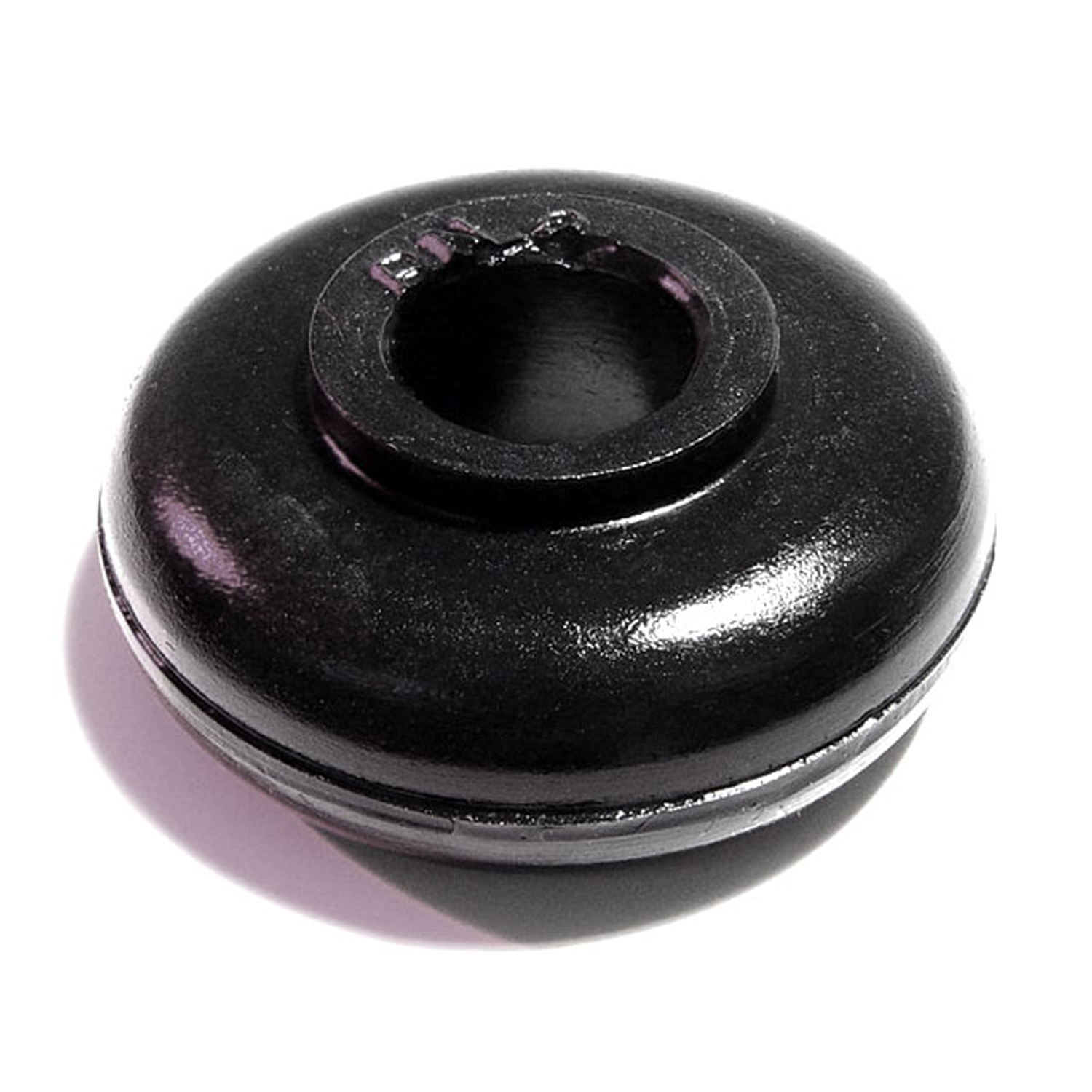 1974 Aston Martin Vantage Roll Bar Bushing. 1/2" high, with 1/2" hole. Each-BN 2Roll Bar Bushing. 1/2" high, with 1/2" hole. Each
 1974 Aston Martin Vantage Shock Grommet. 9/16" high, 3/8" hole. Each-BN 2-AShock Grommet. 9/16" high, 3/8" hole. Each
 1974 Aston Martin Vantage Clutch and Brake Pedal Pads. Perfect reproduction-CB 175Clutch and Brake Pedal Pads. Perfect reproduction. 1-3/4" wide X 3-1/4" long. Pair
 1974 Aston Martin Vantage Upper Door Waist Seal for 2-Door Coupes w/V-8-LP 104-MUpper Door Waist Seal for 2-Door Coupes w/V-8. Fits between chrome and body. When window down arm rests on it. Sold by the foot
Why Choose Metro?
For over 100 years, Metro Moulded Parts has been the pinnacle of quality in classic car restoration parts. Our commitment to precision and authenticity in every component ensures a perfect fit and an OEM-level appearance.
- Expert Craftsmanship & Quality: Each part is a testament to our dedication to reliability and perfection, crafted from original designs and thoroughly tested.
- Advanced Technology: We use cutting-edge techniques to create flawless, long-lasting parts that surpass others in performance.
- SuperSoft Sponge – The Ultimate Door Seal: Not only are our door seals 30% softer than competitors', but they're also guaranteed to never leak. They effectively reduce wind and road noise, enhancing your classic car's comfort and driving experience.
- Proudly American: Our parts are a product of American craftsmanship, made in the USA with a spirit of excellence and heritage.
- Unrivaled Warranty: We back our products with a 30-year industry-leading warranty, a testament to our confidence in their quality.
Join us in preserving the legacy of classic cars with parts that are crafted for perfection, not just made.