

Image of 1980 Aston Martin V-8, Note: These illustrations use artistic license and may differ from actual historical models.
Performance Metrics
Fundamental Metrics
Emotional Appeal
MMP Rating
| Engine Specifications | |
|---|---|
| Engine: | V8 |
| Displacement: | 5340 cc |
| Horsepower: | 305-390 hp |
| Torque: | 320-400 lb-ft |
| Compression Ratio: | 9.3:1 |
| Ignition System: | Electronic |
| Cooling System: | Water-cooled |
| Performance Specifications | |
| 0-60 Time: | 5.3 seconds |
| 1/4 Mile Time: | 13.5 seconds |
| Top Speed: | 160 mph |
| Transmission and Drive | |
| Drive Type: | Rear-wheel drive |
| Transmission Type: | 5-speed manual or 3-speed automatic |
| Fuel and Efficiency | |
| Fuel System Type: | Fuel Injection |
| MPG: | 10-15 mpg |
| Dimensions and Brakes | |
| Brakes: | Disc brakes |
| Wheelbase: | 102.8 inches |
| Weight: | 3990 lbs |
Note: Specifications for classic cars are given to the best of our ability, considering the limited and variant data available.
1980 Aston Martin V8: A British Grand Tourer with Muscle
The 1980 Aston Martin V8 paired the manners of a hand-finished British grand tourer with the punch of a large-capacity V8. Built at Aston Martin’s Newport Pagnell works in Buckinghamshire, it belonged to a line that had replaced the DBS V8 name in 1972. By 1980, the model had matured into a formidable, distinctly British alternative to the fastest luxury coupes from Italy, Germany, and the United States.
This was also an important period for Aston Martin. The company was making beautiful, costly cars in small numbers while navigating serious financial pressures. Its V8 became a symbol of the firm’s determination to keep building exclusive performance cars. One detail that helps identify the version introduced in 1978 is its nickname: “Oscar India,” a reference to the phonetic-alphabet letters O and I, for October Introduction, when the updated model was unveiled.
Oscar India Styling and Handcrafted Cabin
The V8 has the proportions of a classic front-engined grand tourer: a long, sculpted bonnet, a set-back cabin, and a short, purposeful rear. At the front, four round headlamps flank a broad grille, giving the car a confident expression without excessive ornament. The low nose and flowing wings lead into a gently tapered rear, while the Oscar India’s raised bonnet profile and integrated rear spoiler lend the shape a more purposeful finish than earlier V8s.
Inside, the atmosphere is more country-house lounge than stripped-out sports car. Supple leather covers the seats and much of the cabin, with thick carpeting underfoot and polished wood veneer across the dashboard. The instruments are clearly laid out, but the experience is tactile and traditional: substantial switches, deep seats, and materials chosen for richness rather than minimal weight. As a hand-built Aston, finish and trim could vary with the original buyer’s specification.
Buyers could choose from a range of bespoke paint and trim combinations rather than a single fixed palette. Deep greens, metallic greys, silver, and rich reds suit the car especially well, but individual examples may wear less familiar factory colors. The main body styles were the fixed-roof V8 Saloon and the open-top V8 Volante. The Saloon is the most recognizable shape in the range; the Volante adds a folding soft top and a more relaxed touring character. A V8 Vantage version was also available, bringing substantially more performance to the coupe formula.
Under the skin, the V8 used an all-alloy, 5.3-liter, double-overhead-camshaft engine. Specification varied by market and individual build, but the model combined a sophisticated multi-valve V8 with power steering, four-wheel disc brakes, and independent front suspension. A De Dion rear axle helped keep the rear wheels controlled over uneven roads. Buyers could find manual and automatic transmissions, with the exact pairing depending on model and market.
Why the Aston Martin V8 Mattered
The V8 set itself apart by combining immense engine capacity with traditional coachbuilt luxury. It was not a lightweight, bare-bones sports car. Instead, it offered high-speed performance in a quiet, leather-lined cabin, with a chassis intended to make long-distance travel feel composed. That blend helped define the modern high-performance grand tourer: a car capable of crossing countries quickly without asking its occupants to endure a race-car ride.
Its character also reflected Aston Martin’s small-scale approach. The company built these cars in limited numbers, with significant hand-finishing and a high degree of personalization. The result was not the uniform precision of a mass-produced luxury coupe, but a distinctive machine with a strong sense of place and craftsmanship. The V8 remains an important link between Aston Martin’s earlier postwar sports cars and the later, more technology-focused performance models.
V8 Performance and Road Manners
Performance depends on the precise version, transmission, and market specification. A standard 1980 V8 Saloon could reach roughly 145 to 150 mph, with a 0-to-60-mph time in the region of six to seven seconds. The V8 Vantage was the sharper proposition: contemporary claims put its top speed around 170 mph, with acceleration to 60 mph in roughly five to six seconds. Test conditions and published figures vary, so these numbers are best treated as representative rather than universal.
The engine’s appeal is not just its output. Press the throttle and the V8 answers with a deep, muscular growl that becomes a hard-edged roar as the revs rise. The car’s long gearing encourages smooth, effortless progress, while the engine’s torque makes overtaking feel less like a calculated maneuver and more like a confident surge.
On a motorway, the V8 feels planted and relaxed, with enough weight and wheelbase to settle into a steady cruise. On rougher roads, its suspension filters many bumps, though the car is heavy and does not float over every broken surface. A winding road reveals a different side: the steering is assisted and relatively deliberate, and the car rewards a smooth driving style rather than abrupt inputs. It can be quick and capable, but its size and mass are always part of the conversation. The Vantage feels more urgent, while the standard Saloon is usually the more relaxed long-distance companion.
Living with a 1980 V8
Today, most owners use an Aston Martin V8 for weekend drives, touring, club events, and concours displays rather than everyday commuting. It can handle regular road use, but fuel consumption is substantial and the car’s age makes condition more important than the odometer reading. A well-maintained example can be rewarding; a neglected one can quickly become an expensive restoration project.
Routine maintenance is within reach of a capable classic-car specialist, but this is not an inexpensive car for the average home mechanic to keep in top condition. Parts availability is generally supported by the Aston Martin specialist network, yet labor-intensive repairs, careful engine work, and restoration of body or trim can cost significantly more than on a common classic. Buyers should commission a thorough inspection, paying close attention to the engine, cooling system, transmission, suspension, corrosion, and evidence of previous repair. Service records and specialist invoices are especially valuable.
V8 Facts, Variants, and Criticisms
The Oscar India update is a small but memorable piece of Aston Martin lore: its nickname came from the month it was introduced, not from a special engine or racing victory. The model also came in more than one personality. The standard V8 prioritized fast, comfortable touring, while the V8 Vantage used performance upgrades to become one of Britain’s most formidable road cars of its era. Later V8s and Vantages appeared in popular culture, including Aston Martin V8s featured in the James Bond film The Living Daylights, released in 1987.
Common criticisms are familiar to owners of powerful, hand-built classics: high fuel use, costly upkeep, limited parts interchange, and a cabin that can feel less modern than its performance suggests. The car is also heavy, so it will not feel as nimble as a lighter sports car on tight roads. Those trade-offs are part of the V8’s identity. It is a fast, substantial grand tourer, not a delicate track machine.
Collector Values and Availability
Exact production totals depend on how variants and market specifications are counted. As a useful estimate, roughly 300 Oscar India V8 Saloons were built, while production of the wider V8 Saloon family across its full run reached around two thousand cars. The V8 Volante added another limited-production branch, and Vantage versions are scarcer still. These figures are approximate, so buyers researching a particular car should verify its identity and history through marque records.
As a broad 2026 guide, a sound, standard 1980 V8 Saloon might fall around US$70,000 to US$140,000, depending heavily on condition, originality, history, and location. A well-presented V8 Volante may bring roughly US$100,000 to US$200,000. A genuine V8 Vantage is in a different bracket, often around US$250,000 to US$450,000 or more for exceptional examples. These are estimates, not appraisals: restoration needs can reduce a car’s value sharply, while exceptional provenance or rare specification can push it above the usual range.
Values have generally been supported by the V8’s rarity, hand-built character, and growing appreciation for classic British performance cars. The strongest demand tends to be for original, well-documented Vantages and Volantes. Standard Saloons can offer a more accessible way into the model, though market movement is not uniform and ongoing ownership costs remain a major factor in total value.
A Lasting British V8
The 1980 Aston Martin V8 is a compelling mix of craftsmanship, comfort, and serious performance. Its long bonnet and rich cabin announce its grand-touring purpose, while its 5.3-liter engine gives it the force to keep pace with far newer machinery. Whether in Saloon, Volante, or Vantage form, it captures a distinctive era when Aston Martin built powerful, personalized cars by hand. More than four decades later, the V8 still makes a memorable promise: arrive in comfort, and arrive very quickly.
1980 Aston Martin V-8 Catalog of Parts
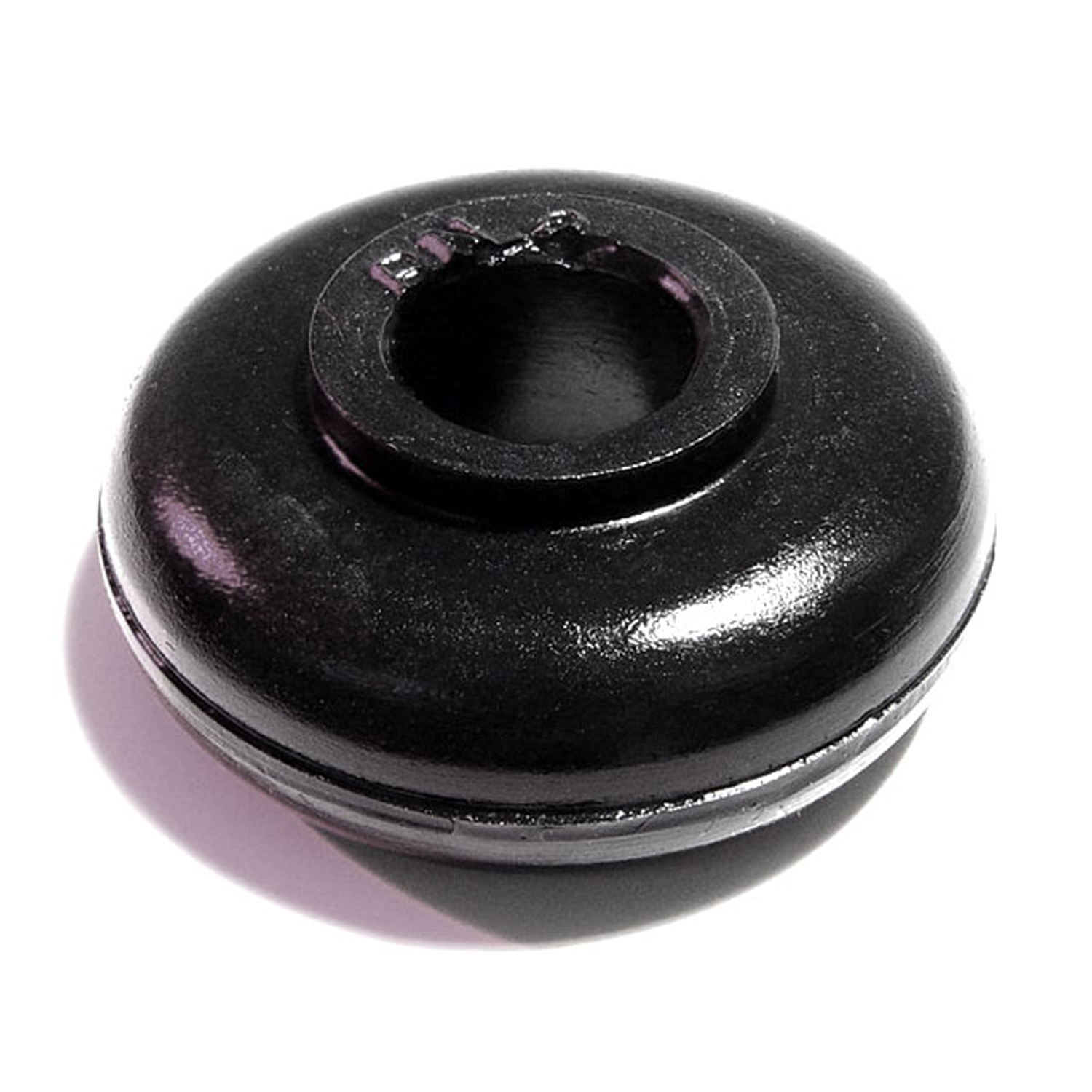 1980 Aston Martin V-8 Roll Bar Bushing. 1/2" high, with 1/2" hole. Each-BN 2Roll Bar Bushing. 1/2" high, with 1/2" hole. Each
 1980 Aston Martin V-8 Lower 'A' Arm Bushing. Fits on rear part of 'A' arm-BN 23-BLower 'A' Arm Bushing. Fits on rear part of 'A' arm. Four used per car. 3-1/8" O.D., 7/8" I.D., 3/4" thick. Each
 1980 Aston Martin V-8 Shock Grommet. 9/16" high, 3/8" hole. Each-BN 2-AShock Grommet. 9/16" high, 3/8" hole. Each
 1980 Aston Martin V-8 Clutch and Brake Pedal Pads. Perfect reproduction-CB 175Clutch and Brake Pedal Pads. Perfect reproduction. 1-3/4" wide X 3-1/4" long. Pair
 1980 Aston Martin V-8 Upper Door Waist Seal for 2-Door Coupes w/V-8-LP 104-MUpper Door Waist Seal for 2-Door Coupes w/V-8. Fits between chrome and body. When window down arm rests on it. Sold by the foot
 1980 Aston Martin V-8 Cam Cover Plug. For models with 8-cylinder engines-RP 8-DCam Cover Plug. For models with 8-cylinder engines. 1-1/4" long X 3/8" thick. Each
 1980 Aston Martin V-8 Outside Door Window Sweeper. All rubber. Sold by the foot-WC 27-/FTOutside Door Window Sweeper. All rubber. Sold by the foot.
 1980 Aston Martin V-8 Outside Door Window Sweeper. All rubber. 48" Piece. Each-WC 27-48Outside Door Window Sweeper. All rubber. 48" Piece. Each
 1980 Aston Martin V-8 Outside Door Window Sweeper. All rubber. 96" Piece. Each-WC 27-96Outside Door Window Sweeper. All rubber. 96" Piece. Each
 1980 Aston Martin V-8 Outside Window Sweeper. Sold by the foot-WC 27-A/FTOutside Window Sweeper. Sold by the foot
Why Choose Metro?
For over 100 years, Metro Moulded Parts has been the pinnacle of quality in classic car restoration parts. Our commitment to precision and authenticity in every component ensures a perfect fit and an OEM-level appearance.
- Expert Craftsmanship & Quality: Each part is a testament to our dedication to reliability and perfection, crafted from original designs and thoroughly tested.
- Advanced Technology: We use cutting-edge techniques to create flawless, long-lasting parts that surpass others in performance.
- SuperSoft Sponge – The Ultimate Door Seal: Not only are our door seals 30% softer than competitors', but they're also guaranteed to never leak. They effectively reduce wind and road noise, enhancing your classic car's comfort and driving experience.
- Proudly American: Our parts are a product of American craftsmanship, made in the USA with a spirit of excellence and heritage.
- Unrivaled Warranty: We back our products with a 30-year industry-leading warranty, a testament to our confidence in their quality.
Join us in preserving the legacy of classic cars with parts that are crafted for perfection, not just made.