
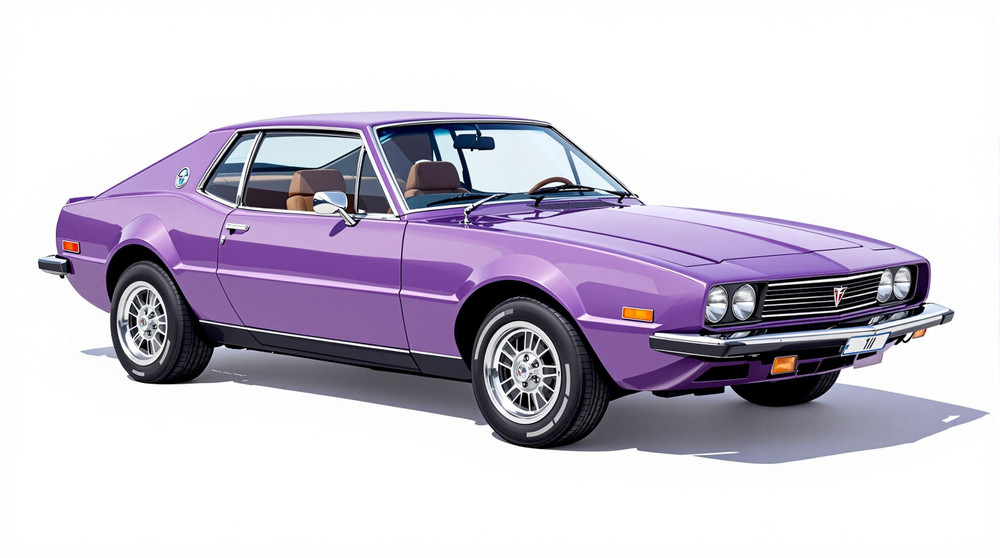
Image of 1980 Avanti Ii, Note: These illustrations use artistic license and may differ from actual historical models.
Performance Metrics
Fundamental Metrics
Emotional Appeal
MMP Rating
| Engine Specifications | |
|---|---|
| Engine: | GM 305 V8 |
| Displacement: | 5.0L (305 cu in) |
| Horsepower: | 155-160 hp |
| Torque: | 240 lb-ft |
| Compression Ratio: | 8.6:1 |
| Ignition System: | Electronic Ignition |
| Cooling System: | Liquid-cooled |
| Performance Specifications | |
| 0-60 Time: | 10 seconds |
| 1/4 Mile Time: | 17 seconds |
| Top Speed: | 120 mph |
| Transmission and Drive | |
| Drive Type: | RWD (Rear Wheel Drive) |
| Transmission Type: | 3-speed automatic |
| Fuel and Efficiency | |
| Fuel System Type: | Carburetor |
| MPG: | 15-20 mpg |
| Dimensions and Brakes | |
| Brakes: | Disc brakes |
| Wheelbase: | 109 inches |
| Weight: | 3,400 lbs |
Note: Specifications for classic cars are given to the best of our ability, considering the limited and variant data available.
The 1980 Avanti II was a hand-built American luxury coupe with a story that refused to end when its original manufacturer disappeared. It carried the dramatic shape of Studebaker’s Avanti into a new decade, pairing a fiberglass body and customized cabin with Chevrolet V8 power. The result was an unusual blend of independent-car-maker character and familiar GM mechanicals.
1980 Avanti II Origins and History
The Avanti story began with Studebaker’s original Avanti, introduced in 1962 and styled by a team led by Raymond Loewy. When Studebaker ended U.S. production in 1963, South Bend Studebaker dealers Nate Altman and Leo Newman acquired the Avanti name, tooling, and remaining parts. They formed the Avanti Motor Corporation and began producing the Avanti II in 1965.
By 1980, the Avanti II was a low-volume specialist car, not a mass-market model. It was assembled in South Bend using a hand-finished fiberglass body, a modified Studebaker-based chassis, and Chevrolet V8 power. That combination gave it a distinctive identity: the design came from a landmark Studebaker, while its engine and many service parts came from a much larger parts network.
One remarkable part of its history is that the Avanti continued after Studebaker itself had vanished. The name survived through several ownership changes and production moves, making the 1980 model part of one of the longest-running efforts to keep a postwar American design alive.
Avanti II Design and Interior
The Avanti II’s profile is unmistakable. Its long hood, low nose, sweeping roofline, and tucked-in rear end create a sleek, almost futuristic silhouette. The front is especially distinctive: rather than a conventional broad grille, the car has a smooth, sculpted face with a narrow lower air opening. Pronounced wheel arches and a gently tapered rear give the coupe a purposeful stance without relying on oversized trim or flashy ornament.
Although the original design dated from the early 1960s, it still looked individual in 1980. The fiberglass body allowed the company to preserve the Avanti’s complex curves and avoid the expense of large-scale steel stamping. Fiberglass also resisted conventional rust, though age can bring its own challenges, including stress cracks, repairs, and deterioration around mounting points.
Inside, the Avanti II was positioned as a personalized luxury car. Leather upholstery, carpeting, padded trim, and wood accents were common, with more room for customization than buyers would find in a standard production coupe. Materials and fit could vary from car to car because the Avanti was assembled in small numbers, so condition and originality matter when inspecting one today.
The usual body style was a two-door coupe. The cabin was designed for four, though the rear seat is best suited to shorter trips or smaller passengers. Buyers could choose from a range of exterior and interior colors, and many cars were ordered in conservative shades such as silver, cream, dark blue, or burgundy. Since production was personalized, there was no single color combination that defined the model.
Features and Engineering
The 1980 Avanti II was not a technology showcase in the modern sense. Its appeal lay in combining a distinctive body and tailored interior with relatively familiar mechanical components. A Chevrolet small-block V8, commonly listed as a 350-cubic-inch engine, provided the power. Output depended on emissions calibration and individual specification, but period versions were generally in the neighborhood of 155 to 170 horsepower.
Most examples were paired with a three-speed automatic transmission. The front suspension and chassis retained the basic Studebaker-based architecture, modified over the years for the Avanti II. Power steering and power-assisted braking helped make the large coupe easier to use, while the original Avanti’s emphasis on strong braking and a planted road feel remained part of the car’s character.
Equipment could differ between cars, so buyers should verify the engine, transmission, brake setup, and other options against the vehicle’s records and components. That is especially important for a hand-built model whose production details were not as uniform as those of a high-volume sedan.
Why the Avanti II Matters
The Avanti II stands out because it kept a landmark American design in production after the company that created it had closed. It was neither a straightforward factory continuation nor a modern redesign. Instead, it was a small manufacturer’s attempt to preserve the Avanti’s distinctive styling while updating its powertrain and finishing it as a more luxurious personal coupe.
The original Avanti had already made a significant impression on American automotive design. Its clean, grille-less front, sculpted body, and integrated roofline were unusually advanced for a domestic car of the early 1960s. The 1980 Avanti II was not responsible for the original design’s influence, but it extended that design’s life and gave buyers a rare alternative to the more familiar luxury coupes from Detroit.
Its compromises are part of its significance, too. The car had a vintage chassis foundation and a body whose styling was more modern than its underlying architecture. That contrast made it charming to some owners and dated to others. Either way, it was a genuine independent car in an era when most American coupes came from large manufacturers.
1980 Avanti II Performance and Road Feel
With its V8 and automatic transmission, the Avanti II delivered relaxed rather than sports-car performance. A reasonable period-style estimate for a typical 1980 example is roughly 10 to 12 seconds from 0 to 60 mph, with a top speed in the neighborhood of 105 to 115 mph. These are estimates, not guaranteed factory figures. Engine condition, axle ratio, emissions equipment, tires, and vehicle weight can all affect the results.
The small-block Chevrolet engine gives the car a familiar American V8 sound: a muted burble at idle and a deeper note under acceleration. It is best suited to smooth, unhurried cruising, where the automatic transmission and broad torque make highway travel easy. The Avanti II is not a lightweight sports coupe, and its performance should be judged in the context of a luxury grand touring car built in limited numbers.
On ordinary roads, the car’s long-wheelbase feel and power assistance make it comfortable and manageable. Its older chassis design is more noticeable on broken pavement and tight, winding roads than it would be in a newer coupe. Expect some body movement over bumps and a less precise response than a contemporary European sports car. On the highway, however, the Avanti’s low stance and substantial feel suit it well for steady cruising.
Living with an Avanti II
Today, most 1980 Avanti IIs are used as weekend drivers, touring cars, or show-field curiosities rather than everyday commuters. A well-maintained example can be enjoyable on regular drives, and Chevrolet mechanical components may be easier to source than parts for a rare, all-original powertrain. A mechanic familiar with older GM V8s can handle many engine and transmission jobs.
The specialist nature of the car still calls for patience. Fiberglass body repairs require appropriate materials and experience, while trim, glass, interior pieces, and model-specific components can take more effort to locate. The chassis and suspension also deserve careful inspection. Look for corrosion in steel components, worn bushings, leaking steering or brake parts, and evidence of poorly executed previous repairs.
For an owner who wants an easy, inexpensive daily driver, a more common Chevrolet or Ford coupe is the practical choice. For someone who values distinctive styling and enjoys maintaining an unusual car, the Avanti II offers a memorable driving experience and a strong conversation starter.
Avanti II Trivia and Common Criticisms
The Avanti II’s most unusual claim to fame is its survival. It was produced by an independent company after Studebaker ended car manufacturing, and it carried a design associated with one of the most dramatic American production cars of the 1960s into the 1980s. The original Studebaker Avanti also became famous for speed-record runs at Bonneville, but those records belong to specially prepared early Avantis, not the 1980 Avanti II.
Celebrity interest is often associated with the broader Avanti story, including the original car’s high-profile launch and famous early owners. That should not be confused with proof of celebrity ownership for any particular 1980 example. For a specific car, documentation is essential.
Common criticisms include the dated chassis, modest performance by later standards, inconsistent hand-built fit and finish, and the challenge of finding certain body and interior parts. Some enthusiasts also feel that the Avanti’s original design looked increasingly out of step with the more angular cars of 1980. Its supporters see the same qualities differently: a timeless shape, rarity, and a personality no mass-produced coupe could quite match.
1980 Avanti II Values and Rarity
Exact production figures for individual Avanti II model years can be difficult to pin down, but the 1980 model was built in very small numbers. A reasonable estimate is roughly 100 to 150 cars for the year, with total Avanti II production across its original South Bend era often placed at around 3,000 cars. Treat year-by-year totals as estimates rather than definitive factory records.
As a current collector-market guide, a driver-quality 1980 Avanti II might sell for about $12,000 to $25,000. A particularly clean, well-documented, and correctly restored example could reach roughly $25,000 to $40,000, while a project car may be worth considerably less. These are broad estimates: regional demand, condition, originality, paperwork, and the quality of fiberglass repairs can move the price substantially.
Values tend to be steady rather than fast-rising. The Avanti II’s rarity and design appeal attract dedicated buyers, but its limited recognition and specialist maintenance needs constrain the market. A carefully preserved car with clear provenance is generally a safer bet than a heavily modified example, although the best purchase is ultimately the one with the strongest condition and service history.
The Lasting Appeal of the 1980 Avanti II
The 1980 Avanti II is a rare American luxury coupe that connects the independent-car era with the practical realities of the 1980s. It combined Raymond Loewy’s striking Avanti shape, hand-finished fiberglass construction, a modified Studebaker foundation, and familiar Chevrolet V8 power. Its performance was modest, and its upkeep takes a little more commitment than that of an ordinary classic, but its personality is anything but ordinary.
More than a surviving old design, the Avanti II is evidence that a distinctive car can outlive the company that created it. That persistence is what makes this unusual coupe worth remembering, and worth saving.
1980 Avanti Ii Catalog of Parts
 1980 Avanti II Front and Rear Bumper Arm Grommets-BG 67Front and Rear Bumper Arm Grommets. 2-3/4" wide X 5-3/8" long, with 1-3/4" long inner slot. Pair
Why Choose Metro?
For over 100 years, Metro Moulded Parts has been the pinnacle of quality in classic car restoration parts. Our commitment to precision and authenticity in every component ensures a perfect fit and an OEM-level appearance.
- Expert Craftsmanship & Quality: Each part is a testament to our dedication to reliability and perfection, crafted from original designs and thoroughly tested.
- Advanced Technology: We use cutting-edge techniques to create flawless, long-lasting parts that surpass others in performance.
- SuperSoft Sponge – The Ultimate Door Seal: Not only are our door seals 30% softer than competitors', but they're also guaranteed to never leak. They effectively reduce wind and road noise, enhancing your classic car's comfort and driving experience.
- Proudly American: Our parts are a product of American craftsmanship, made in the USA with a spirit of excellence and heritage.
- Unrivaled Warranty: We back our products with a 30-year industry-leading warranty, a testament to our confidence in their quality.
Join us in preserving the legacy of classic cars with parts that are crafted for perfection, not just made.