
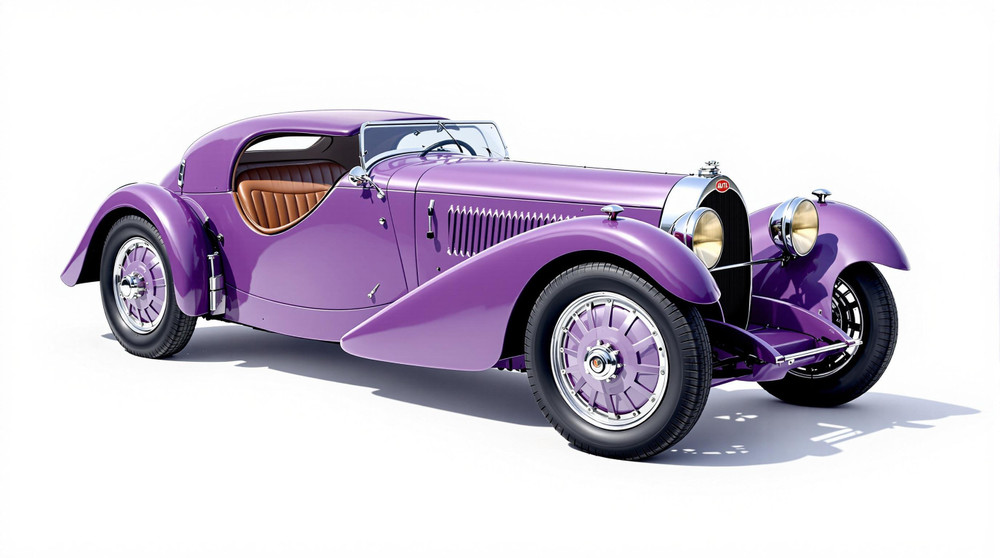
Image of 1927 Bugatti Type 41 Royale, Note: These illustrations use artistic license and may differ from actual historical models.
Performance Metrics
Fundamental Metrics
Emotional Appeal
MMP Rating
| Engine Specifications | |
|---|---|
| Engine: | Straight 8 |
| Displacement: | 12.7 L (12763 cc/778 in³) |
| Horsepower: | 300 HP |
| Torque: | Not available |
| Compression Ratio: | Not available |
| Ignition System: | Battery and coil |
| Cooling System: | Water-cooled |
| Performance Specifications | |
| 0-60 Time: | Not available |
| 1/4 Mile Time: | Not available |
| Top Speed: | 100 mph (160 km/h) |
| Transmission and Drive | |
| Drive Type: | Rear-wheel drive |
| Transmission Type: | 3-speed manual |
| Fuel and Efficiency | |
| Fuel System Type: | Carburetor |
| MPG: | Not available |
| Dimensions and Brakes | |
| Brakes: | Mechanical drum brakes |
| Wheelbase: | 169.3 in (4,300 mm) |
| Weight: | 7,000 lb (3,175 kg) |
Note: Specifications for classic cars are given to the best of our ability, considering the limited and variant data available.
1927 Bugatti Type 41 Royale: A Car Built for Kings
The 1927 Bugatti Type 41 Royale did not simply aim to be the finest car on the road. It aimed to make every other luxury car look modest. Conceived by Ettore Bugatti and built by the French marque that bore his name, the Royale combined monumental proportions, meticulous coachwork and a 12.7-liter engine in a machine so exclusive that even the world’s wealthiest buyers found it difficult to justify.
Bugatti planned the Royale for royalty and heads of state, at a time when the best-known luxury marques were competing for the attention of industrialists, aristocrats and celebrities. But the project collided with the Great Depression and a market that could not absorb its staggering price. The result was a remarkable mismatch between ambition and sales: just six customer cars were completed, and all six are believed to survive.
One of the most famous examples, the Coupé Napoléon, was Ettore Bugatti’s personal car. After it was badly damaged in a 1931 crash, his son Jean redesigned and rebuilt it. Today it is a centerpiece of the Schlumpf collection in France, a fitting home for a car that became a legend despite never finding the royal clientele its creator had in mind.
Design: Monumental Bugatti Proportions
The Royale’s scale is its first design statement. Depending on its coachwork, it stretches to roughly six meters in length, with a long wheelbase of about 4.3 meters. The upright radiator, tall bonnet and sweeping fenders give it a commanding profile. Its hood ornament, a sculpted elephant based on a work by Ettore’s late brother, the sculptor Rembrandt Bugatti, adds a distinctive flourish to the otherwise imposing front end.
Each Royale chassis received custom coachwork, so there was no single standard body or factory color palette. Buyers could commission a formal limousine, a town car or an open touring body in finishes selected to suit their taste. Dark blue, black, cream and two-tone combinations are often associated with surviving examples, but these were individual commissions rather than a fixed list of production colors.
The cabin was equally dependent on the body style and coachbuilder. Fine leather, polished wood, quality upholstery and carefully finished metal fittings were appropriate to the car’s price and purpose. Formal versions could include spacious rear seating and the kind of appointments expected in a private drawing room on wheels. The driving position, by contrast, had to accommodate a huge steering wheel, large instruments and the physical controls needed to manage a very large car.
Several body styles became especially well known, including the imposing Coupé Napoléon, the formal Park Ward limousine, the Kellner coupé and the Weinberger cabriolet. Their different silhouettes show how the Royale’s chassis served as a platform for bespoke design. The Coupé Napoléon is perhaps the best-known example, but no single body style was produced in enough numbers to be called a common or standard choice.
Engineering: A 12.7-Liter Statement
At the heart of the Type 41 was an enormous straight-eight engine displacing approximately 12,763 cc. It used a single overhead camshaft and three valves per cylinder, an advanced arrangement for a road car of the late 1920s. Output is commonly given at around 300 horsepower, delivered at relatively low engine speed. The engine was designed to move a heavy luxury car with strong, unhurried force rather than to chase racing-car revs.
The Royale also had a three-speed manual gearbox and mechanically operated four-wheel brakes. Those brakes were substantial for their time, but they required more driver effort and anticipation than modern systems. Its huge wheels, long chassis and large mechanical components were part of a design philosophy that favored durability, presence and smooth progress over light weight.
The car’s famous elephant mascot was more than decoration. It connected the Royale to the Bugatti family’s artistic side, while the chassis and engine expressed Ettore’s engineering ambition. This blend of sculpture and machinery is one reason the Type 41 feels unlike a merely enlarged touring car.
Historical Significance: Luxury Without Compromise
The Type 41 stands apart from contemporaries because Bugatti treated scale itself as a form of engineering theater. Its engine was far larger than those of ordinary passenger cars, and its chassis was designed to carry elaborate bodies that could rival the most prestigious bespoke carriages. The Royale was not intended to win races or serve as a practical daily automobile. It was a rolling demonstration of what Bugatti believed the ultimate car could be.
Its influence is less about a specific feature copied by mass-market manufacturers and more about the lasting idea of the coachbuilt flagship: a powerful chassis, exceptional materials and bodywork tailored to an individual owner. Later luxury cars continued to use this formula, though none needed a 12.7-liter engine to make the same point. The Royale remains a benchmark for automotive excess and a reminder that engineering can be a statement of identity as much as a response to practical needs.
The timing was unforgiving. The late 1920s brought economic instability, and the Depression made a car of such extravagance harder to sell. Bugatti’s intended royal customers largely failed to materialize. The Royale’s limited production was not evidence of weak engineering so much as a sign that its market was exceptionally small, even among the wealthy.
Performance and Driving Experience
Published accounts commonly put the Type 41’s top speed at around 100 mph, or roughly 160 km/h, though exact performance varied with the body fitted and the condition of the car. There is no reliable, standardized factory 0-to-60 mph figure. Given the car’s considerable weight and period gearing, a rough modern estimate might be in the 12-to-15-second range, but that should be treated as an estimate rather than a verified test result.
On a smooth, open road, the Royale’s long wheelbase and abundant low-speed power would have made it feel composed and effortless. The engine’s sound is more likely a deep, measured mechanical rumble than a high-revving sports-car howl. Its mass and size would become more apparent on uneven roads, tight corners and narrow lanes. The ride could smooth out long undulations, but sharp bumps would still be transmitted through the heavy chassis and large wheels.
Winding roads would demand planning. The Royale was not nimble, and its long body, wide turning circle and substantial weight made quick direction changes a poor match for its character. The driver had to work the manual gearbox, steer a large wheel and plan braking well ahead. It was built to make distance feel grand, not to make a mountain pass feel like a racetrack.
Ownership: A Museum-Grade Responsibility
Today, a Royale is a collector’s showpiece, museum centerpiece and occasional participant in prestigious historic motoring events. It is not a plausible daily driver, and it was never designed as a racing car. Even in its own era, ownership meant commissioning a personal luxury object rather than buying a standard model from a dealer forecourt.
Maintenance requires specialist knowledge, custom-made components and access to people familiar with prewar Bugatti engineering. The engine, transmission and mechanical brakes are understandable in principle to a skilled vintage-car mechanic, but their scale and rarity make routine work anything but routine. For an average owner or general repair shop, sourcing parts and maintaining the car correctly would be extremely difficult. Reliability depends heavily on careful preservation, expert servicing and limited, considered use.
That specialist care is also part of the ownership appeal. A Royale is not simply transport; it is a historically important machine whose condition, coachwork and mechanical details need to be protected. Most examples are better suited to curated events and controlled touring than regular road use.
Royale Facts, Records and Criticisms
Bugatti completed six customer Royales, and all six are believed to have survived. Some accounts also mention an experimental or prototype chassis, which helps explain why production totals can vary depending on what is counted. The six completed cars each have individual histories and coachwork, making the model’s small production run unusually well documented and closely followed by collectors.
The Coupé Napoléon’s story is particularly memorable. Ettore Bugatti used it as his personal car, and after its 1931 crash, Jean Bugatti rebuilt it with new coachwork. Another Royale, the Weinberger cabriolet, was sold to German physician Dr. Joseph Fuchs and eventually made its way to the United States. Its later preservation helped introduce the car to generations of American visitors.
The Royale is sometimes criticized as excessive, impractical and out of step with its time. Those criticisms are fair if it is judged as everyday transport. Its size makes it awkward in modern traffic, its fuel use is inevitably high, and its brakes and controls reflect a very different era. Yet those same qualities are central to its historical identity: the Royale was meant to be extraordinary, not convenient.
Collector Value and Rarity
With only six completed cars and no regular public market, valuing a Type 41 Royale is necessarily an exercise in informed estimation. A reasonable broad modern estimate might place an example in the range of roughly $20 million to $40 million or more, depending on its condition, provenance, body style and sale circumstances. An exceptional car could exceed that range, but there are too few transactions to treat any figure as a dependable market quote.
The market has seen striking historical prices. In 1987, a Royale Kellner coupé reportedly sold for about $9.8 million, setting a major auction record at the time. That figure is not a direct guide to today’s value, and the lack of frequent sales makes price comparisons difficult. In broad terms, the Royale has appreciated over the long run as its rarity and cultural importance have grown, though its thin market means values can be shaped by a single private transaction.
Availability is effectively near zero for most collectors. The six cars are held in major collections or museums, and a public sale would be a landmark event. For the Type 41, rarity is not a marketing claim. It is a basic fact of production.
Why the Bugatti Type 41 Royale Still Matters
The 1927 Bugatti Type 41 Royale brought together a giant straight-eight engine, bespoke coachwork, fine materials and a level of ambition few manufacturers have attempted. It was too extravagant for most buyers, too large for ordinary use and built at the wrong moment to achieve its intended commercial success. Yet its tiny production run and extraordinary design made it one of the defining luxury cars of the prewar era.
The Royale did not need a royal owner to become automotive royalty. Nearly a century later, it remains a vivid reminder that the greatest cars are sometimes created not to meet the market, but to challenge its idea of what a car can be.
1927 Bugatti Type 41 Royale Catalog of Parts
 1927 Bugatti TYPE 41 ROYALE Headlight Pads. 3" wide X 8-1/8" long. Pair-MP 337-AHeadlight Pads. 3" wide X 8-1/8" long. Pair
 1927 Bugatti TYPE 41 ROYALE Door Handle Pads. 1-3/8" wide X 2-1/4" long. Pair-MP 337-BDoor Handle Pads. 1-3/8" wide X 2-1/4" long. Pair
Why Choose Metro?
For over 100 years, Metro Moulded Parts has been the pinnacle of quality in classic car restoration parts. Our commitment to precision and authenticity in every component ensures a perfect fit and an OEM-level appearance.
- Expert Craftsmanship & Quality: Each part is a testament to our dedication to reliability and perfection, crafted from original designs and thoroughly tested.
- Advanced Technology: We use cutting-edge techniques to create flawless, long-lasting parts that surpass others in performance.
- SuperSoft Sponge – The Ultimate Door Seal: Not only are our door seals 30% softer than competitors', but they're also guaranteed to never leak. They effectively reduce wind and road noise, enhancing your classic car's comfort and driving experience.
- Proudly American: Our parts are a product of American craftsmanship, made in the USA with a spirit of excellence and heritage.
- Unrivaled Warranty: We back our products with a 30-year industry-leading warranty, a testament to our confidence in their quality.
Join us in preserving the legacy of classic cars with parts that are crafted for perfection, not just made.