
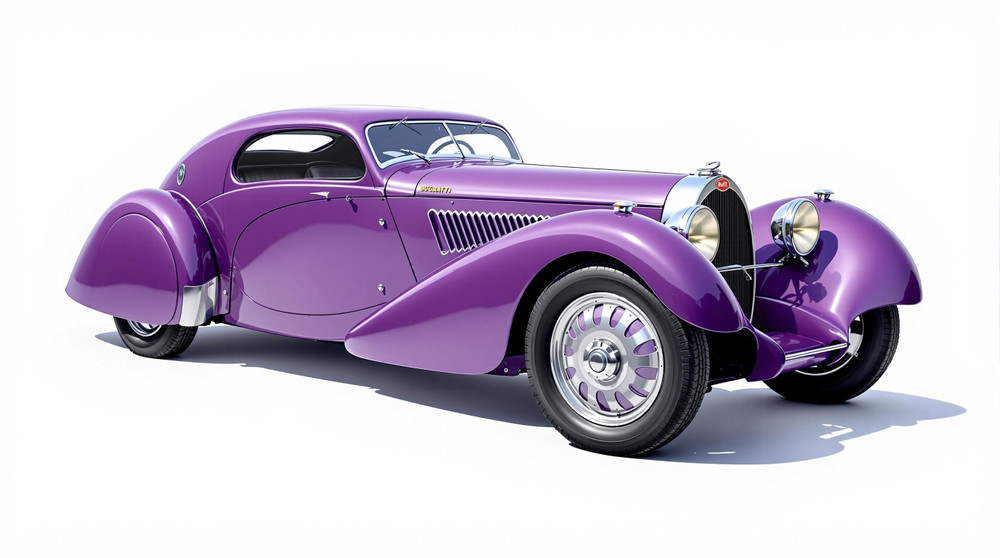
Image of 1933 Bugatti Type 41 Royale, Note: These illustrations use artistic license and may differ from actual historical models.
Performance Metrics
Fundamental Metrics
Emotional Appeal
MMP Rating
| Engine Specifications | |
|---|---|
| Engine: | Straight 8 |
| Displacement: | 12.7 L (12763 cc/778 in³) |
| Horsepower: | 300 HP |
| Torque: | Not available |
| Compression Ratio: | Not available |
| Ignition System: | Battery Ignition |
| Cooling System: | Water-cooled |
| Performance Specifications | |
| 0-60 Time: | Not available |
| 1/4 Mile Time: | Not available |
| Top Speed: | 100 mph (160 km/h) |
| Transmission and Drive | |
| Drive Type: | Rear-wheel drive |
| Transmission Type: | 3-speed manual |
| Fuel and Efficiency | |
| Fuel System Type: | Carburetor |
| MPG: | Not available |
| Dimensions and Brakes | |
| Brakes: | Mechanical drum brakes |
| Wheelbase: | 169.3 in (4,300 mm) |
| Weight: | 7,000 lb (3,175 kg) |
Note: Specifications for classic cars are given to the best of our ability, considering the limited and variant data available.
1933 Bugatti Type 41 Royale: The Ultimate Prewar Luxury Car
The Bugatti Type 41 Royale was so grand that its engine could almost pass for a small building’s power plant. Conceived by Ettore Bugatti as the ultimate automobile for kings, industrialists, and heads of state, the Royale combined immense scale with the meticulous craftsmanship of the Molsheim marque. A 1933 example belongs to the final chapter of the Royale story, but it is important to note that there was no single standardized 1933 body or trim package: each of the six cars built received its own coachwork.
The Royale arrived during the late 1920s, when Europe’s most prestigious manufacturers competed to build cars that signaled wealth, status, and engineering prowess. Bugatti’s ambition was extraordinary. He reportedly envisioned producing 25 cars, but the Great Depression made the market for such extravagance vanishingly small. Just six Type 41 chassis were completed. One captivating detail: despite being designed for royalty, the Royale was never bought by a reigning king.
Royale Design: A Monument on Wheels
Every Royale makes an impression through sheer presence. Its very long hood stretches over a massive straight-eight engine, while a tall, horseshoe-shaped radiator gives the front end the unmistakable Bugatti profile. Huge wheels, sweeping fenders, running boards, and a dramatically long wheelbase complete the formal, almost ceremonial stance. Depending on the coachwork, the car could look like a stately limousine, a grand touring coupe, or an open-air parade car.
The famous elephant mascot became the Royale’s signature flourish. Sculpted by Ettore Bugatti’s brother, Rembrandt Bugatti, the ornament turns the radiator cap into a piece of sculpture. It was more than decoration: the elephant expressed the same combination of scale, elegance, and theatricality that defined the entire car.
Inside, the Royale was built for comfort and display rather than minimalism. Coachbuilders tailored each cabin to its owner and body style, using fine leather, polished wood, plush upholstery, and carefully finished metal fittings. The result was closer to bespoke furniture than a mass-produced automobile interior. There was no universal factory color chart, either. Paint and cabin finishes varied from car to car, with rich dark tones, creams, and two-tone schemes among the kinds of finishes associated with formal prewar luxury. The iconic Coupé Napoléon, for example, is often seen in a dark-and-light treatment.
Bugatti offered no ordinary menu of body options. Instead, the company supplied the chassis and customers commissioned specialist coachbuilders to create a complete body. The six Royales wore bodies by firms including Binder, Kellner, Park Ward, and Weymann. Their forms included limousines, coupes, a cabriolet, and other formal touring styles. The Coupé Napoléon is perhaps the best-known, while the monumental Kellner Coupe is another celebrated expression of the Royale’s scale.
Engineering and Historical Significance
At the heart of the Type 41 is a 12.7-liter inline-eight, among the largest passenger-car engines ever built. The engine used a single overhead camshaft and three valves per cylinder, an advanced and technically ambitious arrangement for its era. Output is commonly quoted at roughly 275 to 300 horsepower, depending on the source and specification. Power went to the rear wheels through a three-speed gearbox.
The Royale did not introduce one single technology that transformed the whole industry. Its significance lies in how it pushed existing ideas to an extraordinary scale. Bugatti combined advanced engine design, bespoke coachbuilding, high-speed capability, and exceptional finish in a car that few manufacturers could have attempted, let alone produced. It helped establish the idea of the automobile as a fully integrated luxury commission, where chassis engineering and body design were both part of the owner’s personal statement.
The Type 41 also reflects the limits of the prewar luxury-car market. Its conception belonged to a world of immense fortunes and formal prestige, but it reached customers just as the Depression undermined demand for extravagant machines. The Royale’s failure to sell in large numbers was not a failure of engineering. It was a reminder that even the most impressive car must find a market.
Performance and Driving Experience
Despite its imposing dimensions, the Royale was built to travel quickly. Period and later accounts commonly place top speed around 100 mph, though the exact figure depends on body style, gearing, condition, and the reliability of the source. A precise factory 0-to-60 mph figure is not well established. Given the car’s mass and gearing, modern estimates generally put acceleration in the region of 10 to 15 seconds, but that should be treated as an estimate rather than a verified test result.
Behind the wheel, the Royale would feel very different from a modern luxury car. Its huge engine delivers torque in a deep, steady swell, accompanied by the layered mechanical sounds of a large prewar straight-eight. The driver works with a substantial steering wheel, a long gearshift, and controls that demand more deliberate input than today’s power-assisted systems. The ride is intended to be composed and stately, but the car’s great length and weight mean that rough roads and tight bends require patience. On a winding route, it is less a nimble sports car than a powerful grand tourer that rewards smooth, measured driving.
There are no dependable, standardized handling test figures for all six cars. Each Royale’s bodywork and restoration history affect its weight and behavior. A well-maintained example can cover ground impressively, but its size calls for room, careful planning, and an experienced driver.
Owning and Maintaining a Type 41
A Royale is not a daily driver in the modern sense. Its natural roles are concours events, museum displays, carefully planned touring, and private collections. Even a short outing is likely to attract attention, and the car’s rarity makes routine use a matter of preservation as much as enjoyment.
Maintenance is specialist work. The engine’s enormous displacement and unusual construction demand technicians familiar with Bugatti’s prewar engineering, while bespoke coachwork and unique components can make repairs complex and time-consuming. Parts are not something an average owner can simply pick up at a local supplier. Reliability depends heavily on condition, restoration quality, and regular expert care. A Royale can be made roadworthy and driven, but it is not an easy or inexpensive car to repair without marque specialists and substantial resources.
Royale Facts, Records, and Criticisms
Only six Type 41 Royales were completed, each with individual coachwork. That tiny production run is one reason the model occupies such a prominent place in collector-car history. The elephant radiator mascot is another enduring link to the Bugatti family’s artistic side, connecting the car to Rembrandt Bugatti’s sculpture as well as Ettore’s engineering.
The Royale’s enormous engine also had a life beyond the luxury car. Bugatti used related engine technology in railcars, including the company’s distinctive autorails. Those rail vehicles are associated with high-speed records, but their achievements should not be confused with a speed record set by a Type 41 automobile.
One of the model’s most famous criticisms is that it was simply too grand for its moment. It was expensive to build, costly to own, physically imposing, and aimed at an extremely small clientele. Its scale can also make it cumbersome in confined spaces. Yet those same qualities are central to its appeal: the Royale was never intended to be practical in the ordinary sense. It was designed to be the most imposing car in the room, or on the road.
Collector Value and Rarity
The Type 41 is among the rarest and most valuable prewar automobiles. Only six chassis were built, and all are accounted for in major collections or institutions. They do not appear on the open market regularly, so any estimate must be treated as a broad guide rather than a dependable asking price.
Depending on the individual car, provenance, condition, and coachwork, a Royale could plausibly be valued in the tens of millions of U.S. dollars. A rough modern estimate might place examples around $20 million to $30 million or higher, though a major sale could fall outside that range. Public auction results from decades ago, including headline-making sales, are not direct comparisons for today’s market. Because most transactions are rare or private, it is difficult to chart a clean year-by-year price trend. The broader direction is strongly supported by the Royale’s scarcity and historical importance, but there is no dependable annual market index for six cars that seldom change hands.
For collectors, condition and identity matter enormously. Each Royale is a unique commission, so its coachbuilder, documented history, restoration, and originality can influence value as much as the Type 41 badge itself. Availability is effectively limited to exceptional private sales or institutional changes in ownership.
Why the Bugatti Royale Still Captivates
The 1933 Bugatti Type 41 Royale represents a remarkable collision of engineering ambition, bespoke design, and historical timing. Its vast straight-eight, sculptural elephant mascot, custom coachwork, and near-mythical rarity make it unlike almost any other automobile. It was too extravagant for the market that Bugatti hoped to serve, yet that very excess became its legacy. The Royale is not merely a classic car: it is Bugatti’s grandest statement, preserved in six extraordinary forms.
1933 Bugatti Type 41 Royale Catalog of Parts
 1933 Bugatti TYPE 41 ROYALE Headlight Pads. 3" wide X 8-1/8" long. Pair-MP 337-AHeadlight Pads. 3" wide X 8-1/8" long. Pair
 1933 Bugatti TYPE 41 ROYALE Door Handle Pads. 1-3/8" wide X 2-1/4" long. Pair-MP 337-BDoor Handle Pads. 1-3/8" wide X 2-1/4" long. Pair
Why Choose Metro?
For over 100 years, Metro Moulded Parts has been the pinnacle of quality in classic car restoration parts. Our commitment to precision and authenticity in every component ensures a perfect fit and an OEM-level appearance.
- Expert Craftsmanship & Quality: Each part is a testament to our dedication to reliability and perfection, crafted from original designs and thoroughly tested.
- Advanced Technology: We use cutting-edge techniques to create flawless, long-lasting parts that surpass others in performance.
- SuperSoft Sponge – The Ultimate Door Seal: Not only are our door seals 30% softer than competitors', but they're also guaranteed to never leak. They effectively reduce wind and road noise, enhancing your classic car's comfort and driving experience.
- Proudly American: Our parts are a product of American craftsmanship, made in the USA with a spirit of excellence and heritage.
- Unrivaled Warranty: We back our products with a 30-year industry-leading warranty, a testament to our confidence in their quality.
Join us in preserving the legacy of classic cars with parts that are crafted for perfection, not just made.