

Image of 1935 Bugatti Type 57, Note: These illustrations use artistic license and may differ from actual historical models.
Performance Metrics
Fundamental Metrics
Emotional Appeal
MMP Rating
| Engine Specifications | |
|---|---|
| Engine: | Straight 8 |
| Displacement: | 3.3 L (3257 cc/198 cu in) |
| Horsepower: | 135-140 hp |
| Torque: | Not available |
| Compression Ratio: | Not available |
| Ignition System: | Coil ignition |
| Cooling System: | Water-cooled |
| Performance Specifications | |
| 0-60 Time: | Not available |
| 1/4 Mile Time: | Not available |
| Top Speed: | 95 mph |
| Transmission and Drive | |
| Drive Type: | Rear-wheel drive |
| Transmission Type: | 4-speed manual |
| Fuel and Efficiency | |
| Fuel System Type: | Twin carburetor |
| MPG: | Not available |
| Dimensions and Brakes | |
| Brakes: | 4-wheel drum brakes |
| Wheelbase: | 130 in (3,302 mm) |
| Weight: | 2,200 lbs |
Note: Specifications for classic cars are given to the best of our ability, considering the limited and variant data available.
1935 Bugatti Type 57: A Grand Touring Icon
The 1935 Bugatti Type 57 was built for drivers who wanted the pace of a sporting car without giving up the elegance of a grand tourer. Introduced by Bugatti in 1934, it was designed under the direction of Jean Bugatti, son of company founder Ettore Bugatti. Its blend of advanced engineering, meticulous craftsmanship, and coachbuilt style made it one of the marque’s defining prewar models.
The Type 57 arrived during a period when Europe’s leading manufacturers were competing to build faster, more refined cars for wealthy customers. Bugatti’s answer was not a single fixed-bodied model, but a sophisticated chassis that could be paired with a range of bodies created by the factory or specialist coachbuilders. That combination produced cars with a shared mechanical identity but strikingly individual personalities.
A noteworthy detail is that the Type 57’s story reached far beyond 1935. Later versions formed the basis for the dramatic Type 57S and supercharged 57SC, while the Type 57G Tank race car helped secure Bugatti a victory at the 1937 24 Hours of Le Mans. The 1935 car belongs to the beginning of that influential family.
Elegant Lines, Tailored Bodies
The Type 57’s exterior was shaped by its bodywork, so no single silhouette defines every example. The chassis could wear a formal four-door body, a close-coupled coupé, or an open touring body. Depending on the coachwork, the car might look stately and upright or low, flowing, and distinctly sporting.
Many examples feature a long bonnet, sweeping front wings, a tall horseshoe-shaped radiator grille, and carefully proportioned running boards. The radiator and bonnet give the Type 57 a commanding front view, while details such as polished trim, sculpted fenders, and a neatly integrated spare wheel add a handcrafted finish. The result is less mass-produced automobile than tailored piece of automotive design.
Inside, buyers could expect a cabin finished to a high standard, with leather upholstery, quality carpeting, polished metal fittings, and carefully made wood trim where specified. Instrument panels were laid out for the driver, with clear gauges and finely finished controls. Materials and details varied with the bodybuilder and customer, which means two Type 57s can differ substantially even when their chassis are closely related.
There was no universal color palette. Customers could commission paint and interior combinations to suit their tastes, and coachbuilders offered their own finishes. Deep blues, greens, maroons, and black were among the period-appropriate choices seen on luxury cars of the era, often paired with contrasting upholstery or subtle exterior accents. Individual specifications, rather than a standard factory color chart, are part of the Type 57’s appeal.
Type 57 Body Styles
Common Type 57 body styles included the Galibier saloon, the Ventoux coupé, and the Stelvio cabriolet. Names and details could vary by year and coachbuilder, and the car’s bespoke nature means surviving examples do not all fit neatly into a single catalogue description. The closed coupé and elegant saloon were especially well suited to the Type 57’s grand-touring role, while open bodies emphasized its sporting character.
The most famous shape associated with the Type 57 family is the Atlantic, but it is important to place it in context. The dramatic Type 57SC Atlantic arrived later, in the late 1930s, and was an exceptionally rare, specialized development rather than a typical 1935 body style. Its riveted dorsal seam and flowing teardrop form have become icons of automotive design, but they should not be mistaken for the appearance of every early Type 57.
Engineering Ahead of Its Time
At the heart of the Type 57 was a 3.3-litre straight-eight engine with twin overhead camshafts. In standard form, it produced roughly 135 horsepower, a strong figure for a luxury touring car of the mid-1930s. The engine’s sophisticated layout reflected Bugatti’s competition-minded engineering, while its smooth, high-revving character suited long-distance travel as well as spirited driving.
Power went to the rear wheels through a four-speed manual gearbox. The Type 57 combined this advanced engine with a conventional front-engine, rear-wheel-drive layout and a chassis designed to accommodate different body styles. Later Type 57S and 57SC versions used more specialized, lower chassis arrangements, with the SC adding a supercharger. Those distinctions matter: a standard 1935 Type 57 is not the same specification as the later, rarer S or SC models.
Bugatti’s achievement was to make sophisticated mechanical engineering part of a complete luxury automobile. The Type 57 was not merely a fast engine attached to a chassis. It offered buyers a refined, usable touring platform that could be dressed in coachwork ranging from practical elegance to exceptional showpiece design.
Why the Type 57 Mattered
The Type 57 helped define the high-performance grand tourer: a car capable of covering distance quickly while surrounding its occupants with craftsmanship and comfort. Its advanced twin-cam engine set it apart from many contemporaries, while its coachbuilt construction gave customers a degree of personalization that mass-produced luxury cars could not match.
Its lasting influence is visible in the way collectors and designers still value the relationship between engineering and bodywork. The Type 57 showed that a production model could serve as a foundation for multiple, highly individual interpretations. Its most exotic descendants, especially the Atlantic, also helped establish Bugatti’s enduring reputation for combining technical ambition with sculptural form.
The model’s competition legacy added another dimension. The later Type 57G Tank won the 1937 Le Mans 24 Hours, demonstrating the potential of the Type 57 platform in a very different setting from a hand-finished road car. That victory belongs to the later racing development, but it underscores the family’s broad capabilities.
Performance and Road Manners
A standard Type 57 could reach approximately 95 to 100 mph, depending on its body, gearing, condition, and specification. Published period acceleration figures are not consistent, and surviving cars vary considerably in weight. As a broad estimate, a standard-bodied example might take around 11 to 13 seconds to reach 60 mph. Treat that as an informed approximation rather than a guaranteed factory figure.
On a smooth open road, the Type 57’s straight-eight delivers its appeal through refinement as much as outright speed. The engine has a deep, mechanical note that grows more urgent as revs rise. Its long gearing and substantial torque suit flowing progress, while the manual gearbox asks the driver to work deliberately rather than rush through changes.
The ride and handling depend heavily on the body and the condition of the chassis. On a winding road, the car rewards measured inputs and a smooth driving style. Its period suspension and narrow tires cannot provide the grip or composure of a modern sports car, and rough surfaces can unsettle it more than a contemporary vehicle. Steering can feel heavy at low speeds, while bumps and ruts demand attention. At a steady touring pace, however, a well-maintained Type 57 feels composed, substantial, and remarkably purposeful for its age.
Owning a Bugatti Type 57
Today, a Type 57 is most often a collector car, concours entrant, or carefully used touring machine. Owners may take one to historic motoring events and rallies, but regular commuting is uncommon. These cars are valuable, mechanically complex, and increasingly dependent on specialist knowledge, making casual everyday use a costly proposition.
Maintenance is not a do-it-yourself weekend project for most owners. The twin-cam engine, period systems, bespoke components, and coachbuilt bodywork call for experienced specialists and careful record-keeping. Routine servicing is essential, and restoration work can involve sourcing or reproducing rare parts. A mechanically sound example can be rewarding to operate, but “reliable” depends on the quality of its upkeep and the expertise of the people maintaining it.
For an average owner without access to a marque specialist, repairs would be difficult and expensive. Even seemingly simple work can require knowledge of the car’s exact specification, since components and body details may differ from one example to another. Prospective buyers should prioritize documented maintenance, originality, and a thorough inspection over cosmetic presentation alone.
Rare Versions and Type 57 Trivia
Bugatti produced approximately 710 Type 57 cars across the model’s production run from 1934 to 1940, though totals can vary slightly among historical references. The 1935 model year represents only part of that production, and surviving cars are far less common than the overall figure suggests. Each coachbuilt car’s individual history and specification add another layer of rarity.
The later Atlantic is among the most celebrated Bugattis ever made. Only a handful were built, and one famous example, chassis 57453, disappeared during the Second World War and has never been found. Its absence has become one of the great mysteries of classic-car history. The Atlantic’s extraordinary fame can sometimes overshadow the broader Type 57 range, which includes many elegant and historically important touring cars.
Another notable family fact is the Type 57G Tank’s 1937 Le Mans win. It is a landmark achievement for the Type 57 lineage, not a record held by the standard 1935 road car. Likewise, headline-grabbing values attached to Atlantic examples should not be applied to an ordinary Type 57. Condition, provenance, body style, originality, and specification make an enormous difference.
Common criticisms are practical rather than stylistic: the cars are expensive to maintain, parts can be difficult to find, and their period handling and braking require a more attentive driver than a modern car. Their rarity also means that using one freely can feel risky. For owners who want an easy, low-cost classic, a Type 57 is not the obvious choice. For those who value craftsmanship, history, and mechanical character, those challenges are part of the experience.
Collector Values and Availability
There is no single price for a 1935 Bugatti Type 57. As a broad current-market estimate, a standard example in sound, presentable condition might fall somewhere around US$1 million to US$3 million, while exceptional, highly original, concours-quality, or unusually well-documented cars can command more. A rare factory-developed version or celebrated coachbuilt body can reach substantially higher figures. The later Atlantic is in an entirely different value category and should not be used as a typical comparison.
These estimates are necessarily broad because Type 57 transactions are infrequent and often depend on private sales, detailed provenance, and the exact body and chassis specification. A restoration project may still be worth a large sum, but it can require a huge additional investment. A complete, correctly documented car is generally more desirable than one with uncertain history or extensive undocumented changes.
Type 57 values have generally benefited from the model’s historic importance and the long-term strength of the market for significant prewar Bugattis. As with any collectible, prices can move with economic conditions and buyer demand. Over the long term, exceptional examples have tended to appreciate, but rarity does not guarantee a quick sale or a profit after restoration, insurance, storage, and specialist maintenance costs.
A Grand Tourer With Lasting Presence
The 1935 Bugatti Type 57 brought together a sophisticated twin-cam straight-eight, coachbuilt individuality, and the poise of a true grand tourer. It was quick for its era, beautifully constructed, and adaptable enough to inspire a remarkable range of bodies. Later racing successes and the fame of the Atlantic strengthened its legacy, but the standard Type 57 remains impressive on its own terms.
Nearly a century later, the Type 57 still captures what made the great prewar automobile special: engineering with ambition, design with personality, and craftsmanship built around the individual owner. It is not simply a valuable classic. It is a rolling expression of Bugatti’s belief that a car could be both a serious machine and a work of art.
1935 Bugatti Type 57 Catalog of Parts
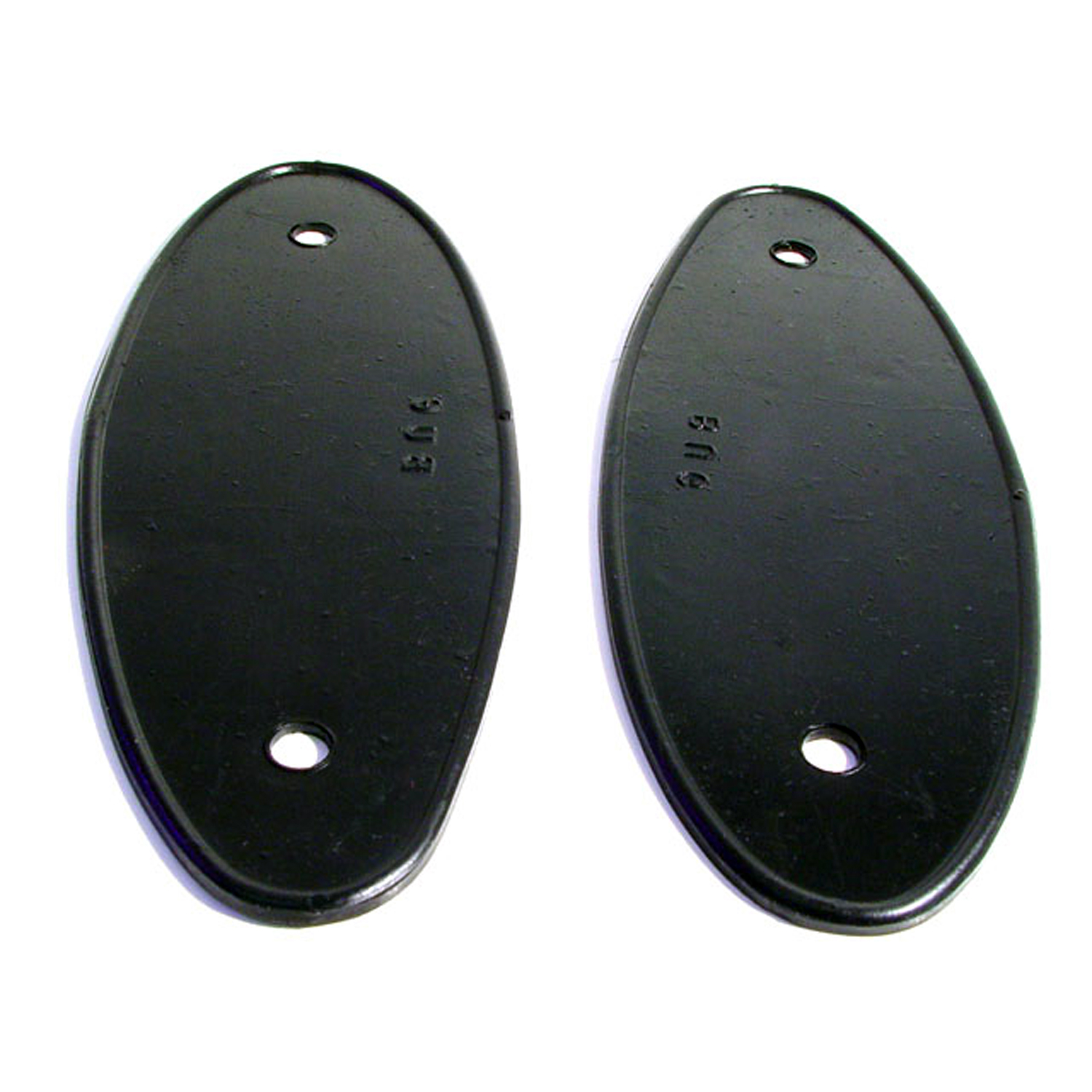 1935 Bugatti Type 57 Headlight Pads. 3" wide X 8-1/8" long. Pair-MP 337-AHeadlight Pads. 3" wide X 8-1/8" long. Pair
 1935 Bugatti Type 57 Door Handle Pads. 1-3/8" wide X 2-1/4" long. Pair-MP 337-BDoor Handle Pads. 1-3/8" wide X 2-1/4" long. Pair
Why Choose Metro?
For over 100 years, Metro Moulded Parts has been the pinnacle of quality in classic car restoration parts. Our commitment to precision and authenticity in every component ensures a perfect fit and an OEM-level appearance.
- Expert Craftsmanship & Quality: Each part is a testament to our dedication to reliability and perfection, crafted from original designs and thoroughly tested.
- Advanced Technology: We use cutting-edge techniques to create flawless, long-lasting parts that surpass others in performance.
- SuperSoft Sponge – The Ultimate Door Seal: Not only are our door seals 30% softer than competitors', but they're also guaranteed to never leak. They effectively reduce wind and road noise, enhancing your classic car's comfort and driving experience.
- Proudly American: Our parts are a product of American craftsmanship, made in the USA with a spirit of excellence and heritage.
- Unrivaled Warranty: We back our products with a 30-year industry-leading warranty, a testament to our confidence in their quality.
Join us in preserving the legacy of classic cars with parts that are crafted for perfection, not just made.