
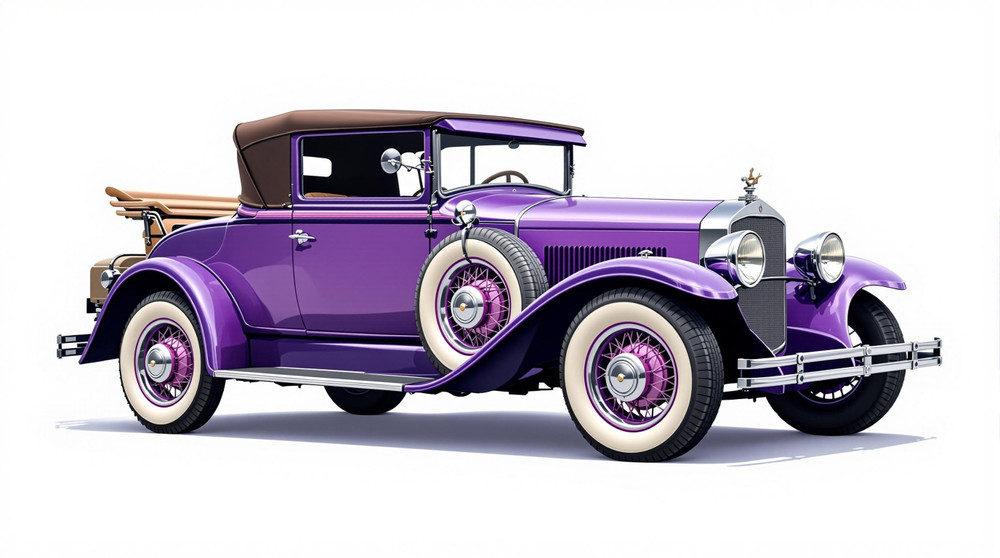
Image of 1926 Cadillac Custom, Note: These illustrations use artistic license and may differ from actual historical models.
Performance Metrics
Fundamental Metrics
Emotional Appeal
MMP Rating
| Engine Specifications | |
|---|---|
| Engine: | L-head V8 |
| Displacement: | 314 cubic inches |
| Horsepower: | Estimated 80-85 hp |
| Torque: | Not available |
| Compression Ratio: | Not available |
| Ignition System: | Battery and coil |
| Cooling System: | Water-cooled |
| Performance Specifications | |
| 0-60 Time: | Not available |
| 1/4 Mile Time: | Not available |
| Top Speed: | 60 mph |
| Transmission and Drive | |
| Drive Type: | Rear-wheel drive |
| Transmission Type: | 3-speed manual |
| Fuel and Efficiency | |
| Fuel System Type: | Carburetor |
| MPG: | Not available |
| Dimensions and Brakes | |
| Brakes: | Mechanical drum brakes |
| Wheelbase: | 138 inches |
| Weight: | Estimated 4,500 lbs |
Note: Specifications for classic cars are given to the best of our ability, considering the limited and variant data available.
1926 Cadillac Custom: A Hand-Built American Statement
In 1926, a Cadillac could be more than a luxury car: with a special body and carefully chosen trim, it could be a rolling portrait of its owner. The name “1926 Cadillac Custom” does not refer to one single factory model. It usually describes a Cadillac chassis fitted with distinctive coachwork, often from Cadillac’s own Fleetwood operation or another specialist body builder.
At its foundation was Cadillac’s Series 314, named for its 314-cubic-inch (5.1-liter) L-head V8. Cadillac, founded in Detroit in 1902 and part of General Motors since 1909, had built its reputation on precision manufacturing and refined engineering. By the mid-1920s, its cars were among America’s most prestigious automobiles, competing with other high-end marques for buyers who wanted comfort, craftsmanship, and status.
One notable piece of the story is Cadillac’s growing connection with Fleetwood. GM acquired the Fleetwood Metal Body Company in 1925, bringing an established coachbuilding name closer to Cadillac. That relationship helped make individualized bodies a more visible part of Cadillac’s luxury identity, even as the company continued to build cars in series.
Custom Coachwork and 1920s Style
A 1926 Cadillac makes a bold impression without relying on modern styling tricks. Its long hood, upright radiator, prominent Cadillac crest, sweeping fenders, and large wire or wood-spoke wheels give it the formal proportions of a classic brass-and-nickel-era automobile. Headlamps sit proudly out front, while running boards connect the separate fenders and give passengers a practical step into the cabin. Depending on the body, a rear-mounted spare tire and luggage rack complete the touring-car profile.
The “custom” part could transform that basic silhouette. A coachbuilder might alter the roofline, window arrangement, rear compartment, seating layout, or trim. Formal limousines and town cars emphasized privacy and ceremony, while open phaetons and roadsters put passengers in the fresh air. The finish and details could be tailored to a buyer’s preferences, so two surviving cars described as 1926 Cadillac Customs may look quite different from one another.
Inside, materials depended on the body style and the customer’s specification. Leather upholstery was a popular choice, while broadcloth or other woven fabrics could create a quieter, more understated cabin. Polished wood, carefully finished metal fittings, deep carpeting, and generous seating helped distinguish a Cadillac from an ordinary touring car. Formal chauffeur-driven bodies could separate the driver’s position from the passenger compartment, with features such as a division window or extra rear seating depending on the order.
Paint choices also varied with the body and buyer. Black suited formal cars and was a familiar choice for limousines, but dark blue, green, maroon, and other rich colors could give a custom car more personality. Period paint was not always a single solid shade: coachwork could combine colors or use contrasting trim. The exact palette for a particular car should be confirmed through its original records, surviving paint layers, or factory documentation rather than assumed from its model year.
V8 Power and Period Technology
The 314-cubic-inch Cadillac V8 was the car’s mechanical centerpiece. It used an L-head, or side-valve, layout and produced about 90 horsepower. Power went through a manual three-speed transmission to the rear wheels. Cadillac’s V8 was not new in 1926, but by then it had become a well-established part of the marque’s identity, giving the company a smoother and more substantial powerplant than many ordinary cars of the period.
Four-wheel mechanical brakes were another important feature for a car of this size and performance. They required more driver effort and maintenance than modern hydraulic systems, but they represented a meaningful step beyond cars that relied on braking at only the rear wheels. The Cadillac also had a conventional ladder-type chassis and solid axles, reflecting the robust construction common to luxury cars of the era.
Available body styles included roadsters, coupes, sedans, phaetons, limousines, town cars, and other enclosed or open touring forms. Fisher and Fleetwood were important names in Cadillac body production, while independent coachbuilders could create additional special designs. Among the most immediately recognizable forms are the formal limousine and town car, but there is no single “iconic” custom body shared by every 1926 Cadillac.
Why the 1926 Cadillac Matters
The 1926 Cadillac Custom represents an important stage in the move from individually commissioned coachwork toward the modern luxury-car business. Buyers could still order a car with a highly personal appearance, but Cadillac’s growing relationship with Fleetwood connected that tradition to a major automobile manufacturer. The result helped define a lasting American luxury formula: a capable production chassis paired with elegant, carefully finished bodywork.
Cadillac also stood apart from many contemporaries through its combination of V8 power, substantial construction, and attention to refinement. Its cars were not merely transportation for the wealthy. They demonstrated how an automaker could use engineering and craftsmanship together to create a distinct brand identity. The custom Cadillac’s influence can be seen in later luxury cars that offered varied body styles, formal passenger accommodations, and increasingly individualized trim.
Performance and Driving Feel
Period performance figures vary with body style, gearing, vehicle condition, and passenger load. A reasonable estimate for a sound 1926 Cadillac is a top speed in the neighborhood of 70 to 80 mph. A light open car would likely feel livelier than a heavy limousine. There is no dependable, universal factory 0-to-60-mph figure for every custom-bodied version; a modern estimate might fall around 25 to 35 seconds or longer, especially for a large formal body. These are estimates, not standardized test results.
On the road, the V8 delivers its power in a steady, unhurried way. The engine’s sound is a deep mechanical burble, accompanied by the tire, wind, and transmission noises that are part of driving a century-old automobile. The three-speed gearbox calls for deliberate shifts, while steering and braking demand more effort and anticipation than a modern driver may expect.
The long wheelbase helps the Cadillac feel composed on smoother roads, but its solid axles and period suspension cannot disguise potholes or sharp bumps. On a winding road, the car rewards measured steering rather than quick inputs. Its size, high center of gravity, and narrow tires make it best driven with a generous margin of space and speed. A 1926 Cadillac is about presence and stately progress, not sports-car agility.
Owning and Maintaining a 1926 Cadillac
Today, most 1926 Cadillacs are treasured show cars, touring vehicles, or occasional-use classics rather than daily drivers. A well-sorted example can participate in vintage motoring events and local shows, but regular use requires preparation. Owners need to understand manual starting and controls, keep an eye on engine temperature and lubrication, and allow extra distance for stopping.
Maintenance is manageable for an experienced vintage-car owner, but it is not quite a casual garage project for everyone. Mechanical parts can often be repaired or sourced through specialist networks, and the straightforward prewar layout is accessible to a competent mechanic. The challenge is that custom body hardware, upholstery, trim, and coachbuilder-specific details may be difficult or expensive to reproduce. Originality and specialist knowledge matter, especially when a car has unusual bodywork.
Reliability depends heavily on restoration quality and ongoing care. A neglected example may need extensive work on the engine, brakes, cooling system, electrical equipment, wood structure, or body. Before purchase, a prospective owner should seek an inspection from someone familiar with prewar Cadillacs and verify that the chassis, engine, and body identification details are consistent with the car’s history.
1926 Cadillac Facts and Common Criticisms
“Custom” is a description, not one exact model. It can mean a Cadillac with special factory-associated coachwork or a car bodied by an independent firm. The body builder, chassis, and surviving documentation are essential to understanding what a particular car is.
There is no reliable production count for all custom versions. A reasonable broad estimate is that Cadillac built roughly 20,000 cars across its 1926 range, though exact totals can vary by source and how model-year production is counted. Custom-bodied examples were only a portion of that total, and the number for any particular body style or coachbuilder is much harder to establish.
Its strengths have trade-offs. The large size and formal styling deliver impressive presence, but they make narrow roads, tight garages, and city parking more difficult. Mechanical brakes and period steering also require a different driving technique. These are not defects so much as reminders that the car was designed for another era.
There is no single famous record or celebrity story that applies to every 1926 Cadillac Custom. Individual cars may have notable ownership histories, but those claims should be supported by documentation. Their strongest claim to distinction is broader: they embody the period when American luxury manufacturers were turning coachbuilding craftsmanship into a recognizable part of the automobile itself.
Collector Values and Availability
Values vary widely because “1926 Cadillac Custom” covers many body styles and levels of originality. As a broad current-market estimate, a project car might sell for about $15,000 to $40,000. A sound driver-quality example could fall around $40,000 to $100,000, while a high-quality restoration may bring roughly $100,000 to $250,000. A particularly rare, documented coachbuilt car in exceptional condition could exceed that range, sometimes substantially. These are estimates, not appraisals, and a specific car’s provenance, body style, restoration, and condition can shift its value considerably.
Availability is limited. Cadillacs from the period appear in specialist auctions and classic-car listings, but a buyer seeking a specific coachbuilder or body style may wait a long time. Custom cars with original, traceable bodywork are especially scarce. Restored cars can also vary in authenticity, so careful research is as important as a polished finish.
Like many prewar classics, the market has been uneven. Exceptional and well-documented examples tend to hold the strongest appeal, while ordinary cars may be more sensitive to restoration costs and changing collector tastes. Over the long term, top examples can appreciate, but ownership expenses mean that purchase price alone does not tell the full financial story. Buyers should focus on condition, history, and enjoyment rather than assuming every example will rise in value.
A Lasting Cadillac Classic
The 1926 Cadillac Custom combines Cadillac’s established V8 engineering with the individuality of early luxury coachwork. Its imposing exterior, crafted interior, and formal road manners capture a moment when a car could still be tailored to its owner while benefiting from the resources of a major manufacturer. It is demanding by modern standards, but that is part of its appeal. More than a century later, a well-preserved example remains a striking reminder that luxury once meant not only arriving in comfort, but arriving in a car unlike anyone else’s.
1926 Cadillac Custom Catalog of Parts
 1926 Cadillac CUSTOM Door Handle Ferrule Grommet. I.D. 11/16", O.D. 1-3/16"-MP 546-IDoor Handle Ferrule Grommet. I.D. 11/16", O.D. 1-3/16". Each
 1926 Cadillac CUSTOM Flexible Rubber Window Channel-WC 32-14Flexible Rubber Window Channel. For Fisher Closed Bodies, except those using a stainless bead type. Used on side windows. 13/16" outer width X 6/16" outer depth, with a 5/16" inner channel width X 14" long. Each
Why Choose Metro?
For over 100 years, Metro Moulded Parts has been the pinnacle of quality in classic car restoration parts. Our commitment to precision and authenticity in every component ensures a perfect fit and an OEM-level appearance.
- Expert Craftsmanship & Quality: Each part is a testament to our dedication to reliability and perfection, crafted from original designs and thoroughly tested.
- Advanced Technology: We use cutting-edge techniques to create flawless, long-lasting parts that surpass others in performance.
- SuperSoft Sponge – The Ultimate Door Seal: Not only are our door seals 30% softer than competitors', but they're also guaranteed to never leak. They effectively reduce wind and road noise, enhancing your classic car's comfort and driving experience.
- Proudly American: Our parts are a product of American craftsmanship, made in the USA with a spirit of excellence and heritage.
- Unrivaled Warranty: We back our products with a 30-year industry-leading warranty, a testament to our confidence in their quality.
Join us in preserving the legacy of classic cars with parts that are crafted for perfection, not just made.