
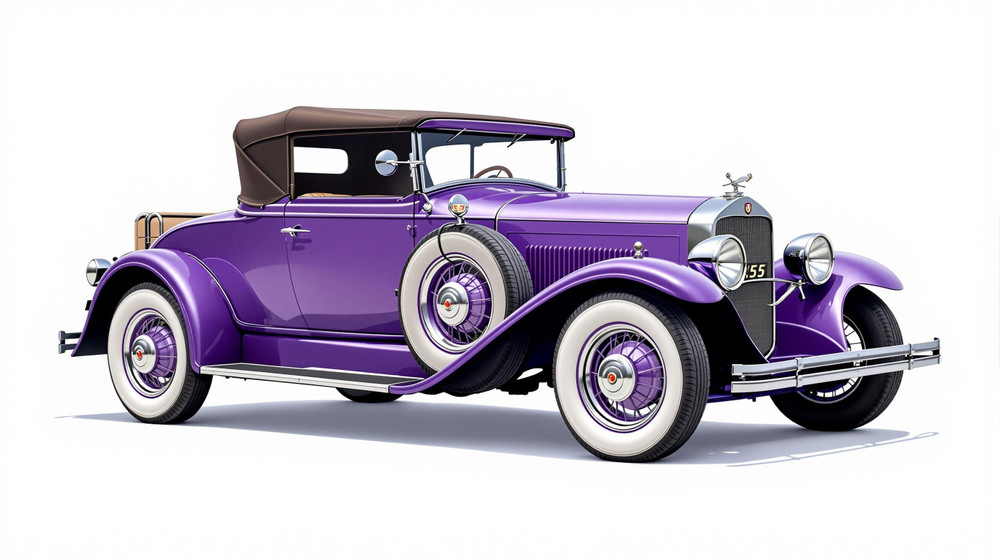
Image of 1927 Cadillac Custom, Note: These illustrations use artistic license and may differ from actual historical models.
Performance Metrics
Fundamental Metrics
Emotional Appeal
MMP Rating
| Engine Specifications | |
|---|---|
| Engine: | V8 |
| Displacement: | 341 cubic inches |
| Horsepower: | Estimated 90 HP |
| Torque: | Not available |
| Compression Ratio: | Not available |
| Ignition System: | Battery and coil |
| Cooling System: | Water-cooled |
| Performance Specifications | |
| 0-60 Time: | Not available |
| 1/4 Mile Time: | Not available |
| Top Speed: | 60 mph |
| Transmission and Drive | |
| Drive Type: | Rear-wheel drive |
| Transmission Type: | 3-speed manual |
| Fuel and Efficiency | |
| Fuel System Type: | Carburetor |
| MPG: | Not available |
| Dimensions and Brakes | |
| Brakes: | Mechanical drum brakes |
| Wheelbase: | 140 inches |
| Weight: | Estimated 5000 lbs |
Note: Specifications for classic cars are given to the best of our ability, considering the limited and variant data available.
1927 Cadillac Custom: The Coachbuilt American Classic
A 1927 Cadillac Custom was less a single factory model than a statement of personal taste: a Cadillac V-8 chassis dressed in elegant coachwork, sometimes tailored by the celebrated Fleetwood body works. At its heart was the Cadillac Series 314, a substantial, high-quality automobile from a company already known for precision engineering and prestige.
Cadillac was founded in Detroit in 1902 and became part of General Motors in 1909. By 1927, it had established itself as one of America’s leading luxury-car makers. The name “custom” can be confusing today: period references may mean special-order coachwork, while modern listings sometimes use it for a modified or restored car. There was no single factory model officially called the “1927 Cadillac Custom,” so the exact details depend on the chassis and body fitted to each car.
One intriguing piece of context is that 1927 was also the debut year of the LaSalle, Cadillac’s companion marque. Its sleek styling, created under designer Harley Earl, helped point American luxury cars toward a more coordinated, modern look. A custom Cadillac from the same year sits at a fascinating crossroads between formal coachbuilt tradition and the coming age of automotive styling.
Design, Coachwork, and Cabin Craft
The 1927 Cadillac has the stately proportions typical of a luxury car of its era: a long hood, upright radiator, broad fenders, running boards, and tall, narrow wheels. Brass-era ornament had largely given way to nickel- or chrome-finished details, lending the front end a bright, polished appearance. Depending on its body, a Cadillac could look imposing and formal or surprisingly sporty, with open cockpits and exposed lines.
Bodywork made a major difference. Cadillac offered a range of factory bodies, while Fleetwood and other coachbuilders produced more exclusive designs. Buyers could choose from styles such as roadsters, phaetons, coupes, sedans, and limousines. Closed sedans and limousines suited formal use, while open phaetons and roadsters showed off the chassis and were popular choices for owners who wanted a more sporting look. Fleetwood-bodied cars are especially prized today for their tailored proportions and details.
Inside, the experience was built around craftsmanship rather than modern convenience. Depending on the body and trim level, occupants might find generous leather upholstery, fine wood trim, quality carpeting, and carefully finished hardware. Limousines could include a division between the driver and rear passengers. Materials and equipment varied, especially on custom orders, so no single interior specification applies to every 1927 Cadillac.
Color choices were also specific to the body, order, and finish. Buyers could select tasteful dark colors or more expressive combinations, sometimes using contrasting paint on body panels and fenders. Black and other subdued shades suited formal sedans, while open cars could carry brighter or two-tone schemes. Original paint records are not universal, so a car’s factory color is best confirmed through documentation rather than assumed from its current finish.
The Series 314’s most important technology was its V-8 engine, but Cadillac’s reputation rested on more than one component. The marque had introduced electric starting and lighting to its cars in 1912, innovations that had helped make motoring more accessible and dependable. By 1927, those features were established equipment rather than novelties. The Cadillac’s engineering emphasis was on smooth, dependable power and refinement, not on modern-style electronics or driver aids.
Why the 1927 Cadillac Matters
The 1927 Cadillac’s significance comes from its combination of advanced-for-its-time V-8 engineering, high-quality manufacture, and broad body selection. Cadillac helped establish the V-8 as a credible powerplant for luxury cars, delivering a smoother character than many large four-cylinder engines of the period. Its use of a common chassis with a variety of bodies also gave buyers room to choose a car suited to personal, business, or chauffeur-driven use.
Custom coachwork reflected a time when a luxury automobile could be treated much like a tailored suit. The chassis provided the mechanical foundation, while the coachbuilder shaped the car’s identity. This approach influenced the prestige-car world for decades, even as mass production and standardized bodies gradually made one-off coachbuilding less common.
The arrival of the LaSalle in 1927 added another important design chapter. Harley Earl’s work there helped bring a more integrated, fashion-conscious approach to General Motors design. Although the LaSalle was a separate marque, its launch shows how Cadillac and GM were beginning to think beyond engineering and craftsmanship toward styling as a central part of a car’s appeal.
V-8 Performance and Road Manners
The Series 314 used a 314-cubic-inch (about 5.1-liter) L-head V-8, commonly rated at roughly 90 horsepower, paired with a three-speed manual transmission. Exact specifications can vary by source and by the car’s condition or later modifications, but those figures provide a useful picture of the standard setup. Period gearing, body style, and vehicle weight all affected performance.
There is no dependable factory 0-to-60 mph figure comparable to a modern test. As a broad estimate, a sound, standard car might take roughly 20 to 30 seconds to reach 60 mph, with heavier bodies likely toward the slower end. Top speed is also condition- and body-dependent; a reasonable estimate for a healthy example is around 70 to 80 mph. These are approximate figures, not guaranteed specifications, and many surviving cars are now driven conservatively.
Behind the wheel, the V-8 is valued more for its steady pull and composed character than for quick acceleration. Expect engine noise and mechanical presence, but not the harsh, high-revving soundtrack of a modern performance car. The manual gearbox and period controls ask for deliberate operation, and braking, steering, and visibility reflect the standards of the 1920s rather than today’s traffic.
On rough roads, the long wheelbase and substantial mass can help the car feel settled, though its leaf-spring suspension cannot erase sharp bumps. On winding roads, it rewards smooth inputs and measured speeds. A tall body, narrow tires, and relatively slow steering make it less nimble than a modern car, while crosswinds can be noticeable, particularly in an open body. The best drive is a relaxed one, with enough space to enjoy the engine’s easygoing character.
Living With a 1927 Cadillac
Today, most 1927 Cadillacs are collector cars used for touring, club events, concours gatherings, and occasional pleasure drives. They are generally not practical daily drivers: traffic speeds, limited braking performance, weather exposure, and the challenge of finding suitable parking all count against routine commuting. Open models are especially rewarding on fair-weather tours, while sedans and limousines offer a more sheltered experience.
Maintenance is manageable for an experienced vintage-car owner, but it is not the same as servicing a modern vehicle. Routine work may include careful lubrication, ignition and carburetor attention, cooling-system checks, brake adjustment, and regular inspection of tires and suspension. Many mechanical tasks are straightforward in principle, yet age, wear, and previous repairs can complicate the job. Specialized knowledge is particularly useful for engine rebuilding, transmission work, and sourcing correct coachwork hardware.
Parts availability varies. Common service items may be obtainable through vintage-car suppliers and marque networks, while rare body pieces, trim, and components specific to a custom coachbuilder can be difficult and expensive to find. Reliability depends heavily on the quality of restoration and ongoing care. A well-sorted Cadillac can tour reliably at sensible speeds, but an uninspected example should not be assumed road-ready just because it starts.
Notable Details and Common Criticisms
The most distinctive “special edition” quality of many 1927 Cadillacs lies in their individual coachwork rather than in a numbered factory edition. Two cars sharing the same basic chassis can look markedly different because of their body style, trim, paint, and coachbuilder. That individuality is part of their appeal, but it also makes research and comparison challenging.
There is no widely recognized production record or single celebrity ownership story attached to the general category “1927 Cadillac Custom.” Nor is there one verified production total for custom-bodied examples. Cadillac built cars in significant numbers for a luxury manufacturer of the era, but the surviving population of original, documented coachbuilt cars is much smaller. Claims about a rare body or famous owner should be supported by chassis records, period photographs, or other documentation.
Common criticisms are rooted in the car’s age. It is large, heavy, relatively slow by modern standards, and demanding to maneuver in tight spaces. Braking distances are long compared with contemporary traffic, and a manual gearbox requires practice. Custom cars can also be costly to restore because unusual body parts may need to be repaired or reproduced by specialists. Those limitations are part of the ownership calculation, not defects that can be corrected without changing the car’s character.
Collector Values and Availability
As a broad current-market estimate, a sound but less exceptional 1927 Cadillac might sell for roughly $40,000 to $100,000, while a well-restored, desirable example could reach approximately $100,000 to $200,000 or more. Rare, highly documented coachbuilt cars in outstanding condition can exceed that range, sometimes substantially. These figures are general estimates: body style, originality, restoration quality, provenance, and market timing can shift a price considerably.
Standard-bodied cars are more attainable than rare custom examples, but even “available” is relative. Such cars appear far less often than modern classics, and the exact combination of chassis, body, and coachbuilder can be hard to find. No reliable single production figure captures every car described today as a 1927 Cadillac Custom. A useful best estimate is that Cadillac produced tens of thousands of cars across its 1927 range, while bespoke or unusually coachbuilt examples represented a small fraction of that total.
Values have generally been supported by the appeal of early V-8 Cadillacs, the quality of their construction, and the scarcity of exceptional coachwork. Prices do not rise uniformly, however. A car with excellent documentation and an authentic, desirable body may attract stronger interest than a modified car or a restoration with uncertain history. As with most prewar collectibles, condition and provenance matter more than a broad label such as “custom.”
A Cadillac From the Coachbuilt Era
The 1927 Cadillac Custom brings together Cadillac’s early V-8 engineering, the craftsmanship of the coachbuilding age, and the styling shifts that were beginning to reshape American luxury cars. Its performance is stately rather than fast, and ownership asks for patience, mechanical care, and an appreciation of period manners.
What makes it memorable is the way no two special-bodied examples need be quite alike. A well-preserved 1927 Cadillac is more than a vintage car: it is a rolling record of an era when luxury could be ordered to measure.
1927 Cadillac Custom Catalog of Parts
 1927 Cadillac CUSTOM Door Handle Ferrule Grommet. I.D. 11/16", O.D. 1-3/16"-MP 546-IDoor Handle Ferrule Grommet. I.D. 11/16", O.D. 1-3/16". Each
 1927 Cadillac CUSTOM Flexible Rubber Window Channel-WC 32-14Flexible Rubber Window Channel. For Fisher Closed Bodies, except those using a stainless bead type. Used on side windows. 13/16" outer width X 6/16" outer depth, with a 5/16" inner channel width X 14" long. Each
Why Choose Metro?
For over 100 years, Metro Moulded Parts has been the pinnacle of quality in classic car restoration parts. Our commitment to precision and authenticity in every component ensures a perfect fit and an OEM-level appearance.
- Expert Craftsmanship & Quality: Each part is a testament to our dedication to reliability and perfection, crafted from original designs and thoroughly tested.
- Advanced Technology: We use cutting-edge techniques to create flawless, long-lasting parts that surpass others in performance.
- SuperSoft Sponge – The Ultimate Door Seal: Not only are our door seals 30% softer than competitors', but they're also guaranteed to never leak. They effectively reduce wind and road noise, enhancing your classic car's comfort and driving experience.
- Proudly American: Our parts are a product of American craftsmanship, made in the USA with a spirit of excellence and heritage.
- Unrivaled Warranty: We back our products with a 30-year industry-leading warranty, a testament to our confidence in their quality.
Join us in preserving the legacy of classic cars with parts that are crafted for perfection, not just made.