
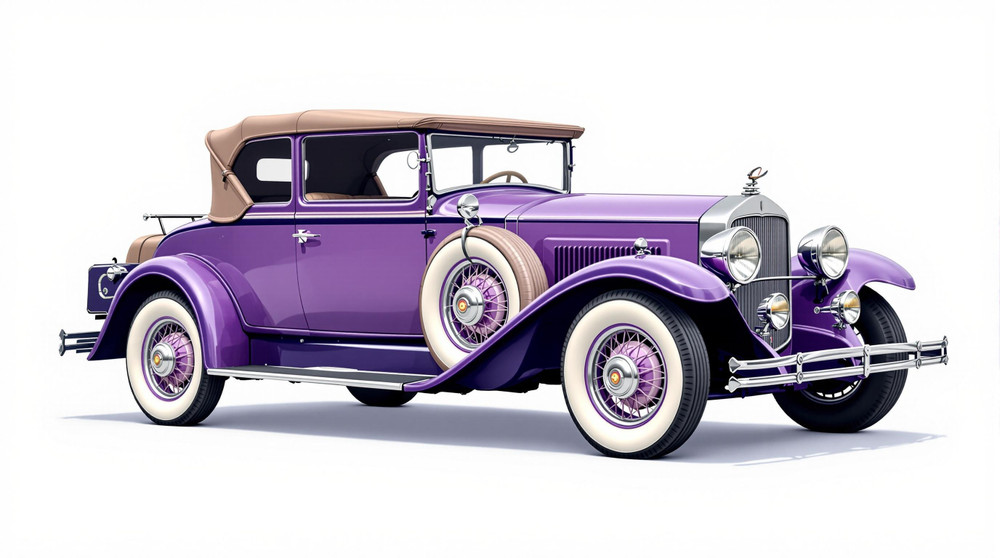
Image of 1927 Cadillac Fleetwood, Note: These illustrations use artistic license and may differ from actual historical models.
Performance Metrics
Fundamental Metrics
Emotional Appeal
MMP Rating
| Engine Specifications | |
|---|---|
| Engine: | L-head V8 |
| Displacement: | 341 cubic inches |
| Horsepower: | Estimated 90 HP |
| Torque: | Not available |
| Compression Ratio: | Not available |
| Ignition System: | Battery and coil |
| Cooling System: | Water-cooled |
| Performance Specifications | |
| 0-60 Time: | Not available |
| 1/4 Mile Time: | Not available |
| Top Speed: | 60 mph |
| Transmission and Drive | |
| Drive Type: | Rear-wheel drive |
| Transmission Type: | 3-speed manual |
| Fuel and Efficiency | |
| Fuel System Type: | Carburetor |
| MPG: | Not available |
| Dimensions and Brakes | |
| Brakes: | Mechanical drum brakes |
| Wheelbase: | 140 inches |
| Weight: | 4,850 lbs |
Note: Specifications for classic cars are given to the best of our ability, considering the limited and variant data available.
1927 Cadillac Fleetwood: Coachbuilt Luxury on a V-8 Chassis
A 1927 Cadillac Fleetwood was less a single model than a statement of how a luxury car could be built: Cadillac supplied the powerful chassis, while Fleetwood shaped it into a hand-finished automobile for buyers who wanted something more personal than a standard production body.
Cadillac was part of General Motors, and Fleetwood was a respected Pennsylvania coachbuilding company acquired by Fisher Body in 1925 and closely associated with Cadillac afterward. In 1927, many Fleetwood-bodied Cadillacs used the V-63 chassis, powered by Cadillac’s 314-cubic-inch V-8. The Fleetwood name identified the coachwork, so two cars from the same year could look and feel quite different depending on their body style and original specification.
That distinction is part of the car’s appeal today. A surviving 1927 Fleetwood is not simply an old Cadillac; it is a snapshot of the era when wealthy buyers could select a body, trim, and finish that reflected their own tastes.
Fleetwood Coachwork and 1927 Cadillac Design
The V-63 had the commanding proportions expected of a prestige automobile: a long hood, upright radiator, separate fenders, exposed running boards, and large wheels set beneath sweeping fender lines. Nickel-plated or polished brightwork framed the radiator and lamps, while the tall body and formal roofline gave many Fleetwood versions a stately presence. Even at rest, the car looked substantial and deliberately composed.
Fleetwood’s role was to turn the chassis into a finished body, and its work could range from dignified closed sedans and limousines to more open touring styles. Limousines and formal sedans suited chauffeur-driven travel, while phaetons, roadsters, and convertible coupes offered a more sporting way to enjoy the Cadillac. The most iconic Fleetwood cars are often the formal town-car, limousine, and sedan types, though open cars have their own following among collectors.
Interiors were specified for comfort and presentation rather than minimalism. Depending on the body and order, owners could find carefully fitted upholstery, polished wood trim, quality carpeting, and thoughtful details such as window shades or a division between the driver and rear passenger compartment. Materials and equipment varied from car to car, so there is no single interior that represents every 1927 Fleetwood.
Paint choices were also influenced by the body order and buyer preference. Dark colors such as black, deep blue, and maroon suited formal cars, while two-tone schemes could emphasize the long body and separate fenders. Original color records are not consistent across every surviving car, so today’s examples may wear a period-inspired repaint rather than a fully documented factory color combination.
V-63 Engineering and Cadillac’s Influence
Under the hood, the Cadillac V-63’s 314-cubic-inch, side-valve V-8 produced approximately 90 horsepower. Cadillac’s V-8 expertise went back to 1915, but the V-63 represented a mature version of the company’s engineering, pairing smooth power delivery with the refinement expected in an expensive touring car. Its counterbalanced crankshaft helped reduce vibration, a meaningful advantage in a period when many cars felt busy and mechanical at speed.
Cadillac also offered four-wheel brakes by this era, an important safety feature compared with cars that relied on rear brakes alone. The V-63 used a three-speed manual transmission, and its substantial chassis was designed to carry a range of bodies rather than serve one narrow purpose. The result was not a lightweight sports car. It was a refined, capable automobile that combined power, braking, and bespoke coachwork in a way that helped define American luxury.
Fleetwood’s lasting influence came from making custom bodywork part of Cadillac’s identity. The company helped establish the idea that a premium manufacturer could offer the engineering of a series-built car while giving customers a choice of distinctive, carefully finished bodies. That combination of factory capability and coachbuilt character became a hallmark of luxury motoring.
Road Manners, Speed, and Driving Feel
Period performance figures vary with body style, gearing, vehicle condition, and load. A reasonable estimate for a healthy 1927 Cadillac V-63 is a top speed in the neighborhood of 75 to 80 mph. Reaching 60 mph was a much slower affair than in a modern car, with a rough estimate of around 20 to 30 seconds. A heavy limousine would generally be slower than a lighter open-bodied version.
On the road, the V-8’s character matters more than the numbers. It delivers a steady, low-revving surge rather than a sharp burst of acceleration. The engine’s subdued mechanical rumble, the deliberate action of the three-speed gearbox, and the car’s long wheelbase create a calm, formal driving experience. The driver must plan shifts and braking well ahead, especially in modern traffic.
The long chassis and generous suspension travel help the Cadillac absorb uneven roads, though it will still move and pitch over large bumps by modern standards. Its size and relatively tall body make narrow, winding roads more demanding than open highways. Crosswinds can be noticeable, particularly in a tall closed body, and steering response is slower and heavier than in a contemporary car. The V-63 is best enjoyed at a measured pace, where its smoothness and presence can be appreciated.
Ownership, Maintenance, and Reliability
A 1927 Fleetwood Cadillac is primarily a show, touring, and collection car today, not a sensible daily driver. Owners take them to concours events, vintage motoring gatherings, and carefully planned tours. A well-sorted example can cover distance, but its age, size, braking limits, and scarcity of specialist parts call for thoughtful use.
Routine work includes attention to ignition and fuel systems, lubrication, cooling, brakes, tires, and the condition of the electrical system. Mechanical repairs are possible for an experienced vintage-car mechanic, but the average modern owner should not expect the convenience of a later classic. The V-8 is mechanically straightforward by current standards, yet body repairs, correct trim, and Fleetwood-specific details can be expensive and difficult to source. A pre-purchase inspection by a mechanic familiar with early Cadillacs is essential.
Reliability depends heavily on restoration quality and maintenance history. A car that starts easily in a collector’s garage may still need substantial work before it is ready for extended touring. Buyers should look beyond shiny paint and check the frame, engine condition, transmission, brakes, wiring, and the authenticity of the coachwork.
Notable Details and Common Criticisms
One intriguing point is that “Fleetwood” describes the body’s coachbuilding heritage, not a unique 1927 Cadillac model with one fixed specification. That makes identification especially important: buyers should establish which Cadillac chassis and body style they are considering, and whether the body is original to the car.
There is no widely recognized speed or endurance record that defines the 1927 Fleetwood. Its historical importance is better understood through its craftsmanship and its place in Cadillac’s luxury-car development. Nor is there a single famous celebrity ownership story that applies to the model as a whole. Individual cars may have notable histories, but those claims should be supported by documented ownership records.
The main criticisms are practical ones. The car is large, thirsty by modern standards, slow to accelerate, and demanding to maneuver in tight spaces. Its braking and handling require more anticipation than a modern driver may expect. For collectors, those limitations are part of the period experience, but they also explain why careful touring and specialist upkeep matter.
Collector Values and Rarity
Exact production figures for 1927 Fleetwood-bodied Cadillacs are difficult to pin down because Fleetwood built bodies in multiple styles and the total does not always appear as one distinct factory model count. A cautious estimate is that several thousand Fleetwood bodies may have been associated with Cadillac production around this period, but that is a broad estimate rather than a verified 1927 Fleetwood production total. The number of surviving, correctly documented cars is much smaller, especially for unusual body styles.
As a broad present-day guide, a project car or heavily altered example might sell for roughly $30,000 to $60,000. A sound, usable car may fall in the $60,000 to $150,000 range, while a high-quality restoration, rare body style, or well-documented example can reach $150,000 to $300,000 or more. Exceptional cars with remarkable provenance or concours-level work may exceed that range. These are estimates, not a substitute for recent comparable sales or a specialist appraisal.
Values depend on originality, restoration quality, coachwork, mechanical condition, documentation, and the strength of the classic-car market. Top examples remain attractive to collectors, but the market is selective: a costly restoration does not automatically guarantee a higher sale price. Over the long term, the most compelling cars are likely to hold interest because they combine Cadillac engineering with genuine coachbuilt character.
Why the 1927 Fleetwood Still Matters
The 1927 Cadillac Fleetwood brought together Cadillac’s smooth V-8 engineering and the tailored workmanship of a leading coachbuilder. Its long-hood styling, carefully finished interiors, and choice of formal or open bodies made it a showcase for American luxury in the late 1920s. It is not a uniform model with one specification, but a family of individual cars shaped by their original buyers.
For collectors, that individuality is the point. A Fleetwood-bodied Cadillac is a reminder of an era when luxury meant more than equipment or speed: it meant craftsmanship, proportion, and the freedom to arrive in a car built to feel like no other.
1927 Cadillac Fleetwood Catalog of Parts
 1927 Cadillac Fleetwood Door Handle Ferrule Grommet. I.D. 11/16", O.D. 1-3/16"-MP 546-IDoor Handle Ferrule Grommet. I.D. 11/16", O.D. 1-3/16". Each
 1927 Cadillac Fleetwood Flexible Rubber Window Channel-WC 32-14Flexible Rubber Window Channel. For Fisher Closed Bodies, except those using a stainless bead type. Used on side windows. 13/16" outer width X 6/16" outer depth, with a 5/16" inner channel width X 14" long. Each
Why Choose Metro?
For over 100 years, Metro Moulded Parts has been the pinnacle of quality in classic car restoration parts. Our commitment to precision and authenticity in every component ensures a perfect fit and an OEM-level appearance.
- Expert Craftsmanship & Quality: Each part is a testament to our dedication to reliability and perfection, crafted from original designs and thoroughly tested.
- Advanced Technology: We use cutting-edge techniques to create flawless, long-lasting parts that surpass others in performance.
- SuperSoft Sponge – The Ultimate Door Seal: Not only are our door seals 30% softer than competitors', but they're also guaranteed to never leak. They effectively reduce wind and road noise, enhancing your classic car's comfort and driving experience.
- Proudly American: Our parts are a product of American craftsmanship, made in the USA with a spirit of excellence and heritage.
- Unrivaled Warranty: We back our products with a 30-year industry-leading warranty, a testament to our confidence in their quality.
Join us in preserving the legacy of classic cars with parts that are crafted for perfection, not just made.