
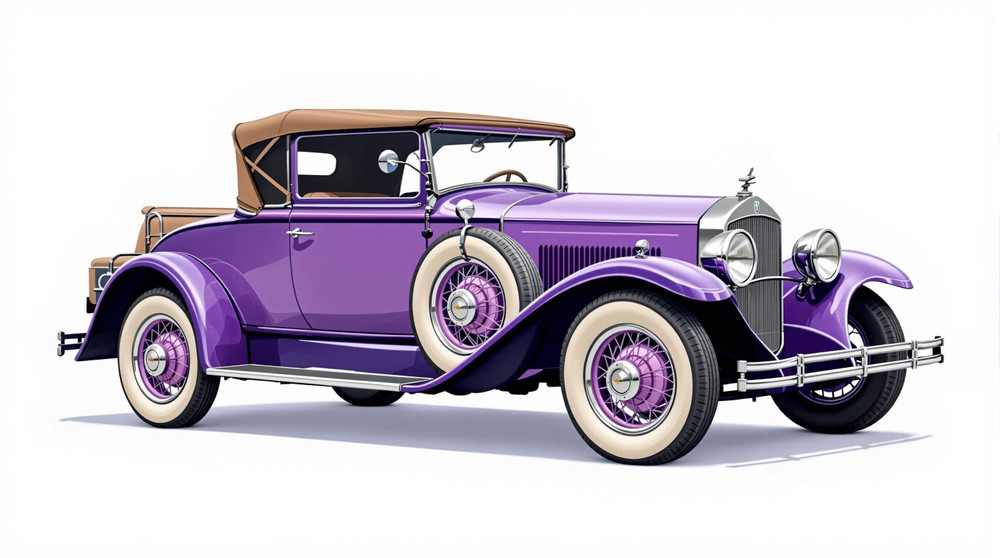
Image of 1927 Cadillac Willoughby, Note: These illustrations use artistic license and may differ from actual historical models.
Performance Metrics
Fundamental Metrics
Emotional Appeal
MMP Rating
| Engine Specifications | |
|---|---|
| Engine Options: | L-head V8 |
| Displacement Range: | 341 cubic inches |
| Horsepower Range: | Estimated 90 HP |
| Torque: | Not available |
| Compression Ratio: | Not available |
| Ignition System: | Battery and coil |
| Cooling System: | Water-cooled |
| Performance Specifications | |
| 0-60 Time: | Not available |
| 1/4 Mile Time: | Not available |
| Top Speed: | 60 mph |
| Transmission and Drive | |
| Drive Type: | Rear-wheel drive |
| Transmission Type: | 3-speed manual |
| Fuel and Efficiency | |
| Fuel System Type: | Carburetor |
| MPG: | Not available |
| Dimensions and Brakes | |
| Brakes: | Mechanical drum brakes |
| Wheelbase: | 138 inches |
| Weight: | Estimated 4,850 lbs |
Note: Specifications for classic cars are given to the best of our ability, considering the limited and variant data available.
1927 Cadillac Willoughby: A Cadillac in Custom Dress
A 1927 Cadillac Willoughby was more than a luxury car: it was a Cadillac chassis clothed in individually commissioned coachwork, built for owners who wanted their motoring to make an unmistakable entrance. The name describes two makers working together. Cadillac supplied the engineering and running gear, while the Willoughby Company of Utica, New York, crafted the body.
That distinction matters because “Willoughby” was not a separate Cadillac model in the ordinary sense. The car belonged to Cadillac’s 1927 V-8 range, but its particular body, trim and fittings could be tailored to the buyer. A surviving car’s details may therefore differ from another Willoughby-bodied Cadillac of the same year.
Its timing was significant. America’s luxury-car market was thriving, and wealthy buyers could choose between factory-built bodies and coachbuilt cars shaped to their tastes. One intriguing consequence is that the same Cadillac mechanical package could serve very different roles: a formal limousine for chauffeured travel, or a more intimate closed car for private motoring.
Willoughby Coachwork and Cadillac Style
The 1927 Cadillac presented a long, upright profile typical of high-end cars of the period. Its tall radiator, prominent Cadillac crest, separate headlamps and sweeping front fenders gave the nose a stately, architectural look. Behind it, the Willoughby body added its own proportions and details, often emphasizing passenger space, a high roofline and a carefully finished rear compartment.
On a formal limousine, the rear doors and enclosed passenger area were central to the design. A glass division could separate the chauffeur from the passengers, while features such as landau-style roof treatments or other decorative fittings depended on the specific body order. The result was less about sporty lines than quiet authority and privacy.
Inside, buyers could specify a richer environment than the average production car offered. A chauffeur’s area might be trimmed in durable leather, while the rear compartment could feature broadcloth or other fine upholstery, polished wood fittings, carpeting, shades and interior lamps. Because this was custom coachwork, the exact materials and appointments varied by car rather than following one universal Willoughby specification.
Paint and trim were similarly personal. Dark colors such as black, deep blue, burgundy and dark green suited the formal character of a limousine, while two-tone schemes could emphasize the body’s long panels and roofline. There was no single “Willoughby color” that applies to every 1927 example; original build records and surviving paint layers are the best guides to an individual car’s factory finish.
Body Styles and Bespoke Details
Willoughby was known for formal closed bodies, including limousine-style designs, but coachbuilders could offer different body patterns and equipment according to the chassis and customer’s order. Depending on the particular Cadillac, the result might be a limousine, sedan or another formal enclosed style. It is safest to identify a car by its documented body designation rather than assume every Willoughby option was available on every Cadillac chassis.
The limousine is the most iconic interpretation. Its generous rear seating, tall doors and potential division window made it especially suited to chauffeured use. That layout also explains why Willoughby Cadillacs tend to look imposing even beside other large cars of the 1920s.
V-8 Engineering in the 1920s
Under the long hood was Cadillac’s 314-cubic-inch L-head V-8, rated at about 90 horsepower. Cadillac had introduced its V-8 in 1915, so the 1927 engine was not a new experiment. By this point, the marque had built a reputation around the smoothness and refinement of multi-cylinder power, and the V-8 gave a substantial luxury car useful strength for touring.
The engine drove the rear wheels through a three-speed manual transmission. The driver had to manage the gears directly, and the period gearbox did not provide the modern convenience of a synchronized shift. Four-wheel mechanical brakes were part of the car’s safety equipment, a meaningful feature for a heavy automobile, though they require more driver effort and careful adjustment than modern hydraulic systems.
Electric starting and lighting also made the Cadillac far more practical than the earliest automobiles. Still, its technology should be judged in context: it was a sophisticated luxury car for 1927, not a modern vehicle with power steering, disc brakes or electronic controls.
Performance on the Open Road
There is no dependable single performance figure for every 1927 Cadillac Willoughby. Body weight, axle ratio, mechanical condition and passenger load all affected how a particular car performed. As a broad period-appropriate estimate, a healthy Cadillac V-8 might reach approximately 65 to 75 mph, while a heavy limousine would be most comfortable cruising at more modest speeds.
A 0-to-60-mph time is likewise an estimate, not a definitive factory figure for the coachbuilt car. A reasonable ballpark is roughly 25 to 35 seconds, with a particularly heavy or tired example taking longer. The V-8’s appeal was its smooth, steady pull rather than quick acceleration by modern standards.
On a reasonably maintained road, the long wheelbase and substantial chassis helped the Cadillac settle into a composed touring rhythm. Broken pavement would still send impacts through the suspension, and a tall, heavy body could lean noticeably on winding roads. The driver had to plan ahead, use the gearbox, and allow plenty of room for the car’s weight when slowing or turning.
From the driver’s seat, the experience is mechanical and involving. The V-8 produces a measured, low-pitched sound, while the gear changes and brake operation remind you that this is a car from a different era. A chauffeured passenger, by contrast, would have experienced the car’s size and enclosure as part of its luxury: a quiet rear compartment, generous seating and a view from well above the road.
Why the Cadillac Willoughby Matters
The Willoughby Cadillac illustrates the close relationship between automakers and independent coachbuilders during the great custom-body era. Cadillac provided a standardized chassis and engine, but firms such as Willoughby gave customers a way to commission a body with a more individual character than a mass-produced automobile could offer.
This approach helped establish the idea that luxury could mean more than a powerful engine or a prestigious badge. Body proportions, passenger privacy, upholstery and personalized fittings all became part of the buying decision. As automakers increasingly brought body production in-house, the independent coachbuilder’s role diminished. A Willoughby-bodied Cadillac therefore represents a stage in automotive history when a luxury car could still be a collaboration between separate specialists.
What set it apart from many contemporaries was the combination of Cadillac’s V-8 reputation and Willoughby’s custom-built passenger space. Its influence is less about one breakthrough feature than the broader coachbuilding tradition it embodies: the belief that a car’s body could be made to suit its owner, rather than selected from a single factory catalog.
Living With a 1927 Willoughby
Today, a Willoughby Cadillac is best suited to touring events, concours gatherings, museum display and occasional ceremonial use. Its size, age and manual controls make it a poor choice for routine modern commuting. Narrow streets, fast traffic and long periods of stop-and-go driving can quickly turn its imposing dimensions into a challenge.
Maintenance is manageable for an experienced vintage-car owner, but it is not quite a matter of visiting any general repair shop. The engine and chassis are mechanical and can be serviced with conventional skills, yet correct parts, specialist knowledge and patient adjustment may be necessary. The body is a separate concern: custom woodwork, upholstery, window mechanisms and coachbuilt fittings can require the attention of a restoration specialist.
Reliability depends heavily on condition and previous work. A properly restored Cadillac can tour, but age-related problems with fuel delivery, ignition, cooling, wiring, brakes and tires should be expected unless those systems have been thoroughly addressed. Before buying, a specialist inspection is especially valuable. It should assess the chassis and engine as well as the body structure, since an impressive exterior can conceal costly coachwork repairs.
Rare Details, Records and Realities
The Willoughby name is the first useful piece of trivia: it identifies the bodybuilder, not a separate engine or Cadillac model. The precise story of each car is often its most fascinating feature. Original build sheets, ownership records, photographs and surviving trim can reveal how a customer specified the car and how it changed hands over time.
There is no widely established production total for 1927 Cadillac chassis fitted with Willoughby bodies. Cadillac built cars in much larger numbers than an independent coachbuilder could produce custom bodies, so a Willoughby example was only a small part of the overall Cadillac output. As a clearly labeled working estimate, the number of Willoughby-bodied Cadillacs from this model year may have been somewhere from several dozen to a few hundred. That is not a documented factory figure, and the true total may be difficult to establish.
No particular speed, endurance or sales record is commonly associated with the 1927 Willoughby Cadillac itself. Nor should celebrity ownership or appearances at a major historical event be assumed without documentation for the individual car. This is a case where a well-supported personal history is more meaningful than an unsupported famous-owner claim.
Common criticisms are practical ones: the car is large, thirsty by modern standards, slow to accelerate, and demanding to stop and maneuver compared with a contemporary vehicle. Its mechanical brakes and unsynchronized transmission call for attention. For collectors, those limitations are part of the period experience, but they also explain why the car is not an easy all-purpose classic.
Collector Value and Availability
There is no single price for a 1927 Cadillac Willoughby. Condition, originality, body style, documentation and restoration quality can change the value dramatically. As a broad 2026 market estimate, a project or incomplete example might fall around $30,000 to $75,000. A sound, presentable car could plausibly bring about $90,000 to $250,000, while an exceptional, well-documented restoration may exceed that range, potentially reaching $300,000 or more in the right sale.
These are guide figures, not a formal appraisal. A coachbuilt car’s unusual features can attract specialist buyers, but restoration costs can be substantial and the pool of buyers is smaller than for more familiar production classics. The market is best described as selective: top-quality, documented examples have the strongest appeal, while cars needing extensive bodywork may be hard to value because repairs can outweigh the purchase price.
Availability is limited. A prospective buyer may wait a long time for a correctly identified example with sound coachwork and useful history. Values for desirable prewar luxury cars have generally been supported by their craftsmanship and rarity, but they do not rise in a straight line. Condition and provenance matter more than age alone, so price trends can vary sharply from one car to the next.
A Coachbuilt Cadillac Worth Remembering
The 1927 Cadillac Willoughby combines Cadillac’s established V-8 engineering with the individualized craftsmanship of an independent coachbuilder. Its formal styling, carefully appointed passenger compartment and custom-built character place it firmly in the golden age of American coachwork.
It is not a car for effortless modern driving, and its rarity does not make every example automatically valuable. Its real distinction is the story it tells about luxury before mass-produced bodies became the norm: a Cadillac could provide the mechanical foundation, but the owner could still choose how that foundation met the road. That partnership is what makes a Willoughby Cadillac memorable.
1927 Cadillac Willoughby Catalog of Parts
 1927 Cadillac WILLOUGHBY Door Handle Ferrule Grommet. I.D. 11/16", O.D. 1-3/16"-MP 546-IDoor Handle Ferrule Grommet. I.D. 11/16", O.D. 1-3/16". Each
 1927 Cadillac WILLOUGHBY Flexible Rubber Window Channel-WC 32-14Flexible Rubber Window Channel. For Fisher Closed Bodies, except those using a stainless bead type. Used on side windows. 13/16" outer width X 6/16" outer depth, with a 5/16" inner channel width X 14" long. Each
Why Choose Metro?
For over 100 years, Metro Moulded Parts has been the pinnacle of quality in classic car restoration parts. Our commitment to precision and authenticity in every component ensures a perfect fit and an OEM-level appearance.
- Expert Craftsmanship & Quality: Each part is a testament to our dedication to reliability and perfection, crafted from original designs and thoroughly tested.
- Advanced Technology: We use cutting-edge techniques to create flawless, long-lasting parts that surpass others in performance.
- SuperSoft Sponge – The Ultimate Door Seal: Not only are our door seals 30% softer than competitors', but they're also guaranteed to never leak. They effectively reduce wind and road noise, enhancing your classic car's comfort and driving experience.
- Proudly American: Our parts are a product of American craftsmanship, made in the USA with a spirit of excellence and heritage.
- Unrivaled Warranty: We back our products with a 30-year industry-leading warranty, a testament to our confidence in their quality.
Join us in preserving the legacy of classic cars with parts that are crafted for perfection, not just made.