
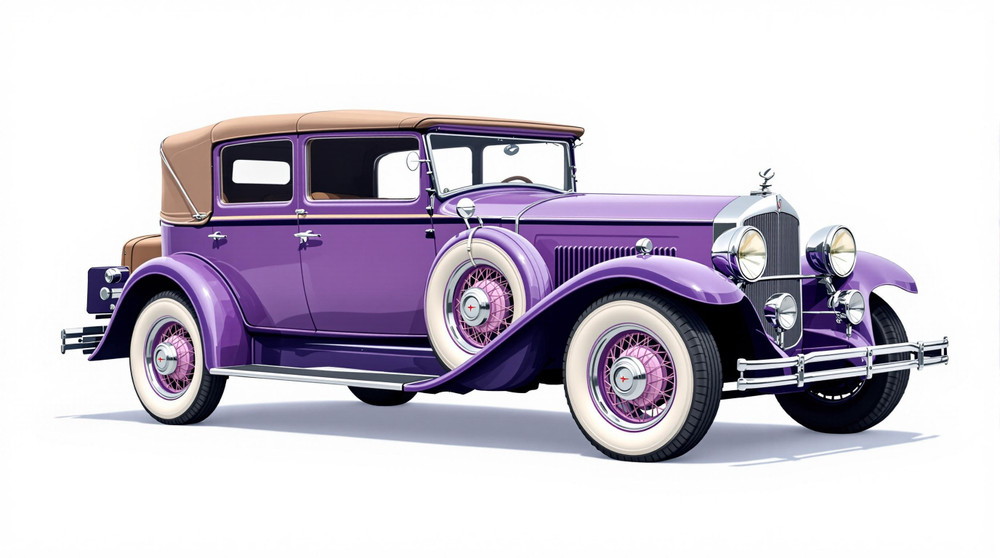
Image of 1928 Cadillac Fleetwood, Note: These illustrations use artistic license and may differ from actual historical models.
Performance Metrics
Fundamental Metrics
Emotional Appeal
MMP Rating
| Engine Specifications | |
|---|---|
| Engine: | L-head V8 |
| Displacement: | 341 cubic inches |
| Horsepower: | Estimated 90-95 HP |
| Torque: | Not available |
| Compression Ratio: | Not available |
| Ignition System: | Battery and coil |
| Cooling System: | Water-cooled |
| Performance Specifications | |
| 0-60 Time: | Not available |
| 1/4 Mile Time: | Not available |
| Top Speed: | 60-65 mph |
| Transmission and Drive | |
| Drive Type: | Rear-wheel drive |
| Transmission Type: | 3-speed manual |
| Fuel and Efficiency | |
| Fuel System Type: | Carburetor |
| MPG: | Not available |
| Dimensions and Brakes | |
| Brakes: | Mechanical drum brakes |
| Wheelbase: | 140 inches |
| Weight: | Estimated 5000 lbs |
Note: Specifications for classic cars are given to the best of our ability, considering the limited and variant data available.
1928 Cadillac Fleetwood: A Coachbuilt American Flagship
A 1928 Cadillac Fleetwood was less a single model than a statement of how far American luxury motoring had come. It paired Cadillac’s substantial V8 chassis with bodywork crafted by Fleetwood, a respected coachbuilder whose name signaled elegance, careful workmanship, and considerable expense.
Cadillac was founded in Detroit in 1902 and had become one of the leading American luxury-car makers by the late 1920s. Fleetwood’s roots were in Fleetwood, Pennsylvania, where the Fleetwood Metal Body Company built custom bodies for wealthy clients. General Motors’ Fisher Body division acquired the company in 1925, and Fleetwood coachwork became closely associated with Cadillac.
Most 1928 Cadillac V8s belonged to the Series 341-A range, named for the engine’s displacement. “Fleetwood” generally identifies the body’s coachbuilder, not a separate engine or chassis model. That distinction matters when researching one today: two 1928 Cadillacs may share the same mechanical foundation yet differ greatly in body style, equipment, rarity, and value.
One detail that makes the year especially interesting is Cadillac’s introduction of synchromesh transmission technology in 1928. It helped drivers change gears more smoothly, a meaningful refinement in an era when shifting a large luxury car could demand both skill and attention.
Fleetwood Styling and Interior Craft
The 1928 Cadillac has the unmistakable proportions of a formal prewar automobile: a tall, upright radiator grille, long hood, prominent headlamps, sweeping fenders, and running boards connecting the front and rear steps. Wire wheels and externally mounted spare tires added to the purposeful, carefully balanced look. Fleetwood bodies gave those familiar Cadillac lines a more individual character, with details shaped around the intended use of each car.
Inside, materials and finish varied by body style and customer specification. A sedan might feature rich upholstery, polished wood trim, a carefully finished dashboard, and a roomy rear compartment. Formal limousines could add a glass division between the chauffeur and passengers, while closed bodies offered occupants shelter from weather and road dust. Depending on the order, upholstery could be cloth or leather, with the most elaborate cars receiving especially fine trim and fittings.
Color choices also depended on the body and the buyer. Black and deep, conservative shades suited formal limousines, while dark blue, green, maroon, and other rich colors could give a sedan or open car more distinction. Special paint combinations were possible, so a surviving car’s original finish and build records are more reliable guides than any single claim about a standard Fleetwood palette.
Fleetwood-bodied Cadillacs appeared in a broad range of configurations, including sedans, coupes, town cars, limousines, roadsters, and phaetons. The formal limousine is among the most recognizable versions, particularly when fitted with a chauffeur’s compartment and enclosed rear seating. Open touring bodies, however, show off the long hood and flowing fenders especially well.
Engineering Ahead of Its Time
The Series 341-A’s 341-cubic-inch side-valve V8 produced about 90 horsepower. Cadillac had helped establish the V8 as a practical luxury-car engine with its earlier models, and by 1928 the layout offered smooth, quiet power suited to a large, heavy automobile. The engine’s broad delivery mattered more in everyday driving than a high-revving character ever could.
A three-speed manual transmission was standard equipment, and Cadillac’s 1928 synchromesh system made gear changes easier than on many earlier cars. The car also had four-wheel mechanical brakes, a valuable safety feature for a vehicle that could weigh well over two tons depending on its body and equipment. These were not modern power-assisted brakes, but they represented serious engineering for the period.
Fleetwood’s contribution was chiefly in coachwork rather than in a unique mechanical package. The importance of that work should not be underestimated: custom body design allowed buyers to choose a car shaped around their social standing, family needs, or chauffeur-driven lifestyle. Cadillac supplied the prestigious mechanical platform; Fleetwood helped turn it into a personal luxury object.
Performance and Road Manners
Period specifications and modern accounts suggest a top speed in the neighborhood of 75 to 80 mph, although actual performance depended on body style, gearing, condition, and load. A 0-to-60-mph time is not a dependable factory figure for every Fleetwood-bodied car. As a modern estimate, a heavy example might take roughly 25 to 30 seconds, with lighter or more favorable configurations potentially quicker.
On a smooth road, the Cadillac’s V8 would feel relaxed and composed, with a muted exhaust note and enough low-speed pull to move the large car without constant gear changes. The steering is entirely mechanical, and the driver must do more work at low speeds than in a modern vehicle. The transmission also rewards deliberate shifts, even with synchromesh assistance.
The long wheelbase and substantial mass help the car settle over broad, gentle undulations, but they do not make it immune to rough roads. Large bumps can send a noticeable motion through the body, and narrow, winding roads call for patience. High-speed cornering is not its forte: the Cadillac is built to travel steadily and comfortably, not to attack bends. Its mechanical brakes require planning, especially when slowing from speed or descending a hill.
What Ownership Is Really Like
Today, a 1928 Fleetwood Cadillac is best suited to touring events, concours gatherings, museum display, and occasional fair-weather drives. It is not a sensible everyday commuter by modern standards. Its size, fuel consumption, starting routine, manual controls, and limited protection in a collision all demand a different approach from contemporary motoring.
Routine work is manageable for an experienced vintage-car owner, but this is not an ideal first project for someone expecting modern parts availability. The V8’s basic mechanical layout is understandable to a specialist, yet age, bespoke bodywork, and model-specific components can complicate repairs. Brake adjustment, ignition service, cooling-system care, lubrication, and careful storage are essential. Original Fleetwood trim and body details can be particularly difficult and costly to restore.
Reliability depends heavily on restoration quality and maintenance. A properly sorted example can tour reliably at period-appropriate speeds, but neglect can quickly turn small problems into expensive ones. Owners should also verify that the chassis, engine, body identification, and paperwork agree, especially when a car has passed through decades of restoration or parts replacement.
Rare Details and Common Criticisms
Fleetwood’s story is part of the car’s appeal. The company’s Pennsylvania origins and its later connection to Fisher Body help explain why the name came to represent high-end Cadillac coachwork. The Fleetwood identity would remain tied to Cadillac luxury for decades, eventually becoming familiar as a Cadillac model designation in its own right.
There is no reliable, widely accepted production total for every 1928 Cadillac body built by Fleetwood. A reasonable working estimate is several thousand, perhaps around 3,000 to 6,000 Fleetwood-bodied Cadillacs for the model year, but that is an informed approximation rather than a verified factory count. Production records and surviving examples do not always make it easy to separate Fleetwood bodies from other Cadillac coachwork.
No single speed, sales, or endurance record defines the 1928 Fleetwood Cadillac. Its significance lies instead in the combination of Cadillac V8 engineering and custom American coachbuilding during a period when luxury cars were increasingly sophisticated and highly visible. Specific celebrity ownership claims should be checked against documentation; the car’s prestige alone is not proof that a particular famous person owned one.
Common criticisms are practical rather than mysterious: the car is heavy, thirsty, difficult to park by modern standards, and less forgiving to stop than a contemporary vehicle. Its age also means that originality can be hard to maintain, while rare trim and body parts may command a premium. For collectors, those drawbacks are part of the commitment involved in keeping a nearly century-old luxury car on the road.
Collector Values and Availability
Values vary widely with body style, condition, originality, restoration quality, and documentation. As a broad U.S. market estimate, a project or incomplete car might fall around $25,000 to $60,000. A sound, well-presented driver could bring roughly $60,000 to $150,000, while an exceptional, correctly restored formal body or particularly desirable configuration may reach $150,000 to $300,000 or more. These are guide ranges, not appraisals; rare coachwork and auction competition can move the result substantially.
Survivors appear occasionally through specialist dealers, auctions, and major classic-car events, but buyers should expect limited choice. The number of cars offered in any given year is small, and a buyer looking for a particular body style may need to wait. A pre-purchase inspection by a mechanic familiar with prewar Cadillacs is money well spent.
Well-restored, historically significant examples have generally retained collector interest, and the finest cars can appreciate when the market favors major prewar automobiles. The broader market is selective, however. Ordinary examples may remain stable or soften if restoration costs rise faster than buyer demand. Provenance, authenticity, condition, and the quality of the bodywork usually matter more than simply having a Fleetwood badge.
Why the 1928 Fleetwood Still Matters
The 1928 Cadillac Fleetwood brought together a smooth, powerful-for-its-day V8, advanced transmission engineering, substantial chassis construction, and coachwork tailored to the buyer. It was not a mass-market car, and it was never meant to be driven like one. Its appeal comes from the way mechanical confidence and handcrafted luxury meet in a single imposing automobile.
Nearly a century later, a Fleetwood-bodied Cadillac remains a rolling reminder of an era when a luxury car could be both transportation and a personal commission. Its long hood, quiet V8, and carefully made cabin still make a statement without needing to say a word.
1928 Cadillac Fleetwood Catalog of Parts
 1928 Cadillac Fleetwood Door Handle Ferrule Grommet. I.D. 11/16", O.D. 1-3/16"-MP 546-IDoor Handle Ferrule Grommet. I.D. 11/16", O.D. 1-3/16". Each
 1928 Cadillac Fleetwood Flexible Rubber Window Channel-WC 32-14Flexible Rubber Window Channel. For Fisher Closed Bodies, except those using a stainless bead type. Used on side windows. 13/16" outer width X 6/16" outer depth, with a 5/16" inner channel width X 14" long. Each
Why Choose Metro?
For over 100 years, Metro Moulded Parts has been the pinnacle of quality in classic car restoration parts. Our commitment to precision and authenticity in every component ensures a perfect fit and an OEM-level appearance.
- Expert Craftsmanship & Quality: Each part is a testament to our dedication to reliability and perfection, crafted from original designs and thoroughly tested.
- Advanced Technology: We use cutting-edge techniques to create flawless, long-lasting parts that surpass others in performance.
- SuperSoft Sponge – The Ultimate Door Seal: Not only are our door seals 30% softer than competitors', but they're also guaranteed to never leak. They effectively reduce wind and road noise, enhancing your classic car's comfort and driving experience.
- Proudly American: Our parts are a product of American craftsmanship, made in the USA with a spirit of excellence and heritage.
- Unrivaled Warranty: We back our products with a 30-year industry-leading warranty, a testament to our confidence in their quality.
Join us in preserving the legacy of classic cars with parts that are crafted for perfection, not just made.