

Image of 1936 Cadillac Series 75, Note: These illustrations use artistic license and may differ from actual historical models.
Performance Metrics
Fundamental Metrics
Emotional Appeal
MMP Rating
| Engine Specifications | |
|---|---|
| Engine: | V8 |
| Displacement: | 5.7L |
| Horsepower: | Estimated 135-150 HP |
| Torque: | 280 lb-ft |
| Compression Ratio: | Estimated 6.25:1 |
| Ignition System: | Distributor and coil |
| Cooling System: | Liquid cooled |
| Performance Specifications | |
| 0-60 Time: | Information not available |
| 1/4 Mile Time: | Information not available |
| Top Speed: | 85 mph |
| Transmission and Drive | |
| Drive Type: | Rear wheel drive |
| Transmission Type: | 3-speed manual |
| Fuel and Efficiency | |
| Fuel System Type: | Carburetor |
| MPG: | Information not available |
| Dimensions and Brakes | |
| Brakes: | Drum brakes |
| Wheelbase: | 138 inches |
| Weight: | Estimated 5000 lbs |
Note: Specifications for classic cars are given to the best of our ability, considering the limited and variant data available.
1936 Cadillac Series 75: The Art of the American Luxury Car
The 1936 Cadillac Series 75 turned a long country road into a private first-class cabin. Built by Cadillac, General Motors’ flagship luxury marque, it paired formal Fleetwood coachwork with a smooth V8 and room for a full party of passengers. It was a car for owners who expected presence as well as comfort, and it arrived at a moment when American luxury cars were becoming more streamlined without giving up their imposing scale.
The Series 75 sat near the top of Cadillac’s range. Its long wheelbase, typically listed at 138 inches, gave designers room for spacious passenger compartments and chauffeur-friendly body styles. A notable detail is that the Series 75’s stately appearance concealed thoroughly modern-for-its-day engineering, including hydraulic brakes and independent front suspension. This was not simply a grand carriage with a new engine; it was a carefully developed motorcar built for long-distance travel.
Fleetwood Style and Cabin Craft
From the curb, the 1936 Cadillac Series 75 is unmistakably formal. Its tall, upright grille, long hood, sweeping fenders, and substantial running boards create a strong, balanced profile. The headlights sit neatly against the fenders, while the hood’s louvers and bright trim add detail without distracting from the car’s dignified proportions. The long body makes the Series 75 look imposing even when standing still.
Many examples wore Fleetwood bodies, reflecting Cadillac’s tradition of high-grade coachwork. Fleetwood had become part of the General Motors organization in the 1920s, and its name was closely associated with carefully finished luxury bodies. Inside, passengers could expect broad upholstered seats, polished wood trim, quality carpeting, and an instrument panel laid out for clear use. Upholstery materials and trim varied by body style and order, and surviving cars may have been retrimmed during restoration.
Factory color combinations depended on the body and specification. Buyers could choose from a range of solid and two-tone finishes, with dark blue, maroon, green, and black among the colors that suit the car’s formal character particularly well. Fleetwood buyers could also specify distinctive trim and interior details, so no single color combination defines every Series 75.
The most recognizable body style is the seven-passenger sedan, with its spacious rear compartment and occasional seating for additional passengers. Limousines offered a more chauffeur-oriented arrangement, often with a division separating the front and rear cabins. Cadillac also cataloged other formal and open body styles within its broader Fleetwood program, though availability varied by market and production. For many enthusiasts, the seven-passenger sedan best captures the Series 75’s role as a grand family and executive car.
Engineering Ahead of Its Era
Power came from Cadillac’s 346-cubic-inch (5.7-liter) L-head V8, rated at about 135 horsepower for 1936. The flathead layout placed the valves in the engine block, a design prized for smoothness and durability. Cadillac tuned the V8 to deliver confident low-speed pulling power rather than high-revving sports-car performance, a sensible match for a large luxury car.
A three-speed manual transmission with synchromesh helped make gear changes smoother and less demanding than in many earlier cars. Hydraulic brakes provided more consistent braking effort than the mechanical systems still found on some vehicles of the period. Independent front suspension also helped the Cadillac ride and steer with greater composure over uneven roads than a conventional solid front axle setup.
The Series 75’s significance lies partly in how it combined those engineering features with traditional coachbuilt luxury. At a time when the industry was moving toward more integrated, aerodynamic designs, Cadillac preserved the formal look its buyers wanted while improving comfort and drivability. Its long body and carefully finished cabin made a clear statement, but its suspension, brakes, and transmission kept it from feeling like a relic of the carriage age.
V8 Performance and Road Manners
Period testing figures vary, and acceleration was not usually the headline for a seven-passenger luxury car. As a practical modern estimate, a sound, correctly tuned Series 75 might reach 60 mph in roughly 20 to 25 seconds. Top speed is commonly estimated at about 85 to 90 mph, although actual performance depends on body style, gearing, mechanical condition, and how willing an owner is to push a valuable prewar car.
Behind the wheel, the V8 delivers a low, even burble and a steady supply of torque. The three-speed gearbox asks for deliberate shifts, and the driver must plan overtakes rather than expect an instant burst of acceleration. The Cadillac feels most at home cruising at a measured pace, where the engine’s smoothness and the long wheelbase come into their own.
On rough pavement, the independent front suspension helps the car settle more comfortably than many earlier heavy automobiles. It is still a substantial machine, and broken roads can unsettle the body, but the cabin is designed to insulate passengers from much of the commotion. On winding roads, the long wheelbase and weight favor calm, gradual inputs over quick direction changes. The Series 75 is not nimble, but it feels reassuring when driven smoothly and with room to maneuver.
Owning a Prewar Cadillac
Today, a 1936 Series 75 is best suited to touring, club events, exhibitions, and occasional special outings. Its size, age, and value make it an unlikely daily driver. A well-sorted example can cover distance comfortably, but it needs careful operation, regular attention, and secure storage. Many owners use a modern vehicle for routine transportation and bring the Cadillac out for planned drives.
Mechanical maintenance is manageable for an experienced vintage-car enthusiast, but the car is not an ideal first restoration project. The V8 is a robust design when properly maintained, while brakes, cooling, ignition, fuel delivery, and electrical components all need age-appropriate inspection. Routine service is only part of the equation: specialist knowledge may be needed for engine work, transmission repairs, or restoration of the chassis and body.
Parts availability is mixed. Common service items and some mechanical components can be sourced through vintage Cadillac suppliers and marque clubs. Fleetwood trim, correct interior materials, body-specific hardware, and rare exterior pieces can be much harder to find. A complete, well-documented car is often a better purchase than an apparently inexpensive project with missing coachwork details.
Notable Details and Common Criticisms
The Series 75 belonged to a Cadillac era that also included V12 and V16 models elsewhere in the company’s range. The 1936 Series 75 itself used the V8, not those larger multi-cylinder engines. That distinction makes it a useful reminder that Cadillac’s prestige did not depend on cylinder count alone: refinement, craftsmanship, and a broad model range were central to the marque’s identity.
There is no single famous speed record or universally recognized celebrity connection that defines the 1936 Series 75. Its historical importance is quieter and more representative. Cars like it served executives, wealthy families, hotels, and formal transport services, and they illustrate the level of comfort and engineering American luxury buyers expected before the Second World War.
Its most common criticisms are practical ones. The car is large, heavy, thirsty by modern standards, and slow to accelerate compared with contemporary traffic. Parking and tight streets can be challenging, while parts for bespoke Fleetwood details may require patience and expense. Those drawbacks are part of the bargain: the Series 75 was designed to travel in comfort and make an impression, not to dart through traffic or minimize running costs.
1936 Cadillac Series 75 Values and Rarity
Production figures are not always presented consistently across surviving references, especially when body styles and coachwork variations are counted differently. A reasonable working estimate is that roughly 2,000 to 3,000 Series 75 cars were built for 1936. That makes the model uncommon today, and surviving examples are rarer still in complete, correct, and well-restored condition.
As a broad 2026 U.S. market estimate, a project car may fall around $15,000 to $30,000, while a presentable driver-quality example could bring approximately $35,000 to $65,000. Strong restorations and especially desirable body styles may reach $70,000 to $120,000 or more. These are general ranges, not a substitute for a close inspection and appraisal. Condition, originality, restoration quality, documentation, and the exact body style have a major effect on price.
Values for prewar luxury cars tend to be selective rather than uniformly rising. Exceptional, correctly restored examples remain attractive to collectors, but ordinary driver-grade cars can be harder to sell than their size and purchase price might suggest. The Series 75 is best viewed as a long-term ownership choice for someone who values the experience and history, rather than as a guaranteed short-term investment.
A Cadillac Built for the Grand Journey
The 1936 Cadillac Series 75 brought together Fleetwood craftsmanship, a smooth 346-cubic-inch V8, useful contemporary engineering, and the commanding proportions of a true American luxury car. It was not the fastest or easiest car to own, but speed and convenience were never its main purpose. Its lasting appeal comes from the way it made distance feel special, turning every journey into a demonstration of Cadillac’s prewar ambition.
1936 Cadillac Series 75 Catalog of Parts
 1936 Cadillac Series 75 Spring and Shackle Bushing-BN 22Spring and Shackle Bushing. For front or rear eyes on rear leaf spring. 1-3/4" bottom O.D X 1-3/8" high, with 3/4" I.D. Each
 1936 Cadillac Series 75 Upper Door Hinge Post Bumper. Held by screw-DB 60-AUpper Door Hinge Post Bumper. Held by screw. 7/8" diameter X 1/8" thick. Each
 1936 Cadillac Series 75 Inner and Outer Center Division Bar Seals-DP 20Inner and Outer Center Division Bar Seals. Each piece 14-1/4" long. Set
 1936 Cadillac Series 75 Gas filler grommet. Fits all models '36 Buick-GF 25Gas filler grommet. Fits all models '36 Buick. Fits '37 Buick Series 80/90. 2-1/8 in. ID; 4 in. OD. Dense black rubber. Each.
 1936 Cadillac Series 75 Rear Hood Corners. 1-1/4" wide. Pair-HC 29Rear Hood Corners. 1-1/4" wide. Pair
 1936 Cadillac Series 75 Windshield and Rear Window Channel. Used with 1/4" glass-LP 105Windshield and Rear Window Channel. Used with 1/4" glass. Fits some models. Sold by the foot
 1936 Cadillac Series 75 Trunk Seal. Sponge rubber. Sold by the foot.-LP 96-/FTTrunk Seal. Sponge rubber. Sold by the foot.
 1936 Cadillac Series 75 Rumble Seat Step Plate Bracket Pad-MP 348-BRumble Seat Step Plate Bracket Pad. 3-1/8" wide X 4-7/8" long. Each
 1936 Cadillac Series 75 Tail-Light Pads. 2" wide X 8-1/2" long. Pair-MP 360Tail-Light Pads. 2" wide X 8-1/2" long. Pair
 1936 Cadillac Series 75 Rumble Seat Step Plate Bracket. 4-1/2" wide X 4-1/4" long-MP 374-BRumble Seat Step Plate Bracket. 4-1/2" wide X 4-1/4" long. Each
 1936 Cadillac Series 75 Headlight Pads. 3-3/8" wide X 7-7/8" long. Pair-MP 380Headlight Pads. 3-3/8" wide X 7-7/8" long. Pair
 1936 Cadillac Series 75 Rumble Seat Step Plate Bracket Pad. Each-MP 380-ARumble Seat Step Plate Bracket Pad. Each
 1936 Cadillac Series 75 Headlight Pads. 3-1/4" wide X 11" long. Pair-MP 383Headlight Pads. 3-1/4" wide X 11" long. Pair
 1936 Cadillac Series 75 Park Light Pads. 2" wide X 11-1/2" long. Pair-MP 431Park Light Pads. 2" wide X 11-1/2" long. Pair
 1936 Cadillac Series 75 Tail-light Pads. 1-7/8" wide X 4-1/2" long. Pair-MP 432Tail-light Pads. 1-7/8" wide X 4-1/2" long. Pair
 1936 Cadillac Series 75 Headlight Pads. 3-1/4" wide X 6-5/8" long. Pair-MP 433Headlight Pads. 3-1/4" wide X 6-5/8" long. Pair
 1936 Cadillac Series 75 Door Handle Ferrule Grommet. I.D. 11/16", O.D. 1-3/16"-MP 546-IDoor Handle Ferrule Grommet. I.D. 11/16", O.D. 1-3/16". Each
 1936 Cadillac Series 75 Windshield Wiper Transmission Pad-MP 546-YWindshield Wiper Transmission Pad. 2-1/2" wide X 1-1/4" long. Each
 1936 Cadillac Series 75 Cowl Vent Seal. 3-1/4" wide X 15-5/8" long. Each-RP 100-JCowl Vent Seal. 3-1/4" wide X 15-5/8" long. Each
 1936 Cadillac Series 75 Door Lock Knob. Brown. 1/2" diameter X 1" long X 1/8" hole-RP 303Door Lock Knob. Brown. 1/2" diameter X 1" long X 1/8" hole. Each
 1936 Cadillac Series 75 Door Bumper. 1" diameter X 1/4" thick Each-SB 60Door Bumper. 1" diameter X 1/4" thick Each
 1936 Cadillac Series 75 Spare Tire Mount Bumper. 5/8" square. Each-SB 80Spare Tire Mount Bumper. 5/8" square. Each
 1936 Cadillac Series 75 Firewall grommet for headlight and tail-light wires-SM 34Firewall grommet for headlight and tail-light wires. Fits 11/16" hole. 5/16" I.D., 15/16" O.D. Each
 1936 Cadillac Series 75 Trunk seal. '36-'40 GM coupes and convertibles only-TK 58-A/18Trunk seal. '36-'40 GM coupes and convertibles only. Does not fit Buick models (order LP 58-L per foot). 3/4 in. W x 1/2 in. Thk x 18 ft. L. Each.
 1936 Cadillac Series 75 Trunk Seal for Coupes and Convertibles Only-TK 58-B/18Trunk Seal for Coupes and Convertibles Only. 1" wide X 1/2" thick. Each
 1936 Cadillac Series 75 Trunk Seal, for Sedans. Each-TK 96-15Trunk Seal, for Sedans. Each
 1936 Cadillac Series 75 Vertical Seal for Vent Window. Each is 17" long. Pair-VS 2Vertical Seal for Vent Window. Each is 17" long. Pair
 1936 Cadillac Series 75 Flexible glass-run channel-WC 11-72Flexible glass-run channel. Mohair lined, cloth covered with stainless steel bead. Used on side windows. 72 in. long. Each. NOTE: $20 special shipping charge applies for domestic orders. Call or email for overseas shipping costs. Part can be sectioned in two equal lengths to reduce overseas shipping costs.
 1936 Cadillac Series 75 Rigid division-bar channel. Made with stainless steel bead-WC 2-72Rigid division-bar channel. Made with stainless steel bead. 72 in. long. Each. NOTE: $20 special shipping charge applies for domestic orders. Call or email for overseas shipping costs. Part can be sectioned into two equal lengths to reduce overseas shipping costs.
 1936 Cadillac Series 75 Flexible Rubber Window Channel-WC 32-14Flexible Rubber Window Channel. For Fisher Closed Bodies, except those using a stainless bead type. Used on side windows. 13/16" outer width X 6/16" outer depth, with a 5/16" inner channel width X 14" long. Each
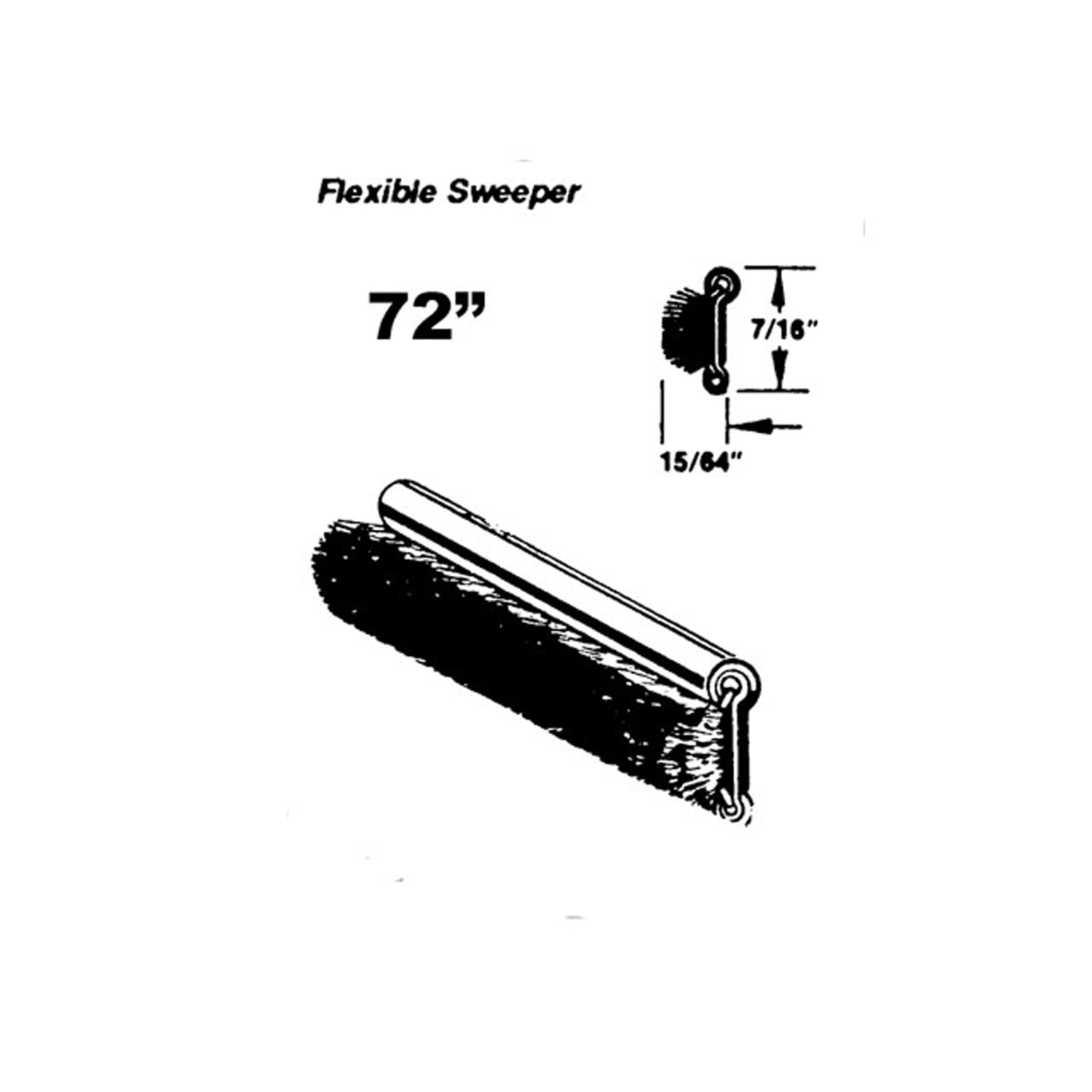 1936 Cadillac Series 75 Flexible sweeper. Made with stainless steel bead-WC 8-72Flexible sweeper. Made with stainless steel bead. Used on inner and outer beltlines. Also forms easily for use with sliding quarter windows. 72 in. long. Each. NOTE: $20 special shipping charge applies for domestic orders. Call or email for overseas shipping costs. Part can be sectioned into two equal lengths to reduce overseas shipping costs.
 1936 Cadillac Series 75 Fender Bolts. For use with Fender Bolt Washers; WF 3001-WF 3000Fender Bolts. For use with Fender Bolt Washers; WF 3001. Zinc Chromate plated, high strength. 1" X 5/16". Set of 25
 1936 Cadillac Series 75 Fender Bolt Washers. For use with Fender Bolts; WF 3000-WF 3001Fender Bolt Washers. For use with Fender Bolts; WF 3000. High quality, cadmium plated. 1-1/4" O.D., 3/8" I.D. Set of 25
Why Choose Metro?
For over 100 years, Metro Moulded Parts has been the pinnacle of quality in classic car restoration parts. Our commitment to precision and authenticity in every component ensures a perfect fit and an OEM-level appearance.
- Expert Craftsmanship & Quality: Each part is a testament to our dedication to reliability and perfection, crafted from original designs and thoroughly tested.
- Advanced Technology: We use cutting-edge techniques to create flawless, long-lasting parts that surpass others in performance.
- SuperSoft Sponge – The Ultimate Door Seal: Not only are our door seals 30% softer than competitors', but they're also guaranteed to never leak. They effectively reduce wind and road noise, enhancing your classic car's comfort and driving experience.
- Proudly American: Our parts are a product of American craftsmanship, made in the USA with a spirit of excellence and heritage.
- Unrivaled Warranty: We back our products with a 30-year industry-leading warranty, a testament to our confidence in their quality.
Join us in preserving the legacy of classic cars with parts that are crafted for perfection, not just made.