

Image of 1936 Cadillac Series 80, Note: These illustrations use artistic license and may differ from actual historical models.
Performance Metrics
Fundamental Metrics
Emotional Appeal
MMP Rating
| Engine Specifications | |
|---|---|
| Engine Options: | V-8 |
| Displacement Range: | 368 cubic inches |
| Horsepower Range: | Estimated 135-150 hp |
| Torque: | Not available |
| Compression Ratio: | 6.25:1 |
| Ignition System: | Battery and coil |
| Cooling System: | Liquid-cooled |
| Performance Specifications | |
| 0-60 Time: | Not available |
| 1/4 Mile Time: | Not available |
| Top Speed: | 85 mph |
| Transmission and Drive | |
| Drive Type: | Rear-wheel drive |
| Transmission Type: | 3-speed manual |
| Fuel and Efficiency | |
| Fuel System Type: | Carburetor |
| MPG: | Not available |
| Dimensions and Brakes | |
| Brakes: | Mechanical drum brakes |
| Wheelbase: | 131-149 inches |
| Weight: | 4,900-5,300 lbs |
Note: Specifications for classic cars are given to the best of our ability, considering the limited and variant data available.
1936 Cadillac Series 80: A V-12 Luxury Car Near the End of an Era
The 1936 Cadillac Series 80 delivered twelve-cylinder refinement at a moment when the great American luxury car was beginning to change. Built by Cadillac, General Motors’ flagship marque, it paired imposing prewar coachwork with a smooth 368-cubic-inch V-12. It was designed for buyers who valued quiet power and formal presence, not bargain pricing or sporting agility.
The Series 80 belonged to Cadillac’s V-12 range, positioned below the even more exclusive V-16 Series 90. Its engine and craftsmanship made it a standout in a shrinking world of multi-cylinder luxury cars. One especially intriguing detail is its timing: the 1936 model was part of the V-12’s final years, as Cadillac increasingly focused its engineering and sales effort on V-8 models.
Art Deco Cadillac Styling and Coachwork
The Series 80 wore the tall, confident proportions associated with luxury cars of the mid-1930s. Its long hood announced the V-12 beneath it, while a prominent upright grille, sweeping front fenders, separate headlamps, and carefully formed running boards gave the car a formal, almost architectural appearance. Chrome brightwork added sparkle without overwhelming the body’s substantial lines.
Cadillac’s 1936 design struck a balance between traditional luxury and streamlining. The fenders flowed more smoothly than those of earlier cars, and the body looked less like a carriage perched on a chassis. Depending on the coachwork, the roofline and rear body could be particularly elegant, with the long hood and cabin proportions doing much of the visual work.
Series 80 body styles included closed coupes and sedans, with variations in seating and coachwork. Cadillac and its Fleetwood body operation offered different levels of finish and customization, so equipment and details could differ from car to car. A handsome sedan was a natural choice for formal use, while coupes and convertible-style bodies gave the chassis a sportier, more personal character. Availability varied by catalog year and body configuration, so surviving examples should be identified by their original body tags and records rather than appearance alone.
Paint choices depended on the body and ordering options. Period Cadillacs could be specified in a range of deep, formal colors, including dark blues, greens, maroons, and black, with contrasting trim or two-tone treatments available on some combinations. Dark finishes were especially popular on formal luxury cars, but original color should be verified from factory documentation or hidden paint layers before a restoration.
V-12 Power and 1930s Luxury Features
The Series 80’s defining feature was its 368-cubic-inch, or approximately 6.0-liter, L-head V-12. Period specifications commonly list output at about 135 horsepower. The engine’s appeal was not simply its peak power: twelve cylinders delivered a remarkably even firing rhythm and a smooth, quiet character suited to long-distance touring.
A three-speed manual transmission sent power to the rear wheels. Cadillac’s engineering package also included hydraulic brakes and independent front suspension, features that helped distinguish the car from many older luxury designs. The 1936 body reflected the period’s move toward more integrated, all-steel construction, while the cabin combined generous space with high-quality upholstery, polished trim, and substantial fittings. Exact interior materials varied with body style and equipment, but the overall aim was comfort and finish rather than lightweight sportiness.
Why the Series 80 Mattered
The Series 80 showed how far Cadillac had taken the multi-cylinder luxury formula. A V-12 was expensive to build and maintain, but it offered refinement that a large V-8 could not quite duplicate. Cadillac’s twelve-cylinder cars helped establish the brand’s reputation for engineering prestige during the Depression-era luxury market, when a car’s smoothness, silence, and finish mattered as much as its acceleration.
By 1936, however, the market was changing. Buyers still wanted prestige, but the cost and complexity of V-12 and V-16 engines were increasingly difficult to justify. Cadillac’s more affordable Series 60, introduced for 1936, pointed toward a future in which excellent V-8 performance could serve a broader audience. The Series 80 therefore represents both the high point of Cadillac’s traditional multi-cylinder ambition and one of its last chapters.
It also captures a transition in automotive design. Its long hood, separate fenders, and upright grille preserve the classic prewar silhouette, while its smoother body surfaces and improved chassis reflect the industry’s gradual shift toward modern styling and better road manners.
1936 Cadillac Series 80 Performance and Road Manners
With about 135 horsepower and a substantial curb weight, the Series 80 was a fast luxury car for its day, but not a sports car. A sound, correctly tuned example is generally estimated to reach roughly 85 to 90 mph. A period-style 0-to-60-mph time is likely in the neighborhood of 20 seconds, though actual results depend heavily on body weight, gearing, mechanical condition, and how the car is driven. These are practical estimates, not guaranteed factory test figures.
On a smooth road, the V-12’s quietness is a major part of the experience. It gathers speed with a steady, unhurried surge, and the engine note is more subdued hum than aggressive bark. The suspension is tuned for comfort, absorbing ordinary road imperfections with the relaxed motion expected of a large luxury car. Deep potholes and broken pavement still make themselves known through the substantial chassis and tall tires.
On winding roads, the Series 80 rewards a measured approach. Its size, weight, and relatively tall body call for early braking and smooth steering inputs. It feels composed when driven with care, but it is not designed to change direction like a modern sports sedan. Behind the wheel, the driver encounters a large steering wheel, a commanding view over the long hood, and controls that demand more physical effort than a contemporary car. The result is an involving, deliberate drive rather than a hands-off cruise.
Owning a Cadillac Series 80 Today
Today, the Series 80 is best suited to touring, shows, club events, and carefully planned weekend drives. It can cover distance comfortably when properly sorted, but most owners do not use one as an everyday vehicle. Its size, fuel consumption, limited parts supply, and value as a historic car make regular modern traffic less appealing.
Maintenance is manageable for an experienced vintage-car enthusiast, but it is not a simple first restoration. The V-12 has more ignition and valve-train components than a V-8, and specialist knowledge can be valuable when diagnosing rough running or rebuilding the engine. Cooling-system condition, fuel delivery, ignition timing, brakes, and suspension should all be checked before regular road use. Mechanical work is possible, but some trim, body, and engine parts may be difficult or costly to source.
Reliability depends more on the quality of the restoration and ongoing maintenance than on the car’s original reputation. A well-maintained example can be dependable for touring, while a long-stored car may need extensive work before it is safe to drive. Buyers should seek a pre-purchase inspection from a mechanic familiar with prewar Cadillacs and verify that any claimed restoration is documented.
Rare Facts About the 1936 Series 80
The Series 80 was not Cadillac’s most expensive car in 1936. That distinction belonged to the V-16 Series 90, which sat above the V-12 in the model hierarchy. The Series 80 offered twelve-cylinder smoothness in a somewhat less exclusive package, although it remained a costly, prestigious automobile.
There is no widely recognized Series 80 speed or endurance record that defines the model’s story. Its significance is instead tied to Cadillac’s engineering and the short-lived prestige of the V-12 in American production cars. Individual cars may have interesting ownership histories, but celebrity associations should be supported by documentation rather than assumed from a famous make or model.
Common criticisms are practical ones: the car is heavy, consumes fuel generously by modern standards, and can be expensive to restore. Its brakes, steering, and handling also require the driver to adapt to 1930s technology. Those drawbacks are part of the ownership experience, but they are balanced by the distinctive engine, striking presence, and craftsmanship.
1936 Cadillac Series 80 Value and Rarity
Production figures for individual body styles can be difficult to pin down, and published totals may vary according to how models and coachwork are counted. A reasonable working estimate is roughly 900 Series 80 cars for the 1936 model year, though that figure should be treated as an estimate rather than a definitive factory total. Many have disappeared, and the number of surviving, roadworthy examples is much smaller.
Collector values vary substantially with body style, originality, condition, restoration quality, and documentation. As a broad current-market estimate, a project car might bring about $20,000 to $50,000. A usable or partially restored example could fall around $60,000 to $120,000, while a high-quality restoration may reach roughly $120,000 to $250,000 or more. Exceptional, highly original, or especially desirable coachbuilt cars can exceed that range. These are general estimates, not appraisals, and a specific car’s history can shift its value considerably.
The market is best described as selective rather than uniformly rising. Top-quality prewar Cadillacs remain attractive to collectors, but major restoration costs can exceed the market value of an average example. Over time, the best cars are likely to remain the most resilient, while projects and mediocre restorations may be harder to sell at a premium. Condition, provenance, and mechanical health matter more than simply having a V-12.
The Cadillac Series 80 Legacy
The 1936 Cadillac Series 80 combined a smooth V-12, substantial craftsmanship, and elegant prewar styling in one of Cadillac’s last great twelve-cylinder offerings. It was not built for economy or sharp cornering. It was built to make distance feel effortless and to remind everyone nearby that Cadillac stood at the top of the American luxury-car world.
For collectors, its appeal lies in that combination of engineering ambition and historical timing. The Series 80 is a striking reminder of an era when prestige could be measured in cylinders, coachwork, and the quiet confidence of a long, powerful hood.
1936 Cadillac Series 80 Catalog of Parts
 1936 Cadillac Series 80 Spring and Shackle Bushing-BN 22Spring and Shackle Bushing. For front or rear eyes on rear leaf spring. 1-3/4" bottom O.D X 1-3/8" high, with 3/4" I.D. Each
 1936 Cadillac Series 80 Upper Door Hinge Post Bumper. Held by screw-DB 60-AUpper Door Hinge Post Bumper. Held by screw. 7/8" diameter X 1/8" thick. Each
 1936 Cadillac Series 80 Inner and Outer Center Division Bar Seals-DP 20Inner and Outer Center Division Bar Seals. Each piece 14-1/4" long. Set
 1936 Cadillac Series 80 Gas filler grommet. Fits all models '36 Buick-GF 25Gas filler grommet. Fits all models '36 Buick. Fits '37 Buick Series 80/90. 2-1/8 in. ID; 4 in. OD. Dense black rubber. Each.
 1936 Cadillac Series 80 Rear Hood Corners. 1-1/4" wide. Pair-HC 29Rear Hood Corners. 1-1/4" wide. Pair
 1936 Cadillac Series 80 Windshield and Rear Window Channel. Used with 1/4" glass-LP 105Windshield and Rear Window Channel. Used with 1/4" glass. Fits some models. Sold by the foot
 1936 Cadillac Series 80 Trunk Seal. Sponge rubber. Sold by the foot.-LP 96-/FTTrunk Seal. Sponge rubber. Sold by the foot.
 1936 Cadillac Series 80 Rumble Seat Step Plate Bracket Pad-MP 348-BRumble Seat Step Plate Bracket Pad. 3-1/8" wide X 4-7/8" long. Each
 1936 Cadillac Series 80 Tail-Light Pads. 2" wide X 8-1/2" long. Pair-MP 360Tail-Light Pads. 2" wide X 8-1/2" long. Pair
 1936 Cadillac Series 80 Rumble Seat Step Plate Bracket. 4-1/2" wide X 4-1/4" long-MP 374-BRumble Seat Step Plate Bracket. 4-1/2" wide X 4-1/4" long. Each
 1936 Cadillac Series 80 Headlight Pads. 3-3/8" wide X 7-7/8" long. Pair-MP 380Headlight Pads. 3-3/8" wide X 7-7/8" long. Pair
 1936 Cadillac Series 80 Rumble Seat Step Plate Bracket Pad. Each-MP 380-ARumble Seat Step Plate Bracket Pad. Each
 1936 Cadillac Series 80 Headlight Pads. 3-1/4" wide X 11" long. Pair-MP 383Headlight Pads. 3-1/4" wide X 11" long. Pair
 1936 Cadillac Series 80 Park Light Pads. 2" wide X 11-1/2" long. Pair-MP 431Park Light Pads. 2" wide X 11-1/2" long. Pair
 1936 Cadillac Series 80 Tail-light Pads. 1-7/8" wide X 4-1/2" long. Pair-MP 432Tail-light Pads. 1-7/8" wide X 4-1/2" long. Pair
 1936 Cadillac Series 80 Headlight Pads. 3-1/4" wide X 6-5/8" long. Pair-MP 433Headlight Pads. 3-1/4" wide X 6-5/8" long. Pair
 1936 Cadillac Series 80 Door Handle Ferrule Grommet. I.D. 11/16", O.D. 1-3/16"-MP 546-IDoor Handle Ferrule Grommet. I.D. 11/16", O.D. 1-3/16". Each
 1936 Cadillac Series 80 Windshield Wiper Transmission Pad-MP 546-YWindshield Wiper Transmission Pad. 2-1/2" wide X 1-1/4" long. Each
 1936 Cadillac Series 80 Cowl Vent Seal. 3-1/4" wide X 15-5/8" long. Each-RP 100-JCowl Vent Seal. 3-1/4" wide X 15-5/8" long. Each
 1936 Cadillac Series 80 Door Lock Knob. Brown. 1/2" diameter X 1" long X 1/8" hole-RP 303Door Lock Knob. Brown. 1/2" diameter X 1" long X 1/8" hole. Each
 1936 Cadillac Series 80 Door Bumper. 1" diameter X 1/4" thick Each-SB 60Door Bumper. 1" diameter X 1/4" thick Each
 1936 Cadillac Series 80 Spare Tire Mount Bumper. 5/8" square. Each-SB 80Spare Tire Mount Bumper. 5/8" square. Each
 1936 Cadillac Series 80 Firewall grommet for headlight and tail-light wires-SM 34Firewall grommet for headlight and tail-light wires. Fits 11/16" hole. 5/16" I.D., 15/16" O.D. Each
 1936 Cadillac Series 80 Trunk seal. '36-'40 GM coupes and convertibles only-TK 58-A/18Trunk seal. '36-'40 GM coupes and convertibles only. Does not fit Buick models (order LP 58-L per foot). 3/4 in. W x 1/2 in. Thk x 18 ft. L. Each.
 1936 Cadillac Series 80 Trunk Seal for Coupes and Convertibles Only-TK 58-B/18Trunk Seal for Coupes and Convertibles Only. 1" wide X 1/2" thick. Each
 1936 Cadillac Series 80 Trunk Seal, for Sedans. Each-TK 96-15Trunk Seal, for Sedans. Each
 1936 Cadillac Series 80 Vertical Seal for Vent Window. Each is 17" long. Pair-VS 2Vertical Seal for Vent Window. Each is 17" long. Pair
 1936 Cadillac Series 80 Flexible glass-run channel-WC 11-72Flexible glass-run channel. Mohair lined, cloth covered with stainless steel bead. Used on side windows. 72 in. long. Each. NOTE: $20 special shipping charge applies for domestic orders. Call or email for overseas shipping costs. Part can be sectioned in two equal lengths to reduce overseas shipping costs.
 1936 Cadillac Series 80 Rigid division-bar channel. Made with stainless steel bead-WC 2-72Rigid division-bar channel. Made with stainless steel bead. 72 in. long. Each. NOTE: $20 special shipping charge applies for domestic orders. Call or email for overseas shipping costs. Part can be sectioned into two equal lengths to reduce overseas shipping costs.
 1936 Cadillac Series 80 Flexible Rubber Window Channel-WC 32-14Flexible Rubber Window Channel. For Fisher Closed Bodies, except those using a stainless bead type. Used on side windows. 13/16" outer width X 6/16" outer depth, with a 5/16" inner channel width X 14" long. Each
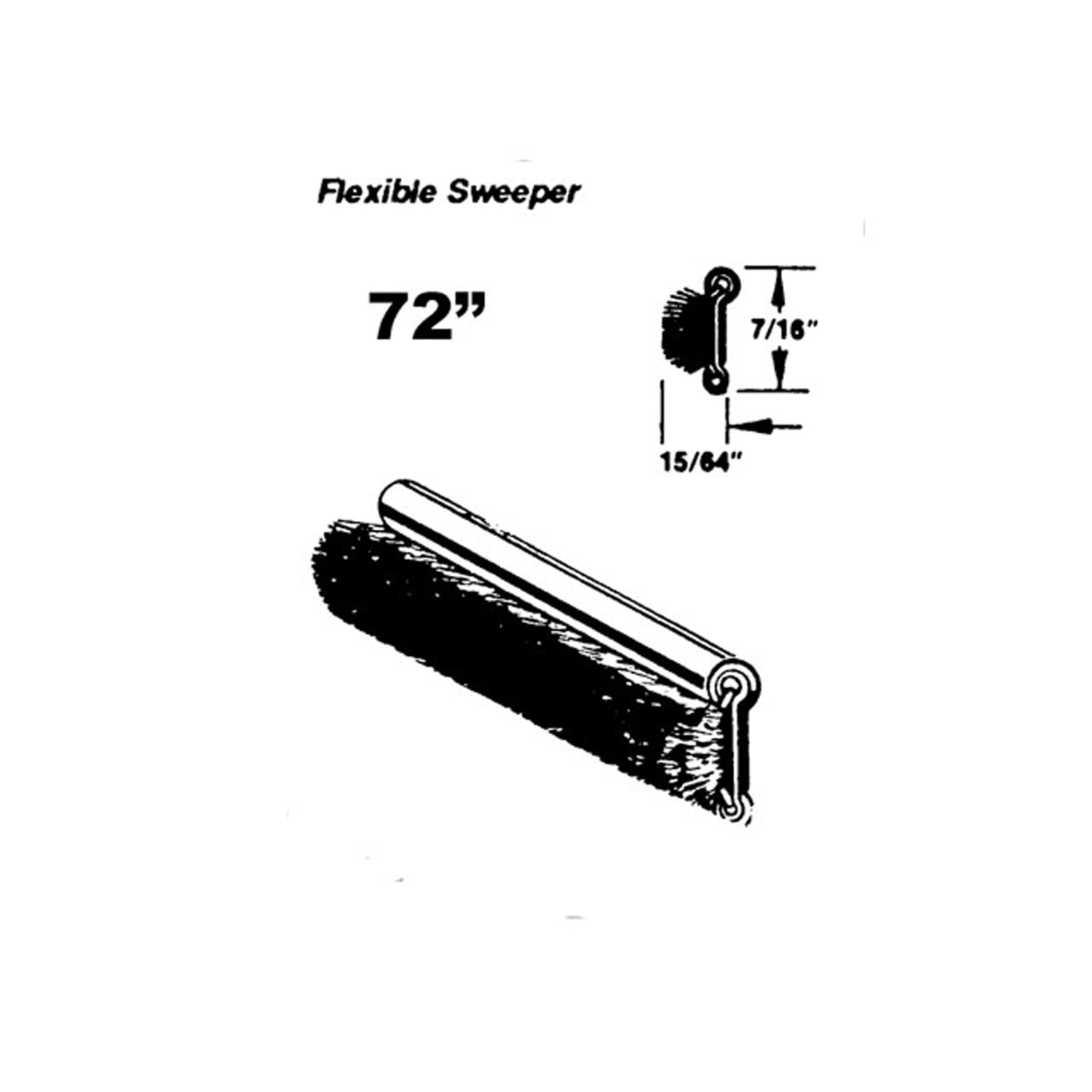 1936 Cadillac Series 80 Flexible sweeper. Made with stainless steel bead-WC 8-72Flexible sweeper. Made with stainless steel bead. Used on inner and outer beltlines. Also forms easily for use with sliding quarter windows. 72 in. long. Each. NOTE: $20 special shipping charge applies for domestic orders. Call or email for overseas shipping costs. Part can be sectioned into two equal lengths to reduce overseas shipping costs.
 1936 Cadillac Series 80 Fender Bolts. For use with Fender Bolt Washers; WF 3001-WF 3000Fender Bolts. For use with Fender Bolt Washers; WF 3001. Zinc Chromate plated, high strength. 1" X 5/16". Set of 25
 1936 Cadillac Series 80 Fender Bolt Washers. For use with Fender Bolts; WF 3000-WF 3001Fender Bolt Washers. For use with Fender Bolts; WF 3000. High quality, cadmium plated. 1-1/4" O.D., 3/8" I.D. Set of 25
Why Choose Metro?
For over 100 years, Metro Moulded Parts has been the pinnacle of quality in classic car restoration parts. Our commitment to precision and authenticity in every component ensures a perfect fit and an OEM-level appearance.
- Expert Craftsmanship & Quality: Each part is a testament to our dedication to reliability and perfection, crafted from original designs and thoroughly tested.
- Advanced Technology: We use cutting-edge techniques to create flawless, long-lasting parts that surpass others in performance.
- SuperSoft Sponge – The Ultimate Door Seal: Not only are our door seals 30% softer than competitors', but they're also guaranteed to never leak. They effectively reduce wind and road noise, enhancing your classic car's comfort and driving experience.
- Proudly American: Our parts are a product of American craftsmanship, made in the USA with a spirit of excellence and heritage.
- Unrivaled Warranty: We back our products with a 30-year industry-leading warranty, a testament to our confidence in their quality.
Join us in preserving the legacy of classic cars with parts that are crafted for perfection, not just made.