
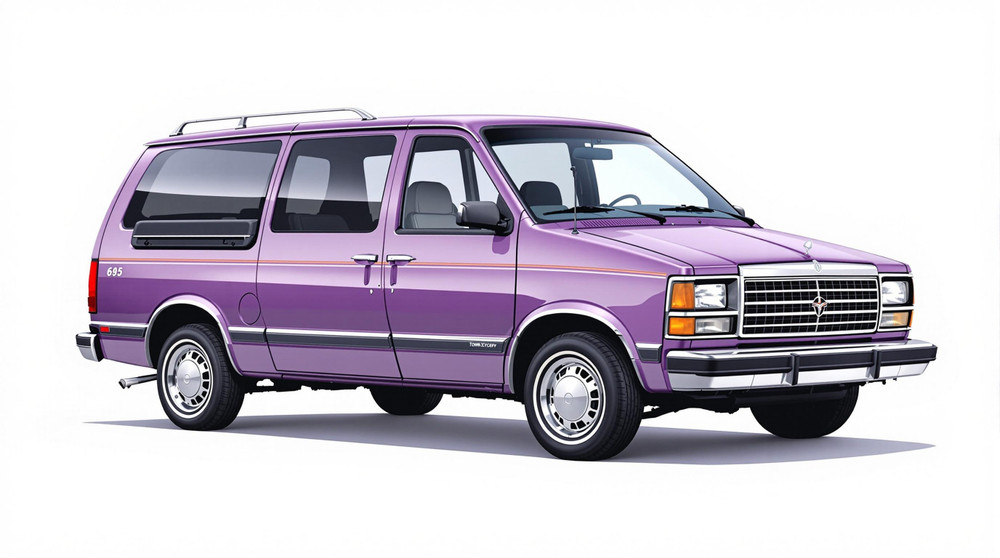
Image of 1985 Chrysler Town & Country, Note: These illustrations use artistic license and may differ from actual historical models.
Performance Metrics
Fundamental Metrics
Emotional Appeal
MMP Rating
| Engine Specifications | |
|---|---|
| Engine: | 2.2L I4, 2.6L I4 |
| Displacement: | 2.2 - 2.6L |
| Horsepower: | 96 - 114 hp |
| Torque: | 125 - 145 lb-ft |
| Compression Ratio: | 8.5:1 - 9.0:1 |
| Ignition System: | Electronic |
| Cooling System: | Liquid-cooled |
| Performance Specifications | |
| 0-60 Time: | 11 - 13 seconds |
| 1/4 Mile Time: | 18 - 20 seconds |
| Top Speed: | 105 - 110 mph |
| Transmission and Drive | |
| Drive Type: | FWD |
| Transmission Type: | 3-speed automatic, 5-speed manual |
| Fuel and Efficiency | |
| Fuel System Type: | Carburetor |
| MPG: | 20 - 25 mpg |
| Dimensions and Brakes | |
| Brakes: | Front disc, rear drum |
| Wheelbase: | 103.3 inches |
| Weight: | 2,600 - 2,800 lbs |
Note: Specifications for classic cars are given to the best of our ability, considering the limited and variant data available.
1985 Chrysler Town & Country: The Woodie That Went Front-Wheel Drive
By 1985, the Chrysler Town & Country had traded its postwar timber-and-chrome grandeur for a modern, front-wheel-drive shape, but it had not given up its signature woodgrain. The result was a distinctive American luxury car for an era of downsizing: part family hauler, part suburban status symbol, and a rolling reminder of Chrysler’s long-running “woodie” tradition.
Built by Chrysler Corporation, the 1985 Town & Country belonged to the LeBaron family. The name could be found on a woodgrain-trimmed station wagon and, in Chrysler’s limited-production convertible revival, a LeBaron convertible with matching faux-wood body accents. It was not a minivan. Although Chrysler’s first Dodge Caravan and Plymouth Voyager minivans arrived for 1984, the Town & Country name remained attached to the company’s woodgrain luxury cars.
That overlap makes the 1985 model an interesting snapshot of Chrysler in transition. The company was building its future around practical front-wheel-drive platforms while continuing to sell an old-fashioned idea of American luxury: a well-equipped car with the look of a country estate wagon. One memorable twist was the convertible version, which brought woodgrain styling to an open-top car, an unusual combination even by the standards of the 1980s.
LeBaron Lines and Woodgrain Style
The Town & Country’s appearance was less about chrome excess than about contrast. Its restrained LeBaron body wore broad woodgrain-look appliqué along the flanks, outlined by bright trim. On the wagon, the long roof and extended cargo area gave the car a practical, estate-car profile. The convertible took a very different approach: compact proportions, a folding fabric roof, and woodgrain panels that made it look like a modern interpretation of Chrysler’s classic Town & Country convertibles.
The wagon was the more useful and familiar body style, with a tailgate and generous cargo space for luggage, groceries, or weekend projects. The convertible was the more eye-catching choice, combining open-air motoring with the Town & Country’s country-club styling. Availability and equipment could vary by body style and market, so buyers should check the specific car’s original documentation rather than assume every 1985 example had identical features.
Color choices varied with configuration and order. Period-appropriate shades included whites, reds, blues, silvers, and darker tones, usually paired with contrasting woodgrain graphics. White and red examples are especially striking because the bright paint makes the wood-look trim stand out. On a survivor, the condition of the appliqué matters as much as the paint: peeling edges, faded panels, and mismatched replacement sections can quickly spoil the car’s carefully coordinated look.
A Comfortable 1980s Cabin
Inside, the Town & Country leaned toward comfort rather than sport. Depending on configuration and equipment, buyers could find plush cloth or velour upholstery, carpeting, padded surfaces, and a broad bench-seat layout. Convertible examples could have a more upscale feel, including leather-trimmed upholstery on some cars. The overall impression was soft and welcoming, especially compared with the firmer, more utilitarian interiors of many compact cars of the period.
Available conveniences could include power windows and locks, air conditioning, cruise control, and an AM/FM stereo or cassette system. These were useful luxuries, not exotic technology, but they helped make the car feel well appointed in everyday use. The front-wheel-drive layout also created a relatively flat floor and a cabin that made practical use of the car’s exterior dimensions.
By modern standards, the materials are a mix of durable hard trim and period-correct soft-touch surfaces, rather than the hand-finished wood and metal found in much earlier Town & Country models. The woodgrain is decorative, not structural. Still, a clean interior with intact seat upholstery, door panels, and dashboard trim can give the car a surprisingly polished presentation.
Front-Wheel Drive in a Woodie
The 1985 Town & Country reflected a major change in American car design. Earlier Town & Country models were known for large bodies and, in some generations, real wood construction. The 1980s cars instead used Chrysler’s modern front-wheel-drive architecture, with the engine mounted transversely and the wood look recreated with exterior appliqué. This made the Town & Country more efficient in its use of space and easier to maneuver than the big rear-wheel-drive wagons that had defined the name in earlier decades.
Four-cylinder engines were typical of the LeBaron-based cars. Depending on body style, equipment, and market, a 2.2-liter Chrysler four-cylinder or a 2.6-liter Mitsubishi-built four-cylinder could be found. Exact output and performance depend on the engine and transmission fitted to a particular car. These were tuned for everyday driving and reasonable economy, not high-speed performance.
Comfort and convenience equipment was more important than cutting-edge electronics. Features such as power accessories, cruise control, and upgraded audio were the kind of technology most owners noticed day to day. The larger historical innovation was underneath: Chrysler was using front-wheel drive to make a comparatively compact car feel roomy and useful, a formula that would become central to the company’s success in the 1980s.
Performance and Road Manners
A 1985 Town & Country is best understood as a relaxed cruiser. Depending on engine, transmission, vehicle condition, and load, a reasonable period-style estimate is roughly 13 to 16 seconds for 0 to 60 mph, with a top speed in the neighborhood of 95 to 105 mph. Those figures are approximate rather than a promise for every car. A tired engine, aging automatic transmission, or heavily loaded wagon will be slower.
The four-cylinder engine tends to sound busy when pushed, especially during highway acceleration, but settles into a steady hum at ordinary cruising speeds. The automatic transmission favors smooth, unhurried progress. The steering is light by older American-car standards, which helps in parking lots and tight streets, while the front-wheel-drive layout gives the car predictable behavior in normal conditions.
On rough pavement, the suspension is tuned more for comfort than sharp cornering. It can absorb ordinary bumps well, though worn bushings, tired shocks, and sagging springs can make an old example feel loose or floaty. On winding roads, body roll and modest tire grip encourage a measured pace. In crosswinds, the wagon’s broad sides can catch the breeze, so sound tires and tight suspension components make a noticeable difference.
The overall driving experience is pleasantly straightforward. You sit upright, have a good view of the road, and interact with controls designed for everyday use. The car does not invite hard driving; it invites a calm trip with the family, a load of luggage, and the stereo playing in the background.
Why the Town & Country Mattered
The 1985 model was part of a broader shift from large, rear-wheel-drive American cars to smaller, more space-efficient front-wheel-drive vehicles. Chrysler helped make that transition feel less austere by wrapping practical engineering in familiar luxury cues. The Town & Country’s woodgrain was a visual link to earlier generations, even as the car beneath it represented a very different approach to packaging and construction.
It also preserved the Town & Country identity during the years before the name became closely associated with Chrysler’s luxury minivan. That later minivan would carry the name into a new era, but the 1985 LeBaron-based cars show how Chrysler used the badge to bridge old and new ideas: traditional woodie styling on a modern platform.
What set the car apart from many contemporaries was not outright speed or technical complexity. It was the unusual pairing of front-wheel-drive practicality, upscale LeBaron trim, and unmistakable woodgrain. The result was a distinctive alternative to a plain family wagon, and a final chapter in the Town & Country’s long history as a symbol of American domestic comfort.
Living With a 1985 Town & Country
Today, these cars are most often used as weekend classics, local-show entries, or nostalgic cruisers. A sound wagon can still handle errands and light family duty, while the convertible is better suited to sunny-day drives and car gatherings. Neither is a sensible choice for racing, and hard use is likely to expose the limits of an aging suspension, modest power, and decades-old components.
Routine maintenance is familiar to most independent mechanics. Oil changes, brakes, belts, hoses, ignition parts, and many engine components are generally manageable jobs. The main challenge is often not mechanical complexity but age and parts availability. Body-specific trim, woodgrain appliqué, wagon hardware, convertible-top components, and interior pieces can be difficult to source in good condition.
Before buying, inspect for rust around the floors, wheel openings, lower body, and wagon tailgate area. Check the automatic transmission for delayed engagement or harsh shifts, and make sure the cooling system keeps the engine at a stable temperature. On a convertible, carefully examine the top fabric, frame, seals, and hydraulic operation if fitted. Test every power accessory, since diagnosing an electrical fault can take longer than replacing a common service part.
Woodgrain Trivia and Common Criticisms
The Town & Country name dates to the early 1940s, when Chrysler introduced wood-bodied models that became some of the best-known American “woodies.” By 1985, the visible wood was a simulated finish rather than structural timber. That change was practical: real wood required far more labor and upkeep, while decorative panels could preserve the look with less maintenance.
The convertible is among the most unusual versions of the 1980s Town & Country idea. It combined an open roof with woodgrain side trim, a styling move that was bold enough to be memorable and uncommon enough to attract attention at shows. Exact production figures for individual 1985 Town & Country configurations are not consistently published, so claims of a precise number should be treated cautiously.
Common criticisms include modest acceleration, an interior that feels dated by modern standards, and the vulnerability of the exterior woodgrain to age and weather. Some owners also find that replacement trim and convertible-specific parts are harder to locate than routine mechanical components. The flip side is that the car is relatively approachable mechanically and has a look that stands apart from more ordinary 1980s family cars.
Collector Values and Availability
The 1985 Town & Country is a niche collectible rather than a high-dollar muscle car. Values depend heavily on body style, originality, rust, mechanical condition, and the state of the woodgrain. As a broad U.S. market estimate for 2026, a running driver-quality wagon might sell for roughly $2,000 to $6,000. A well-kept, highly presentable wagon could bring about $7,000 to $12,000. A project with major mechanical or body needs may be worth less than $2,000.
The convertible generally attracts more attention because of its unusual combination of open-air styling and Town & Country trim. A usable example might fall around $5,000 to $12,000, while an exceptionally clean, original car could reach approximately $15,000 to $25,000 in the right sale. These are estimates, not guaranteed asking or sale prices, and a rare-looking car is not automatically a valuable one if it needs a costly restoration.
There is no dependable, widely cited production total for 1985 Town & Country cars separated by body style. A cautious best guess is that several thousand were built, with a rough combined estimate of 5,000 to 10,000 wagons and convertibles for the model year. That should be treated as an estimate, not an official factory figure. The cars are uncommon today, but patient buyers can still find them through enthusiast listings, classic-car dealers, and online auctions.
Prices are best described as stable to gradually strengthening for clean, original examples, rather than rapidly appreciating across the board. Exceptional convertibles and wagons with sound bodies, intact woodgrain, and documented history have the strongest collector appeal. Rough cars remain affordable because restoration costs can quickly exceed their market value.
A Distinctive Chapter in Chrysler History
The 1985 Chrysler Town & Country brought together two eras of American motoring. Its woodgrain recalled the grand woodies of the past, while its front-wheel-drive LeBaron platform reflected the practical engineering that was reshaping Chrysler’s future. Comfortable, recognizable, and a little unconventional, it was never about speed or exclusivity.
For today’s collector, its appeal lies in that contrast. The Town & Country is a reminder that a family car can carry a strong design identity, and that Chrysler managed to keep a classic name alive while changing almost everything beneath it.
1985 Chrysler Town & Country Catalog of Parts
 1985 Chrysler Town & Country Side slider door seal. Each.-LM 102-VSSide slider door seal. Each.
Why Choose Metro?
For over 100 years, Metro Moulded Parts has been the pinnacle of quality in classic car restoration parts. Our commitment to precision and authenticity in every component ensures a perfect fit and an OEM-level appearance.
- Expert Craftsmanship & Quality: Each part is a testament to our dedication to reliability and perfection, crafted from original designs and thoroughly tested.
- Advanced Technology: We use cutting-edge techniques to create flawless, long-lasting parts that surpass others in performance.
- SuperSoft Sponge – The Ultimate Door Seal: Not only are our door seals 30% softer than competitors', but they're also guaranteed to never leak. They effectively reduce wind and road noise, enhancing your classic car's comfort and driving experience.
- Proudly American: Our parts are a product of American craftsmanship, made in the USA with a spirit of excellence and heritage.
- Unrivaled Warranty: We back our products with a 30-year industry-leading warranty, a testament to our confidence in their quality.
Join us in preserving the legacy of classic cars with parts that are crafted for perfection, not just made.