
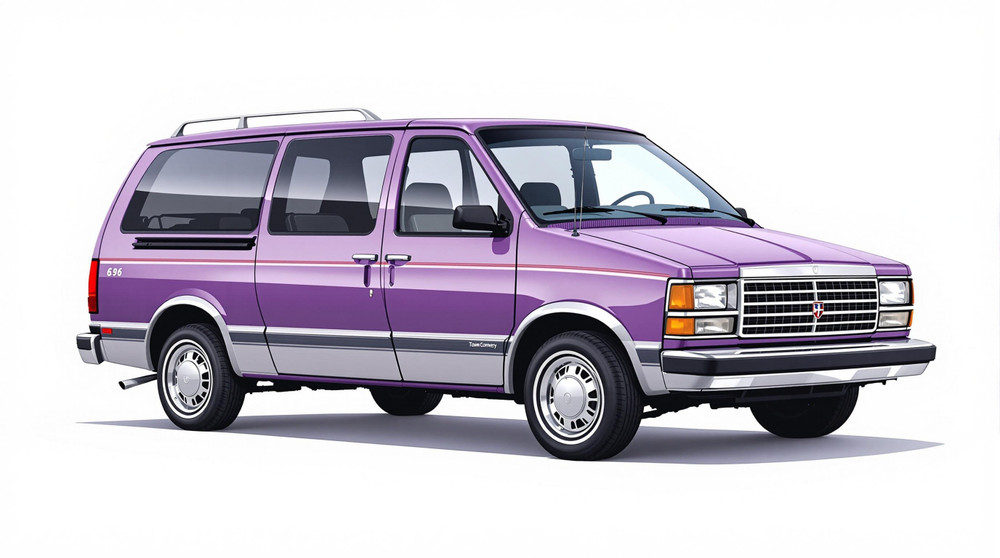
Image of 1986 Chrysler Town & Country, Note: These illustrations use artistic license and may differ from actual historical models.
Performance Metrics
Fundamental Metrics
Emotional Appeal
MMP Rating
| Engine Specifications | |
|---|---|
| Engine Options: | 2.2L 4-cylinder, 2.6L 4-cylinder |
| Displacement Range: | 2.2L - 2.6L |
| Horsepower Range: | 96-146 HP |
| Torque: | 125-170 lb-ft |
| Compression Ratio: | 8.9:1 - 9.5:1 |
| Ignition System: | Electronic |
| Cooling System: | Liquid-cooled |
| Performance Specifications | |
| 0-60 Time: | 11-13 seconds |
| 1/4 Mile Time: | 18-20 seconds |
| Top Speed: | 105-110 mph |
| Transmission and Drive | |
| Drive Type: | FWD (Front Wheel Drive) |
| Transmission Type: | 3-speed automatic, 5-speed manual |
| Fuel and Efficiency | |
| Fuel System Type: | Fuel Injection |
| MPG: | 17-20 city / 24-27 highway |
| Dimensions and Brakes | |
| Brakes: | Front Disc / Rear Drum |
| Wheelbase: | 103.3 inches |
| Weight: | 2,600-2,800 lbs |
Note: Specifications for classic cars are given to the best of our ability, considering the limited and variant data available.
1986 Chrysler Town & Country: The Woody Wagon Before the Minivan
The 1986 Chrysler Town & Country brought a familiar slice of American wagon style into a new front-wheel-drive era: a practical family hauler dressed up with simulated woodgrain and upscale trim. It was part of Chrysler’s LeBaron wagon family, built during the company’s K-car years, when compact, efficient vehicles were central to Chrysler’s recovery.
The Town & Country name had a much older and more glamorous history. Chrysler first used it in the 1940s for high-end wagons with genuine wood bodies. By 1986, real wood had given way to durable wood-look appliqué, but the badge still suggested comfort and a touch of country-club polish. One notable twist is that the Town & Country name would soon move from a traditional wagon to Chrysler’s luxury minivan, introduced for the 1990 model year.
LeBaron Roots and K-Car Practicality
The 1986 Town & Country was a front-wheel-drive wagon related to Chrysler’s LeBaron and other K-platform cars. That connection mattered. Chrysler’s K-cars helped the company compete with smaller, more fuel-efficient vehicles during a difficult period for American automakers. The Town & Country applied that practical engineering to a family wagon, offering useful cargo space without the bulk and fuel appetite of a full-size, rear-wheel-drive estate car.
It was not a separate platform or a single-purpose luxury model. Think of it as the wagon-shaped member of the LeBaron family, with Town & Country trim adding the distinctive woody appearance and a more dressed-up cabin. The minivan that later carried the same name was a different vehicle altogether.
Woodgrain Style and Wagon Details
The wagon’s most recognizable feature was its broad wood-look body-side trim. Framed by bright moldings, the appliqué ran along the flanks and gave the car the classic “woody” profile without the upkeep of real timber. The long roof, upright tailgate, and large side windows emphasized function, while the grille, chrome accents, and LeBaron-derived front styling helped it look more refined than a basic utility wagon.
Exterior paint choices varied by market and equipment, but Town & Country examples commonly paired the woodgrain with colors such as white, silver, red, blue, or muted metallic shades. Light colors made the wood trim especially prominent, while darker paint gave the wagon a more understated look. The faux wood is a key part of the car’s character, so its condition matters: faded, cracked, or peeling appliqué can make an otherwise sound example look tired.
The 1986 Town & Country was a four-door station wagon, rather than a choice of multiple body styles under one model name. Chrysler’s broader Town & Country history includes other types of vehicles, but the LeBaron-based wagon is the version most relevant to this model year. Its long roof and rear cargo area made it the practical choice for families, road trips, and hauling bulky everyday items.
A Comfortable, Period-Style Cabin
Inside, the wagon favored comfort and straightforward controls over modern gadgetry. Depending on equipment, buyers could find supportive cloth upholstery, upgraded trim, power accessories, air conditioning, cruise control, and an AM/FM sound system. Some cars were fitted with more luxurious seat and interior materials, but equipment varied, so it is best to check the individual car rather than assume every Town & Country had the same specification.
The dashboard reflected the era’s move toward more integrated, driver-focused controls. It was not a screen-heavy cabin, of course. The technology highlights were practical features such as electronic fuel management, power conveniences, and available cruise control. A well-equipped example could feel pleasantly civilized for the mid-1980s, especially compared with a bare-bones economy wagon.
Performance and Road Manners
Most examples are associated with Chrysler’s naturally aspirated 2.2-liter four-cylinder engine, paired with a three-speed automatic transmission and front-wheel drive. Engine availability and output could vary with equipment and market, so the car’s VIN, emissions label, and build documentation are the best sources for confirming a particular wagon’s specification.
With roughly 90 to 100 horsepower in common non-turbo configurations, the Town & Country was built for steady transport rather than quick acceleration. Period performance estimates for a typical car put the 0-to-60-mph run in the neighborhood of 13 to 15 seconds, with a top speed around 100 to 105 mph. Those figures are estimates, not guaranteed results, and depend on engine, gearing, condition, and test method.
On the road, the four-cylinder engine makes a modest, workmanlike sound, and the automatic transmission favors smooth progress over sporty response. The front-wheel-drive layout gives predictable traction in rain and light snow, while the long roof and soft suspension help the wagon settle into relaxed highway cruising. Over broken pavement, it tends to absorb bumps better than it attacks corners. On a winding road, expect body roll and some understeer rather than sharp turn-in. Crosswinds can also remind the driver that this is a tall, boxy wagon.
The driving experience is best described as easygoing and practical. Steering and braking feel firmly rooted in the 1980s, with less precision and feedback than a modern car. In return, the Town & Country offers a useful view out, a comfortable ride, and the reassuring simplicity of a conventional wagon layout.
Why the Town & Country Mattered
The 1986 wagon represents a transitional moment in American family transportation. Chrysler had used compact front-wheel-drive engineering to make practical cars with less weight and smaller engines than traditional full-size wagons. At the same time, the rising popularity of minivans was beginning to change what families expected from a people-mover.
The Town & Country’s combination of K-car economy, wagon utility, and wood-look luxury was a distinctly Chrysler solution. It was not a technological revolution on its own, but it reflects the company’s broader shift toward efficient front-drive vehicles. Its name also provides a neat link between two eras: the traditional woody wagon and the premium minivan that would become one of Chrysler’s most recognizable family vehicles.
Living With a 1986 Town & Country
Today, these wagons are most often used as occasional drivers, nostalgia vehicles, or informal show cars. They are not common choices for racing or heavy-duty hauling. A sound example can still handle local driving and relaxed trips, but its age makes condition more important than the model’s original reputation for practicality.
Routine mechanical work is generally approachable for an owner with basic tools and experience. The four-cylinder engine and front-drive layout are familiar to many mechanics, and some service parts overlap with other Chrysler K-platform cars. Wagon-specific trim, glass, tailgate parts, and woodgrain panels can be harder to locate. Before buying, inspect for rust around the floor, rocker panels, wheel arches, tailgate, and windshield area. Also check for cooling-system problems, oil or coolant leaks, aging electrical connections, worn suspension components, and transmission issues.
Originality affects value. A complete car with intact trim, a clean interior, and its factory-style woodgrain is more appealing than a mechanically sound wagon with missing body pieces. Reproduction or donor parts may help, but finding a clean, matching set of wagon-specific exterior details can take patience.
Trivia, Rarity, and Common Criticisms
The Town & Country badge is older than the modern minivan by nearly half a century. Its original association with wood-bodied luxury wagons makes the 1986 model a useful reminder of how automakers adapted old names to new designs. The woodgrain on this car is simulated, but that is part of its period-correct charm.
There is no widely cited, reliable production total specifically for 1986 LeBaron Town & Country wagons. As a rough estimate rather than a factory-confirmed figure, production may have been in the low thousands, perhaps around 2,000 to 6,000 examples. The number of surviving, presentable cars is certainly smaller, since ordinary family wagons were often driven hard and discarded rather than preserved.
Common criticisms include modest acceleration, dated interior plastics, aging electrical systems, and handling that prioritizes comfort over control. The wood-look trim can also be a maintenance headache if it has deteriorated. There is no famous speed record or major historical-event appearance attached to the model. Its appeal is quieter: it is a snapshot of Chrysler’s K-car era and of the last generation of traditional wood-trimmed family wagons before minivans took over much of the market.
Collector Value and Market Outlook
As a niche classic, the 1986 Town & Country is usually affordable compared with collectible muscle cars or high-performance Chryslers. In the U.S. market, a project or rough driver might sell for about $1,000 to $2,500. A presentable, roadworthy example could bring roughly $3,000 to $6,000, while an unusually clean, original wagon with excellent woodgrain and interior trim might reach $7,000 to $10,000 or more in the right sale. These are broad estimates, and location, rust, equipment, and documentation can move the price significantly.
The model is uncommon, but not so rare that every example automatically commands a premium. Values have generally stayed modest, though clean and unusual wagons are attracting more interest as buyers look beyond the usual muscle-car and pickup-truck classics. The best examples may appreciate gradually, but condition and originality will matter more than simply owning the badge.
A Small Wagon With a Long Legacy
The 1986 Chrysler Town & Country combines practical K-car engineering with one of the most recognizable styling ideas in American wagon history. It is comfortable, useful, and unmistakably of its time, with modest performance and a personality built around easygoing family travel rather than speed.
For collectors, it offers an affordable way to preserve a disappearing kind of car: the compact, wood-trimmed American wagon. And in the Town & Country name, it carries a story that runs from genuine wood-bodied luxury cars to the minivans that reshaped family motoring.
1986 Chrysler Town & Country Catalog of Parts
 1986 Chrysler Town & Country Side slider door seal. Each.-LM 102-VSSide slider door seal. Each.
Why Choose Metro?
For over 100 years, Metro Moulded Parts has been the pinnacle of quality in classic car restoration parts. Our commitment to precision and authenticity in every component ensures a perfect fit and an OEM-level appearance.
- Expert Craftsmanship & Quality: Each part is a testament to our dedication to reliability and perfection, crafted from original designs and thoroughly tested.
- Advanced Technology: We use cutting-edge techniques to create flawless, long-lasting parts that surpass others in performance.
- SuperSoft Sponge – The Ultimate Door Seal: Not only are our door seals 30% softer than competitors', but they're also guaranteed to never leak. They effectively reduce wind and road noise, enhancing your classic car's comfort and driving experience.
- Proudly American: Our parts are a product of American craftsmanship, made in the USA with a spirit of excellence and heritage.
- Unrivaled Warranty: We back our products with a 30-year industry-leading warranty, a testament to our confidence in their quality.
Join us in preserving the legacy of classic cars with parts that are crafted for perfection, not just made.