
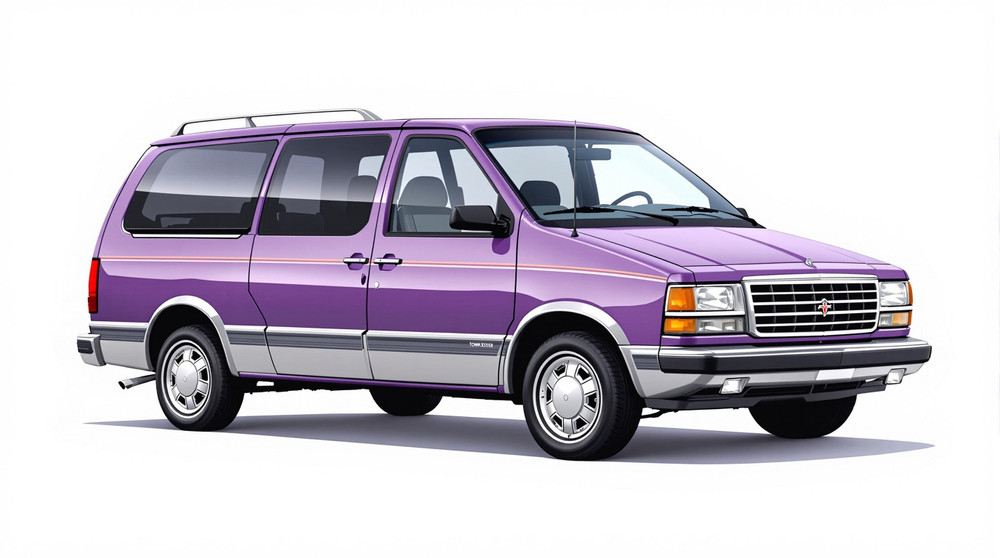
Image of 1987 Chrysler Town & Country, Note: These illustrations use artistic license and may differ from actual historical models.
Performance Metrics
Fundamental Metrics
Emotional Appeal
MMP Rating
| Engine Specifications | |
|---|---|
| Engine Options: | 2.2L 4-cylinder, 2.6L 4-cylinder |
| Displacement Range: | 2.2L - 2.6L |
| Horsepower Range: | 96-146 HP |
| Torque: | 125-170 lb-ft |
| Compression Ratio: | 8.9:1 - 9.5:1 |
| Ignition System: | Electronic |
| Cooling System: | Liquid-cooled |
| Performance Specifications | |
| 0-60 Time: | 11-13 seconds |
| 1/4 Mile Time: | 18-20 seconds |
| Top Speed: | 105-110 mph |
| Transmission and Drive | |
| Drive Type: | FWD (Front Wheel Drive) |
| Transmission Type: | 3-speed automatic, 5-speed manual |
| Fuel and Efficiency | |
| Fuel System Type: | Fuel Injection |
| MPG: | 17-20 city / 24-27 highway |
| Dimensions and Brakes | |
| Brakes: | Front Disc / Rear Drum |
| Wheelbase: | 103.3 inches |
| Weight: | 2,800-3,000 lbs |
Note: Specifications for classic cars are given to the best of our ability, considering the limited and variant data available.
1987 Chrysler Town & Country: The K-Car in Its Sunday Best
The 1987 Chrysler Town & Country brought a familiar American luxury-car flourish to a practical front-wheel-drive platform: simulated woodgrain, extra comfort equipment, and a name with deep roots in Chrysler history. For this model year, Town & Country was not a separate platform. It identified an upscale version of Chrysler’s LeBaron, most commonly encountered as a five-door station wagon.
The name had once belonged to grand, wood-bodied Chrysler wagons. By the 1980s, real structural wood had given way to practical wood-look trim, but the idea remained the same: combine useful carrying capacity with a polished, almost resort-bound style. A distinctive detail is that the Town & Country name also appeared on LeBaron convertibles during this era, so period advertisements and used-car listings can use the label in more than one way. Check the body style, VIN, and original equipment documents when identifying a particular car.
Woodgrain Meets the K-Car
The wagon’s shape was clean and unmistakably 1980s. Its long roof, upright rear hatch, broad side glass, and practical cargo area gave it a conventional family-wagon profile, while the LeBaron’s squared-off nose and restrained brightwork added a more formal look. The signature feature was its wood-look body-side trim, usually framed by narrow moldings. It was a visual nod to Chrysler’s classic “woodie” wagons without the upkeep of real timber.
Town & Country examples were commonly finished in light, tasteful colors that showed off the woodgrain, including white, cream, silver, and shades of blue. Actual availability varied by paint code and equipment, and survivors may have been repainted over the decades. The contrast between pale paint, simulated wood, and bright trim is especially associated with the model’s period look.
Inside, the LeBaron wagon offered a more comfortable environment than a bare-bones utility vehicle. Depending on equipment, buyers could find cloth upholstery, carpeting, a folding rear seat, air conditioning, power windows and locks, cruise control, and an upgraded stereo. The materials were appropriate to a mainstream luxury trim of the time: soft-touch and padded surfaces where occupants interacted with them, patterned cloth, and molded plastics elsewhere. This was not hand-finished luxury, but it felt a step above a basic economy wagon.
Convenience features reflected the technology of the period. Front-wheel drive helped make the cabin and cargo area more usable, while automatic transmissions, power accessories, and available cruise control made longer trips easier. Some cars were fitted with electronic or upgraded instrument and audio equipment, but exact features depended on the original order. The Town & Country’s most visible innovation was less about electronics than packaging: Chrysler dressed an efficient, compact-platform wagon to feel like a small luxury cruiser.
LeBaron Roots and Chrysler’s Recovery
The Town & Country wagon was part of the LeBaron family, which used Chrysler’s compact front-wheel-drive architecture and shared engineering with the company’s broader K-car program. That platform strategy was central to Chrysler’s recovery in the early 1980s. Common components helped the company control costs and offer a wide range of vehicles, from practical family cars to better-equipped models such as the LeBaron.
The 1987 Town & Country was therefore a meeting point between two Chrysler identities. Its mechanical layout belonged to the modern, economical era of front-wheel drive, while its name and woodgrain styling recalled the prestige and leisure imagery of earlier Town & Country wagons. It was not a groundbreaking performance car, but it helped make the practical station wagon feel less utilitarian at a time when buyers were increasingly drawn to minivans and other versatile family vehicles.
That balance is what sets it apart from many contemporaries. The Town & Country offered wagon usefulness without the bulky dimensions of a full-size American estate car, and it brought upscale trim to a more compact package. Its influence is best understood as part of Chrysler’s broader move toward efficient, family-oriented vehicles rather than as a single design revolution.
Engines, Speed, and Road Manners
Engine and transmission specifications depended on the exact LeBaron body style and equipment. Typical 1987 LeBaron power came from Chrysler’s four-cylinder engines, including naturally aspirated 2.2-liter and 2.5-liter versions. Turbocharged 2.2-liter engines were also part of the wider LeBaron range, though buyers should verify whether a particular Town & Country wagon was factory-equipped with one rather than assuming that every car carrying the trim had turbo power. Most wagons were oriented toward relaxed everyday driving, not outright speed.
As a practical estimate, a naturally aspirated wagon in sound condition is likely to reach 0 to 60 mph in roughly 11 to 14 seconds, with a top speed in the neighborhood of 100 to 110 mph. A turbocharged LeBaron can be considerably quicker, with performance varying by engine version, transmission, and condition. These are broad estimates rather than guaranteed factory test figures. Aged components, emissions equipment, tire condition, and transmission health can make a major difference today.
On the road, the Town & Country feels light and manageable compared with a traditional rear-wheel-drive wagon. Front-wheel drive gives it predictable traction in rain and on slick pavement, while its compact footprint makes parking and urban errands straightforward. The suspension is tuned for comfort, so it generally takes ordinary road imperfections without drama. On rough pavement, however, worn bushings, tired struts, or aging tires can make the car feel loose or noisy.
Windy roads are not its natural habitat. The steering and suspension favor easy cruising over sharp responses, and a tall wagon body can lean more than a modern crossover. The experience is best described as calm and unhurried: the four-cylinder engine produces a modest working hum, the cabin is designed to keep the ride comfortable, and the driver’s job is mostly to steer, monitor the gauges, and enjoy the visibility. A turbocharged version adds a more pronounced surge when boost arrives, but it remains a comfortable road car rather than a sports wagon.
Living With a 1987 Town & Country
Today, the Town & Country makes the most sense as a vintage daily driver for someone who enjoys 1980s cars, a weekend cruiser, or a conversation-starting show vehicle. Its cargo space and upright glass make it useful for light hauling, but an original survivor is better treated with care than used as a workhorse. It is not a natural choice for racing, and modifications can quickly reduce its appeal to collectors who value originality.
Routine maintenance is familiar to many independent mechanics. The four-cylinder layout is relatively accessible, and basic service items such as filters, belts, plugs, and brakes are generally straightforward. The bigger challenge is the age of the car and the availability of model-specific trim. Engine and transmission parts may be easier to source than correct woodgrain appliqué, exterior moldings, interior panels, or wagon-specific glass and hardware.
Before buying, inspect the cooling system, transmission operation, electrical accessories, suspension, and body for rust. Pay particular attention to the floors, lower body seams, wheel openings, and the areas around the rear hatch. Check the simulated woodgrain for lifting, fading, or mismatched replacement sections. A well-kept car can be enjoyable, but neglected examples often need accumulated repairs that cost more than their modest market value.
Trivia, Misconceptions, and Common Complaints
The Town & Country name dates to Chrysler’s prewar wood-bodied wagons, making the 1987 model part of a long-running nameplate rather than a new model invented for the decade. Its wood-look trim was a deliberate styling reference, not structural wood. That makes it easier to maintain than a genuine wood-bodied classic, though the decorative material itself can still be difficult to replace in a factory-correct finish.
There is no widely recognized speed, endurance, or sales record associated specifically with the 1987 Town & Country. Nor is it commonly linked to a major historical event or a famous celebrity owner. Its appeal is quieter: it represents Chrysler’s practical, front-wheel-drive era and the company’s effort to carry a traditional luxury image into a more fuel-conscious market.
Common criticisms include modest acceleration from naturally aspirated versions, a ride and handling balance that favors comfort over precision, and aging electrical or trim components. The woodgrain can look dated to some people, though that same feature is a major part of the car’s charm for enthusiasts. Another source of confusion is the Town & Country name’s use on different Chrysler body styles, including LeBaron convertibles. Documentation matters when originality or value is important.
Collector Value and Rarity
Exact production figures for the 1987 Town & Country trim are not consistently published, so any model-specific total should be treated as an estimate. A reasonable working guess is that production was in the low thousands, perhaps around 2,000 to 5,000 wagons, rather than a mass-market volume comparable to ordinary LeBarons. This is an informed estimate, not a confirmed factory count. Surviving examples in sound, original condition are less common than the broad LeBaron family’s production might suggest.
In today’s collector market, condition and originality matter more than mileage alone. A rough or incomplete car may sell for about $1,000 to $3,000, while a usable driver with sound mechanicals and presentable trim might bring roughly $3,000 to $7,000. An unusually clean, well-documented example could reach approximately $8,000 to $12,000 or more, especially if its woodgrain, interior, and bodywork are exceptionally well preserved. These are broad U.S. market estimates, and regional demand can shift them substantially.
LeBaron Town & Country convertibles are a related but distinct comparison. Their open-air novelty and wood-look styling can command different prices, so they should not be used as direct price guides for the wagon. In general, the 1987 wagon is a niche collectible rather than a high-dollar investment car. Values are most likely to rise gradually for excellent survivors, while ordinary drivers remain affordable. Restoration costs can easily exceed the finished car’s market value.
Why the 1987 Town & Country Still Matters
The 1987 Chrysler Town & Country combined a useful compact wagon, front-wheel-drive practicality, and one of the most recognizable styling cues in American automotive history. It was comfortable rather than fast, distinctive rather than exotic, and easy to understand as a product of Chrysler’s K-car era. Its importance lies in how it carried the Town & Country name into a new automotive age while keeping the family-wagon formula inviting and approachable.
For collectors, the best example is not necessarily the rarest or most powerful one. It is the car with intact woodgrain, honest documentation, sound mechanicals, and the unhurried character that made a Town & Country feel like more than just another wagon.
1987 Chrysler Town & Country Catalog of Parts
 1987 Chrysler Town & Country Side slider door seal. Each.-LM 102-VSSide slider door seal. Each.
Why Choose Metro?
For over 100 years, Metro Moulded Parts has been the pinnacle of quality in classic car restoration parts. Our commitment to precision and authenticity in every component ensures a perfect fit and an OEM-level appearance.
- Expert Craftsmanship & Quality: Each part is a testament to our dedication to reliability and perfection, crafted from original designs and thoroughly tested.
- Advanced Technology: We use cutting-edge techniques to create flawless, long-lasting parts that surpass others in performance.
- SuperSoft Sponge – The Ultimate Door Seal: Not only are our door seals 30% softer than competitors', but they're also guaranteed to never leak. They effectively reduce wind and road noise, enhancing your classic car's comfort and driving experience.
- Proudly American: Our parts are a product of American craftsmanship, made in the USA with a spirit of excellence and heritage.
- Unrivaled Warranty: We back our products with a 30-year industry-leading warranty, a testament to our confidence in their quality.
Join us in preserving the legacy of classic cars with parts that are crafted for perfection, not just made.