
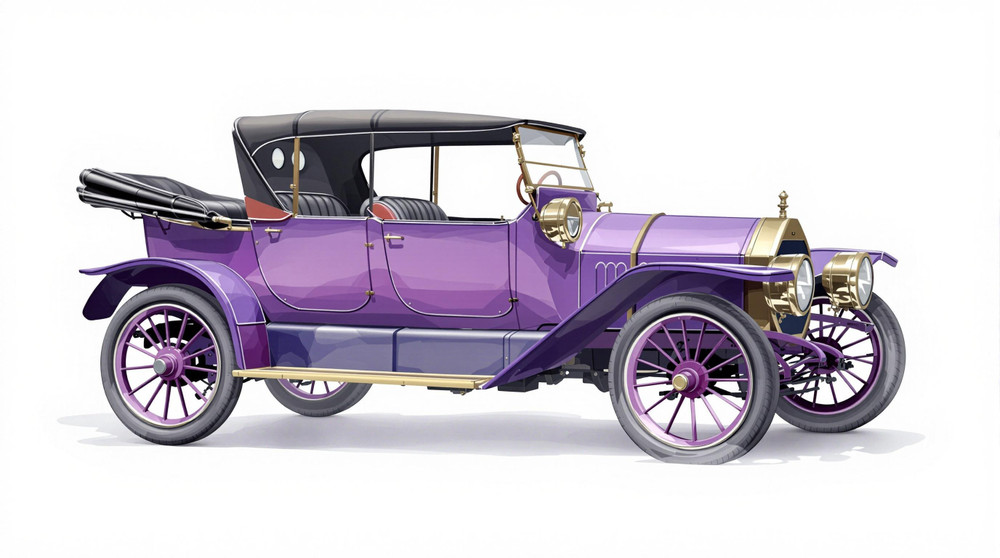
Image of 1908 Diamond T Four, Note: These illustrations use artistic license and may differ from actual historical models.
Performance Metrics
Fundamental Metrics
Emotional Appeal
MMP Rating
| Engine Specifications | |
|---|---|
| Engine Options: | Four-cylinder engine |
| Displacement Range: | Estimated 4.0 L |
| Horsepower Range: | Estimated 10 - 20 HP |
| Torque: | Not Available |
| Compression Ratio: | Not Available |
| Ignition System: | Magneto ignition system |
| Cooling System: | Water-cooled |
| Performance Specifications | |
| 0-60 Time: | Not Available |
| 1/4 Mile Time: | Not Available |
| Top Speed: | Estimated 20 - 30 mph |
| Transmission and Drive | |
| Drive Type: | Rear-wheel drive |
| Transmission Type: | Manual |
| Fuel and Efficiency | |
| Fuel System Type: | Carburetor |
| MPG: | Not Available |
| Dimensions and Brakes | |
| Brakes: | Mechanical drum brakes |
| Wheelbase: | Estimated 100 - 120 inches |
| Weight: | Estimated 1500 - 2000 lbs |
Note: Specifications for classic cars are given to the best of our ability, considering the limited and variant data available.
1908 Diamond T Four: The Car Before the Trucks
Before Diamond T became a familiar name on American trucks, it built automobiles. The 1908 Diamond T Four belongs to that brief, easily overlooked chapter: an early Chicago-made car from a company whose later reputation would be earned on the road and at work sites across the country.
Diamond T was founded by Charles A. Tilt in Chicago, Illinois. The company began building motorcars in the first decade of the 20th century, before shifting its attention to commercial vehicles. The “Four” name refers to its four-cylinder engine, a practical configuration that was becoming an increasingly popular alternative to the single- and two-cylinder powerplants found in many early cars.
Details about the 1908 model are scarce, and surviving examples are exceptionally uncommon. That scarcity makes it an intriguing machine, but it also means that some specifications and options are not as firmly documented as those of better-known mass-produced cars. The figures below are best treated as informed estimates where noted, not as confirmed factory specifications.
Brass-Era Design and Craftsmanship
The Diamond T Four would have looked unmistakably like a car from the brass era. Its tall, narrow wheels, exposed chassis, upright radiator, and high ground clearance gave it a light, almost carriage-like profile. Brass fittings and lamps added bright highlights against the darker bodywork, while the hood and engine sat prominently ahead of the passenger compartment. Early cars were built to be seen as well as driven, and the Diamond T’s open layout put its mechanical parts on display.
Inside, expect an open cabin with straightforward, functional furnishings rather than modern comforts. Seats were likely upholstered in leather or leather-like material, with a simple steering wheel, exposed controls, and limited protection from weather. The exact trim and equipment could vary by body style and buyer specification. There was no enclosed, climate-controlled interior, and passengers would have relied on robes, coats, and optional weather gear for comfort.
Factory color records for the 1908 Diamond T Four are difficult to establish. Buyers of the period could often choose from a small range of finishes, and dark colors such as black, deep red, or green were common across the industry. Those shades would have suited the car’s brass details, but they should not be mistaken for a confirmed Diamond T color chart.
Like many early manufacturers, Diamond T could offer cars in different body configurations. An open touring body or runabout would fit the period’s typical use, although surviving documentation does not establish a definitive list of 1908 Four body styles. Touring cars were especially practical for carrying several occupants, while a smaller runabout favored simpler motoring and a lighter appearance.
Early Technology, Before the Truck Era
The four-cylinder engine was an important step toward smoother, more usable motoring. Compared with many single-cylinder cars, a four-cylinder layout could deliver power more evenly and make longer trips less tiring. For an owner in 1908, that mattered: roads were inconsistent, service stations were rare, and a car needed to be manageable as well as mechanically interesting.
The Diamond T Four should not be mistaken for a modern car in miniature. Its controls, braking system, lighting, and suspension belonged to a period when drivers were expected to understand their machines. Starting, shifting, and keeping the engine running could call for patience and hands-on attention. Even so, the move toward a multi-cylinder engine showed how rapidly automobile engineering was developing.
Why the Diamond T Four Matters
The model’s significance comes partly from its place in Diamond T’s story. The company began as an automobile maker and later became best known for trucks. That transition reflects a wider change in the American motor industry, as specialist manufacturers discovered that commercial vehicles offered a more durable business than competing in the crowded passenger-car market.
In 1908, Diamond T was competing with numerous young automakers, many of which had limited production and short lives. Its four-cylinder car represented the era’s push toward greater refinement and practical road use. The Diamond T name would eventually be associated with sturdy trucks, but the Four shows that the company’s identity began with passenger motoring.
Its lasting influence is less about a single breakthrough than about preserving a link between two periods of the brand’s history. For collectors, it is a reminder that even famous truck manufacturers often began with experiments in passenger-car production.
Performance and the Driving Experience
Reliable factory performance figures for the 1908 Diamond T Four are not readily established. As a cautious period-based estimate, a car of this type might have produced roughly 20 to 30 horsepower and reached a top speed in the neighborhood of 35 to 45 mph, depending on its engine, gearing, body, and condition. These are estimates, not verified Diamond T specifications.
A modern 0-to-60-mph time is not especially useful here. Many cars of this class were slow to accelerate by contemporary standards, and some were not geared or equipped for sustained 60-mph running at all. A period car’s useful performance was judged more by whether it could climb a hill, keep a steady pace, and complete a journey than by a stopwatch.
On the road, the Diamond T would feel tall and exposed compared with a modern car. Its narrow tires and early suspension would transmit bumps and ruts directly to the occupants. On a winding road, the driver would need to plan ahead, keep speeds modest, and make deliberate steering inputs. Wind, loose surfaces, and poor road crowns could all influence the car’s direction.
The experience would be wonderfully mechanical. The four-cylinder engine would make a steady, unmuted sound, while the driver managed the controls with little assistance. There would be no power steering, modern brakes, or sound insulation to soften the experience. Every trip would feel like participation in the machinery rather than simply riding inside it.
Ownership, Upkeep, and Reliability
A 1908 Diamond T Four is best suited to a collector, museum, or vintage-car enthusiast, not as a daily driver. Its natural roles are careful touring, club events, demonstrations, and static display. Even a well-restored example would need a knowledgeable owner and access to specialist help.
Basic mechanical work may be approachable for an experienced hobbyist, since early cars often use relatively straightforward systems. However, “simple” does not mean effortless. Original parts can be difficult to find, and components may need to be repaired or fabricated by a specialist. Correct restoration also requires research into period materials, construction methods, and finishes.
Reliability depends heavily on the quality of the restoration and the owner’s maintenance routine. Fuel, ignition, lubrication, tires, and fasteners all require regular attention. Before driving, an owner should inspect the car carefully and understand its braking and starting procedures. A breakdown may be mechanically simple to diagnose, but locating the correct replacement part can be the harder task.
Rare Facts and Common Criticisms
The Diamond T name is often linked to Charles A. Tilt’s family background in the shoe business. The company’s distinctive diamond-and-T emblem helped carry the name from its early cars into its later trucks, giving the brand a visual identity that outlasted its passenger-car period.
No widely recognized speed, sales, or endurance record is associated with the 1908 Diamond T Four. Nor is there a well-established celebrity ownership story or a famous event that can confidently be tied to this specific model. Its appeal is quieter: it is a rare survivor from the company’s early years, before Diamond T became a truck specialist.
Common criticisms are the same ones that apply to many cars of its age. It is slow by modern standards, offers little weather protection, and requires more attention from its driver than a later automobile. The scarcity of documentation can also make restoration and authentication challenging. For enthusiasts, those limitations are part of the historical experience, but they are important considerations for anyone thinking of ownership.
Collector Value and Availability
The 1908 Diamond T Four is likely to be a rare sight on the market. The number built is not firmly documented, and a precise production total should not be presented as fact. As a broad, explicitly speculative estimate, production may have been in the dozens to a few hundred, with perhaps 100 to 300 cars as a working range. The number of surviving, identifiable examples would be much smaller.
Because comparable public sales are scarce, any value estimate is approximate. A complete project car might fall around $40,000 to $80,000, while a running, well-restored example could reasonably be estimated at about $80,000 to $175,000. Exceptional provenance, originality, or concours-level restoration could push a sale higher, while missing parts or uncertain identity could reduce the price substantially. These ranges are estimates, not a formal appraisal.
There is not enough regular market activity to draw a confident year-by-year price trend. In general, significant early automobiles have benefited from the appeal of rarity and historical importance, but a car this obscure can be difficult to price consistently. Condition, documentation, and the availability of a serious buyer matter more than a simple market index. Its long-term appeal is likely to remain strongest among collectors who value early American motoring and the origins of the Diamond T brand.
A Small Car with a Long Brand Story
The 1908 Diamond T Four combines the mechanical character of the brass era with a lesser-known chapter in the history of an enduring American manufacturer. Its open, upright styling, four-cylinder layout, and hands-on driving experience reflect a time when motoring was still a technical adventure. Exact production and specification records remain elusive, so careful distinction between documented facts and period-based estimates is essential.
For collectors, the Diamond T Four is more than an uncommon early automobile. It is the beginning of a story that would later unfold on the highways and work sites of America, proving that a famous truck name once started out on four passenger-car wheels.
1908 Diamond T Four Catalog of Parts
 1908 DIAMOND T FOUR Accessory Floor Mat - 12"X17" -AC 37Accessory Floor Mat - made of high quality black rubber with molded original emblem. Also designed to be sewn into new carpets. 12"X17", Each
Why Choose Metro?
For over 100 years, Metro Moulded Parts has been the pinnacle of quality in classic car restoration parts. Our commitment to precision and authenticity in every component ensures a perfect fit and an OEM-level appearance.
- Expert Craftsmanship & Quality: Each part is a testament to our dedication to reliability and perfection, crafted from original designs and thoroughly tested.
- Advanced Technology: We use cutting-edge techniques to create flawless, long-lasting parts that surpass others in performance.
- SuperSoft Sponge – The Ultimate Door Seal: Not only are our door seals 30% softer than competitors', but they're also guaranteed to never leak. They effectively reduce wind and road noise, enhancing your classic car's comfort and driving experience.
- Proudly American: Our parts are a product of American craftsmanship, made in the USA with a spirit of excellence and heritage.
- Unrivaled Warranty: We back our products with a 30-year industry-leading warranty, a testament to our confidence in their quality.
Join us in preserving the legacy of classic cars with parts that are crafted for perfection, not just made.