
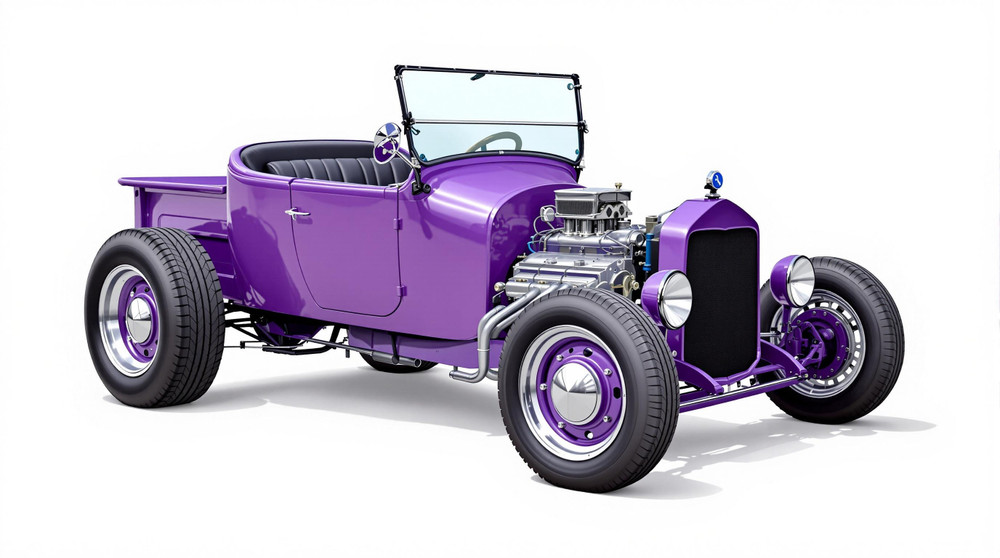
Image of 1923 Ford Model T, Note: These illustrations use artistic license and may differ from actual historical models.
Performance Metrics
Fundamental Metrics
Emotional Appeal
MMP Rating
| Engine Specifications | |
|---|---|
| Engine: | Inline 4 |
| Displacement: | 2.9L |
| Horsepower: | 20 HP |
| Torque: | Estimated 83 lb-ft |
| Compression Ratio: | 4.5:1 |
| Ignition System: | Magneto ignition system |
| Cooling System: | Thermosiphon cooling system |
| Performance Specifications | |
| 0-60 Time: | Not applicable as the vehicle's top speed is below 60 mph |
| 1/4 Mile Time: | Not applicable due to the vehicle's low top speed |
| Top Speed: | 40-45 mph |
| Transmission and Drive | |
| Drive Type: | Rear-wheel drive |
| Transmission Type: | 2-speed planetary transmission |
| Fuel and Efficiency | |
| Fuel System Type: | Gravity fed carburetor |
| MPG: | 13-21 mpg |
| Dimensions and Brakes | |
| Brakes: | Mechanical drum brakes (rear only) |
| Wheelbase: | 100 inches |
| Weight: | 1,200 lbs |
Note: Specifications for classic cars are given to the best of our ability, considering the limited and variant data available.
1923 Ford Model T: The Car That Put America on Wheels
The 1923 Ford Model T turned ordinary roads into routes to opportunity. Built by the Ford Motor Company in the United States, it was part of the car that transformed automobile ownership from a luxury for the wealthy into a realistic goal for millions of families.
By 1923, the Model T had been in production for 15 years and had helped establish Ford’s moving assembly-line approach to manufacturing. Its simple design, relatively low price, and widespread parts supply made it a familiar sight in cities and rural communities alike. A Model T could take a family to town, carry supplies to a farm, or serve as the foundation for a homemade work vehicle.
One striking measure of its success is the scale of production. Ford built roughly two million Model Ts in 1923 alone, contributing to a total that reached about 15 million before the line ended in 1927. The 1923 model was not a radical redesign. Its significance lies in how effectively Ford kept a proven car available to a rapidly expanding market.
Model T Styling and Body Choices
The 1923 Model T has the upright, practical proportions that define early motoring. Its narrow front end is dominated by a tall radiator, flanked by round headlamps and front fenders that sweep over slim wheels. A long, exposed running board connects the front and rear fenders, while the high-set body and thin tires give the car a distinctly tall, light-footed appearance.
Most 1923 Model Ts were finished in black, the color most closely associated with Ford’s production methods and the Model T’s identity. Ford’s emphasis on standardized, efficient manufacturing kept the range of factory finishes limited compared with many modern cars. Buyers could choose from several body styles, but a broad palette of paint and trim combinations was not the point: Ford aimed to build a dependable car in large numbers at an accessible price.
Open cars were especially familiar on the road. The Touring model offered seating for a family or small group, with a folding fabric top and removable side curtains for weather protection. The Runabout, a compact two-seat roadster-style body, is one of the most recognizable Model T configurations. Closed bodies, including coupe and sedan styles, provided more shelter and privacy, though they generally cost more. Ford also supplied commercial and chassis versions that businesses could adapt for work.
Inside, the Model T was straightforward rather than luxurious. The cabin used practical materials, with simple upholstery, painted metal surfaces, basic instruments, and limited weather sealing by modern standards. Open models exposed occupants to wind, dust, and rain, while closed versions offered a more protected ride. The appeal was functional simplicity: there was little decorative trim to distract from the car’s purpose.
Ingenious Engineering for Its Era
The Model T’s most important innovation was not a single gadget. It was the combination of practical engineering and production methods that made a car affordable to a broad public. Ford’s moving assembly line, introduced at Highland Park in 1913, dramatically reduced the time required to build a vehicle. The Model T’s standardized components and straightforward construction also helped keep repairs manageable.
Power came from a 177-cubic-inch, or 2.9-liter, inline four-cylinder engine producing about 20 horsepower. It used a thermosiphon cooling system, which circulated coolant without a conventional water pump, and a magneto system supplied ignition current. A two-speed planetary transmission provided low and high forward gears, along with reverse.
Driving controls were unlike those in a modern car. The driver used pedals and levers to operate the transmission and braking system, while a hand throttle and spark advance helped regulate engine speed and ignition timing. A left pedal selected low gear, the center pedal engaged reverse, and the right pedal operated the transmission brake. A separate hand lever controlled the parking brake and helped select high gear. Electric starting was available on 1923 cars, with a hand crank retained as a backup on many examples.
Why the Model T Changed Motoring
The Model T’s impact came from making personal transportation more practical and more widespread. Its simple construction suited the rough roads and limited service networks of the period, while the availability of replacement parts helped owners keep cars running far from a major city. The car also encouraged the growth of garages, repair shops, fuel stations, roadside businesses, and road infrastructure.
Compared with many contemporaries, the Model T was relatively inexpensive, mechanically uncomplicated, and adaptable. Owners could use it as a family car, a delivery vehicle, or a farm tool. Its chassis and powertrain inspired countless modifications, including utility vehicles and racing machines. That versatility helped establish the automobile as more than a leisure purchase.
The Model T’s influence continued well beyond its production run. It helped normalize mass-produced cars and showed that manufacturing efficiency could reshape an entire industry. Its legacy is not that every later car copied its layout, but that automakers had to respond to the expectation that a car could be built in volume and sold within reach of ordinary buyers.
1923 Model T Performance and Road Manners
With about 20 horsepower, the Model T was built for steady travel rather than fast acceleration. A well-maintained example can reach roughly 40 to 45 mph under favorable conditions. Reaching 60 mph is not a realistic or consistent measure for a standard 1923 Model T. Many examples struggle to reach that speed, and acceleration to 60, if possible at all, would be very slow and highly dependent on condition, gearing, road, and setup. Period driving was judged by whether the car could make a reliable journey, not by a zero-to-60 stopwatch.
The transverse leaf springs and solid axles were suited to the rough, uneven roads of the day, but the ride is busy by modern standards. The car rocks and bounces over potholes, and its narrow tires and relatively high stance call for measured cornering. On a winding road, the driver needs to plan ahead, keep speeds modest, and avoid abrupt steering inputs. Strong crosswinds can also make a light, upright car feel less settled.
From behind the wheel, the Model T demands attention. The unusual pedal arrangement takes practice, and the driver must coordinate the throttle, spark control, transmission, and hand lever. The engine has a rhythmic, mechanical sound, with little insulation between it and the occupants. At cruising speed, the car feels lively and open to the world, but it is not quiet, smooth, or effortless in the modern sense. Driving one is an active conversation between person, machine, and road.
Owning and Maintaining a Model T
Today, most 1923 Model Ts are enjoyed as touring cars, parade vehicles, museum pieces, and show cars. Some owners still take them on local drives or vintage-car tours, where moderate speeds and scenic routes suit the car far better than modern highways. Carefully prepared Model Ts can also appear in vintage racing and hill-climb events, though competition use often involves specialized modifications.
Maintenance is one of the Model T’s attractions. Its mechanical systems are comparatively accessible, and many routine jobs can be handled by an owner with basic tools, a repair manual, and patience. The large supply of reproduction and used parts makes restoration practical. However, simple does not mean maintenance-free. Ignition, fuel mixture, cooling, clutch bands, brakes, wheel bearings, and lubrication all need regular attention.
Reliability depends heavily on condition and setup. A sound, correctly adjusted Model T can be remarkably dependable for its intended use, but a century-old example may have worn components, outdated repairs, or safety issues. Before regular driving, owners should inspect the tires, steering, brakes, wheels, and fuel system, and learn the correct starting and operating procedures. Its braking system is particularly unlike a modern four-wheel hydraulic setup, so generous stopping distances and conservative speeds are essential.
Model T Facts and Common Criticisms
The 1923 Model T belongs to a car line that became a symbol of mass motoring around the world. Model Ts were used by families, farmers, businesses, and public services, and their rugged reputation made them well suited to regions where roads were still developing. During the Model T era, the car also became a familiar sight in military and civilian support roles, although the 1923 model itself should not be confused with vehicles built for earlier wartime service.
A common criticism is that Model Ts were available only in black. The line’s paint history is more complicated than the popular slogan suggests, but black became strongly associated with Ford’s drive for standardized, efficient production. The familiar phrase about any customer choosing a color “so long as it is black” captures the company’s manufacturing philosophy, even though it is often repeated more broadly than the exact historical details warrant.
Another frequent complaint is the car’s unconventional controls. New drivers may find the pedals and hand lever confusing, while the modest power, limited braking performance, open-cabin exposure, and lack of modern safety equipment can make contemporary traffic intimidating. These are real limitations, but they also reflect the roads, expectations, and engineering priorities of the 1920s.
1923 Ford Model T Collector Values
The Model T is not rare in the broadest sense, since Ford produced millions of examples and surviving cars remain available through clubs, dealers, auctions, and private sales. Individual body styles, unusual factory configurations, documented history, and high-quality restorations can be much harder to find. The 1923 Runabout and Touring models are among the most recognizable and commonly sought configurations.
As a general 2026 market estimate, a project or incomplete example may sell for roughly $3,000 to $8,000. A usable driver in fair to good condition might fall around $8,000 to $18,000, while a well-restored example can bring approximately $18,000 to $35,000. Exceptional restorations, rare body styles, and cars with strong provenance may exceed that range. Actual prices vary substantially with originality, mechanical condition, restoration quality, and location.
Values have generally been steady rather than explosive. Well-presented cars remain appealing to vintage motoring enthusiasts, but the Model T’s plentiful supply keeps many examples within reach compared with genuinely rare prewar cars. Over time, the best-maintained and most carefully documented cars are likely to hold their appeal, while rough projects can be expensive once restoration costs are considered.
The Lasting Appeal of the 1923 Ford Model T
The 1923 Ford Model T combines simple engineering, distinctive styling, and an extraordinary place in automotive history. Its 20-horsepower engine and unusual controls may seem modest today, but its affordability and adaptability helped make car ownership part of everyday life for millions of people.
More than a century later, the Model T remains enjoyable not because it drives like a modern car, but because it reveals how dramatically the automobile changed the world. Every rattle, lever, and deliberate shift connects the driver to the moment when the open road began to belong to ordinary people.
1923 Ford Model T Catalog of Parts
 1923 Ford Model T Door Opener Gasket. 7/8" wide X 3-3/4" long X 5/16" high-RP 24Door Opener Gasket. 7/8" wide X 3-3/4" long X 5/16" high. Each
 1923 Ford Model T Gas Tank Strap Cushions-RP 25Gas Tank Strap Cushions. Two pieces, 11" long x 1-7/16" wide. Pair
Why Choose Metro?
For over 100 years, Metro Moulded Parts has been the pinnacle of quality in classic car restoration parts. Our commitment to precision and authenticity in every component ensures a perfect fit and an OEM-level appearance.
- Expert Craftsmanship & Quality: Each part is a testament to our dedication to reliability and perfection, crafted from original designs and thoroughly tested.
- Advanced Technology: We use cutting-edge techniques to create flawless, long-lasting parts that surpass others in performance.
- SuperSoft Sponge – The Ultimate Door Seal: Not only are our door seals 30% softer than competitors', but they're also guaranteed to never leak. They effectively reduce wind and road noise, enhancing your classic car's comfort and driving experience.
- Proudly American: Our parts are a product of American craftsmanship, made in the USA with a spirit of excellence and heritage.
- Unrivaled Warranty: We back our products with a 30-year industry-leading warranty, a testament to our confidence in their quality.
Join us in preserving the legacy of classic cars with parts that are crafted for perfection, not just made.