
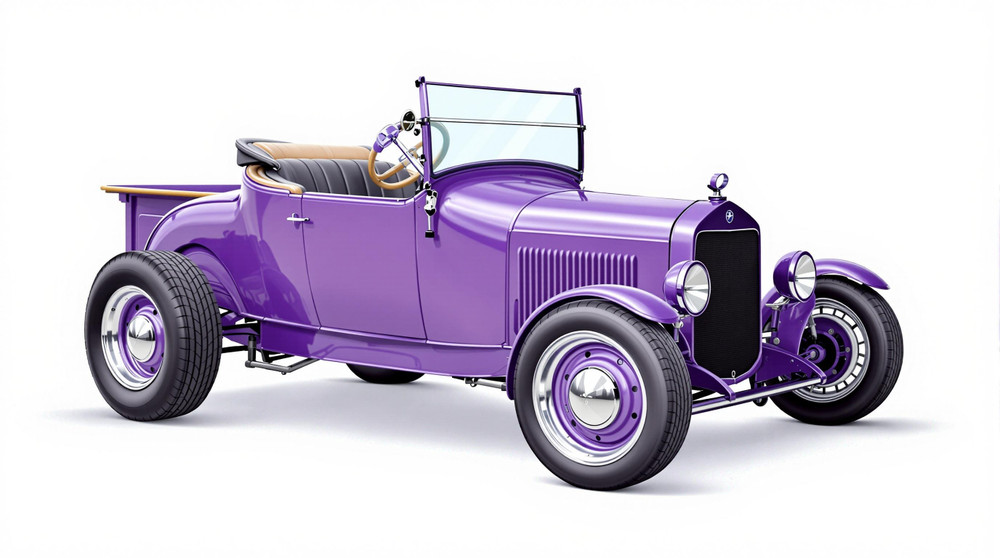
Image of 1925 Ford Model T, Note: These illustrations use artistic license and may differ from actual historical models.
Performance Metrics
Fundamental Metrics
Emotional Appeal
MMP Rating
| Engine Specifications | |
|---|---|
| Engine: | Inline 4 |
| Displacement: | 2.9L |
| Horsepower: | 20 HP |
| Torque: | Estimated at 83 lb-ft |
| Compression Ratio: | 4.5:1 |
| Ignition System: | Magneto ignition system |
| Cooling System: | Thermosiphon cooling system |
| Performance Specifications | |
| 0-60 Time: | Not applicable as the vehicle's top speed is below 60 mph |
| 1/4 Mile Time: | Not applicable due to the vehicle's low top speed |
| Top Speed: | 45 mph |
| Transmission and Drive | |
| Drive Type: | Rear-wheel drive |
| Transmission Type: | 2-speed planetary transmission |
| Fuel and Efficiency | |
| Fuel System Type: | Gravity fed carburetor |
| MPG: | 13-21 mpg |
| Dimensions and Brakes | |
| Brakes: | Mechanical drum brakes |
| Wheelbase: | 100 inches |
| Weight: | 1,200 lbs |
Note: Specifications for classic cars are given to the best of our ability, considering the limited and variant data available.
1925 Ford Model T: The Car That Put America on Wheels
The 1925 Ford Model T did not need a powerful engine or lavish trim to change the world. Its real accomplishment was making personal transportation affordable to millions. Built by the Ford Motor Company in the final stretch of the Model T’s long production run, this simple, adaptable car carried families, farmers, tradespeople, and businesses through an era when many roads were still rough or unpaved.
The Model T had been introduced in 1908, and by 1925 its basic formula was well established: a sturdy chassis, a compact four-cylinder engine, straightforward mechanicals, and a price within reach of many working households. One intriguing detail is that the 1925 model arrived just two years before Ford ended Model T production. It was a late-generation example of a design that had already helped reshape American life, but it still retained the distinctive controls and engineering that made the car famous.
Model T Styling and Body Styles
The 1925 Model T looks tall, narrow, and upright beside a modern car. Its high, near-vertical radiator, separate fenders, exposed running boards, and large spoked wheels give it the unmistakable profile of an early automobile. Brass-era decoration had largely given way to practical black-painted fittings by this point, but the car’s graceful curves and open proportions still have plenty of charm.
Inside, the Model T was built for utility rather than luxury. The cabin was functional, with simple seating, basic instrumentation, and exposed metal and painted surfaces. Depending on the body style and trim, seat coverings could be upholstered in durable cloth or leatherette. Materials were chosen to be serviceable and affordable, not plush. The driver faced a steering wheel and a small number of controls, but operating the car took more coordination than driving a modern manual-transmission vehicle.
Ford offered the Model T in a wide range of configurations, including the open Touring car, Runabout, Coupe, Tudor Sedan, Fordor Sedan, truck and pickup bodies, and chassis supplied for commercial conversions. The Touring car, with its open passenger compartment and folding top, is among the most recognizable versions. It suited family outings and rural travel, while the Runabout provided a more compact, economical option.
Black was the characteristic Model T color by 1925. Ford had famously standardized black paint for much of the car’s production, partly because it was practical and helped streamline manufacturing. The Model T’s color range expanded as production neared its end, but a 1925 example is most commonly associated with the familiar black finish.
Simple Technology, Lasting Influence
The Model T’s innovation was not a single gadget. Its importance came from combining practical engineering with large-scale production. Ford’s moving assembly line, introduced for Model T production in 1913, reduced manufacturing time and helped lower costs. The car’s design also emphasized parts that were relatively simple to service, an important advantage for owners far from established repair shops.
Under the hood is a 177-cubic-inch (2.9-liter) inline four-cylinder engine producing about 20 horsepower. It uses a three-bearing crankshaft and a low-compression design suited to the fuels and operating conditions of its era. Power reaches the rear wheels through Ford’s unusual planetary transmission, which provides two forward speeds and reverse. Rather than a conventional clutch pedal and floor-mounted gear lever, the driver uses pedals and a hand throttle to control the transmission and engine speed.
The Model T also helped establish the idea that a car could be a practical household tool, not merely a luxury for the wealthy. Its influence can be seen in the growth of suburban travel, road building, auto repair businesses, fuel stations, and car-based rural commerce. The Volkswagen Beetle eventually surpassed the Model T’s total production record in 1972, but the Ford’s legacy as a mass-market pioneer remains central to automotive history.
1925 Model T Performance and Driving
Performance is modest by modern standards. A well-tuned 1925 Model T can generally manage a top speed in the neighborhood of 35 to 45 mph, depending on its condition, gearing, tires, and body style. A conventional 0-to-60-mph time is not especially useful: most stock examples are not suited to reaching 60 mph, and Ford did not publish a modern-style acceleration figure. The car was designed for everyday roads of its time, not high-speed cruising.
Driving one is an involved, hands-on experience. The engine produces a steady, mechanical chug, while the transmission responds to the driver’s foot pedals and hand controls. The steering feels heavy at low speeds, and the high seating position gives a clear view over the hood. On a smooth road, the Model T can feel surprisingly willing. On bumps, ruts, or washboard gravel, its relatively basic suspension and narrow tires pass plenty of movement into the cabin.
On winding roads, the driver needs to plan ahead. The car is tall and narrow by modern standards, its steering is not especially precise, and its brakes require more distance and attention than contemporary drivers are used to. The Model T’s controls reward smooth, deliberate inputs. It is best enjoyed at a pace that suits its engineering, with room to slow down and take in the scenery.
Owning and Maintaining a Model T
In 1925, a Model T might serve as a family car, farm vehicle, delivery van, taxi, or work truck. Today, most are owned as touring cars, show vehicles, museum pieces, or hobby cars. Some enthusiasts still drive them regularly, often on local roads and organized vintage-car tours rather than in modern traffic.
Maintenance is one of the Model T’s strengths. Its mechanical layout is comparatively straightforward, and many repairs can be handled by an owner with basic tools and a service manual. Parts support remains strong because the Model T was produced in enormous numbers and has a large enthusiast community. Regular attention to ignition, lubrication, cooling, brakes, tires, and transmission adjustments helps keep one dependable.
That simplicity does not mean every repair is effortless. The planetary transmission has its own operating and adjustment requirements, and the car’s age means condition varies widely. A prospective owner should inspect the frame, woodwork where applicable, engine, transmission, wheels, and brakes. A car that starts easily may still need substantial work to be safe and reliable on the road.
Model T Facts and Common Criticisms
Ford built more than 15 million Model Ts between 1908 and 1927, a production record that stood for decades. Estimates for 1925 production vary by source and by what is counted, but roughly 1.8 to 1.9 million Model Ts were produced that year across the range. That does not mean many remain today: surviving numbers are far smaller, and the condition and originality of individual cars differ considerably.
The Model T appeared in many settings beyond private ownership, including farms, businesses, public services, and military use. Its adaptability helped make it a common sight in communities where roads and services were limited. It could be fitted with specialized bodies and equipment, and its straightforward construction made it a natural choice for practical conversions.
Its most common criticisms are equally clear. The Model T is slow, noisy, and less comfortable than later cars. Braking and handling feel dated, weather protection can be limited on open models, and the pedal-operated planetary transmission takes practice. Those shortcomings are part of the ownership experience, but they also explain why the car is best treated as a historic machine rather than a modern daily driver.
1925 Ford Model T Collector Values
Values depend heavily on body style, originality, restoration quality, and mechanical condition. As a broad current-market estimate, a project or incomplete car may sell for roughly $5,000 to $10,000. A usable driver or older restoration often falls around $10,000 to $25,000, while a high-quality restoration, desirable body style, or exceptionally original example can bring $25,000 to $40,000 or more. These are general ranges, not appraisals, and local markets can differ.
The 1925 Model T is not rare in the same way as a limited-production luxury car. Ford built it in huge numbers, and examples remain available through specialist dealers, auctions, clubs, and private sales. However, a well-preserved car with documented history, correct parts, and a desirable configuration is harder to find than the production totals might suggest.
Prices have generally favored complete, well-maintained cars over rough projects. Exceptional examples can appreciate, but ordinary cars may see slower gains, and restoration costs can exceed the eventual resale value. Most owners buy a Model T for the experience, history, and community rather than as a guaranteed investment.
Why the 1925 Model T Still Matters
The 1925 Ford Model T brought together affordable production, practical engineering, and remarkable adaptability. Its upright styling, distinctive planetary transmission, and hardworking four-cylinder engine make it unlike any modern car, while its mass-market success helped shape how people traveled and how automobiles were built.
It may be slow by today’s standards, but the Model T’s achievement was never speed. It made the open road accessible to ordinary people, and nearly a century later, every rattling, pedal-controlled mile still tells that story.
1925 Ford Model T Catalog of Parts
 1925 Ford Model T Door Opener Gasket. 7/8" wide X 3-3/4" long X 5/16" high-RP 24Door Opener Gasket. 7/8" wide X 3-3/4" long X 5/16" high. Each
 1925 Ford Model T Gas Tank Strap Cushions-RP 25Gas Tank Strap Cushions. Two pieces, 11" long x 1-7/16" wide. Pair
Why Choose Metro?
For over 100 years, Metro Moulded Parts has been the pinnacle of quality in classic car restoration parts. Our commitment to precision and authenticity in every component ensures a perfect fit and an OEM-level appearance.
- Expert Craftsmanship & Quality: Each part is a testament to our dedication to reliability and perfection, crafted from original designs and thoroughly tested.
- Advanced Technology: We use cutting-edge techniques to create flawless, long-lasting parts that surpass others in performance.
- SuperSoft Sponge – The Ultimate Door Seal: Not only are our door seals 30% softer than competitors', but they're also guaranteed to never leak. They effectively reduce wind and road noise, enhancing your classic car's comfort and driving experience.
- Proudly American: Our parts are a product of American craftsmanship, made in the USA with a spirit of excellence and heritage.
- Unrivaled Warranty: We back our products with a 30-year industry-leading warranty, a testament to our confidence in their quality.
Join us in preserving the legacy of classic cars with parts that are crafted for perfection, not just made.