
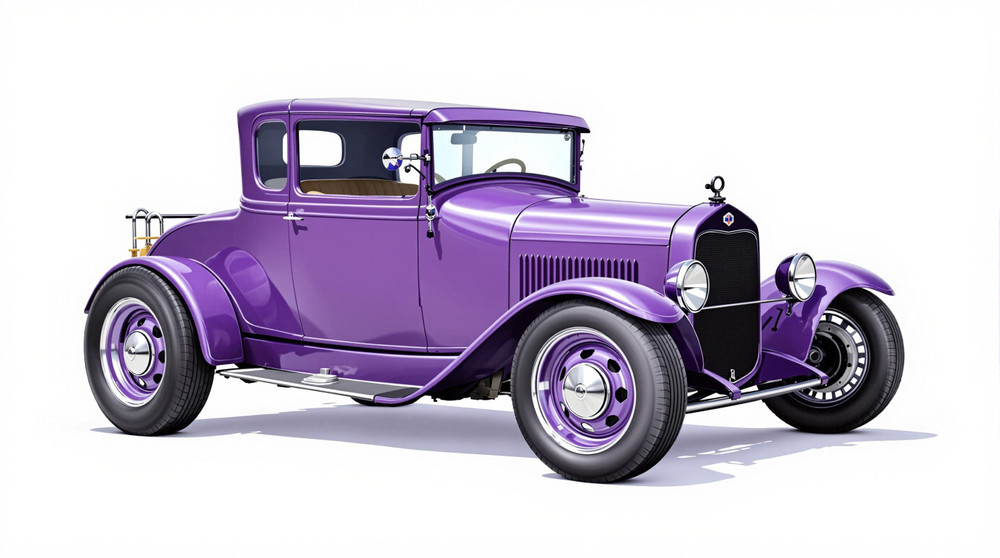
Image of 1926 Ford Model T, Note: These illustrations use artistic license and may differ from actual historical models.
Performance Metrics
Fundamental Metrics
Emotional Appeal
MMP Rating
| Engine Specifications | |
|---|---|
| Engine Options: | Inline 4 |
| Displacement Range: | 2.9L |
| Horsepower Range: | 20 HP |
| Torque: | Estimated at 83 lb-ft |
| Compression Ratio: | 4.5:1 |
| Ignition System: | Magneto ignition system |
| Cooling System: | Thermosiphon cooling system |
| Performance Specifications | |
| 0-60 Time: | Not applicable as the vehicle's top speed is below 60 mph |
| 1/4 Mile Time: | Not applicable due to the vehicle's low top speed |
| Top Speed: | 40-45 mph |
| Transmission and Drive | |
| Drive Type: | Rear-wheel drive |
| Transmission Type: | 2-speed planetary gear |
| Fuel and Efficiency | |
| Fuel System Type: | Gravity fed fuel system |
| MPG: | 13-21 mpg |
| Dimensions and Brakes | |
| Brakes: | Mechanical drum brakes |
| Wheelbase: | 100 inches |
| Weight: | 1,200 lbs |
Note: Specifications for classic cars are given to the best of our ability, considering the limited and variant data available.
1926 Ford Model T: The Last Great Tin Lizzie
The 1926 Ford Model T arrived near the end of an automotive revolution, carrying the familiar engineering that had put millions of Americans on the road while adopting a fresher look for its final production years. Built by the Ford Motor Company in the United States, the Model T had been introduced in 1908 as a practical, relatively affordable car for ordinary buyers. By 1926, it was no longer the newest or most sophisticated car on the market, but its influence was unmatched.
Ford built about 1.5 million Model Ts in 1926, a best estimate within a production run that ultimately exceeded 15 million cars. A remarkable detail for fans of the final-generation cars is that Ford began offering color choices again around this period. For years, black had dominated Model T production because it suited Ford’s fast, standardized manufacturing system. The late cars signaled a changing market, as buyers increasingly expected both modern styling and a little more personal choice.
Late Model T Styling and Body Choices
The 1926 Model T looks familiar at a glance, with its upright radiator, separate rounded fenders, narrow tires, running boards, and tall cabin. Look closer and it has a more modern appearance than the earliest Tin Lizzies. The hood and radiator sit lower, the body has a fuller profile, and the fenders have a more sweeping shape. These changes gave the late Model T a less boxy, more finished look while retaining the exposed, utilitarian character that makes the car instantly recognizable.
Inside, the Model T is simple and functional rather than plush. Depending on body style and trim, occupants found basic upholstery, painted or finished metal surfaces, and straightforward controls. Materials were chosen for durability and price, not luxury. A closed car could offer welcome shelter from weather, but even its cabin was spare by the standards of a modern automobile. Comfort also depended on the body: a touring car was airy and social in fine weather, while a coupe or sedan offered better protection from cold and rain.
Late Model Ts were available in several colors, with choices varying by body style and production details. Black remained an important and common choice, while shades such as dark blue, green, maroon, and gray appeared in the period’s palette. Exact colors can be difficult to identify on surviving cars because decades of repainting are common. Buyers could choose from open bodies such as the touring car and roadster or closed styles including coupes and sedans. The four-door touring car is among the most iconic Model T shapes, while the practical runabout was a popular choice for everyday work and local travel.
Simple Technology That Changed Motoring
The Model T’s great innovation was not one exotic component. It was the way Ford combined a robust, straightforward car with standardized parts and high-volume production. The moving assembly line, introduced by Ford in 1913, sharply reduced assembly time and helped lower the price of the car. That production breakthrough influenced how automobiles and many other manufactured goods would be built.
The 1926 car used a 177-cubic-inch, or 2.9-liter, inline four-cylinder engine producing about 20 horsepower. It was paired with a two-speed planetary transmission, a durable arrangement that helped make the car manageable for drivers unfamiliar with conventional gear shifting. The pedals and hand controls take some learning: the left pedal operates the transmission’s low and high ranges, the center pedal selects reverse, and the right pedal applies the transmission brake. A hand lever controls the parking brake and helps place the transmission in neutral. Throttle and ignition timing are adjusted with levers on the steering column.
That arrangement was well suited to the Model T’s era, when roads were often rough, rural, and poorly marked. Its high ground clearance, relatively narrow wheels, and uncomplicated mechanical layout made it useful on farms and in small towns. It was not modern technology in 1926, however. Hydraulic brakes, electric starters, and more conventional transmissions were becoming increasingly attractive features on competing cars.
Why the Model T Still Matters
The Model T helped transform the automobile from a costly novelty into a practical tool for a much wider public. It supported commuting, rural independence, small businesses, and farm life. Its standardized components and repairable construction also encouraged a culture of owner maintenance and aftermarket parts. The car was not the first automobile or the first mass-produced product, but Ford’s production system made the Model T a defining example of large-scale, affordable manufacturing.
By the mid-1920s, though, the market had moved on. Buyers wanted more comfort, smoother controls, stronger brakes, and styling that looked current. Chevrolet and other rivals offered features that made the Model T seem increasingly old-fashioned. Ford’s response was to update the late cars’ appearance and broaden color choices, but the basic design remained rooted in an earlier era. Production of the Model T ended in 1927, when Ford replaced it with the Model A.
Model T Performance and Driving Feel
A healthy 1926 Model T can generally reach about 35 to 45 mph, depending on its condition, gearing, tires, load, and road surface. Around 40 mph is a more comfortable cruising expectation for many examples. A modern 0-to-60-mph figure is not especially useful: the car is slow to accelerate by today’s standards, and many Model Ts will not reach 60 mph in ordinary road use. Exact acceleration figures are rarely meaningful because the cars vary widely in mechanical condition and are normally driven at more modest speeds.
Driving one takes attention and coordination. The engine has a steady, mechanical putter, and its sound becomes busier as speed rises. The driver uses the hand throttle and spark advance, works the pedals in a way that feels unfamiliar today, and plans braking well ahead. Steering is not as precise as a modern car, and the ride can feel firm and lively over potholes or washboard roads. On a winding road, the high seating position, narrow tires, and basic suspension encourage a relaxed pace rather than quick cornering.
In period terms, the Model T was capable and versatile. Its ground clearance and simple construction suited rough roads, but wind, mud, steep hills, and poor surfaces still demanded care. The mechanical transmission brake is less reassuring than modern four-wheel hydraulic brakes, so a safe driver leaves generous stopping distance. The reward is an unusually direct connection to the machine: the driver is not just steering and accelerating, but actively managing how the car runs.
Living With a 1926 Ford Model T
Today, most Model Ts serve as show cars, parade vehicles, touring cars, or weekend hobby cars. Some owners still use them for local errands and club drives, but regular modern traffic can be stressful. Their modest speed, limited braking, lack of contemporary safety equipment, and visibility differences make busy highways a poor fit.
Maintenance is a major part of the ownership appeal. The engine and chassis are mechanically simple, and many repairs can be handled by an owner with basic tools, patience, and a good Model T reference book. Parts support remains strong because so many cars were built and enthusiast suppliers continue to reproduce components. Still, simplicity does not mean maintenance-free. Ignition, fuel delivery, cooling, transmission bands, brakes, and lubrication all need regular attention. A pre-purchase inspection by someone familiar with Model Ts is wise, especially because a car that starts easily may still need substantial work on its chassis or transmission.
Model T Trivia, Records, and Common Complaints
The nickname “Tin Lizzie” became closely associated with the Model T, though the exact origin of the name is uncertain. The model’s biggest record is its extraordinary production total: more than 15 million were built before the Model A took over. Model Ts also appeared in a wide range of working roles, from farm transport and rural mail delivery to military support vehicles during the First World War. The most famous production milestone came in 1927, when Ford celebrated building its 15-millionth Model T.
There is no shortage of familiar criticisms. The controls have a learning curve, the ride is basic, the brakes are limited by modern expectations, and the car is slow compared with later classics. Closed-car comfort is modest, while open models expose occupants to weather and dust. Those drawbacks are real, but they also explain why the Model T feels so different from a modern car. Its appeal is as much about hands-on motoring and historical character as about transportation.
1926 Model T Collector Values
The 1926 Ford Model T is not generally rare, although condition, body style, originality, and documented history can make a particular example much harder to find. A rough project car may sell for roughly $3,000 to $8,000. A usable driver often falls around $10,000 to $20,000, while a nicely restored example may bring about $20,000 to $40,000. Exceptional restorations, desirable body styles, or cars with unusually strong provenance can exceed that range. These are broad U.S. market estimates, not a substitute for checking recent sales of comparable cars.
Model T values are usually condition-driven rather than powered by rarity alone. Prices have tended to remain comparatively accessible, with good examples holding interest among collectors and restorations requiring careful budgeting. The market can vary by region and by the quality of the car, and a well-kept, mechanically sound driver may be a better buy than an expensive restoration with uncertain work underneath. As with many established classics, nominal prices may rise over time, but buyers should not assume every Model T will appreciate quickly.
The 1926 Model T’s Lasting Appeal
The 1926 Ford Model T combines the practical engineering that made the original famous with the revised styling of its final years. It is not fast, quiet, or effortless to drive, but it is straightforward, historically important, and still remarkably approachable for a vintage automobile. More than a century after the Model T first put America on wheels, the 1926 version remains a rolling lesson in how one car helped reshape manufacturing, mobility, and everyday life.
1926 Ford Model T Catalog of Parts
 1926 Ford Model T Door Opener Gasket. 7/8" wide X 3-3/4" long X 5/16" high-RP 24Door Opener Gasket. 7/8" wide X 3-3/4" long X 5/16" high. Each
 1926 Ford Model T Gas Tank Strap Cushions-RP 25Gas Tank Strap Cushions. Two pieces, 11" long x 1-7/16" wide. Pair
Why Choose Metro?
For over 100 years, Metro Moulded Parts has been the pinnacle of quality in classic car restoration parts. Our commitment to precision and authenticity in every component ensures a perfect fit and an OEM-level appearance.
- Expert Craftsmanship & Quality: Each part is a testament to our dedication to reliability and perfection, crafted from original designs and thoroughly tested.
- Advanced Technology: We use cutting-edge techniques to create flawless, long-lasting parts that surpass others in performance.
- SuperSoft Sponge – The Ultimate Door Seal: Not only are our door seals 30% softer than competitors', but they're also guaranteed to never leak. They effectively reduce wind and road noise, enhancing your classic car's comfort and driving experience.
- Proudly American: Our parts are a product of American craftsmanship, made in the USA with a spirit of excellence and heritage.
- Unrivaled Warranty: We back our products with a 30-year industry-leading warranty, a testament to our confidence in their quality.
Join us in preserving the legacy of classic cars with parts that are crafted for perfection, not just made.