
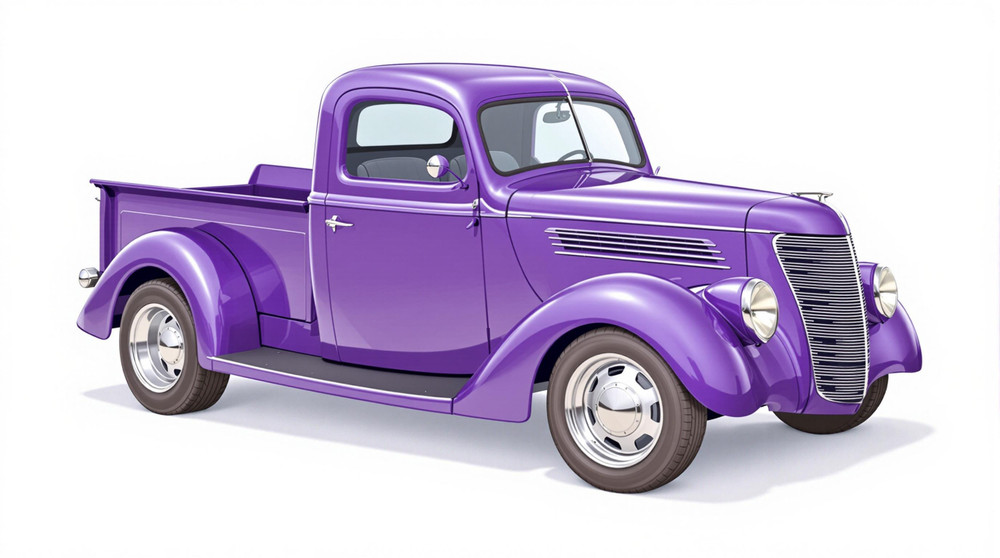
Image of 1937 Ford 1 Ton Pickup, Note: These illustrations use artistic license and may differ from actual historical models.
Performance Metrics
Fundamental Metrics
Emotional Appeal
MMP Rating
| Engine Specifications | |
|---|---|
| Engine: | Flathead V8 |
| Displacement: | 221 cubic inches |
| Horsepower: | Estimated 85 hp |
| Torque: | 144 lb-ft |
| Compression Ratio: | Estimated 6.15:1 |
| Ignition System: | Distributor and coil |
| Cooling System: | Water-cooled |
| Performance Specifications | |
| 0-60 Time: | Not available due to the age and type of vehicle |
| 1/4 Mile Time: | Not available due to the age and type of vehicle |
| Top Speed: | 65 mph |
| Transmission and Drive | |
| Drive Type: | Rear-wheel drive |
| Transmission Type: | 3-speed manual |
| Fuel and Efficiency | |
| Fuel System Type: | Carburetor |
| MPG: | Estimated 10-15 mpg |
| Dimensions and Brakes | |
| Brakes: | Mechanical drum brakes |
| Wheelbase: | 131.5 inches |
| Weight: | Estimated 3,400 lbs |
Note: Specifications for classic cars are given to the best of our ability, considering the limited and variant data available.
1937 Ford 1-Ton Pickup: A Working Classic
With its upright grille, broad fenders, and unmistakable flathead V8 soundtrack, the 1937 Ford 1-Ton Pickup looks ready to leave the farmyard and head straight for a hard day’s work. Built by Ford Motor Company during a period when American roads and businesses were rapidly changing, it combined a freshly styled cab with the sturdy construction expected of a commercial truck.
The truck belonged to Ford’s 1937 commercial lineup, which offered vehicles for everything from light deliveries to heavier hauling. Its one-ton rating made it a useful choice for farms, contractors, local businesses, and municipal fleets. One notable detail for modern enthusiasts is its braking system: unlike many later trucks, the 1937 Ford relied on mechanical brakes rather than hydraulic brakes. It is a reminder that this handsome machine came from a very different era of vehicle engineering.
Art Deco Looks, Built for Business
The 1937 Ford wears its styling with confidence. A tall, deeply curved grille gives the nose a purposeful look, while rounded front fenders flow around the headlamps and down toward the running boards. The hood’s horizontal louvers add visual length, and the separate cargo bed keeps the truck’s working identity clear. It is less streamlined than a modern pickup, but its smooth curves and balanced proportions give it a distinctive prewar presence.
The cab is a straightforward, practical place to work. Painted metal surfaces, a broad bench seat, a simple instrument panel, and large windows make up the basic environment. Upholstery and trim varied with specification and restoration, so surviving trucks may have different seat materials. The materials were durable rather than luxurious, and the upright driving position puts the driver close to the steering wheel and controls.
Ford’s 1937 trucks benefited from styling and manufacturing developments that made the cab feel more contemporary than earlier commercial vehicles. The steel body, improved visibility, and familiar dashboard controls were useful advances, even though the truck remained mechanically simple by later standards. Its most notable technology was its powertrain: Ford’s flathead V8 gave the truck smooth, flexible power compared with many four-cylinder work vehicles of the period.
Factory paint choices depended on the model, market, and commercial order, and fleet buyers could have different priorities from private owners. Period trucks often appeared in practical solid colors, including dark shades and more vivid red, blue, or green finishes. Today, restored examples in classic Ford colors, especially dark blue, red, and black, tend to catch the eye, though an authentic working-truck finish can be just as appealing.
The best-known configuration is the conventional pickup with an open cargo bed, but Ford’s commercial chassis also supported a range of work bodies. Depending on the chassis and buyer’s needs, trucks could be fitted as stake-bed, platform, panel-delivery, or other commercial vehicles. The pickup remains the most recognizable version, while specialized bodies are especially interesting to collectors who value a truck’s working history.
Why the 1937 Ford Truck Matters
The 1937 Ford 1-Ton Pickup was not a radical engineering experiment. Its importance lies in how it brought more modern styling and a V8 option to a practical commercial platform at a time when trucks were becoming essential to American commerce. Ford’s broad manufacturing reach helped make the truck a familiar sight in towns and rural communities alike.
Its combination of car-like styling and work-truck usefulness helped shape expectations for later pickups. The rounded fenders and integrated-looking front end made a commercial vehicle more attractive without disguising its purpose. Underneath, the solid axles, leaf springs, and straightforward drivetrain were designed for durability and serviceability, not luxury.
Against contemporaries, the Ford stood out for its V8 power and strong brand support. It still had the compromises of its period: a basic cab, a firm ride, and mechanical brakes that demanded careful adjustment and sensible stopping distances. Those traits did not make it obsolete; they defined the practical, hands-on character that many enthusiasts now find appealing.
Flathead Power and Road Manners
Many 1937 Ford trucks are associated with Ford’s flathead V8, including the 221-cubic-inch engine rated at about 85 horsepower. A smaller 136-cubic-inch V8, rated at about 60 horsepower, was also part of Ford’s period engine lineup, though exact availability depended on the truck configuration and order. The 221 is the engine most people picture when they think of a V8-powered Ford work truck from the era. A three-speed manual transmission was common, with gearing selected for useful low-speed pulling rather than effortless highway cruising.
Ford did not publish modern-style acceleration figures for every truck configuration, and a one-ton pickup’s performance varied with engine, gearing, body, load, and condition. As a practical estimate, an unloaded example might approach 55 to 65 mph, while a loaded truck would be happier at lower speeds. A 0-to-60-mph run could take well over 30 seconds, and some trucks may struggle to reach 60 mph at all, especially with a heavy load or original gearing.
On a smooth road, the truck feels sturdy and deliberate. Its solid axles and leaf springs can make bumps feel pronounced, particularly when the bed is empty. A load may settle the suspension, but it also asks more of the engine, tires, and brakes. On winding roads, the high seating position, large steering wheel, and modest tire grip call for steady inputs rather than quick maneuvers. Crosswinds can also make a tall-bodied truck feel unsettled.
Behind the wheel, the flathead V8 offers a deep, even burble, with a mechanical whir and exhaust note that feel very different from a modern truck. The driver shifts by hand, listens to the engine, and plans braking well ahead. With mechanical brakes, good adjustment and conservative following distances are essential. The experience is engaging precisely because the truck asks the driver to participate.
Owning and Maintaining a 1937 Ford
Today, most examples serve as show vehicles, weekend cruisers, vintage-truck displays, or occasional participants in local parades. Some owners keep them in light farm or property use, but regular heavy hauling is less common. Their age, braking design, and modest speeds make them better suited to relaxed local driving than modern traffic or long highway trips.
The Ford’s straightforward mechanical layout is a major ownership advantage. A mechanically minded owner can inspect and service many components with ordinary tools, and specialist clubs and parts suppliers support the popular flathead Ford hobby. Still, “simple” does not mean maintenance-free. Buyers should check engine compression, cooling-system condition, transmission operation, steering play, frame integrity, and the state of the mechanical brakes. Rust around the cab, fenders, running boards, and bed can turn a seemingly small project into a major restoration.
Reliability depends heavily on maintenance and the quality of any restoration. A carefully rebuilt truck can be dependable for short, local trips, but original wiring, aging rubber parts, worn brakes, and neglected cooling systems deserve close attention. For regular road use, a thorough inspection and properly functioning brakes are not optional.
Ford Truck Facts and Myths
The 1937 Ford 1-Ton Pickup is valued for its authentic prewar character rather than a famous speed record or racing achievement. There is no widely recognized production record or endurance title associated with this specific model. Its real historical footprint is the everyday work it performed for farms, delivery routes, construction businesses, and local fleets.
There is also no single celebrity-owned 1937 one-ton pickup that defines the model’s story. Individual trucks may have notable family or local histories, but many surviving examples are celebrated for their own working past. Because the one-ton chassis could carry several different bodies, finding an unusual original commercial configuration can be a special discovery.
Common criticisms are easy to understand: the ride is firm, the cab is basic, the brakes require more attention than modern systems, and highway speeds feel limited. Parts and restoration costs can also add up, particularly when body panels or original commercial equipment are missing. For fans, those drawbacks are part of the bargain. The truck delivers a hands-on driving experience that newer vehicles cannot reproduce.
Collector Value and Rarity
Values vary widely with originality, condition, body style, mechanical quality, and documentation. As a broad current-market estimate, a project truck might sell for roughly $10,000 to $20,000. A solid, usable example could fall around $20,000 to $35,000, while a well-restored truck may bring approximately $35,000 to $60,000 or more. Exceptional restorations, rare commercial bodies, and trucks with strong provenance can exceed that range. These are general estimates, not a formal appraisal.
There is no dependable published production total for the 1937 one-ton pickup alone, separate from Ford’s wider truck output and its many body configurations. As a reasoned estimate rather than a factory figure, perhaps 5,000 to 15,000 one-ton pickup configurations were built for the model year. The actual number could differ, and surviving trucks are a much smaller group. They are not impossible to find, but original one-ton examples and unusual body styles appear less often than more common Ford pickups.
Values for well-presented prewar Ford trucks have generally held up, with the strongest examples benefiting from collector interest in flathead-powered vehicles and early pickups. Condition and authenticity matter more than a simple year-based price trend. A truck with sound structure, correct details, and a documented restoration is likely to attract more attention than a cosmetically shiny vehicle with hidden problems.
A Prewar Workhorse with Lasting Appeal
The 1937 Ford 1-Ton Pickup brings together graceful prewar styling, useful commercial strength, and the unmistakable character of a flathead Ford. It was built to work, not to pamper its driver, and its mechanical brakes, firm ride, and deliberate pace remain part of its identity. For collectors, it offers more than vintage looks: it is a tangible reminder of the trucks that helped keep American businesses and communities moving.
1937 Ford 1 Ton Pickup Catalog of Parts
 1937 Ford 1 Ton Pickup Headlight Pads. 3-1/2" wide X 5-3/8" long. Pair-MP 703Headlight Pads. 3-1/2" wide X 5-3/8" long. Pair
Why Choose Metro?
For over 100 years, Metro Moulded Parts has been the pinnacle of quality in classic car restoration parts. Our commitment to precision and authenticity in every component ensures a perfect fit and an OEM-level appearance.
- Expert Craftsmanship & Quality: Each part is a testament to our dedication to reliability and perfection, crafted from original designs and thoroughly tested.
- Advanced Technology: We use cutting-edge techniques to create flawless, long-lasting parts that surpass others in performance.
- SuperSoft Sponge – The Ultimate Door Seal: Not only are our door seals 30% softer than competitors', but they're also guaranteed to never leak. They effectively reduce wind and road noise, enhancing your classic car's comfort and driving experience.
- Proudly American: Our parts are a product of American craftsmanship, made in the USA with a spirit of excellence and heritage.
- Unrivaled Warranty: We back our products with a 30-year industry-leading warranty, a testament to our confidence in their quality.
Join us in preserving the legacy of classic cars with parts that are crafted for perfection, not just made.