
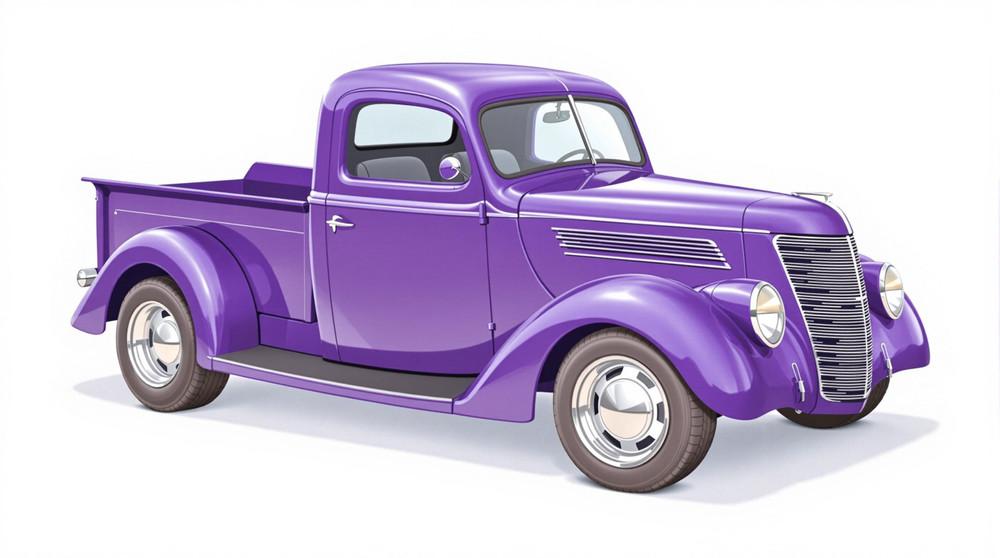
Image of 1937 Ford 1/2 Ton Pickup, Note: These illustrations use artistic license and may differ from actual historical models.
Performance Metrics
Fundamental Metrics
Emotional Appeal
MMP Rating
| Engine Specifications | |
|---|---|
| Engine: | Flathead V8 |
| Displacement: | 221 cubic inches |
| Horsepower: | Estimated 85 HP |
| Torque: | 144 lb-ft |
| Compression Ratio: | Estimated 6.15:1 |
| Ignition System: | Distributor and coil |
| Cooling System: | Water-cooled |
| Performance Specifications | |
| 0-60 Time: | Information not available due to the age of the vehicle |
| 1/4 Mile Time: | Information not available due to the age of the vehicle |
| Top Speed: | 75 mph |
| Transmission and Drive | |
| Drive Type: | Rear-wheel drive |
| Transmission Type: | 3-speed manual |
| Fuel and Efficiency | |
| Fuel System Type: | Carburetor |
| MPG: | Estimated 15-20 MPG |
| Dimensions and Brakes | |
| Brakes: | Mechanical drum brakes |
| Wheelbase: | 112 inches |
| Weight: | Estimated 2,700 lbs |
Note: Specifications for classic cars are given to the best of our ability, considering the limited and variant data available.
1937 Ford 1/2-Ton Pickup: A Prewar Classic
The 1937 Ford 1/2-ton Pickup brought the drama of Ford’s V8 era to the working farm, the neighborhood garage, and the small-town delivery route. Built by the Ford Motor Company in the United States, it paired unmistakable late-1930s styling with a straightforward chassis and a choice of flathead V8 engines. Today, it stands out as both a useful piece of American truck history and one of the most recognizable prewar Ford pickups.
The truck arrived as the country was gradually recovering from the Great Depression. Farmers and businesses needed dependable, practical transport, while buyers were also becoming more interested in comfort and style. Ford met both demands with a truck that looked more polished than a bare-bones work vehicle but remained simple enough to maintain. One intriguing detail is that its distinctive grille is often described as heart-shaped, giving the practical front end a look that is instantly recognizable to vintage Ford fans.
Art Deco Style and Work-Truck Simplicity
The 1937 Ford’s front end is its visual signature. A tall, rounded grille sits between sweeping front fenders, with the headlights integrated into the fender line rather than perched separately on brackets. The hood and grille create a smooth, unified face, while rounded contours soften the truck’s otherwise upright, purposeful shape. Those flowing forms reflect the Art Deco influence that was finding its way into American vehicle design.
The cab is compact and upright, with a broad windshield, simple doors, and a practical step up into the cabin. The pickup bed gives the truck its unmistakable working stance, while the rear fenders echo the rounded shape of the fronts. The result is a vehicle that looks graceful from the front but plainly means business from the side and rear.
Inside, the 1937 Ford is functional rather than luxurious. Drivers sat on a broad bench seat, surrounded by painted metal surfaces, a simple instrument panel, and durable trim chosen for everyday use. A rubber floor covering and uncomplicated gauges suited muddy boots and long workdays. Compared with a modern pickup, the cab is sparse, but its straightforward layout is part of the appeal: the driver has the essential controls and little else to distract from the road.
Ford offered factory paint choices that varied by model, equipment, and production details. Darker shades such as black, blue, green, and maroon are commonly associated with period Fords, though a particular truck’s original color should be confirmed through its paint code or surviving factory evidence. Black remains a popular restoration choice, while deep greens, reds, and blues give restored examples a more distinctive period look. Many trucks seen today also wear colors selected by later owners, so appearance alone does not prove originality.
The 1/2-ton pickup is the best-known version of the 1937 Ford truck, but Ford’s commercial range also included other work-oriented body configurations, such as panel and utility-style bodies, depending on chassis and equipment. The open-bed pickup remains the most iconic and the version most collectors picture when they think of a ’37 Ford truck.
Flathead V8 Technology
Ford’s defining engineering feature was its flathead V8. The 1937 truck was available with a 136-cubic-inch V8 rated at about 60 horsepower, and the larger 221-cubic-inch V8, rated at about 85 horsepower, was available in the period Ford lineup. Exact engine availability could vary with model and specification, so buyers assessing a truck today should check its original documentation rather than assume every 1937 pickup left the factory with the larger engine.
The flathead’s valves sat in the engine block beside the cylinders, a layout that was compact and relatively simple to manufacture. It was not a new design by 1937, but Ford’s ability to offer V8 power at an accessible price helped make the configuration familiar to ordinary motorists. The truck used a three-speed manual transmission and rear-wheel drive. Its mechanical simplicity is a major reason why flathead Fords remain popular with restorers and traditional hot-rodders.
Why the 1937 Ford Pickup Matters
The 1937 Ford pickup captures an important shift in the American work truck. Commercial vehicles were still built primarily to haul goods and endure hard use, but they no longer had to look strictly utilitarian. Ford applied passenger-car styling cues to a practical truck, giving it a more finished appearance without abandoning its work-first character.
Its importance also rests on the flathead V8’s influence. Ford helped popularize affordable V8 power, and the engine went on to become one of the most celebrated platforms in American performance-car history. The 1937 pickup was not a racing truck, but the combination of a relatively light chassis and V8 power later made similar Ford trucks attractive candidates for hot-rod conversions.
Compared with many contemporaries, the Ford’s strongest distinction was the combination of recognizable styling, V8 availability, and a simple mechanical package. It did not introduce every feature it carried, nor was it the only American truck offering a V8. Its lasting influence comes from bringing those qualities together in a form that has remained popular across generations.
Speed, Ride, and Road Manners
Ford did not publish modern-style 0-to-60 mph figures for the 1937 pickup, so performance numbers are best treated as estimates. A 1/2-ton truck with the 85-horsepower V8 might reach 60 mph in roughly 25 to 30 seconds under favorable conditions. A 60-horsepower version would be slower, particularly when loaded. Depending on engine, gearing, tire condition, and load, a sound truck might manage a top speed in the neighborhood of 60 to 70 mph. Those figures are estimates, not guaranteed factory test results.
The truck’s ride reflects its working purpose. Its solid axles and transverse leaf springs front and rear can feel firm over sharp bumps, especially when the bed is empty. Add a modest load and the rear suspension generally feels more settled. On winding roads, the tall cab, period tires, slow steering response, and relatively narrow stance call for a measured driving style. It is best enjoyed at a relaxed pace rather than hustled like a modern pickup.
From behind the wheel, the experience is wonderfully mechanical. The flathead V8 produces a low, even rumble, while the three-speed gearbox requires deliberate shifts and a little patience. Steering and braking demand more effort than in a contemporary vehicle. Many 1937 Fords used mechanical brakes operated through rods and linkages, so careful inspection, adjustment, and sensible following distances are essential. A well-maintained example can feel reassuringly solid, but it does not offer modern braking, crash protection, or handling.
Living With a 1937 Ford
Today, most 1937 Ford pickups are used as weekend drivers, show vehicles, parade trucks, or carefully restored shop and farm displays. Some are modified into hot rods, while others retain a period-correct appearance and serve as rolling reminders of prewar American industry. A stock truck can handle local trips and occasional highway use, but regular high-speed commuting is not its natural role.
Routine maintenance is approachable for an owner with basic mechanical skills. The engine bay is relatively accessible, and the truck’s systems are less complicated than those of a modern vehicle. Flathead-specific knowledge helps with engine work, and parts availability is generally good through specialist suppliers and the classic Ford community. Restoration can still become expensive: rust repair, scarce trim, correct wheels, upholstery, and a quality engine rebuild all add up.
Reliability depends heavily on the quality of the restoration and ongoing maintenance. Cooling-system condition is particularly important on an old flathead, and the ignition, fuel system, brakes, steering, and electrical wiring deserve close attention. Original mechanical brakes can be maintained, but they must be correctly adjusted and kept in good condition. Owners who want frequent modern traffic use sometimes fit upgrades such as improved brakes or a later powertrain, though modifications can reduce originality and may affect collector value.
1937 Ford Pickup Facts and Myths
The 1937 truck’s rounded grille and integrated headlamps make it easy to distinguish from many earlier Ford pickups. It also belongs to the era when Ford’s flathead V8 was becoming an enduring symbol of accessible American power. Its later hot-rod reputation is strong, but the original truck was designed first as a practical commercial vehicle, not as a performance machine.
There is no widely recognized speed, endurance, or production record associated specifically with the 1937 1/2-ton pickup. Nor is there a reliable, comprehensive count of how many examples of this exact body and specification survive. Ford built vehicles in large numbers, but surviving records and production totals are not always separated neatly by truck body style, engine, and payload rating. Claims about a precise pickup production figure should therefore be treated cautiously.
The model is also not chiefly known for a single celebrity owner or a defining appearance in a major historical event. Its significance is broader: trucks of this type served businesses and farms during a pivotal period in American life, and the design represents the prewar generation that came before wartime production reshaped the auto industry.
Common criticisms are part of the ownership picture. The cab is noisy by modern standards, the ride can be choppy, and the brakes and steering require more attention and effort than modern drivers expect. Rust and decades of repairs can also leave a truck with mismatched parts or hidden structural problems. These are not reasons to avoid one, but they are good reasons to inspect carefully before buying.
Collector Values and Availability
The 1937 Ford 1/2-ton Pickup is a desirable classic, but values vary widely with condition, originality, bodywork, and mechanical quality. As a broad U.S. market estimate for 2026, a project truck may sell for about $8,000 to $20,000. A usable driver or older restoration often falls around $20,000 to $40,000, while a high-quality, well-documented restoration can reach roughly $40,000 to $70,000 or more. Exceptional examples and professionally built customs can exceed those ranges, but their prices depend on execution and buyer demand.
The truck is scarce compared with later pickups, yet it is not impossible to find. Restored examples appear through classic-vehicle dealers, auctions, enthusiast networks, and online marketplaces. Project trucks are less expensive but can require extensive metalwork, and replacement parts do not eliminate the cost of correcting old repairs or poorly fitted panels.
No dependable production total is available here for the exact 1937 1/2-ton pickup configuration. A reasonable working estimate is that Ford built tens of thousands of pickups in this class, perhaps roughly 50,000 to 100,000, but that range is an informed estimate rather than a verified factory figure. The number of surviving trucks is considerably smaller and is difficult to establish because many were scrapped, modified, or rebuilt over the decades.
Values for sound, correctly restored trucks have generally benefited from steady collector interest, especially for original-style examples with documented history. The market is not immune to wider classic-car trends, and heavily modified trucks can appeal to a narrower group of buyers. Overall, the model is best viewed as a collectible with solid long-term appeal rather than a guaranteed short-term investment.
A Ford That Still Feels Like a Truck
The 1937 Ford 1/2-ton Pickup combines graceful prewar styling, flathead V8 character, and the honest practicality of a working vehicle. Its cab and controls may feel basic today, but that simplicity is part of what makes it engaging to own and drive. For collectors, it offers a tangible link to Ford’s V8 legacy and to the era when American trucks were becoming as distinctive as the cars beside them. More than a display piece, it is a piece of working history that still knows how to make an entrance.
1937 Ford 1/2 Ton Pickup Catalog of Parts
 1937 Ford 1/2 Ton Pickup Headlight Pads. 3-1/2" wide X 5-3/8" long. Pair-MP 703Headlight Pads. 3-1/2" wide X 5-3/8" long. Pair
Why Choose Metro?
For over 100 years, Metro Moulded Parts has been the pinnacle of quality in classic car restoration parts. Our commitment to precision and authenticity in every component ensures a perfect fit and an OEM-level appearance.
- Expert Craftsmanship & Quality: Each part is a testament to our dedication to reliability and perfection, crafted from original designs and thoroughly tested.
- Advanced Technology: We use cutting-edge techniques to create flawless, long-lasting parts that surpass others in performance.
- SuperSoft Sponge – The Ultimate Door Seal: Not only are our door seals 30% softer than competitors', but they're also guaranteed to never leak. They effectively reduce wind and road noise, enhancing your classic car's comfort and driving experience.
- Proudly American: Our parts are a product of American craftsmanship, made in the USA with a spirit of excellence and heritage.
- Unrivaled Warranty: We back our products with a 30-year industry-leading warranty, a testament to our confidence in their quality.
Join us in preserving the legacy of classic cars with parts that are crafted for perfection, not just made.