
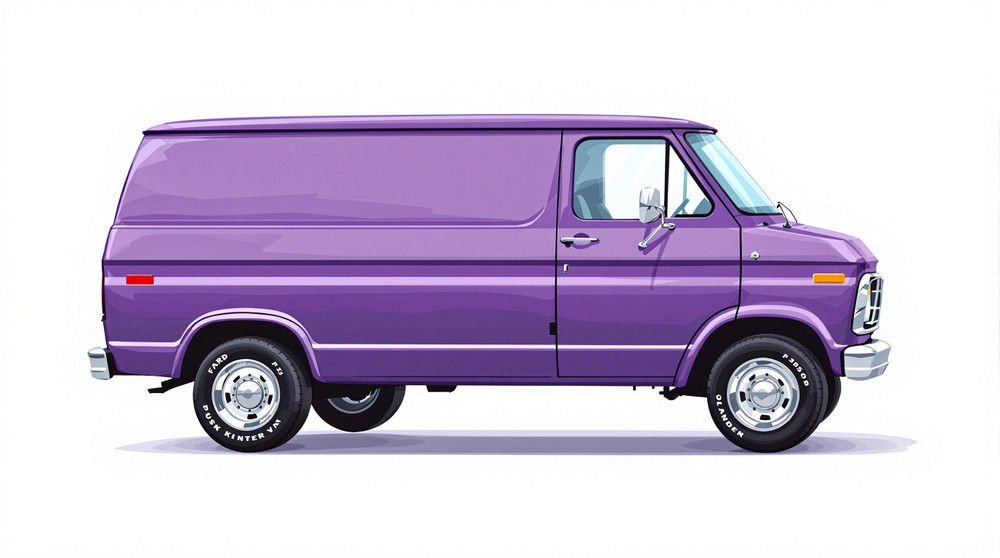
Image of 1973 Ford P-350, Note: These illustrations use artistic license and may differ from actual historical models.
Performance Metrics
Fundamental Metrics
Emotional Appeal
MMP Rating
| Engine Specifications | |
|---|---|
| Engine Options: | 4.9L Inline 6, 5.9L V8, 7.5L V8 |
| Displacement Range: | 4.9L - 7.5L |
| Horsepower Range: | 101 - 224 hp |
| Torque: | 223 - 366 lb-ft |
| Compression Ratio: | 8.0:1 - 8.4:1 |
| Ignition System: | Conventional distributor and coil system |
| Cooling System: | Liquid-cooled |
| Performance Specifications | |
| 0-60 Time: | Estimated 10 - 15 seconds |
| 1/4 Mile Time: | Estimated 18 - 22 seconds |
| Top Speed: | 75 - 85 mph |
| Transmission and Drive | |
| Drive Type: | Rear-wheel drive |
| Transmission Type: | 3-speed automatic, 4-speed manual |
| Fuel and Efficiency | |
| Fuel System Type: | Carburetor |
| MPG: | Estimated 8 - 12 mpg |
| Dimensions and Brakes | |
| Brakes: | Front disc and rear drum brakes |
| Wheelbase: | 138 inches |
| Weight: | 4,000 - 5,000 lbs |
Note: Specifications for classic cars are given to the best of our ability, considering the limited and variant data available.
1973 Ford P-350: The Workhorse Behind the Delivery Van
With its blunt nose, upright cab, and broad side panels, the 1973 Ford P-350 was built to get a job done, not to win a beauty contest. It was a heavy-duty Ford commercial chassis designed to carry a wide range of bodies, from parcel-delivery step vans to motorhomes. That flexibility is the key to understanding the P-350: it was not one standardized van so much as a sturdy platform that different body builders and fleet customers could shape to suit their needs.
Ford’s P-series belonged to the company’s commercial-vehicle world, alongside its Econoline vans and larger trucks. The “350” identified its place in the heavy-duty range, commonly understood as a one-ton-class chassis, though a finished vehicle’s gross vehicle weight rating depended on its exact specification and body. In 1973, American businesses needed vehicles that could haul goods through city streets, serve rural routes, and keep working day after day. The P-350 answered that need with a practical, serviceable layout.
One intriguing detail is that two 1973 P-350s could look and feel like entirely different vehicles. One might be a tall parcel van with a walk-through cab, another a motorhome with a coach-built living space, and another a bare chassis awaiting its commercial body. Ford supplied the foundation; the finished vehicle often told the story of the body builder and the original customer.
Cab-Forward Styling and a Practical Interior
The P-350’s exterior was shaped by its work. Its forward-control layout placed the driver high and close to the front axle, giving the vehicle a short, nearly flat front and making more of its overall length available for cargo or passenger space. Large windows, upright body sides, and broad doors favored visibility and access over aerodynamic polish. On a step-van version, the boxy cargo body and low step made frequent stops easier than they would be in a conventional panel van.
There was no single P-350 interior. A basic commercial cab typically put durability first, with hard-wearing vinyl, simple door panels, a broad steering wheel, and straightforward instrumentation. Trim was generally functional rather than luxurious. Depending on the body and order, equipment could include different seating arrangements, mirrors, ventilation, or additional gauges. A motorhome conversion, by contrast, could have a finished coach interior that had little in common with the plain cab of a delivery truck.
Technology was similarly practical. The P-350 used conventional truck components and a rear-wheel-drive layout, making it familiar to fleet mechanics and independent repair shops. Power steering and power brakes could be fitted depending on specification, but equipment varied. There were no modern driver aids or electronic engine controls: the driver relied on large mirrors, direct steering feedback, and a straightforward instrument panel.
Paint choices depended heavily on how the chassis and body were ordered. Ford commercial colors could be selected for a chassis or cab, while body builders and fleet customers often chose their own finishes. White, fleet colors, and bright commercial shades such as yellow are commonly associated with period delivery vehicles, but no single color defines every P-350. The most iconic look is arguably a tall, white or fleet-painted step van with a large, unbroken cargo box.
One Chassis, Many Working Bodies
The P-350 could underpin several kinds of finished vehicle. Step vans were among its most recognizable applications, especially for parcel, bakery, and local delivery work. Other examples were built as service trucks, utility vehicles, shuttle-style bodies, or motorhomes. The exact body came from the buyer’s requirements and the work of a specialist builder, so features such as cargo doors, windows, roof height, and interior fittings could differ considerably.
That variety is also why it is difficult to identify a single “most popular” body style across all P-350 production. For many people, the classic image is the parcel-delivery step van: tall, square-sided, and designed for a driver making repeated stops. But the motorhome and service-truck versions are part of the P-350 story too.
Why the P-350 Mattered
The P-350 was not a landmark because it introduced a revolutionary engine or a radical new suspension. Its importance was more practical. It gave businesses and coach builders a heavy-duty, forward-control platform that could be adapted to jobs a regular passenger van could not handle as comfortably. The short front end and upright driving position helped make a large vehicle more usable in tight streets, while the open-ended chassis concept allowed specialists to build bodies for different industries.
This approach became a familiar feature of the commercial-vehicle market. Manufacturers supplied a capable chassis, and body builders turned it into a delivery truck, recreational vehicle, or specialized work rig. The P-350 is a good example of how much of a commercial vehicle’s identity can come from the partnership between the chassis maker, the body builder, and the fleet that puts it to work.
Compared with a conventional van, the P-350’s cab-forward design could offer useful cargo space and a commanding view of the road. The trade-off was a driving position close to the front wheels, a tall body that could catch crosswinds, and less refinement than a passenger car. It was engineered for utility, not for a quiet or effortless commute.
Performance and Road Manners
Engine and transmission choices depended on the chassis order and application. Period Ford commercial engines could include six-cylinder and V8 options, with the 300-cubic-inch inline-six a familiar choice in working trucks and larger V8s available for applications needing more power. Some vehicles had manual transmissions, while automatic transmissions were also offered. Because body builders, gearing, vehicle weight, and equipment all varied, there is no single performance specification that applies to every 1973 P-350.
Ford did not publish one standardized 0-to-60 mph time or top speed for every P-350 body configuration. As a broad real-world estimate, a lightly loaded example might manage roughly 20 to 30 seconds from 0 to 60 mph, while a heavy delivery body or motorhome could take longer. A healthy, lightly loaded vehicle might reach around 65 to 75 mph, but that is an estimate, not a universal factory rating. Tires, axle gearing, engine, load, and mechanical condition all make a substantial difference. These vehicles are most comfortable at moderate speeds, not when pushed to modern highway limits.
On a smooth road, the P-350 feels like a substantial old truck: upright, deliberate, and a little noisy. The engine’s sound depends on the installed unit, but a six-cylinder tends to have a steady working hum, while a V8 brings a deeper exhaust note. Steering can feel heavy in a vehicle without power assist, and the large steering wheel gives the driver leverage rather than sports-car precision.
Over bumps, the ride is firm, especially when the chassis is lightly loaded or fitted with heavy-duty springs. A loaded vehicle may settle into a more composed rhythm, but it still behaves like a commercial truck. On winding roads, its height and weight call for smooth steering and sensible cornering speeds. Crosswinds can be noticeable on tall step vans and motorhomes, and braking distances depend heavily on load, brake condition, and road surface. The best driving experience comes from respecting its size and planning ahead.
Living With a 1973 Ford P-350
Today, P-350s are more likely to be weekend projects, mobile businesses, vintage campers, or show vehicles than everyday transportation. Their roomy bodies make them tempting candidates for camper or food-truck conversions, while original delivery vans have a rugged period look that draws attention at commercial-vehicle and classic-truck gatherings.
Mechanical service can be straightforward for an owner familiar with older Ford trucks. Many engine, brake, and chassis components follow conventional designs, and routine work does not require modern diagnostic equipment. The greater challenge is often finding parts specific to the body, cab, or coach conversion. Rust around the frame, floors, cab mounts, door openings, and body seams deserves close inspection. Buyers should also check steering and brake condition, cooling performance, tire age, and whether the vehicle’s weight rating matches its intended use.
Reliability depends less on the badge than on maintenance and past workload. A well-cared-for P-350 can be a durable machine, but decades of commercial service may mean worn suspension, tired wiring, neglected brakes, or a drivetrain that has spent years carrying heavy loads. Before buying, verify the vehicle identification and chassis details, inspect the frame, and have the engine and transmission assessed by someone familiar with vintage trucks. A finished body conversion should also be checked for safe wiring, sound structure, and proper weight distribution.
Useful Trivia and Common Complaints
The P-350’s most distinctive “special edition” was often the body itself. A parcel van built by a specialist could be far more recognizable than the Ford chassis beneath it, and the same chassis designation could appear in very different commercial roles. That makes surviving examples especially interesting to researchers and collectors: the body builder, fleet markings, and original equipment can tell as much about a particular vehicle as its Ford identification plate.
There is no widely recognized P-350 speed or endurance record that defines the model, and exact 1973 production figures for the P-350 chassis are not readily established in commonly available public sources. It is safest not to attach a precise production total to the model without factory records. As a rough, unverified estimate, 1973 production may have amounted to several thousand chassis, perhaps in the 5,000-to-10,000 range, but that figure should be treated as a reasoned guess rather than a documented count. The number of surviving examples in original condition is likely far smaller.
Common criticisms are easy to understand: the cab can be loud and basic, the ride is truck-like, fuel economy is poor by modern standards, and a tall body can be tiring in strong crosswinds. Parts for the chassis may be manageable to source, but unique body components can be difficult. On the positive side, its visibility, generous working space, and straightforward mechanical layout remain appealing qualities.
Collector Values and Market Outlook
Values vary widely because a P-350’s body type, condition, mechanical health, and conversion quality matter more than the model name alone. As a broad current-market estimate, a rough project or non-running example might bring about $2,000 to $5,000. A usable, roadworthy step van or basic commercial vehicle could fall around $5,000 to $15,000. A clean, well-restored, or thoughtfully converted example might reach roughly $15,000 to $30,000 or more. High-quality motorhome or specialty conversions can be priced differently, especially when the interior and equipment are complete and functional.
These are general estimates, not a guaranteed appraisal. A vehicle with serious rust, poor documentation, or an unfinished conversion may be worth substantially less. Conversely, an unusually well-preserved example with a known history, desirable body, and professional restoration can command a premium.
The P-350 is a niche collectible, so its market is smaller than that for famous muscle cars or classic passenger vans. Values are likely to be strongest for sound, usable examples with distinctive period bodies and complete histories. Interest in vintage campers and mobile businesses may help support prices, but restoration costs can rise quickly, making condition especially important. Rather than expecting rapid appreciation, buyers should look for a solid vehicle they genuinely want to preserve or use.
A Ford Built to Keep Working
The 1973 Ford P-350 was a versatile commercial foundation: forward-control, heavy-duty, and ready for a body suited to the job. Its performance was modest, its cabin was workmanlike, and its driving manners demanded respect, especially when loaded or exposed to crosswinds. In return, it offered the space and adaptability that businesses and builders needed.
More than a single van design, the P-350 represents a practical chapter in American commercial motoring, when a dependable chassis could become a delivery truck, service vehicle, or camper. That work-first character is exactly what makes a surviving example memorable today: it is not just an old Ford, but a rolling record of the jobs it was built to do.
1973 Ford P-350 Catalog of Parts
 1973 Ford P-350 Brake Pedal Pad. 4-3/4" wide X 2-1/4" long-CB 111-NBrake Pedal Pad. 4-3/4" wide X 2-1/4" long. Replaces OEM #'s BC3Z2457B, D3TZ2457A, D3TZ2457B. Each
Why Choose Metro?
For over 100 years, Metro Moulded Parts has been the pinnacle of quality in classic car restoration parts. Our commitment to precision and authenticity in every component ensures a perfect fit and an OEM-level appearance.
- Expert Craftsmanship & Quality: Each part is a testament to our dedication to reliability and perfection, crafted from original designs and thoroughly tested.
- Advanced Technology: We use cutting-edge techniques to create flawless, long-lasting parts that surpass others in performance.
- SuperSoft Sponge – The Ultimate Door Seal: Not only are our door seals 30% softer than competitors', but they're also guaranteed to never leak. They effectively reduce wind and road noise, enhancing your classic car's comfort and driving experience.
- Proudly American: Our parts are a product of American craftsmanship, made in the USA with a spirit of excellence and heritage.
- Unrivaled Warranty: We back our products with a 30-year industry-leading warranty, a testament to our confidence in their quality.
Join us in preserving the legacy of classic cars with parts that are crafted for perfection, not just made.