
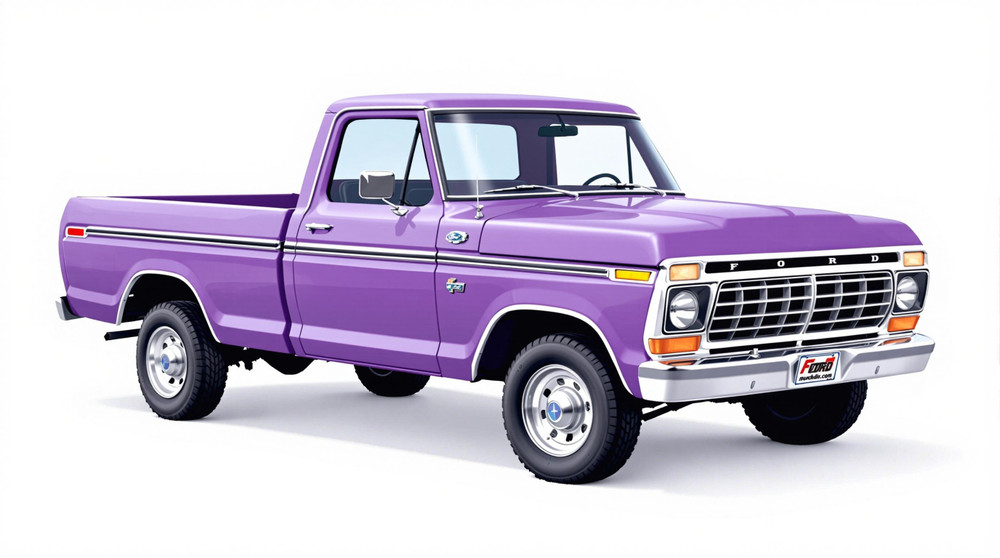
Image of 1975 Ford F-150, Note: These illustrations use artistic license and may differ from actual historical models.
Performance Metrics
Fundamental Metrics
Emotional Appeal
MMP Rating
| Engine Specifications | |
|---|---|
| Engine Options: | 4.9L 300 Cu. In. I6, 5.9L 360 Cu. In. V8, 6.4L 390 Cu. In. V8 |
| Displacement Range: | 300-390 Cu. In. |
| Horsepower Range: | 101-159 HP |
| Torque: | 223-315 lb-ft |
| Compression Ratio: | 8.0:1 - 8.4:1 |
| Ignition System: | Conventional Breaker Point Ignition System |
| Cooling System: | Liquid Cooled |
| Performance Specifications | |
| 0-60 Time: | Estimated 14-18 seconds |
| 1/4 Mile Time: | Estimated 19-22 seconds |
| Top Speed: | 85-95 mph |
| Transmission and Drive | |
| Drive Type: | Rear Wheel Drive |
| Transmission Type: | 3-Speed Manual, 4-Speed Manual, 3-Speed Automatic |
| Fuel and Efficiency | |
| Fuel System Type: | Carburetor |
| MPG: | Estimated 10-14 MPG |
| Dimensions and Brakes | |
| Brakes: | Front Disc and Rear Drum Brakes |
| Wheelbase: | 133 inches |
| Weight: | 4,000-5,000 lbs |
Note: Specifications for classic cars are given to the best of our ability, considering the limited and variant data available.
1975 Ford F-150: The First Year of a Trucking Legend
The 1975 Ford F-150 arrived as a new name in Ford’s pickup range, but it was built on a truck line already trusted across America. Made by Ford Motor Company, it joined the sixth-generation F-Series, introduced in 1973, and slotted between the F-100 and F-250. Its blend of everyday usability and greater capacity helped establish the F-150 as the model that would eventually become Ford’s best-known pickup.
Its debut also makes this model year a milestone: 1975 was the first year the F-150 badge appeared. A common story says Ford created the truck solely to get around emissions rules. That explanation is too simple. Its higher-capacity positioning did have regulatory context, but the F-150 also filled a practical gap for buyers who wanted more capability than an F-100 without stepping up to a heavier-duty F-250.
Dentside Styling and Work-Ready Comfort
The 1975 F-150 wears the square-jawed look enthusiasts call “Dentside,” a nickname for the recessed character lines pressed into the body sides of 1973–79 Ford pickups. A broad grille, upright windshield, flat hood, and strong horizontal lines give it a purposeful stance. The design is simple rather than delicate, with plenty of sheet metal and a clear sense that the truck was built to work.
Buyers could choose a regular cab or the roomier SuperCab, along with a Styleside bed with smooth outer panels or a Flareside bed with separate rear fenders. Styleside pickups are especially common and are often considered the classic all-rounder, while Flareside examples have a more traditional, old-school profile. Two-wheel drive and four-wheel drive were available, with cab, bed, trim, and equipment combinations varying by order.
Trim levels included practical Custom models and better-appointed Ranger and Ranger XLT versions. Inside, the cabin was straightforward and durable. Vinyl upholstery and hard-wearing surfaces were typical, though cloth and more comfort-oriented options could be ordered. The dashboard was broad and easy to read, with large controls suited to drivers wearing work gloves. Power steering, power brakes, air conditioning, and an automatic transmission were among the available conveniences, depending on the truck’s specification.
Ford offered a range of factory colors that varied by trim and production details. White, red, blue, green, yellow, and earth tones all suited the period, while two-tone paint added extra visual punch. White and red trucks remain especially familiar sights at shows and in period photographs, though original paint codes and combinations are worth checking on any claimed factory-correct example.
Why the 1975 F-150 Matters
The F-150 did not introduce a revolutionary new chassis or a new kind of pickup. Its significance was more practical: it gave buyers a clearly positioned step between Ford’s lighter and heavier trucks, while adding a nameplate that could grow with changing expectations. That formula proved remarkably durable. The F-100 eventually left the U.S. market, while the F-150 became the center of Ford’s light-truck lineup.
The sixth-generation trucks also helped define the big, squared-off American pickup look that remained popular for years. Their substantial proportions, broad stance, and useful range of body and drivetrain choices made them equally at home on farms, job sites, and suburban driveways. The 1975 model is especially appealing to collectors because it combines that familiar Dentside shape with the first-year F-150 identity.
Engines, Speed, and Road Manners
Engine availability varied with configuration and market, but 1975 F-150s could be ordered with Ford’s 300-cubic-inch inline-six or V8 options such as the 360, 390, and 460 cubic-inch engines. A three-speed manual was common, with other manual and automatic transmissions available depending on the build. Four-wheel-drive versions added a transfer case for low-range work and rougher terrain.
There is no single reliable performance figure for every 1975 F-150. Engine choice, axle ratio, transmission, tire size, drivetrain, and load all make a major difference. As a broad period-truck estimate, a V8 model might reach 0–60 mph in roughly 10–15 seconds, while a six-cylinder or heavily geared 4x4 could take longer. Top speed commonly falls in the approximate 85–100 mph range, but these trucks were designed for utility, not high-speed running. A well-preserved example should be driven with modern traffic and its age in mind.
On the road, the F-150 feels solid and substantial. The engine note is part of the appeal: a 300 six has a steady, workmanlike sound, while the V8s deliver a deeper rumble and, in larger-displacement form, relaxed pulling power. The ride is truck-firm, particularly when the bed is empty. It can hop over sharp bumps, and its solid-axle four-wheel-drive versions feel more deliberate on winding pavement than a modern SUV. In crosswinds, the tall body and period steering ask for a calm hand. The reward is an engaging, mechanical driving experience with clear feedback through the wheel and controls.
Living With a Classic Ford Pickup
Today, a 1975 F-150 can serve as a weekend cruiser, a work truck, a restoration project, or a show vehicle. Many owners choose a driver-quality example and preserve its honest wear rather than pursue a perfect restoration. Four-wheel-drive trucks are popular for off-road builds, while clean two-wheel-drive Styleside models make appealing period-correct cruisers.
Routine service is generally approachable for a mechanically minded owner. The engines are familiar to many classic-Ford specialists, and parts availability is strong for common service items and restoration components. That said, age brings predictable checks: inspect the frame and cab mounts for corrosion, examine the bed and lower body for rust, and look closely at brake lines, steering components, wiring, and fuel-system condition. On 4x4 models, check the transfer case, front axle, and driveline for leaks or wear. A truck that starts easily is not necessarily a sound truck, so a thorough inspection matters.
First-Year Trivia and Common Gripes
The most important bit of trivia is also the simplest: a 1975 F-150 is a first-year F-150. Ford did not publish a widely accessible model-by-model production breakdown that cleanly isolates every engine, cab, bed, and drivetrain combination. A reasonable broad estimate is that roughly 150,000–200,000 F-150s may have been built for the model year, but that should be treated as an informed estimate, not an official tally.
There is no broadly documented 1975 F-150 speed record or famous celebrity-owned example that defines the model’s story. Its distinction is its place in the evolution of Ford’s most enduring pickup nameplate. Common criticisms are more everyday: fuel consumption can be substantial, especially with a big V8; the cabin is noisy by modern standards; and the ride can be stiff without cargo. Rust and decades of repairs are bigger concerns than any original design flaw.
1975 Ford F-150 Values and Availability
Values depend heavily on condition, originality, engine, drivetrain, and documentation. As a general U.S. market guide in 2026, a rough project might bring around $5,000–$12,000. A usable driver often falls near $15,000–$30,000, while a clean, well-restored example may reach roughly $35,000–$60,000. Exceptional restorations, desirable 4x4s, or unusually original trucks can sell above that range, while rust, incomplete paperwork, or major mechanical needs can pull a price down sharply.
First-year interest gives the 1975 model an extra talking point, and strong classic-truck demand has supported values for clean Dentside pickups. Prices have generally strengthened for well-presented examples, but not every truck is an investment: condition and quality of work matter far more than the badge alone. Project trucks remain available, though rust-free and largely original examples are increasingly sought after.
A Landmark That Still Earns Its Keep
The 1975 Ford F-150 combines honest work-truck engineering with the first appearance of a name that would become an American automotive institution. Its square Dentside styling, broad choice of engines and body configurations, and practical, repairable mechanicals make it enjoyable to own as well as historically significant. More than a collectible badge, it is a reminder of why a good pickup has to do its job first. Nearly five decades later, the first-year F-150 still looks ready to get to work.
1975 Ford F-150 Catalog of Parts
 1975 Ford F-150 Brake Pedal Pad. 4-3/4" wide X 2-1/4" long-CB 111-NBrake Pedal Pad. 4-3/4" wide X 2-1/4" long. Replaces OEM #'s BC3Z2457B, D3TZ2457A, D3TZ2457B. Each
 1975 Ford F-150 Door seal. '73-'79 Ford F-Series trucks. '78-'79 Ford Bronco-LM 110-ADoor seal. '73-'79 Ford F-Series trucks. '78-'79 Ford Bronco. Fits on cab, either side. Each.
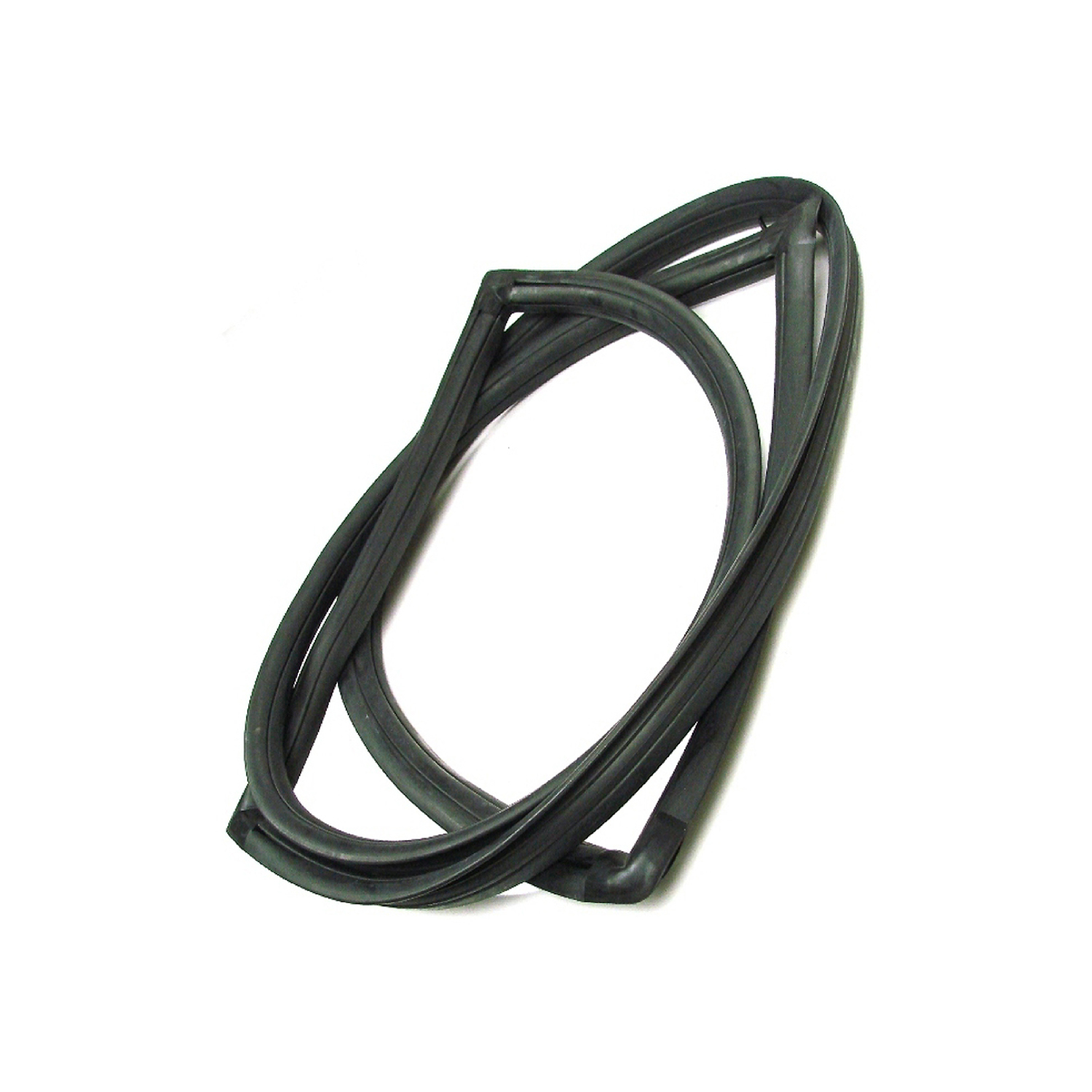 1975 Ford F-150 Windshield seal, '73-'76 Ford F Series Truck-VWS 3304-EWindshield seal, '73-'76 Ford F Series Truck with groove to accept trim, each.
 1975 Ford F-150 Rear window seal, '73-'79 Ford F Series Truck without trim groove-VWS 3304-RRear window seal, '73-'79 Ford F Series Truck without trim groove, each. Replaces OEM part # D3TZ-1042084-A.
Why Choose Metro?
For over 100 years, Metro Moulded Parts has been the pinnacle of quality in classic car restoration parts. Our commitment to precision and authenticity in every component ensures a perfect fit and an OEM-level appearance.
- Expert Craftsmanship & Quality: Each part is a testament to our dedication to reliability and perfection, crafted from original designs and thoroughly tested.
- Advanced Technology: We use cutting-edge techniques to create flawless, long-lasting parts that surpass others in performance.
- SuperSoft Sponge – The Ultimate Door Seal: Not only are our door seals 30% softer than competitors', but they're also guaranteed to never leak. They effectively reduce wind and road noise, enhancing your classic car's comfort and driving experience.
- Proudly American: Our parts are a product of American craftsmanship, made in the USA with a spirit of excellence and heritage.
- Unrivaled Warranty: We back our products with a 30-year industry-leading warranty, a testament to our confidence in their quality.
Join us in preserving the legacy of classic cars with parts that are crafted for perfection, not just made.