
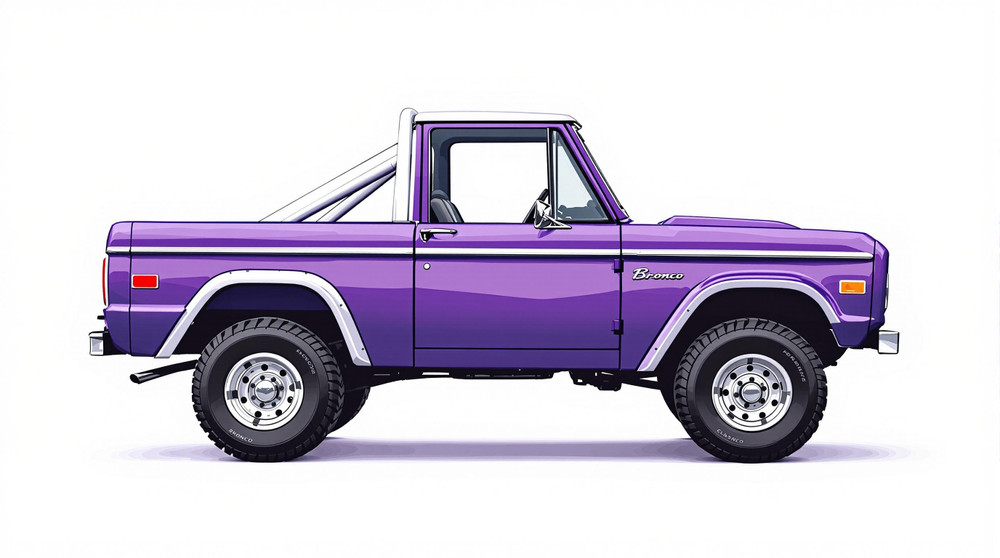
Image of 1976 Ford Bronco, Note: These illustrations use artistic license and may differ from actual historical models.
Performance Metrics
Fundamental Metrics
Emotional Appeal
MMP Rating
| Engine Specifications | |
|---|---|
| Engine: | 302 cu in (4.9 L) Windsor V8, 170 cu in (2.8 L) straight-6 |
| Displacement: | 170-302 cu in |
| Horsepower: | 105-150 hp |
| Torque: | 245 lb-ft for the V8 |
| Compression Ratio: | 8.4:1 for the V8 |
| Ignition System: | Conventional breaker-point ignition system |
| Cooling System: | Liquid-cooled |
| Performance Specifications | |
| 0-60 Time: | 11-13 seconds |
| 1/4 Mile Time: | 18 seconds |
| Top Speed: | 96 mph |
| Transmission and Drive | |
| Drive Type: | 4WD |
| Transmission Type: | 3-speed manual, 3-speed automatic |
| Fuel and Efficiency | |
| Fuel System Type: | Carburetor |
| MPG: | 10-14 mpg |
| Dimensions and Brakes | |
| Brakes: | Front disc and rear drum brakes |
| Wheelbase: | 92.0 in |
| Weight: | 3,600 lbs |
Note: Specifications for classic cars are given to the best of our ability, considering the limited and variant data available.
1976 Ford Bronco: A Compact 4x4 With Big-Screen Presence
The 1976 Ford Bronco can squeeze down a narrow trail, rumble through a muddy field, and still turn heads parked outside a coffee shop. Built by Ford, it belongs to the first-generation Bronco family, introduced in 1966 as a nimble four-wheel-drive alternative to larger trucks and more specialized off-roaders.
Ford designed the original Bronco to compete with vehicles such as the Jeep CJ and International Scout. By 1976, the model had evolved from a simple, utilitarian 4x4 into a more comfortable and better-equipped sport utility vehicle, while keeping the short wheelbase and rugged hardware that made it trail-capable. One noteworthy change for the 1976 model year was the adoption of standard front disc brakes, an important improvement for stopping performance.
The 1976 Bronco also arrived near the end of the first generation, which concluded after the 1977 model year. That timing gives it a special place among classic Broncos: it retains the original compact proportions, but benefits from several years of mechanical development.
Classic Bronco Styling and Cabin
The first-generation Bronco has a distinctive, upright shape. Its nearly flat hood, squared-off grille, round headlights, and straight body sides give it a purposeful look without unnecessary decoration. The 1976 model rides on a compact 92-inch wheelbase, with short overhangs that help it clear steep approaches and departures on rough terrain.
Most 1976 Broncos seen today are wagons with a removable hardtop. The top can be taken off for open-air driving, while the rear tailgate drops down to make loading gear easier. The upright windshield and broad windows give the cabin an airy feel with the top removed, although the vehicle’s compact size means it is not especially spacious by modern SUV standards.
Inside, the Bronco favors practicality over luxury. Expect straightforward gauges, durable vinyl upholstery, a simple dashboard, and materials chosen to handle dirt and regular use. Depending on equipment, buyers could add convenience features and appearance upgrades. Sport trim and other optional equipment could give a Bronco a more finished look, but even a well-equipped example remained a sturdy, easy-to-clean truck rather than a plush cruiser.
Ford offered the Bronco in a range of period colors, from subdued earth tones to brighter reds, blues, and greens. Exact colors varied by year and trim. White and bold primary colors are especially recognizable on surviving examples, while original paint in an unusual factory shade can add appeal for collectors. As with any restoration, buyers should check the data plate and factory records rather than assume a color is original.
First-Generation Bronco Engineering
The original Bronco’s big idea was to combine compact dimensions with genuine four-wheel-drive capability. Its short wheelbase made it easier to maneuver on tight trails than many full-size trucks, and its rugged chassis and transfer case were built for work beyond paved roads. The 1976 model used a solid front axle and a live rear axle, with coil springs at the front and leaf springs at the rear. That layout offered useful articulation off-road, though it did not deliver the refined ride of a modern independent-suspension SUV.
Power came from a 302-cubic-inch V8 paired with a three-speed manual transmission as standard equipment. An automatic transmission was available, along with four-wheel drive through a two-speed transfer case. Output figures vary with the rating method and emissions setup, but period 302s were tuned for usable low- and midrange torque rather than high-revving speed.
For 1976, front disc brakes became standard, improving braking compared with the earlier front-drum arrangement. Power steering and other comfort or convenience equipment could also be specified. These updates made the Bronco more manageable in everyday use without changing its basic, mechanical character.
Performance on Road and Trail
A 1976 Bronco is not a fast truck by modern standards. Depending on condition, gearing, transmission, tire size, and load, expect a 0-to-60-mph time in roughly the 13-to-16-second range. A stock example may reach approximately 85 to 90 mph, but it feels most at home at moderate speeds, where its V8 torque and four-wheel-drive hardware matter more than outright acceleration.
On pavement, the short wheelbase makes the Bronco feel alert and maneuverable. It can also make the ride busy over potholes and expansion joints, and the high stance means it reacts more noticeably to crosswinds than a passenger car. On a winding road, the steering and suspension remind you that this is a body-on-frame 4x4, not a sports car. Smooth inputs and sensible speeds suit it best.
Off-road is where the design makes sense. The compact body, solid axles, low-range gearing, and four-wheel drive help it handle uneven ground and slow, technical routes. Tire choice and vehicle condition make a major difference: an unmodified Bronco on suitable tires can be a capable trail truck, while oversized tires or a poorly executed lift can compromise steering, braking, and reliability.
Behind the wheel, the V8’s low, steady rumble is part of the appeal. The ride is firm and direct, the controls feel mechanical, and the driver sits high with a clear view over the hood. It is an engaging experience precisely because it asks for more participation than a modern SUV.
Why the Bronco Matters
The first-generation Bronco helped define the compact sport utility vehicle as a distinct kind of vehicle: smaller and more trail-friendly than a full-size pickup, but more versatile than a dedicated off-road runabout. Its formula of a short wheelbase, removable top, four-wheel drive, and truck-based construction influenced later 4x4s and helped establish the Bronco name as one of Ford’s most enduring off-road brands.
What set the 1976 Bronco apart from many contemporaries was its balance of size and capability. It was compact enough for narrow trails, yet its V8 and sturdy running gear made it useful for towing, hauling, and general work. It also offered a more adaptable cabin than a purely open utility vehicle, especially with the wagon body and removable hardtop.
The Bronco’s competition and racing heritage added to its reputation. Ford-supported off-road racer Bill Stroppe helped make Broncos familiar in desert racing, while the famous Big Oly racer, driven by Parnelli Jones, demonstrated the potential of Bronco-inspired engineering. Big Oly was a specialized racing vehicle, not a showroom 1976 Bronco, but that competition history strengthened the model’s rugged image.
Living With a 1976 Bronco
Owners use these trucks as weekend drivers, trail rigs, restored show vehicles, and vintage 4x4s for local events. Some are carefully preserved in factory-style condition; others have modern engines, upgraded brakes, improved suspension, or more comfortable interiors. A well-chosen restomod can be enjoyable, but originality is valuable to collectors, so keep removed factory parts whenever possible.
Mechanical work is generally approachable for a home mechanic. The V8 and basic chassis systems are familiar, and many service parts remain available through specialist suppliers. The simple construction is a major advantage over newer vehicles. Still, age brings challenges: wiring may be deteriorated, previous repairs may be poorly done, and decades of modifications can make diagnosis more complicated than the basic design suggests.
Rust deserves particular attention. Inspect the floor pans, inner and outer fenders, rocker areas, body mounts, tailgate, and the frame, especially around suspension and body attachment points. Check the transfer case and axles for leaks, listen for driveline vibration, and test the brakes thoroughly. A shiny paint job can conceal expensive corrosion, so a careful inspection on a lift is money well spent.
1976 Bronco Facts and Caveats
Ford produced approximately 15,256 Broncos for the 1976 model year, according to commonly cited production figures. That is enough to make the model findable, but clean, unmodified examples are much harder to locate than project trucks. The first-generation Bronco as a whole ran from 1966 through 1977 and totaled roughly 225,000 vehicles across its production life.
A common point of confusion is the famous 1994 police chase involving O.J. Simpson. The white Bronco associated with that event was a 1993 model, not a 1976 first-generation truck. The incident nevertheless helped keep the Bronco name in the public eye, while the classic models have built their own following through their design and off-road reputation.
Common criticisms are part of the ownership picture. The cabin is cramped compared with newer SUVs, fuel economy is poor by modern standards, highway noise can be substantial, and the short-wheelbase ride can feel choppy. These are not hidden flaws so much as consequences of a compact, truck-based design from another era.
1976 Ford Bronco Values and Collectibility
Prices vary widely with rust, originality, mechanical condition, and the quality of any restoration. As a broad 2026 U.S. market estimate, a project Bronco may sell for about $10,000 to $25,000. A usable driver often falls around $25,000 to $50,000, while a clean, well-restored example can bring roughly $50,000 to $100,000 or more. Exceptional restorations and professionally built restomods can exceed that range, sometimes substantially.
First-generation Broncos have generally appreciated over the long term, supported by strong enthusiast demand and limited supplies of rust-free trucks. Prices can still fluctuate with the broader collector-car market, and a costly restoration does not guarantee a matching resale price. Buyers should judge the quality of the work, not just the asking price or the number of new parts listed in an advertisement.
For collectors, originality, documented history, correct equipment, and sound bodywork are key. A clean factory-style wagon is an especially recognizable choice, while modified examples may appeal more to drivers seeking trail capability. The best investment is usually the Bronco with the healthiest structure and the clearest history, not necessarily the one with the most dramatic paint or largest tires.
The Enduring Appeal of the 1976 Bronco
The 1976 Ford Bronco brings together compact dimensions, V8 power, simple mechanicals, and genuine four-wheel-drive ability in a package that remains instantly recognizable. Standard front disc brakes made it more reassuring to drive, while its removable hardtop and practical wagon body preserved the open-air character that helped define the original Bronco.
It is not quiet, fast, or economical, and it does not try to be. The 1976 Bronco’s lasting appeal comes from its honest design and the way it makes every drive feel like an occasion. More than a collectible truck, it is a rugged piece of Ford history that still knows how to find its way off the pavement.
1976 Ford Bronco Catalog of Parts
 1976 Ford Bronco Body Cushion. 2-5/16" O.D., 15/16" I.D., 3/4" Thick. Each-BC 6Body Cushion. 2-5/16" O.D., 15/16" I.D., 3/4" Thick. Each
 1976 Ford Bronco Body Cushion. 2-9/16" O.D., 3/4" I.D., 13/16" Thick. Each-BC 6-ABody Cushion. 2-9/16" O.D., 3/4" I.D., 13/16" Thick. Each
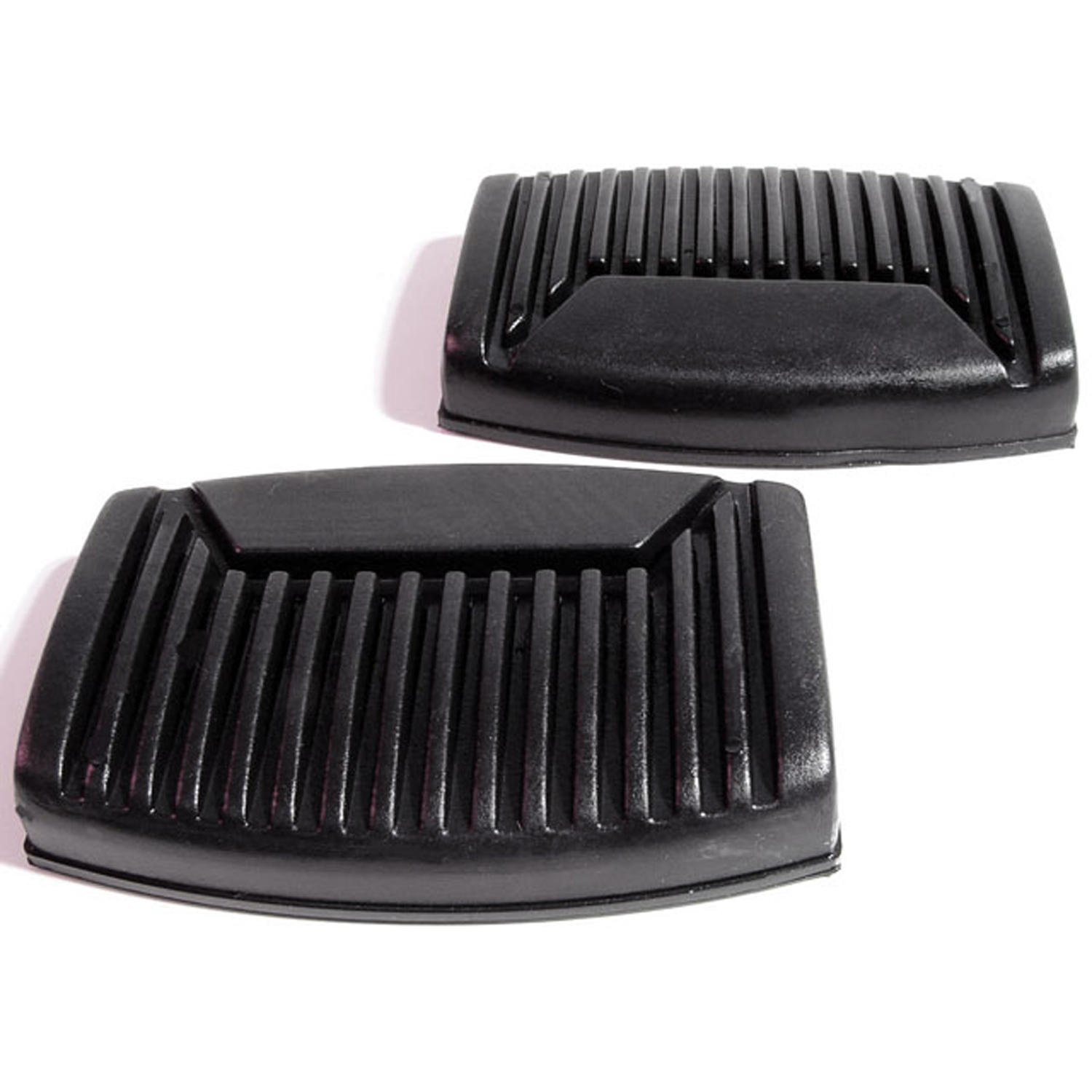 1976 Ford Bronco Clutch and Brake Pedal Pads. 3-1/4" wide X 2-1/4" long-CB 111Clutch and Brake Pedal Pads. 3-1/4" wide X 2-1/4" long. Pair
 1976 Ford Bronco Brake Pedal Pad. 4-3/4" wide X 2-1/4" long-CB 111-NBrake Pedal Pad. 4-3/4" wide X 2-1/4" long. Replaces OEM #'s BC3Z2457B, D3TZ2457A, D3TZ2457B. Each
 1976 Ford Bronco Door Seals. Fits either side. 83-1/2" long. Pair-LM 11-BDoor Seals. Fits either side. 83-1/2" long. Pair
 1976 Ford Bronco Molded Roof Rail Seals. Pair R&L-RR 3310Molded Roof Rail Seals. Pair R&L
 1976 Ford Bronco Vulcanized Windshield Seal-VWS 3390Vulcanized Windshield Seal. For models without chrome garnish on windshield. Each
Why Choose Metro?
For over 100 years, Metro Moulded Parts has been the pinnacle of quality in classic car restoration parts. Our commitment to precision and authenticity in every component ensures a perfect fit and an OEM-level appearance.
- Expert Craftsmanship & Quality: Each part is a testament to our dedication to reliability and perfection, crafted from original designs and thoroughly tested.
- Advanced Technology: We use cutting-edge techniques to create flawless, long-lasting parts that surpass others in performance.
- SuperSoft Sponge – The Ultimate Door Seal: Not only are our door seals 30% softer than competitors', but they're also guaranteed to never leak. They effectively reduce wind and road noise, enhancing your classic car's comfort and driving experience.
- Proudly American: Our parts are a product of American craftsmanship, made in the USA with a spirit of excellence and heritage.
- Unrivaled Warranty: We back our products with a 30-year industry-leading warranty, a testament to our confidence in their quality.
Join us in preserving the legacy of classic cars with parts that are crafted for perfection, not just made.