
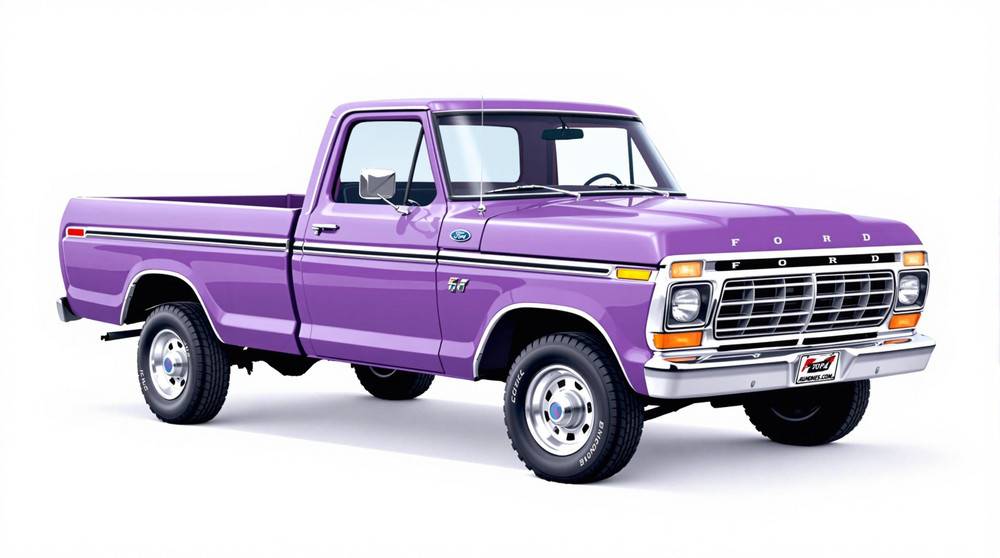
Image of 1976 Ford F-150, Note: These illustrations use artistic license and may differ from actual historical models.
Performance Metrics
Fundamental Metrics
Emotional Appeal
MMP Rating
| Engine Specifications | |
|---|---|
| Engine Options: | 4.9L 300 I6, 5.0L 302 V8, 5.9L 360 V8, 6.4L 390 V8 |
| Displacement Range: | 300-390 cu in |
| Horsepower Range: | 101-159 hp |
| Torque: | 223-315 lb-ft |
| Compression Ratio: | 8.0:1 - 8.4:1 |
| Ignition System: | Conventional breaker point ignition system |
| Cooling System: | Liquid cooled |
| Performance Specifications | |
| 0-60 Time: | 14-18 seconds |
| 1/4 Mile Time: | 19-22 seconds |
| Top Speed: | 85-95 mph |
| Transmission and Drive | |
| Drive Type: | Rear wheel drive |
| Transmission Type: | 3-speed manual, 4-speed manual, 3-speed automatic |
| Fuel and Efficiency | |
| Fuel System Type: | Carburetor |
| MPG: | 10-14 mpg |
| Dimensions and Brakes | |
| Brakes: | Front disc and rear drum brakes |
| Wheelbase: | 133 in (Regular cab), 138.8 in (SuperCab) |
| Weight: | 4,000-5,000 lbs |
Note: Specifications for classic cars are given to the best of our ability, considering the limited and variant data available.
1976 Ford F-150: The Classic Ford Pickup That Bridged Two Eras
The 1976 Ford F-150 was built for people who needed more truck than a light-duty pickup but did not want to step up to a full three-quarter-ton model. It arrived during a turning point for Ford’s truck range, combining traditional, work-ready hardware with the growing comfort and style buyers were beginning to expect from a pickup.
Ford introduced the F-150 for the 1975 model year, placing it between the F-100 and F-250 in the lineup. The 1976 model belongs to the sixth-generation F-Series, produced from 1973 through 1979. It came from a period when pickups were still expected to work hard, but were increasingly being used as family transport, recreational vehicles, and everyday drivers.
One memorable detail is its timing: the 1976 model was part of the U.S. Bicentennial year, when patriotic colors and special graphics appeared across the country. The truck itself was not a single, standardized Bicentennial edition, but period-correct F-Series pickups with red, white, and blue paint or decoration have a natural connection to that anniversary.
Square-Jawed Styling and Practical Options
The 1976 F-150 has the unmistakable shape of a 1970s Ford pickup: a broad, upright hood, nearly vertical windshield, pronounced fenders, and a large grille framed by round headlights. Its proportions are sturdy rather than sleek, with a long, flat-sided body that looks equally at home on a farm road or parked at a classic-truck show. The 1976 front end is especially recognizable for its round lamps. Ford changed to rectangular headlights for the 1978 redesign.
Buyers could choose a conventional Styleside bed, with flat outer sides and a full-width cargo box, or the more old-fashioned Flareside, which has pronounced rear fenders and a narrower bed. Styleside trucks are the most familiar and practical choice, while Flareside examples have a distinctive vintage look. Regular-cab trucks came in different wheelbase and bed configurations, and a SuperCab extended-cab option offered extra space behind the front seat. Four-wheel drive was also available.
Trim ranged from straightforward work-truck equipment to more polished versions, including Ranger and Ranger XLT offerings. Depending on the specification, buyers could add exterior brightwork, upgraded upholstery, carpeting, improved sound insulation, and convenience features. Period colors included practical whites, blues, reds, greens, and earth tones, alongside two-tone combinations. Exact paint choices varied by trim and production details, but deep blue, red, and classic white remain popular among restorers.
Inside, the F-150 was functional and durable rather than luxurious by modern standards. The dashboard used straightforward, easy-to-read instrumentation, while the broad bench seat and generous cab space suited long workdays. Vinyl was common because it was tough and simple to clean, with cloth or upgraded trim available on better-equipped trucks. The materials feel appropriately substantial, though age, sunlight, and decades of use can leave dashboards cracked and upholstery worn.
For its time, the truck’s technology was practical rather than futuristic. Buyers could equip it with an automatic transmission, power steering, power brakes, air conditioning, and a factory radio, depending on the configuration. Four-wheel-drive versions had a transfer case with low range for slow, difficult terrain. These were useful features, but the F-150 remained a largely mechanical vehicle that an owner could understand and service without specialized diagnostic equipment.
Why the F-150 Mattered
The F-150’s place between the F-100 and F-250 gave Ford a useful way to serve buyers who wanted extra capability without the size and weight of a heavier-duty truck. Its arrival also reflected a larger change in the pickup market. Trucks were no longer purchased only as basic tools. Customers increasingly wanted comfort, styling, and options alongside payload and towing ability.
The 1976 truck was not a radical technical breakthrough, but it helped establish the formula that would make the F-Series a lasting success: a wide range of configurations, familiar mechanical components, and a model for nearly every kind of owner. The F-150 name itself endured, becoming one of the most recognizable badges in the pickup market. Today’s trucks are vastly more refined, but the basic idea of offering a versatile half-ton pickup with several cab, bed, engine, and trim choices remains central to the segment.
Compared with many contemporaries, the Ford stood out for its broad engine selection and the availability of both two-wheel drive and four-wheel drive. Its combination of heavy-duty feel and everyday usability made it especially appealing to buyers who wanted one vehicle to handle work during the week and recreation on the weekend.
Engines, Speed, and Road Manners
Engine choices varied by drivetrain, equipment, and market, but the 1976 F-150 could be ordered with Ford’s 300-cubic-inch inline-six and several V8s, including 360-, 390-, and 460-cubic-inch options. The 300 six is known for straightforward construction and strong low-speed pulling character. The larger V8s delivered more power and a deeper exhaust note, with the 460 offering the most substantial performance and towing potential in the range.
Three-speed and four-speed manual transmissions were available, as was an automatic. Rear axle ratios and tire sizes also made a significant difference to how a truck performed. Because of those variations, there is no single meaningful 0-to-60 mph or top-speed figure for every 1976 F-150. As a broad period-truck estimate, many examples take roughly 14 to 20 seconds to reach 60 mph, while a well-equipped V8 truck can be quicker. Depending on gearing and condition, top speed is generally in the neighborhood of 85 to 100 mph. These are estimates, not factory guarantees, and a truck this old should not be judged by modern performance standards.
On the road, the F-150 feels big, deliberate, and mechanical. Two-wheel-drive models use Ford’s Twin I-Beam front suspension, designed to handle truck-duty use while keeping a relatively simple layout. Four-wheel-drive versions have a more rugged front-axle arrangement. The suspension can feel firm and busy over broken pavement, particularly when the truck is unloaded, while a working load may settle the ride. Tall tires and a high center of gravity also call for measured steering on winding roads and extra care in crosswinds.
The driving experience is part of the appeal. The steering is less precise than that of a modern pickup, the brakes require more anticipation, and the cab has more wind and road noise. In return, the driver gets a commanding view, a broad hood, and the unmistakable sounds of an older engine and drivetrain. A healthy inline-six has a steady, workmanlike note; a big-block V8 adds a deeper rumble that suits the truck’s size.
Living With a 1976 Ford F-150
Today, these trucks serve as weekend drivers, restoration projects, farm and property vehicles, show trucks, and increasingly popular classic pickups. A well-maintained example can be used regularly, but it is wise to treat it as an older vehicle rather than a modern daily driver. Safety equipment, braking performance, fuel economy, and highway comfort are all products of another era.
Mechanical repairs are generally approachable for a capable home mechanic. The engines and chassis are conventional, parts support is strong, and many service procedures are well documented. The bigger challenge is often condition rather than complexity. Buyers should inspect the frame, cab corners, floor pans, bed, and wheel arches for rust, and check for signs of collision repairs or poorly executed modifications. On four-wheel-drive trucks, the transfer case, front axle, hubs, and steering components deserve close attention.
Fuel consumption is another common criticism. A six-cylinder may be more economical than a large V8, but none of these engines can match the efficiency of a contemporary pickup. Other complaints include vague steering, a bouncy ride when unloaded, and limited crash protection by modern standards. Those drawbacks are worth understanding before buying, even if they are part of the truck’s old-school character.
Trivia, Reputation, and Collectibility
The F-150’s most important piece of trivia may be its name. Ford created the model to occupy the space between the F-100 and F-250, offering a higher-capacity light-duty option. The 1976 F-150 was also among the final round-headlight F-Series trucks before the front-end styling changed for 1978, making its face a clear marker of the era.
There is no widely cited, definitive production total for every 1976 F-150 configuration. Ford built the F-Series in very large numbers, and the broader truck line sold in the hundreds of thousands during the period. A reasonable, clearly labeled estimate for F-150 production alone is around 150,000 to 250,000 trucks, but that should be treated as an approximation rather than a factory-confirmed figure. Surviving examples are far fewer, especially unmodified four-wheel-drive trucks, clean SuperCabs, and vehicles retaining their original drivetrain and trim.
Values depend heavily on rust, originality, cab and bed configuration, engine, and restoration quality. As a general 2026 guide, a project or rough driver might sell for about $5,000 to $12,000. A solid, usable truck often falls around $12,000 to $25,000, while a clean, well-restored example can bring roughly $25,000 to $45,000 or more. Exceptional restorations and desirable four-wheel-drive or unusual configurations may exceed that range. These are broad estimates, and regional demand can shift prices considerably.
Interest in classic pickups has strengthened, particularly for clean, mostly original trucks, so good examples have generally appreciated over the long term. The market is not uniform: a heavily modified or rust-damaged truck may be difficult to sell, while a documented, rust-free example can attract strong competition. Condition and authenticity matter more than simply having the right badge.
The Enduring Appeal of the 1976 F-150
The 1976 Ford F-150 brought together rugged construction, a broad range of configurations, and the emerging comfort features that were changing what buyers expected from a pickup. It was not fast, quiet, or especially refined, but it was adaptable, serviceable, and unmistakably Ford.
Nearly fifty years later, the truck’s appeal comes from that honest mix of workhorse character and everyday usefulness. A good 1976 F-150 is more than a piece of vintage styling: it is a snapshot of the moment when the pickup began to become the all-purpose vehicle it is today.
1976 Ford F-150 Catalog of Parts
 1976 Ford F-150 Brake Pedal Pad. 4-3/4" wide X 2-1/4" long-CB 111-NBrake Pedal Pad. 4-3/4" wide X 2-1/4" long. Replaces OEM #'s BC3Z2457B, D3TZ2457A, D3TZ2457B. Each
 1976 Ford F-150 Door seal. '73-'79 Ford F-Series trucks. '78-'79 Ford Bronco-LM 110-ADoor seal. '73-'79 Ford F-Series trucks. '78-'79 Ford Bronco. Fits on cab, either side. Each.
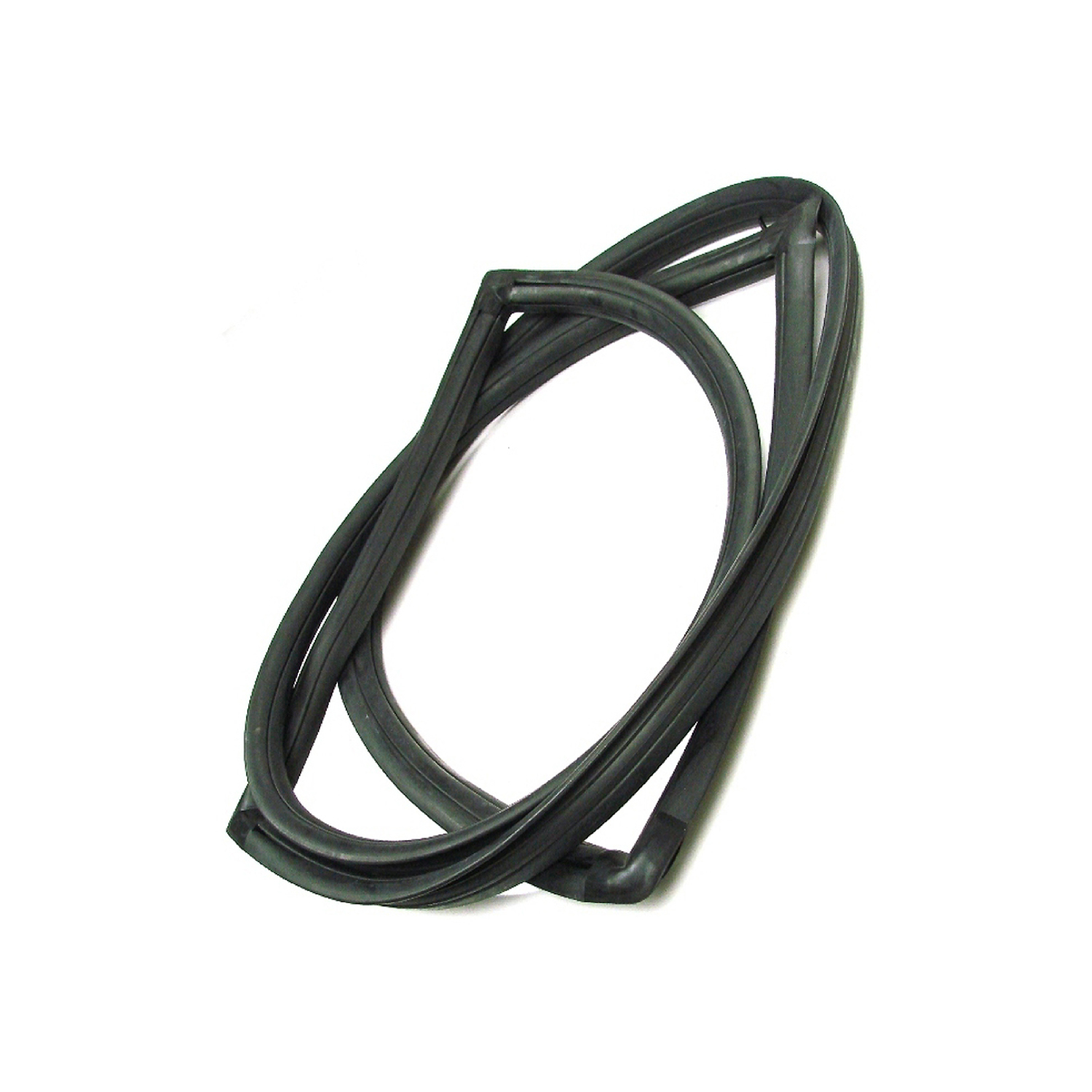 1976 Ford F-150 Windshield seal, '73-'76 Ford F Series Truck-VWS 3304-EWindshield seal, '73-'76 Ford F Series Truck with groove to accept trim, each.
 1976 Ford F-150 Rear window seal, '73-'79 Ford F Series Truck without trim groove-VWS 3304-RRear window seal, '73-'79 Ford F Series Truck without trim groove, each. Replaces OEM part # D3TZ-1042084-A.
Why Choose Metro?
For over 100 years, Metro Moulded Parts has been the pinnacle of quality in classic car restoration parts. Our commitment to precision and authenticity in every component ensures a perfect fit and an OEM-level appearance.
- Expert Craftsmanship & Quality: Each part is a testament to our dedication to reliability and perfection, crafted from original designs and thoroughly tested.
- Advanced Technology: We use cutting-edge techniques to create flawless, long-lasting parts that surpass others in performance.
- SuperSoft Sponge – The Ultimate Door Seal: Not only are our door seals 30% softer than competitors', but they're also guaranteed to never leak. They effectively reduce wind and road noise, enhancing your classic car's comfort and driving experience.
- Proudly American: Our parts are a product of American craftsmanship, made in the USA with a spirit of excellence and heritage.
- Unrivaled Warranty: We back our products with a 30-year industry-leading warranty, a testament to our confidence in their quality.
Join us in preserving the legacy of classic cars with parts that are crafted for perfection, not just made.