
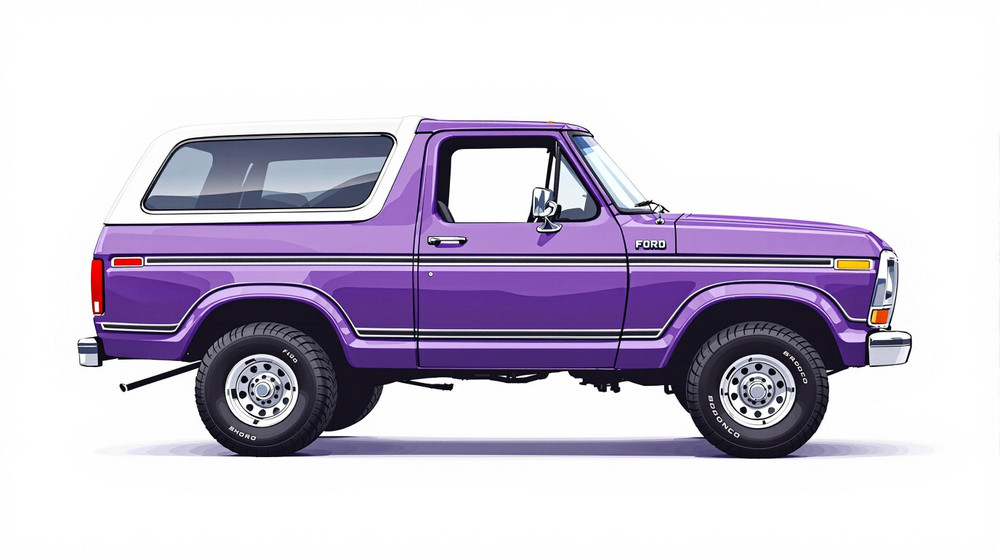
Image of 1980 Ford Bronco, Note: These illustrations use artistic license and may differ from actual historical models.
Performance Metrics
Fundamental Metrics
Emotional Appeal
MMP Rating
| Engine Specifications | |
|---|---|
| Engine: | 4.9L 300 I6, 5.8L 351M V8, 6.6L 400 V8 |
| Displacement: | 300-400 cu in |
| Horsepower: | 120-158 hp |
| Torque: | 223-312 lb-ft |
| Compression Ratio: | 8.0:1 - 8.4:1 |
| Ignition System: | Electronic |
| Cooling System: | Liquid-cooled |
| Performance Specifications | |
| 0-60 Time: | 11-15 seconds |
| 1/4 Mile Time: | 18-20 seconds |
| Top Speed: | 100 mph |
| Transmission and Drive | |
| Drive Type: | Rear-wheel drive (RWD) with optional 4-wheel drive (4WD) |
| Transmission Type: | 3-speed automatic, 4-speed manual |
| Fuel and Efficiency | |
| Fuel System Type: | Carburetor |
| MPG: | 10-14 mpg |
| Dimensions and Brakes | |
| Brakes: | Front disc, rear drum |
| Wheelbase: | 104 inches |
| Weight: | 4,500 lbs |
Note: Specifications for classic cars are given to the best of our ability, considering the limited and variant data available.
1980 Ford Bronco: The Full-Size 4x4 That Changed Its Footing
The 1980 Ford Bronco brought a fresh front suspension and a more polished road feel to Ford’s full-size off-roader, without giving up the rugged, removable-top character that made the name famous. Built by Ford Motor Company, it belonged to the Bronco’s third generation, introduced for 1978, when the model grew from a compact 4x4 into a larger vehicle based on Ford’s F-Series pickup platform.
The timing was significant. By 1980, buyers wanted vehicles that could handle family transport and highway trips as well as dirt roads, work sites, and weekend adventures. The Bronco met that demand with a roomy two-door body, available V8 power, four-wheel drive, and a removable hardtop. Its standout engineering change for 1980 was Twin Traction Beam front suspension, which replaced the previous solid front axle with a design intended to improve ride and handling on pavement while retaining serious off-road ability.
One detail captures the Bronco’s enduring appeal: its rear glass could retract into the tailgate, while the roof section behind the cab could be removed. That gave owners an open-air 4x4 experience decades before removable-roof SUVs became fashionable. The design also makes a 1980 Bronco easy to recognize as a classic, even from across a parking lot.
Square Shoulders and a Removable Roof
The 1980 Bronco has the upright, squared-off proportions that define late-1970s and early-1980s Ford trucks. Its broad hood, flat sides, upright windshield, and substantial wheel arches give it a purposeful stance. Rectangular headlamps and a wide grille create a distinctly period-correct face, while the high beltline and short rear overhang make the truck look ready for rough ground. It is large and imposing, but its two-door layout and relatively short wheelbase keep it more maneuverable than a four-door full-size SUV.
The Bronco was offered as a two-door utility vehicle with a removable rear roof section, rather than as a conventional wagon with a fixed roof. A tailgate provided access to the cargo area, and the rear window lowered into it. With the hardtop in place, the Bronco worked as an enclosed truck for everyday use. With the roof removed, it became an open-air machine, although owners had to store the bulky roof somewhere safe and dry.
Trim levels and equipment varied, with names such as Custom, Ranger, and XLT appearing across the period. The XLT was the more comfort-oriented choice, while a basic truck could be specified with simpler, harder-wearing equipment. Color availability depended on paint and trim combinations, but buyers could find traditional truck shades including white, red, blue, brown, and metallic finishes. White and strong primary colors suit the Bronco’s bold shape especially well, while darker or earth-toned examples have a more understated look.
Inside, the Bronco favored function over luxury. Depending on trim and options, buyers could get vinyl or cloth upholstery, bench or bucket seating, carpeting, and upgraded door and instrument-panel trim. The cabin is upright and practical, with a commanding view over the hood and straightforward controls. Materials are durable by design, though even a well-kept example feels unmistakably like a truck from 1980 rather than a modern SUV. Air conditioning, power conveniences, upgraded audio, and more elaborate trim could make a Bronco more comfortable, but equipment varied from truck to truck.
1980 Engineering: Twin Traction Beam
The biggest technical change for the 1980 model year was Ford’s Twin Traction Beam, or TTB, front suspension. Instead of a single solid front axle moving as one piece, the system used two beams that pivoted independently from the chassis. It was not independent suspension in the modern car-like sense, but it helped the Bronco ride and steer more comfortably on paved roads than the earlier solid-axle setup.
That change mattered because the Bronco had to serve two roles. It needed enough articulation and strength for trail use, but it also had to cope with daily driving and long highway miles. The TTB layout was Ford’s answer to that balancing act and became a defining feature of full-size Broncos through the rest of this generation.
Four-wheel drive was central to the Bronco’s identity. The truck used a part-time 4WD system, with the driver selecting four-wheel drive when conditions called for it. Many examples have manual locking front hubs, which must be engaged before using four-wheel drive. Depending on engine and equipment, transmissions included manual gearboxes and Ford’s automatic options. The precise combination is best confirmed from the vehicle’s identification and build information, since surviving Broncos are often modified.
Engines, Speed, and Road Manners
Engine availability could include Ford’s 300-cubic-inch inline-six and several V8 choices, including 302-, 351-, and 400-cubic-inch engines, depending on configuration and market. Output varied with engine, transmission, emissions equipment, and factory rating method. These were truck engines built for usable low- and mid-range pulling power, not high-revving performance. The 300 six is valued for its straightforward character, while the larger V8s deliver the familiar deep, work-ready sound many buyers want from a classic Bronco.
Published performance figures are difficult to apply uniformly to a 1980 Bronco because engine, axle ratio, transmission, tires, and condition make a substantial difference. As a broad period-appropriate estimate, a typical example may take roughly 13 to 20 seconds to reach 60 mph. Top speed can fall in the neighborhood of 85 to 100 mph, but gearing, tire size, and mechanical condition have a strong effect. These figures are estimates, not a recommendation to test an older, high-profile 4x4 at its limits.
On the road, the Bronco feels substantial and distinctly truck-like. The elevated seating position gives the driver a commanding view, and the large steering wheel and broad hood make the vehicle feel reassuringly solid. The TTB front suspension gives it a more composed ride than the earlier solid-axle Bronco, but it still has body roll, wind noise, and a firm, sometimes busy response over broken pavement. On winding roads, drivers need to respect its height and weight. It is happiest when driven smoothly, not hustled like a sports car.
On dirt roads, gravel, snow, and moderate trails, the Bronco’s four-wheel-drive hardware and generous clearance come into their own. It can absorb rough surfaces well, though tire choice and suspension condition matter greatly. Expect an audible engine, a clear sense of mechanical connection, and a ride that communicates the road beneath the tires. That directness is part of the charm, but it is also a reminder that this is a 1980 truck, not a modern crossover.
Why the Bronco Mattered
The 1980 Bronco helped define the full-size sport-utility vehicle as a practical, multi-purpose vehicle. It combined pickup-derived toughness with an enclosed passenger cabin and a removable roof, giving owners a vehicle that could move from work duties to family travel to recreational use. The formula was not unique to Ford, but the Bronco’s scale, V8 availability, and open-air design gave it a distinctive place in the expanding 4x4 market.
Its move to the F-Series platform in 1978 had already made the Bronco larger than the original 1966 model. The 1980 update then improved its on-road manners without abandoning the truck-based character. That blend of utility and comfort became increasingly important as SUVs shifted from specialized off-road vehicles toward everyday transportation. Later generations would become more refined, but the 1980 model preserves a particularly honest version of the idea: a full-size 4x4 with simple controls, real hardware, and a roof you could take off.
Living With a 1980 Bronco
Today, owners use 1980 Broncos as weekend cruisers, trail rigs, restoration projects, and show vehicles. Some are still pressed into work, but fuel costs and the age of the vehicle make regular commuting less appealing for many owners. A V8 Bronco can be thirsty, and real-world fuel economy commonly lands in the low teens or below, depending on engine, gearing, tires, and driving conditions.
Mechanical service is generally approachable for an owner with basic tools and experience. The Bronco shares many components and design ideas with contemporary Ford trucks, and its carbureted engines and conventional drivetrain are familiar to many classic-truck mechanics. Parts availability is generally good, though trim pieces, correct interior components, and unmodified body panels can take more searching. Modified trucks may require extra work to identify non-factory parts.
Rust is a major inspection point. Check the frame, floor pans, body mounts, inner fenders, and the areas around the tailgate and roof seals. Also inspect the TTB front end for worn joints and steering components, and check that the four-wheel-drive system engages properly. A Bronco that looks clean from the outside can still hide corrosion beneath carpet or under old undercoating. Originality, service records, and the quality of previous repairs can have a significant effect on both reliability and value.
Bronco Trivia and Common Misconceptions
The 1980 Bronco was not offered with the Eddie Bauer trim name that later became closely associated with the model. That package arrived in the mid-1980s. Special appearance equipment and trim packages varied by year and market, so buyers interested in a particular package should verify it through period documentation or the truck’s build information rather than relying on badges alone.
Ford sold roughly 44,000 Broncos for the 1980 model year, a useful guide to the truck’s original popularity. That figure is a sales estimate, not a count of surviving vehicles or a precise production breakdown by engine and trim. No single 1980 Bronco is known for a headline speed record or a landmark endurance achievement. The model’s broader legacy comes from helping establish the full-size SUV as a mainstream choice.
The white Bronco associated with the widely televised 1994 police chase was a 1993 model, not a 1980. That event often comes up in conversations about Bronco history, but it should not be confused with this earlier generation. A more relevant point of trivia is that the removable roof and retracting rear glass were practical features Ford carried through many years of Bronco production.
Common criticisms are familiar to owners of vintage 4x4s: poor fuel economy, substantial road and wind noise, dated safety equipment, and body roll compared with modern vehicles. Rust and deferred maintenance can turn an inexpensive purchase into an expensive project. Still, these shortcomings are part of the honest trade-off: the Bronco offers mechanical simplicity and character, not contemporary comfort or efficiency.
1980 Ford Bronco Values and Collector Appeal
Values depend heavily on condition, originality, engine, trim, rust, and the quality of restoration. As a broad 2026 market estimate, a project or rough-running Bronco might sell for around $5,000 to $12,000. A usable driver in sound condition may fall in the $12,000 to $25,000 range. Clean, well-restored, or unusually original examples can reach roughly $25,000 to $45,000, with exceptional trucks sometimes exceeding that range. These are general estimates rather than formal appraisals, and local demand can shift prices substantially.
The 1980 Bronco is not rare in the sense of having been produced in tiny numbers, but good examples are much harder to find than the original sales figure suggests. Many have rusted, been heavily modified, or worked hard for decades. As a result, an honest, well-documented survivor can be more appealing than a flashy restoration with uncertain history.
Values have generally strengthened as buyers have rediscovered classic SUVs and square-body trucks. Particularly clean, original, and tastefully restored examples have benefited most. The market can fluctuate, and condition remains decisive: a desirable model name cannot compensate for serious structural rust or poor repairs. A careful inspection is worth far more than a rare-looking badge.
The 1980 Bronco’s Lasting Appeal
The 1980 Ford Bronco occupies an important middle ground in SUV history. It is larger and more capable than the original compact Bronco, yet simpler and more mechanical than the modern SUVs that followed. Its Twin Traction Beam front suspension marked a meaningful step toward better road manners, while its removable roof, retracting rear glass, and available V8 power kept its personality unmistakably Bronco.
Buy one for its practicality and you will need to accept age, fuel use, and truck-like handling. Buy one for its character and the trade makes sense: the 1980 Bronco is a substantial, versatile classic with a real connection to the roots of the full-size SUV. It does not merely recall a different era of Ford trucks; it shows how that era helped shape the vehicles people drive today.
1980 Ford Bronco Catalog of Parts
 1980 Ford Bronco Brake Pedal Pad. 4-3/4" wide X 2-1/4" long-CB 111-NBrake Pedal Pad. 4-3/4" wide X 2-1/4" long. Replaces OEM #'s BC3Z2457B, D3TZ2457A, D3TZ2457B. Each
 1980 Ford Bronco Door Seal (Imported). 154" Long-IS-LM 110Door Seal (Imported). 154" Long. Fits right or left, front and rear doors. Each
 1980 Ford Bronco Flocked Window Channel (Imported). Fits left and right side-IS-WC 6600-23Flocked Window Channel (Imported). Fits left and right side. Each
 1980 Ford Bronco Window sweeper kit. Fits 80-87 Ford Bronco and Truck 2 Door Extended/Standard-WC 6600-12This four piece set includes the inner and outer window felt beltline weatherstrips for each door side window. These strips wipe the side windows when the glass is lowered.
Why Choose Metro?
For over 100 years, Metro Moulded Parts has been the pinnacle of quality in classic car restoration parts. Our commitment to precision and authenticity in every component ensures a perfect fit and an OEM-level appearance.
- Expert Craftsmanship & Quality: Each part is a testament to our dedication to reliability and perfection, crafted from original designs and thoroughly tested.
- Advanced Technology: We use cutting-edge techniques to create flawless, long-lasting parts that surpass others in performance.
- SuperSoft Sponge – The Ultimate Door Seal: Not only are our door seals 30% softer than competitors', but they're also guaranteed to never leak. They effectively reduce wind and road noise, enhancing your classic car's comfort and driving experience.
- Proudly American: Our parts are a product of American craftsmanship, made in the USA with a spirit of excellence and heritage.
- Unrivaled Warranty: We back our products with a 30-year industry-leading warranty, a testament to our confidence in their quality.
Join us in preserving the legacy of classic cars with parts that are crafted for perfection, not just made.