
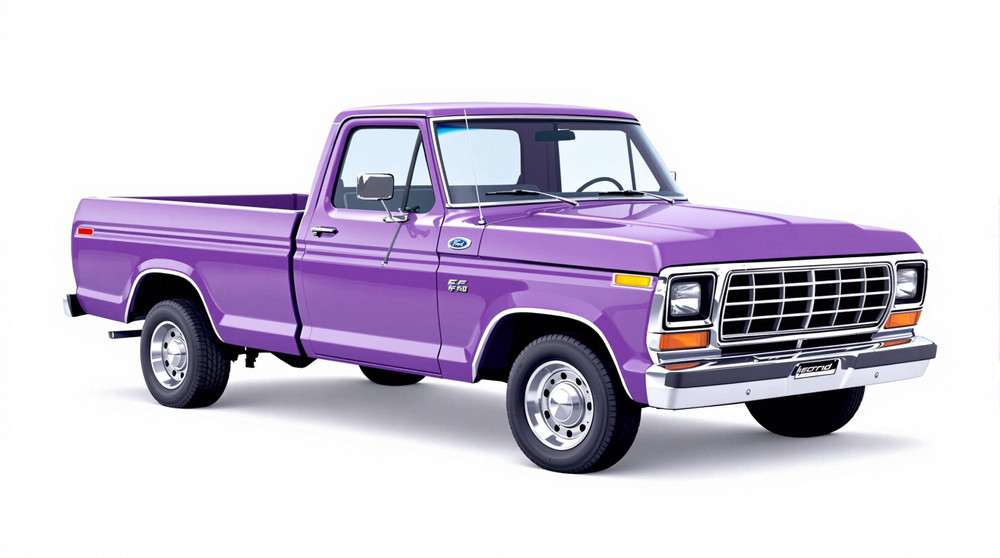
Image of 1980 Ford F-100, Note: These illustrations use artistic license and may differ from actual historical models.
Performance Metrics
Fundamental Metrics
Emotional Appeal
MMP Rating
| Engine Specifications | |
|---|---|
| Engine Options: | 4.9L 300 Cu. In. I6, 5.0L 302 Cu. In. V8, 5.8L 351 Cu. In. V8 |
| Displacement Range: | 300-351 Cu. In. |
| Horsepower Range: | 115-150 HP (estimated) |
| Torque: | 223-283 lb-ft (estimated) |
| Compression Ratio: | 8.0:1 - 8.4:1 (estimated) |
| Ignition System: | Electronic |
| Cooling System: | Liquid-cooled |
| Performance Specifications | |
| 0-60 Time: | 14-16 seconds (estimated) |
| 1/4 Mile Time: | 19-21 seconds (estimated) |
| Top Speed: | 85-95 mph (estimated) |
| Transmission and Drive | |
| Drive Type: | Rear-wheel drive |
| Transmission Type: | 3-speed automatic, 4-speed manual |
| Fuel and Efficiency | |
| Fuel System Type: | Carburetor |
| MPG: | 10-14 mpg (estimated) |
| Dimensions and Brakes | |
| Brakes: | Front disc, rear drum |
| Wheelbase: | 117.6 inches |
| Weight: | 3,600-4,200 lbs (estimated) |
Note: Specifications for classic cars are given to the best of our ability, considering the limited and variant data available.
1980 Ford F-100: The New Shape of a Classic
The 1980 Ford F-100 brought a sharper, more modern look to one of America’s most familiar pickups. It was part of the seventh-generation Ford F-Series, built by the Ford Motor Company for buyers who wanted a hardworking truck that could also serve as everyday transportation. Its squared-off styling marked a clear change from the rounder trucks of the 1970s, while its sturdy construction kept the F-100 firmly rooted in its work-truck heritage.
The timing mattered. The 1980s opened amid high fuel prices and tighter attention to efficiency, and truck makers were under pressure to make pickups more practical without sacrificing usefulness. Ford’s redesigned F-Series answered with cleaner, more angular bodywork and a cabin arranged for greater comfort. A memorable detail: this model year began a design generation that would remain in production through 1986, with updates along the way. The 1980 F-100 was the first step in that long-running chapter.
Square-Jawed Styling and Practical Choices
The 1980 F-100 looks purposeful from every angle. Its broad, flat hood leads into a rectangular grille and squared headlamps, while crisp body lines give the sides a strong, uncomplicated profile. The upright cab and large glass area help it look substantial without feeling overly ornate. Depending on the trim, brightwork could add a little polish, but the truck’s appeal was largely in its honest, work-ready shape.
Buyers could choose a regular cab with either a Styleside bed, which has flat sides and wheel housings inside the box, or a Flareside bed, whose separate rear fenders give the truck a more traditional, narrow-box appearance. Bed lengths and exact combinations depended on configuration. Styleside was the practical, commonly seen choice, while Flareside models have a distinctive vintage look that attracts attention at shows today. The F-100 was the lighter-duty member of the F-Series range, positioned below the F-150 and heavier F-250 and F-350 models.
Cabin materials were straightforward rather than luxurious. Vinyl upholstery and durable floor coverings suited trucks expected to get dirty, while cloth seating and upgraded trim could make the interior more comfortable. Depending on equipment, features such as air conditioning, power steering, power brakes, and an automatic transmission could make the F-100 easier to live with. Color availability changed by trim and paint scheme, but buyers commonly chose practical whites and subdued earth tones, along with classic reds and blues. Two-tone treatments added extra visual character on some trucks.
For its era, the F-100’s technology was about useful improvements, not digital gadgets. Ford offered power assistance and transmission choices to suit different jobs and driving preferences. The dash kept the important controls close at hand, and the truck’s conventional mechanical layout made it familiar to service. Depending on engine and configuration, buyers could choose manual or automatic transmissions.
Why the 1980 F-100 Mattered
The 1980 redesign helped establish the visual language of Ford pickups for much of the decade. Its more squared-off proportions reflected the broader move toward crisp, geometric styling in the 1980s, but Ford did not abandon the basic formula of a separate cab and cargo bed on a rugged frame. That balance between updated appearance and traditional utility helped the F-Series remain relevant to both tradespeople and private owners.
The F-100 also illustrates how pickup trucks were changing. They were still expected to haul, tow, and work hard, but buyers increasingly wanted a truck that felt comfortable on the commute, too. A more usable cabin and a wide range of equipment helped bridge those roles. The F-100 name itself would soon disappear from Ford’s U.S. lineup, making 1980 part of the nameplate’s final decade, though the broader F-Series continued to evolve and grow in popularity.
Engines, Speed, and Road Manners
Engine availability varied with configuration and market, but the F-100 could be equipped with Ford’s 300-cubic-inch, 4.9-liter inline-six, a well-regarded workhorse known for its straightforward design and strong low-speed pulling character. V8 options were also available in the F-Series lineup, with exact choices depending on the truck’s specification. Transmission, axle gearing, emissions equipment, and load all affect how any individual truck performs, so figures should be treated as estimates rather than universal factory numbers.
In period terms, the F-100 was not a fast truck. A six-cylinder example might take roughly 14 to 18 seconds to reach 60 mph, while a V8-equipped truck could be quicker, often in the neighborhood of 11 to 15 seconds. Depending on engine, gearing, tires, and condition, top speed might fall around 85 to 100 mph. Those numbers are best understood as approximate, and the truck feels most at home cruising at sensible speeds or pulling steadily under load rather than making high-speed runs.
Two-wheel-drive models used Ford’s Twin I-Beam front suspension, a distinctive setup that gave the truck independent front-wheel movement while retaining a robust design. It can feel firm over sharp bumps, especially when the truck is unladen, and worn suspension components can make the ride less settled. Four-wheel-drive versions used different front-end hardware. On a winding road, the F-100 feels tall and substantial, with slower responses than a modern pickup. Crosswinds and a heavy load can also make themselves known through the steering wheel.
Behind the wheel, the experience is direct and mechanical. The inline-six has a low, purposeful note, while a V8 brings a deeper rumble. The cabin is quieter and more accommodating than an early work truck, but it remains unmistakably vintage: large controls, a commanding view over the hood, and a ride that communicates the road. A well-maintained example feels sturdy and uncomplicated, not delicate or polished.
Living With a 1980 Ford Pickup
Today, an F-100 can be a weekend cruiser, a practical farm or workshop truck, a restoration project, or a centerpiece at a classic-truck show. Some owners use them regularly, but daily driving depends heavily on condition, local traffic, fuel costs, and whether the truck has modern safety and comfort upgrades. It is not a contemporary tow vehicle, and its brakes, handling, and crash protection should not be mistaken for those of a new pickup.
Maintenance is one of the F-100’s strengths. Its conventional mechanical systems are generally accessible, and many routine repairs are manageable for an experienced home mechanic with basic tools. Parts support is broad for common service items and restoration components, though the availability of specific trim pieces, original interior parts, and unmodified body panels can vary. Before buying, inspect the frame, cab mounts, floor pans, bed, and lower body panels carefully. Rust, past collision repairs, worn steering components, and neglected cooling systems can turn an affordable truck into an expensive project.
Fuel economy is a frequent criticism, particularly with a V8, automatic transmission, or low gearing. Buyers also point to a firm unloaded ride, dated safety equipment, and modest acceleration. Those drawbacks are part of the honest ownership equation: the F-100 rewards care and simplicity, but it does not offer the refinement or efficiency of a modern pickup.
F-100 Trivia and Collector Appeal
The 1980 F-100 is notable as an early example of the seventh-generation F-Series, a design that Ford kept in production until 1986. The F-Series itself became one of the most important pickup families in the American market, but there is no widely established production figure specifically for every 1980 F-100 body, engine, and trim combination. A reasonable estimate is that total 1980 F-100 production reached the tens of thousands and could have been in the low hundreds of thousands, but that is a broad estimate, not a verified model-specific count.
Rather than being defined by a single celebrity owner or famous racing record, the F-100’s appeal comes from its everyday history. These trucks worked on farms, at job sites, and in small businesses across the country. Their most common “record” is their sheer presence in American life: the F-Series has remained a major name in the pickup market for decades. The 1980 F-100 is a recognizable link between the simpler work trucks of earlier years and the increasingly comfortable pickups that followed.
1980 Ford F-100 Values and Availability
Values depend greatly on rust, originality, engine, cab and bed configuration, and restoration quality. As a broad U.S. market guide for 2026, a rough project may sell for about $2,000 to $6,000. A running driver in usable condition might bring roughly $8,000 to $18,000, while a clean, well-restored example can reach $20,000 to $35,000 or more. Exceptional, highly original trucks or particularly desirable configurations may exceed that range, but condition and documentation matter more than a long list of modifications.
These trucks are still findable, though a rust-free example is much harder to locate than a project. Values have generally strengthened as classic pickups have become popular with collectors and younger enthusiasts, but prices are not rising uniformly. Well-presented trucks tend to hold the most interest, while incomplete projects and heavily corroded examples remain price-sensitive. The 1980 F-100 is not rare in the same way as a limited-production performance model, but surviving original examples are increasingly appealing because many working trucks were used hard, altered, or scrapped.
A Classic Built to Keep Working
The 1980 Ford F-100 combines a landmark new look, practical engineering, and the straightforward character that made Ford pickups familiar across generations. It is sturdy rather than sophisticated, slow by modern standards, and happiest doing useful work or enjoying a relaxed cruise. For collectors, its appeal lies in that balance: it represents a pivotal redesign while remaining approachable to maintain and easy to recognize. A good F-100 is more than a piece of old machinery; it is a rolling reminder of when the pickup was becoming both a tool and a daily companion.
1980 Ford F-100 Catalog of Parts
 1980 Ford F-100 Brake Pedal Pad. 4-3/4" wide X 2-1/4" long-CB 111-NBrake Pedal Pad. 4-3/4" wide X 2-1/4" long. Replaces OEM #'s BC3Z2457B, D3TZ2457A, D3TZ2457B. Each
 1980 Ford F-100 Door Seal (Imported). 154" Long-IS-LM 110Door Seal (Imported). 154" Long. Fits right or left, front and rear doors. Each
 1980 Ford F-100 Flocked Window Channel (Imported). Fits left and right side-IS-WC 6600-23Flocked Window Channel (Imported). Fits left and right side. Each
 1980 Ford F-100 Window sweeper kit. Fits 80-87 Ford Bronco and Truck 2 Door Extended/Standard-WC 6600-12This four piece set includes the inner and outer window felt beltline weatherstrips for each door side window. These strips wipe the side windows when the glass is lowered.
Why Choose Metro?
For over 100 years, Metro Moulded Parts has been the pinnacle of quality in classic car restoration parts. Our commitment to precision and authenticity in every component ensures a perfect fit and an OEM-level appearance.
- Expert Craftsmanship & Quality: Each part is a testament to our dedication to reliability and perfection, crafted from original designs and thoroughly tested.
- Advanced Technology: We use cutting-edge techniques to create flawless, long-lasting parts that surpass others in performance.
- SuperSoft Sponge – The Ultimate Door Seal: Not only are our door seals 30% softer than competitors', but they're also guaranteed to never leak. They effectively reduce wind and road noise, enhancing your classic car's comfort and driving experience.
- Proudly American: Our parts are a product of American craftsmanship, made in the USA with a spirit of excellence and heritage.
- Unrivaled Warranty: We back our products with a 30-year industry-leading warranty, a testament to our confidence in their quality.
Join us in preserving the legacy of classic cars with parts that are crafted for perfection, not just made.