
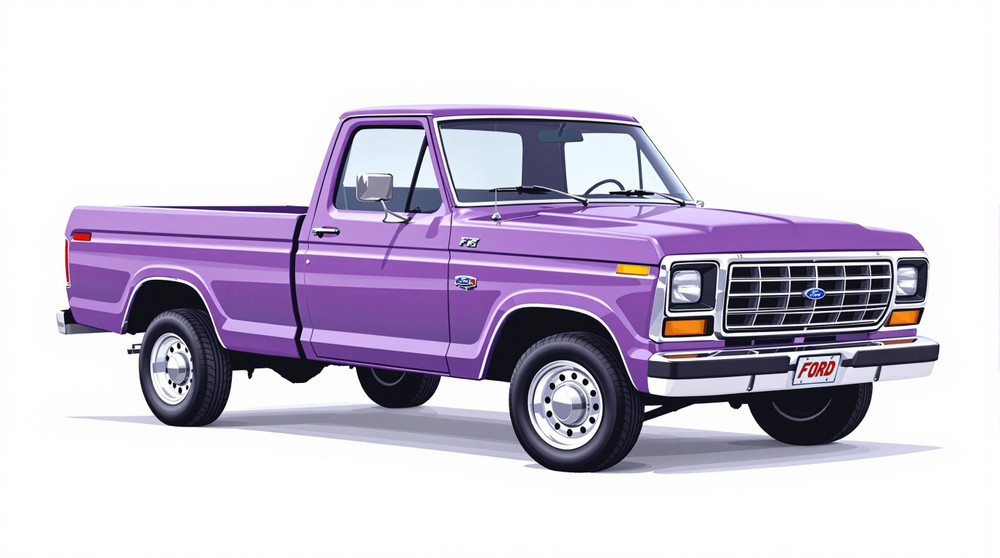
Image of 1980 Ford F-150, Note: These illustrations use artistic license and may differ from actual historical models.
Performance Metrics
Fundamental Metrics
Emotional Appeal
MMP Rating
| Engine Specifications | |
|---|---|
| Engine: | 4.9L 300 I6, 5.0L 302 V8, 5.8L 351 V8, 6.6L 400 V8 |
| Displacement: | 300-400 cu in |
| Horsepower: | 115-170 hp |
| Torque: | 223-315 lb-ft |
| Compression Ratio: | 8.0:1 - 8.4:1 |
| Ignition System: | Electronic |
| Cooling System: | Liquid-cooled |
| Performance Specifications | |
| 0-60 Time: | Estimated 10-15 seconds |
| 1/4 Mile Time: | Estimated 17-20 seconds |
| Top Speed: | 85-100 mph |
| Transmission and Drive | |
| Drive Type: | Rear-wheel drive (RWD) or Four-wheel drive (4WD) |
| Transmission Type: | 3-speed automatic, 4-speed manual |
| Fuel and Efficiency | |
| Fuel System Type: | Carburetor |
| MPG: | 10-15 mpg |
| Dimensions and Brakes | |
| Brakes: | Front disc, rear drum |
| Wheelbase: | 133 inches |
| Weight: | 4,000-5,000 lbs |
Note: Specifications for classic cars are given to the best of our ability, considering the limited and variant data available.
1980 Ford F-150: The First-Year Bullnose Pickup
The 1980 Ford F-150 arrived with a sharper shape, a newly redesigned cab and a name that would become familiar across American job sites and driveways. Built by Ford Motor Company, it was part of the seventh-generation F-Series, a new generation that ran from 1980 through 1986. Today, enthusiasts often call these trucks “Bullnose” Fords, a nickname inspired by the rounded, forward-projecting grille and hood.
The F-150 had joined Ford’s lineup in 1975, positioned between the lighter F-100 and heavier F-250. By 1980, it had become a central part of Ford’s full-size pickup range. This was a consequential moment for trucks: buyers increasingly wanted pickups that could work hard during the week while offering more comfort and convenience for everyday driving. The redesigned F-150 was built to answer both needs.
One intriguing detail is that 1980 was the first model year of the Bullnose generation, giving this truck a distinct place in Ford history. Its new design launched a six-year run that helped establish the look and feel many people still picture when they think of an old Ford pickup.
Square Shoulders, Useful Choices
The 1980 F-150 traded some of the softer contours of earlier trucks for a more squared-off profile. Its broad hood, upright windshield, prominent grille and straight-sided body gave it a purposeful, easy-to-read shape. The front end varied with trim and equipment, but the overall design looked modern without hiding the truck’s working roots. Chrome details could dress it up, while simpler trim kept it rugged and businesslike.
Ford offered the F-150 in regular-cab and SuperCab configurations. The SuperCab added extra space behind the front seats, often with small fold-down jump seats, making it useful for carrying occasional passengers or storing gear inside the cab. Buyers could also choose a Styleside bed, with slab-sided rear fenders integrated into the body, or a Flareside bed, whose external rear fenders gave it a more traditional pickup appearance. The Styleside was the more common, practical choice; the Flareside is now a particularly recognizable option among collectors.
Interior equipment depended on trim and options. A basic truck could be quite plain, with durable vinyl upholstery and straightforward controls. Better-equipped examples offered cloth or patterned seating, upgraded trim, carpeting, woodgrain-style accents and more convenience features. Air conditioning, power steering, power brakes, an automatic transmission and an AM radio were among the features buyers could specify. Materials were chosen for durability rather than luxury, but a well-preserved higher-trim cabin can feel surprisingly comfortable by work-truck standards of the period.
Paint choices varied by package and production details, with solid colors and two-tone combinations available. White, red, blue and earth-toned shades were common sights, while contrasting lower-body colors and bright trim gave some trucks a more dressed-up look. Two-tone trucks are especially appealing today because they emphasize the Bullnose body’s long, straight lines.
Engineering for Work and Road
The seventh-generation redesign brought more than fresh sheet metal. Ford revised the truck’s structure and chassis, with attention to ride, durability and efficiency. Two-wheel-drive models used Ford’s Twin-I-Beam front suspension, a distinctive setup that allowed each front wheel to move independently while retaining a rugged truck layout. Four-wheel-drive models used a different front suspension arrangement, and buyers could select four-wheel drive for work, recreation or travel over rough ground.
Available engines depended on configuration and equipment, but the lineup included Ford’s 300-cubic-inch inline-six, along with V8 choices such as the 302 and 351-cubic-inch engines. Larger-displacement V8 availability varied by specification and market. Buyers could pair engines with manual or automatic transmissions, as well as different axle ratios. Those choices mattered: a truck set up for towing or hauling could feel very different from a lighter-duty pickup geared for everyday use.
By modern standards, the F-150’s technology was simple. There were no electronic drive modes, touchscreen displays or advanced stability systems. Instead, the appeal lay in familiar mechanical components, straightforward controls and a chassis designed to take hard use. Optional four-wheel drive, automatic transmission and convenience equipment made the truck adaptable, but its core formula remained easy to understand and maintain.
How the 1980 F-150 Drives
Performance varies substantially with engine, transmission, axle ratio, body style and condition. As a broad period-style estimate, a typical 1980 F-150 may take roughly 11 to 17 seconds to accelerate from 0 to 60 mph. A top speed in the neighborhood of 85 to 100 mph is plausible for some configurations, but these are estimates, not a single factory specification. The F-150 was designed to haul, tow and work, not to set acceleration records, and tire condition, gearing and engine tune can shift the numbers considerably.
The 300 inline-six is known for low-speed pulling power and a steady, unhurried character. V8 versions provide a deeper exhaust note and stronger acceleration, particularly when lightly loaded. Behind the wheel, the steering feels substantial and the ride is firm compared with a modern pickup. The suspension handles rough roads and work loads well, though an empty truck can bounce over sharp bumps. On winding roads, its size, solid rear axle and period tires call for measured inputs rather than sports-car precision.
On the highway, the cabin is more exposed to wind and road noise than a contemporary truck. The broad hood and upright driving position give the driver a clear view of the road ahead, while the truck’s size is always present in tight parking lots and narrow streets. A healthy example feels direct and mechanical: you hear the engine, feel the suspension work and operate controls that are not filtered through layers of software.
A Truck That Earned Its Place
The 1980 F-150’s historical importance comes from its role in a major redesign of one of America’s most influential vehicle lines. Ford gave the F-Series a more modern shape and updated engineering while preserving the practical qualities that truck buyers expected. The F-150 also reflected a shift in how pickups were used. Many owners needed a working vehicle, but they increasingly wanted a truck that could serve as family transport or a daily driver too.
That mix of utility and comfort helped make the F-150 format influential. Later pickups would add more amenities and increasingly polished road manners, but the basic idea of a full-size truck serving both work and personal needs was already taking hold. The Bullnose generation remains a recognizable chapter in that evolution, and its long production run helped make replacement parts, mechanical knowledge and enthusiast support easier to find.
Ownership, Repairs and Common Uses
Today, a 1980 F-150 may be a weekend cruiser, a farm or workshop truck, a restoration project or a show vehicle. Some owners still use them for light hauling and local driving, while carefully restored examples tend to be saved for events and sunny-day trips. Four-wheel-drive models are popular with buyers looking for a vintage truck with off-road character, though a classic 4x4 needs careful inspection of its drivetrain and suspension.
Mechanical repairs are generally approachable for a capable home mechanic. The engines and drivetrains use conventional components, and many routine jobs can be handled with ordinary tools and a factory service manual. Parts availability is generally good for common service items and popular configurations, although trim pieces, specific interior parts and unmodified original components can take more effort to source.
Age is the bigger challenge than complexity. Check the frame, cab mounts, floor pans, cab corners, bed and wheel arches for rust or previous repairs. Inspect the suspension, steering and brakes closely, especially on trucks that have spent years working. Carburetor tuning, aging ignition parts, vacuum-operated equipment, worn wiring and tired cooling systems can also cause trouble. A clean-looking truck deserves a close inspection underneath, since fresh paint can hide corrosion or hurried repairs.
Bullnose Facts and Foibles
“Bullnose” is an enthusiast nickname, not an official Ford model name. It refers to the 1980–1986 F-Series’ distinctive front-end styling. The 1980 model is especially appealing to collectors who want the first year of that design, while later years brought detail changes that can help identify a truck’s model year.
There is no reliable, widely cited production figure for every 1980 F-150 configuration. As a rough estimate rather than an official factory count, approximately 150,000 to 200,000 F-150s may have been built for the model year. The entire F-Series range was considerably larger. Production totals are difficult to pin down because published figures may combine several F-Series models, body styles and configurations.
The F-150 is not known for a single headline speed record or celebrity ownership story. Its more meaningful claim is its place in a hugely successful truck family: the F-Series became a fixture of American roads and work sites. Common criticisms are familiar to anyone driving a vehicle from 1980: modest fuel economy, substantial road noise, dated safety equipment and a ride that can feel choppy when the bed is empty. Rust and neglected maintenance are bigger concerns than any one design flaw.
1980 Ford F-150 Values
Values depend heavily on rust, originality, engine, cab, drivetrain and trim. As a broad 2026 guide, a project truck might sell for roughly $3,000 to $8,000. A usable driver in fair-to-good condition could fall around $8,000 to $18,000, while a clean, well-maintained example may bring $20,000 to $35,000. A high-quality restoration, desirable 4x4 or especially appealing configuration can exceed $35,000, with exceptional examples sometimes reaching $50,000 or more.
These are general ranges, not a formal appraisal. A solid frame and honest bodywork usually matter more than flashy accessories, while original details can increase interest among collectors. Bullnose F-150s have gained attention as buyers look beyond the most celebrated pickups of the 1950s and 1960s. Clean trucks have generally become more valuable, though condition and market demand create wide swings. The best examples are appreciating in interest, but a rusty or poorly repaired truck can remain expensive to restore.
Availability is reasonable compared with many classic vehicles because Ford built the F-Series in large numbers. Finding a particular combination of body style, engine, four-wheel drive and original trim is harder. Buyers should verify the truck’s identification information and equipment rather than relying solely on badges or seller descriptions.
Why the Bullnose Still Matters
The 1980 Ford F-150 brought a fresh design to a proven truck formula at a time when pickups were becoming more versatile. Its squared styling, practical cab and bed choices, durable mechanical layout and range of available equipment made it useful as both a work vehicle and personal transportation. It was not quick or refined by modern standards, but it offered something many enthusiasts still value: a straightforward truck with character and an honest connection between driver and machine.
As the first Bullnose F-150, the 1980 model marks the beginning of a distinctive generation. Whether restored, used for light work or simply enjoyed on weekend drives, it remains a sturdy reminder of how Ford helped shape the modern full-size pickup.
1980 Ford F-150 Catalog of Parts
 1980 Ford F-150 Brake Pedal Pad. 4-3/4" wide X 2-1/4" long-CB 111-NBrake Pedal Pad. 4-3/4" wide X 2-1/4" long. Replaces OEM #'s BC3Z2457B, D3TZ2457A, D3TZ2457B. Each
 1980 Ford F-150 Door Seal (Imported). 154" Long-IS-LM 110Door Seal (Imported). 154" Long. Fits right or left, front and rear doors. Each
 1980 Ford F-150 Flocked Window Channel (Imported). Fits left and right side-IS-WC 6600-23Flocked Window Channel (Imported). Fits left and right side. Each
 1980 Ford F-150 Window sweeper kit. Fits 80-87 Ford Bronco and Truck 2 Door Extended/Standard-WC 6600-12This four piece set includes the inner and outer window felt beltline weatherstrips for each door side window. These strips wipe the side windows when the glass is lowered.
Why Choose Metro?
For over 100 years, Metro Moulded Parts has been the pinnacle of quality in classic car restoration parts. Our commitment to precision and authenticity in every component ensures a perfect fit and an OEM-level appearance.
- Expert Craftsmanship & Quality: Each part is a testament to our dedication to reliability and perfection, crafted from original designs and thoroughly tested.
- Advanced Technology: We use cutting-edge techniques to create flawless, long-lasting parts that surpass others in performance.
- SuperSoft Sponge – The Ultimate Door Seal: Not only are our door seals 30% softer than competitors', but they're also guaranteed to never leak. They effectively reduce wind and road noise, enhancing your classic car's comfort and driving experience.
- Proudly American: Our parts are a product of American craftsmanship, made in the USA with a spirit of excellence and heritage.
- Unrivaled Warranty: We back our products with a 30-year industry-leading warranty, a testament to our confidence in their quality.
Join us in preserving the legacy of classic cars with parts that are crafted for perfection, not just made.