
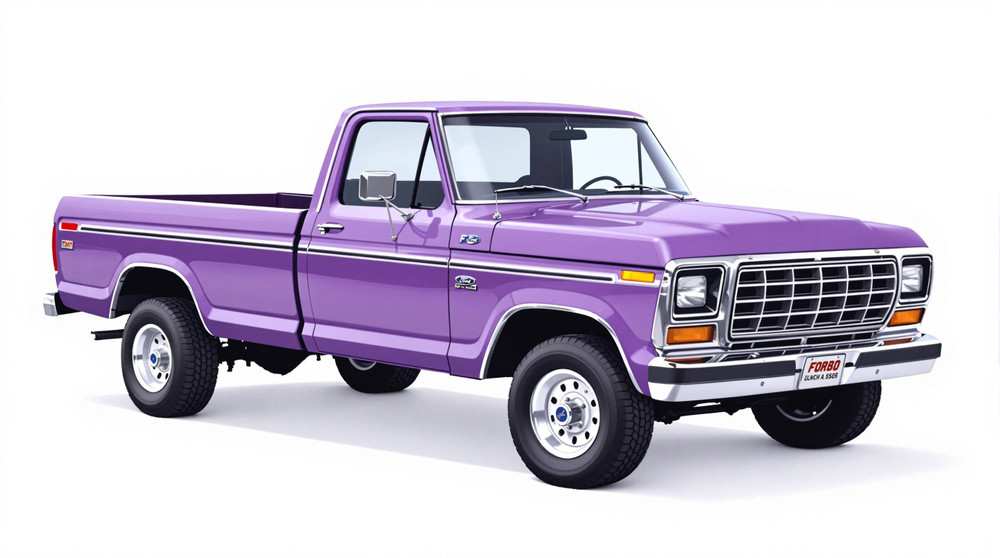
Image of 1980 Ford F-250, Note: These illustrations use artistic license and may differ from actual historical models.
Performance Metrics
Fundamental Metrics
Emotional Appeal
MMP Rating
| Engine Specifications | |
|---|---|
| Engine Options: | 4.9L 300 Cu. In. I6, 5.8L 351 Cu. In. V8, 6.6L 400 Cu. In. V8, 7.5L 460 Cu. In. V8 |
| Displacement Range: | 300-460 Cu. In. |
| Horsepower Range: | 115-225 HP |
| Torque: | 223-338 lb-ft |
| Compression Ratio: | 8.0:1 - 8.4:1 |
| Ignition System: | Electronic |
| Cooling System: | Liquid-cooled |
| Performance Specifications | |
| 0-60 Time: | 10-15 seconds |
| 1/4 Mile Time: | 17-22 seconds |
| Top Speed: | 85-95 mph |
| Transmission and Drive | |
| Drive Type: | Rear-wheel drive (RWD) or Four-wheel drive (4WD) |
| Transmission Type: | 3-speed automatic, 4-speed manual |
| Fuel and Efficiency | |
| Fuel System Type: | Carburetor |
| MPG: | 10-15 mpg |
| Dimensions and Brakes | |
| Brakes: | Front disc, rear drum |
| Wheelbase: | 133.0 in (Regular Cab), 155.0 in (SuperCab) |
| Weight: | 4,000-5,000 lbs |
Note: Specifications for classic cars are given to the best of our ability, considering the limited and variant data available.
1980 Ford F-250: The First Bullnose Heavy-Duty Ford
The 1980 Ford F-250 arrived with a squared-off nose, a tougher stance, and a new generation of Ford truck design. Built by Ford Motor Company, it was the heavy-duty middle member of the F-Series lineup, positioned above the F-100 and F-150 and below the F-350. Today, enthusiasts call this generation the “Bullnose,” a nickname inspired by the shape of its rounded-square hood and grille.
As the first model year of Ford’s redesigned 1980 F-Series, the F-250 marked a visible break from the rounded “Dentside” trucks that came before it. It also debuted at a challenging time for American automakers, when fuel prices, emissions rules, and changing expectations around comfort were reshaping the pickup market. Ford’s answer was a truck that kept its work-ready frame and hardware while offering a more modern cab and a cleaner, more aerodynamic front end.
One detail that makes the 1980 especially appealing to enthusiasts is that it is the first-year Bullnose. It combines the new styling and cabin design with the simpler, traditional mechanical character of a full-size pickup from the period. For collectors, that makes it both a useful classic and the beginning of a distinct F-Series chapter.
Bullnose Styling and Cab Design
The 1980 F-250 is easy to recognize by its broad, upright grille, rectangular headlamps, flat-sided hood, and sharply creased bodywork. The front end looks more squared and composed than the outgoing Dentside design, while the tall stance and substantial fenders make clear that this is a truck built for real work. The grille, trim, wheels, and badging varied with trim level and equipment, giving a Custom work truck a noticeably different personality from a well-optioned Ranger XLT.
Ford offered the F-250 in two-wheel-drive and four-wheel-drive versions, with regular-cab and SuperCab configurations, as well as different bed and chassis arrangements. Styleside beds gave it the familiar full-width pickup-box look, while Flareside beds offered a narrower, more traditional appearance with pronounced rear fenders. Exact combinations depended on configuration and availability. Among collectors, the regular-cab Styleside 4x4 is one of the most recognizable setups, while SuperCab trucks appeal to buyers who want extra interior space.
Cab trim ranged from practical and durable to relatively comfortable for the era. Custom models emphasized function, while Ranger and Ranger XLT versions could add more decorative trim and convenience features. The dashboard was broad and upright, with legible instruments and large, straightforward controls. Materials were chiefly vinyl, painted metal, and hard-wearing plastics, chosen to tolerate work clothes, dust, and regular use rather than imitate a luxury car.
Factory paint choices varied by trim and order. Period colors included familiar work-truck shades as well as brighter reds, blues, greens, browns, and two-tone combinations. White, red, blue, and earth-toned finishes are especially common sights today. A truck’s original paint code and trim combination can be a point of interest for restorers, since color availability and appearance depended on the specific build.
Engines, Equipment, and 1980 Technology
The 1980 F-250 could be ordered with several gasoline engines, depending on drivetrain and configuration. Choices included Ford’s 300-cubic-inch (4.9-liter) inline-six and V8 options such as the 302, 351, 400, and 460 cubic-inch engines in applicable versions. Availability and published output varied, and period horsepower figures should be treated as approximate because ratings, emissions equipment, and drivetrain specifications differed. A six-cylinder truck prioritized dependable low-speed work; larger V8s offered more power for towing and hauling.
Manual transmissions and automatic options were available, with the specific gearbox depending on engine and equipment. Four-wheel-drive models added a transfer case and hardware for rough roads, job sites, and trails. Power steering, power brakes, air conditioning, and upgraded radios could make the truck easier to live with, though many base examples were deliberately simple.
Technology in a 1980 F-250 was practical rather than flashy. Electronic ignition, emissions-control equipment, and available comfort features reflected the changing expectations of the era. The truck still relied on conventional, serviceable mechanical systems, which is part of its appeal today. There were no modern driver aids or computer-managed driving modes: the driver handled the steering, shifting, and braking directly.
Why the 1980 F-250 Matters
The F-250’s significance lies partly in its role within a major redesign. Ford updated the F-Series exterior and cab while retaining the rugged, body-on-frame construction that truck buyers expected. The new shape looked more modern without abandoning the upright proportions and practical layout of a full-size pickup. That balance helped establish a visual identity that carried through the Bullnose generation.
The F-250 also occupied an important middle ground. It offered more capacity and heavier-duty components than a light-duty pickup, without requiring every buyer to step up to an F-350. That made it useful to farmers, tradespeople, recreational towers, and families who needed a truck that could do more than commute. Its mix of capability and relative simplicity remains a major reason these trucks are still used, restored, and modified.
More broadly, the 1980 redesign arrived as the F-Series was cementing its place in the American truck market. Ford’s continued evolution of the line helped shape buyers’ expectations for full-size pickups: a vehicle could be a work tool and, with the right trim and options, a comfortable everyday ride. The F-250 was part of that shift, even though its strongest selling point remained capability.
Performance and Road Manners
There is no single performance figure for a 1980 F-250. Engine, transmission, axle ratio, cab, bed, and four-wheel-drive equipment all affect acceleration and top speed. As a broad real-world estimate, a typical period truck may take roughly 15 to 20 seconds to reach 60 mph. A powerful V8 with suitable gearing can be quicker, while a six-cylinder, heavily equipped, or loaded example may take longer. Approximate top speed can fall in the 80-to-95-mph range, but these are estimates, not a consistent factory performance specification. An F-250 is built to carry and tow, not to chase sports-car numbers.
On the road, the truck feels substantial and mechanical. The engine’s sound ranges from the steady low note of the inline-six to the deeper rumble of a V8. Steering is generally slower and less precise than in a modern pickup, and the large steering wheel and long hood make the driver feel closely connected to the truck’s size. A four-speed manual asks for deliberate shifts, while an automatic is more relaxed in traffic.
Ride quality depends on load and suspension setup. Unladen, a heavy-duty pickup can feel firm, especially over sharp bumps, because its suspension is designed to handle cargo and towing. Add a useful load and the chassis often settles into a more composed ride. Two-wheel-drive examples use Ford’s Twin I-Beam front suspension, a distinctive arrangement that gives the truck a different feel from a conventional independent front end. Four-wheel-drive models have their own heavier front-end hardware and a more truck-like response over rough ground.
On windy roads, the F-250 rewards steady inputs rather than quick direction changes. Its size, weight, and tall body are always present, and a boxy truck can be affected by crosswinds. It feels most at home on open roads, gravel, work sites, and towing routes, where its sturdy construction matters more than nimble handling.
Living With a 1980 F-250
Owners use these trucks as weekend classics, farm and ranch vehicles, towing rigs, work trucks, and restoration projects. A clean, mostly original example may be kept for shows and local events, while a modified truck might receive upgraded brakes, modern tires, improved lighting, or a later engine. The original character is straightforward enough that even a working truck can remain enjoyable without needing a complete restoration.
Routine maintenance is familiar to anyone comfortable with older American vehicles. Oil and filter changes, ignition service, brake work, cooling-system care, and drivetrain checks are generally accessible, and many common parts remain available through classic-truck suppliers. The simple layout helps make repairs approachable for a capable home mechanic, though rust repair, worn suspension components, and aging wiring can demand more time and money than basic servicing.
Condition matters more than the odometer alone. Inspect the frame, cab corners, floor pans, bed, wheel arches, and lower doors for corrosion. Check for evidence of hard towing, neglected cooling systems, worn steering parts, and poorly executed engine or electrical modifications. Four-wheel-drive trucks deserve careful inspection of the transfer case, front axle, and related components. A truck that starts and runs well can still need significant structural or brake work.
F-250 Facts and Common Complaints
“Bullnose” is an enthusiast nickname, not Ford’s official name for the 1980 generation. It refers to the shape of the front end and is now widely used in parts listings, restoration discussions, and truck clubs. Because 1980 was the first year of the redesign, details such as trim, grille, and equipment can help distinguish an early Bullnose from later trucks.
The 1980 F-250 is not known for a special speed record or a single famous celebrity-owned edition. Its notable achievement is more practical: it belongs to a truck line that became a lasting fixture of American work and recreational life. The F-Series’ popularity gave the F-250 a broad role in agriculture, construction, towing, and everyday transportation, rather than tying it to one headline-grabbing event.
Common criticisms are familiar to anyone considering a 1980s heavy-duty pickup. Fuel economy is poor by modern standards, especially with a large V8 or four-wheel drive. The ride can be stiff when empty, steering and braking feel dated, and rust can turn an inexpensive project into a major restoration. Buyers should also remember that old trucks have often been modified or worked hard, so originality and maintenance history vary widely.
1980 Ford F-250 Values and Rarity
As a rough U.S. market guide for 2026, a non-running or heavily rusted project might sell for about $2,000 to $6,000. A usable driver in fair condition could fall around $7,000 to $15,000, while a clean, well-kept example may bring roughly $15,000 to $25,000. Excellent restorations, desirable 4x4s, and particularly attractive or well-documented trucks can reach $25,000 to $40,000 or more. These are broad estimates, not appraisals; region, originality, engine, drivetrain, rust, and build quality can move the price substantially.
Ford did not publish an easily accessible, widely accepted production total specifically for every 1980 F-250 configuration. The F-Series sold in large numbers, but that does not make every F-250 combination easy to find today. As a clearly unverified estimate, the 1980 F-250 population may have been in the tens of thousands to around 100,000 units across configurations. That figure should not be treated as a factory count. Surviving rust-free, original trucks, especially well-equipped 4x4s, are much scarcer than the original production numbers might suggest.
Values have generally strengthened for clean, usable classic pickups, with the biggest gains going to solid, original trucks and high-quality restorations. Rough projects remain sensitive to repair costs, while modified examples are valued according to the quality and appeal of the work. The best investment is usually the truck with a sound frame, honest history, and the right combination of condition and specification, rather than the one with the most expensive modifications.
A Classic Built to Keep Working
The 1980 Ford F-250 introduced a new look while preserving the sturdy construction, useful engine choices, and hands-on character that defined a heavy-duty pickup. It is not quick or refined by modern standards, but it offers a direct driving experience and genuine utility that many newer trucks have moved away from. As the first Bullnose F-250, it stands at the start of a memorable Ford design era: a classic truck that still looks ready to head back to work.
1980 Ford F-250 Catalog of Parts
 1980 Ford F-250 Brake Pedal Pad. 4-3/4" wide X 2-1/4" long-CB 111-NBrake Pedal Pad. 4-3/4" wide X 2-1/4" long. Replaces OEM #'s BC3Z2457B, D3TZ2457A, D3TZ2457B. Each
 1980 Ford F-250 Door Seal (Imported). 154" Long-IS-LM 110Door Seal (Imported). 154" Long. Fits right or left, front and rear doors. Each
 1980 Ford F-250 Flocked Window Channel (Imported). Fits left and right side-IS-WC 6600-23Flocked Window Channel (Imported). Fits left and right side. Each
 1980 Ford F-250 Window sweeper kit. Fits 80-87 Ford Bronco and Truck 2 Door Extended/Standard-WC 6600-12This four piece set includes the inner and outer window felt beltline weatherstrips for each door side window. These strips wipe the side windows when the glass is lowered.
Why Choose Metro?
For over 100 years, Metro Moulded Parts has been the pinnacle of quality in classic car restoration parts. Our commitment to precision and authenticity in every component ensures a perfect fit and an OEM-level appearance.
- Expert Craftsmanship & Quality: Each part is a testament to our dedication to reliability and perfection, crafted from original designs and thoroughly tested.
- Advanced Technology: We use cutting-edge techniques to create flawless, long-lasting parts that surpass others in performance.
- SuperSoft Sponge – The Ultimate Door Seal: Not only are our door seals 30% softer than competitors', but they're also guaranteed to never leak. They effectively reduce wind and road noise, enhancing your classic car's comfort and driving experience.
- Proudly American: Our parts are a product of American craftsmanship, made in the USA with a spirit of excellence and heritage.
- Unrivaled Warranty: We back our products with a 30-year industry-leading warranty, a testament to our confidence in their quality.
Join us in preserving the legacy of classic cars with parts that are crafted for perfection, not just made.