
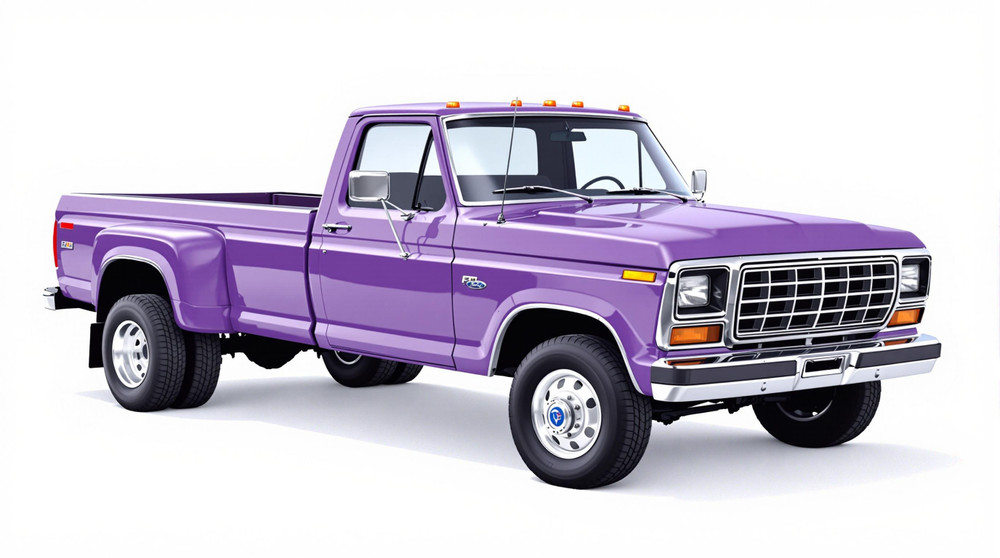
Image of 1980 Ford F-350, Note: These illustrations use artistic license and may differ from actual historical models.
Performance Metrics
Fundamental Metrics
Emotional Appeal
MMP Rating
| Engine Specifications | |
|---|---|
| Engine Options: | 4.9L 300 Cu. In. I6, 5.8L 351 Cu. In. V8, 6.6L 400 Cu. In. V8, 7.5L 460 Cu. In. V8 |
| Displacement Range: | 300-460 Cu. In. |
| Horsepower Range: | 115-225 HP (estimated) |
| Torque: | 223-388 lb-ft (estimated) |
| Compression Ratio: | 8.0:1 - 8.4:1 (estimated) |
| Ignition System: | Distributor |
| Cooling System: | Liquid-cooled |
| Performance Specifications | |
| 0-60 Time: | 12-15 seconds (estimated) |
| 1/4 Mile Time: | 18-20 seconds (estimated) |
| Top Speed: | 85-95 mph (estimated) |
| Transmission and Drive | |
| Drive Type: | Rear-wheel drive (RWD), Four-wheel drive (4WD) |
| Transmission Type: | 3-speed automatic, 4-speed manual |
| Fuel and Efficiency | |
| Fuel System Type: | Carburetor |
| MPG: | 10-14 mpg (estimated) |
| Dimensions and Brakes | |
| Brakes: | Front disc / Rear drum |
| Wheelbase: | 133-155 inches |
| Weight: | 4,000-5,000 lbs (estimated) |
Note: Specifications for classic cars are given to the best of our ability, considering the limited and variant data available.
1980 Ford F-350: The First-Year Bullnose Workhorse
The 1980 Ford F-350 arrived with a square-jawed new look and the kind of heavy-duty hardware built for long days, heavy loads, and hard use. It was part of the seventh-generation Ford F-Series, the first generation to wear the rounded, forward-sloping grille and hood now nicknamed the “Bullnose.” For buyers who needed more capacity than an F-150 or F-250 could offer, the one-ton F-350 was Ford’s serious working truck.
Ford had been building F-Series trucks since 1948, but the 1980 redesign marked a major change in the line’s appearance and engineering direction. The F-350 was offered as a pickup and in chassis-cab form, making it useful for everything from hauling equipment to supporting service bodies and other commercial conversions. One detail that surprises many enthusiasts: the 1980 truck was the first Bullnose model year, while Ford’s popular 6.9-liter diesel would not arrive in the F-Series until 1983.
Bullnose Styling and Work-Truck Details
The 1980 F-350 traded the previous generation’s upright front end for a broad, slightly sloped hood and a large rectangular grille. Rectangular headlamps, simple horizontal trim, and a wide front bumper gave it a purposeful face without unnecessary decoration. The shape looked modern for its time, but it was still unmistakably a truck designed around serviceability and utility.
Buyers could choose a conventional Styleside bed or the more rounded-fender Flareside, along with different bed lengths depending on cab and chassis configuration. Regular Cab and SuperCab pickups were available, while commercial buyers could order a chassis cab for an upfit. Four-wheel drive was also offered. The F-350’s heavy-duty role was especially evident in dual-rear-wheel versions, which provided a broader stance and greater stability for substantial payloads.
Cab trim ranged from basic work-truck finishes to more comfort-oriented packages, including Ranger and Ranger XLT equipment depending on configuration. Materials were practical rather than plush: vinyl or cloth seating, durable door panels, straightforward controls, and a large, easy-to-read instrument panel. Higher trims added more convenience and decorative touches, but even a well-optioned F-350 kept its focus on function.
Factory paint choices varied by year and equipment, with solid whites, reds, blues, greens, and earth tones among the familiar period colors. Two-tone paint and contrasting lower-body treatments could give an F-350 a more distinctive look. White and blue trucks are especially recognizable today, though original color, trim, and condition matter more to collectors than any single “most popular” shade.
Engines, Chassis, and 1980 Technology
Depending on configuration and market, the 1980 F-350 could be ordered with a 300-cubic-inch inline-six or a range of gasoline V8s, including 302-, 351-, 400-, and 460-cubic-inch options. Availability varied with body style, drivetrain, and equipment. The 460 big-block was the choice for buyers who wanted substantial low-speed pulling power, while the inline-six offered simpler mechanicals and a reputation for durability.
Transmission choices included manual gearboxes and Ford’s C6 automatic, with final equipment depending on engine and drivetrain. Two-wheel-drive models used Ford’s Twin I-Beam front suspension, a distinctive design that allowed each front wheel to move independently. Heavy-duty rear suspension, axle, tire, and brake equipment reflected the F-350’s higher load-carrying mission. Four-wheel-drive hardware differed from the two-wheel-drive setup, so shoppers should check the specific truck rather than assume every F-350 has the same chassis components.
By modern standards, the technology was straightforward. The truck offered conventional gauges and mechanical controls rather than electronic driver aids, but power steering, power brakes, automatic transmission, and comfort options could make a working day easier. The Bullnose redesign also brought a cleaner, more contemporary cab and front end, while retaining the mechanical simplicity that many owners appreciate today.
What It Is Like to Drive
There is no single factory 0-to-60-mph figure that neatly describes every 1980 F-350. Engine, axle ratio, transmission, tires, body style, and load all make a major difference. As a broad real-world estimate, many examples take roughly 15 to 22 seconds to reach 60 mph. A lightly loaded truck with a large V8 and favorable gearing may be quicker, while a heavy dual-rear-wheel or chassis-cab truck can be slower.
Top speed is similarly configuration-dependent and was not the truck’s purpose. A reasonable estimate for many stock examples is about 80 to 95 mph, though gearing, tire ratings, mechanical condition, and load can change that substantially. An F-350 is happiest working at moderate road speeds, not chasing sports cars down the highway.
Behind the wheel, the truck feels substantial and direct. The steering is slower than in a modern pickup, and the long hood and broad turning circle take some getting used to. On broken pavement, the heavy-duty suspension can feel firm when the bed is empty, while a load often settles the ride. On winding roads, the F-350 rewards smooth inputs and sensible speeds. Its size and weight are always present, especially when braking or maneuvering in tight spaces.
The engine note is part of the appeal. The inline-six has a steady, workmanlike rasp, while the larger V8s deliver a deeper rumble and a more relaxed sound under load. A healthy 460 has a memorable presence, but it can also make frequent fuel stops part of the ownership experience. These trucks communicate through the wheel, pedals, engine, and suspension rather than filters and electronic systems.
Why the 1980 F-350 Matters
The F-350 was not a radical performance or luxury truck. Its importance lies in how it balanced commercial capability with the increasingly comfortable, recognizable pickup format that would define Ford’s trucks through the 1980s. The Bullnose front end helped establish a visual identity that was distinct from the more slab-sided trucks that came before it, while the wide range of cabs, beds, engines, and chassis configurations made the F-Series adaptable to both personal and professional use.
For enthusiasts, the 1980 model has a special place as the first Bullnose year. It combines a newly styled cab and front end with comparatively simple mechanical systems. That blend has helped the generation remain popular among restorers, contractors, farm owners, and people who want a classic truck that can still earn its keep.
Ownership, Reliability, and Common Repairs
F-350s were built for work, so common uses included towing, farm duties, construction, hauling, and commercial service. Today, a clean example might serve as a weekend cruiser, a vintage show truck, a restoration project, or an occasional tow vehicle. It can be used regularly, but its age, fuel consumption, and lack of modern safety and comfort equipment make it a different proposition from a contemporary daily driver.
Mechanical repairs are often approachable for an experienced home mechanic. The engine bay is roomy, many systems are conventional, and replacement parts remain available through specialist suppliers and the broader classic Ford community. However, heavy-duty components can be expensive, and jobs involving axles, brakes, or dual rear wheels require proper tools and safe lifting equipment. A pre-purchase inspection by a mechanic familiar with older Ford trucks is a smart investment.
Rust deserves close attention. Inspect the cab floors, cab corners, inner and outer fenders, wheel openings, bed seams, and frame, especially around brackets and crossmembers. Also check for worn steering and suspension parts, tired brakes, leaking seals, and evidence of overloading. A truck that spent years working hard may have been repaired or modified in ways that are not immediately obvious.
F-350 Trivia and Common Criticisms
The 1980 F-350 is sometimes mistaken for a diesel truck because later Bullnose F-Series models became closely associated with Ford’s 6.9-liter diesel. That engine, supplied by International Harvester, arrived for the 1983 model year, so a factory-original 1980 F-350 was gasoline-powered. Diesel conversions exist, but they are modifications rather than original 1980 equipment.
There is no widely recognized speed, endurance, or sales record specific to the 1980 F-350, and it is not strongly tied to one famous historical event. Its story is more grounded: countless trucks served on farms, at construction sites, in fleets, and as tow rigs. That everyday working history is a major part of its appeal.
Common criticisms are easy to understand. The truck is thirsty, slow by modern standards, large to park, and comparatively noisy. An empty heavy-duty suspension can be stiff, while old brakes and steering components may feel vague if they have not been maintained. On the other hand, fans value the truck’s straightforward construction, distinctive styling, and ability to be repaired without relying on complex electronics.
Collector Values and Market Outlook
Values depend heavily on body style, drivetrain, rust, originality, and restoration quality. As a broad U.S. market guide in 2026, a rough project might sell for about $3,000 to $7,000. A usable but imperfect truck commonly falls around $8,000 to $18,000, while a clean, well-maintained example may bring roughly $20,000 to $35,000. A high-quality restoration or exceptionally original truck can reach $40,000 to $60,000 or more, particularly when it has desirable equipment such as four-wheel drive, a crew-oriented cab, or dual rear wheels.
These are general estimates, not guaranteed sale prices. Rust-free trucks, documented restorations, and rare combinations can command a premium, while modifications, hidden corrosion, and incomplete paperwork can reduce value. The market has generally strengthened for clean vintage pickups, and Bullnose F-Series trucks have benefited from that interest. Values are likely to remain strongest for well-preserved examples rather than ordinary work trucks with extensive wear.
Ford did not publish an easily verifiable production total for every 1980 F-350 body, cab, and drivetrain combination. A reasonable but unconfirmed estimate is somewhere in the range of 25,000 to 50,000 F-350 units for the model year across pickup and commercial configurations. That should be treated as an informed approximation, not a factory production figure. Surviving examples are far fewer, especially trucks that retain their original equipment and have avoided serious rust.
A First-Year Classic Built to Work
The 1980 Ford F-350 stands out as a first-year Bullnose truck with genuine one-ton capability, a broad choice of engines and configurations, and mechanicals that remain familiar to classic Ford enthusiasts. It is not quick, quiet, or economical, but it offers something modern trucks often cannot: a direct, hands-on driving experience and the presence of a machine designed to do real work.
Whether restored for shows, kept on a farm, or driven on weekend errands, the 1980 F-350 is more than a vintage pickup with a memorable grille. It is a hardworking chapter in Ford’s truck history, and one that still feels ready for the next job.
1980 Ford F-350 Catalog of Parts
 1980 Ford F-350 Brake Pedal Pad. 4-3/4" wide X 2-1/4" long-CB 111-NBrake Pedal Pad. 4-3/4" wide X 2-1/4" long. Replaces OEM #'s BC3Z2457B, D3TZ2457A, D3TZ2457B. Each
 1980 Ford F-350 Door Seal (Imported). 154" Long-IS-LM 110Door Seal (Imported). 154" Long. Fits right or left, front and rear doors. Each
 1980 Ford F-350 Flocked Window Channel (Imported). Fits left and right side-IS-WC 6600-23Flocked Window Channel (Imported). Fits left and right side. Each
 1980 Ford F-350 Window sweeper kit. Fits 80-87 Ford Bronco and Truck 2 Door Extended/Standard-WC 6600-12This four piece set includes the inner and outer window felt beltline weatherstrips for each door side window. These strips wipe the side windows when the glass is lowered.
Why Choose Metro?
For over 100 years, Metro Moulded Parts has been the pinnacle of quality in classic car restoration parts. Our commitment to precision and authenticity in every component ensures a perfect fit and an OEM-level appearance.
- Expert Craftsmanship & Quality: Each part is a testament to our dedication to reliability and perfection, crafted from original designs and thoroughly tested.
- Advanced Technology: We use cutting-edge techniques to create flawless, long-lasting parts that surpass others in performance.
- SuperSoft Sponge – The Ultimate Door Seal: Not only are our door seals 30% softer than competitors', but they're also guaranteed to never leak. They effectively reduce wind and road noise, enhancing your classic car's comfort and driving experience.
- Proudly American: Our parts are a product of American craftsmanship, made in the USA with a spirit of excellence and heritage.
- Unrivaled Warranty: We back our products with a 30-year industry-leading warranty, a testament to our confidence in their quality.
Join us in preserving the legacy of classic cars with parts that are crafted for perfection, not just made.