
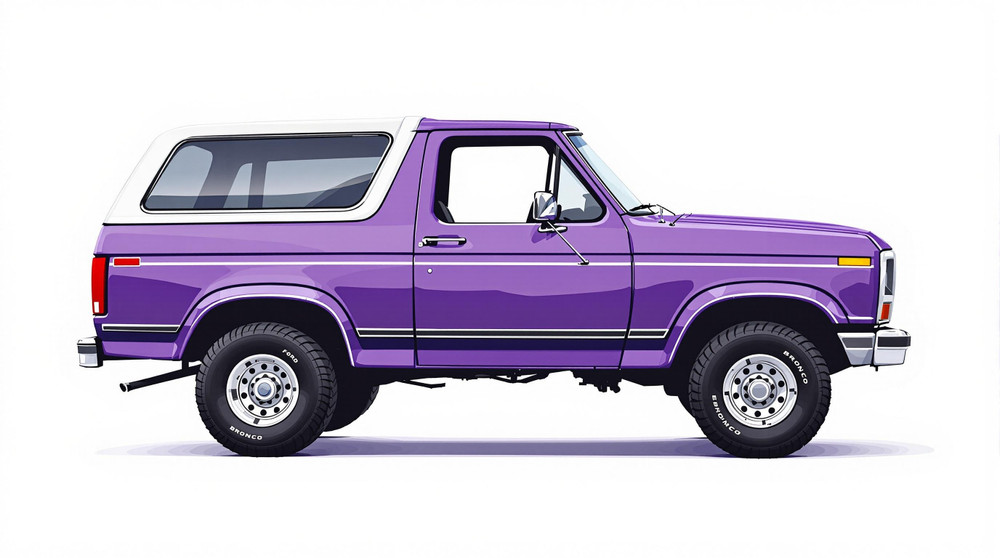
Image of 1981 Ford Bronco, Note: These illustrations use artistic license and may differ from actual historical models.
Performance Metrics
Fundamental Metrics
Emotional Appeal
MMP Rating
| Engine Specifications | |
|---|---|
| Engine Options: | 4.9L 300 Cu In I6, 5.8L 351 Cu In V8, 6.6L 400 Cu In V8 |
| Displacement Range: | 300-400 Cu In |
| Horsepower Range: | 115-156 HP |
| Torque: | 223-277 lb-ft |
| Compression Ratio: | 8.0:1 - 8.4:1 |
| Ignition System: | Electronic Ignition System |
| Cooling System: | Liquid Cooled |
| Performance Specifications | |
| 0-60 Time: | Estimated 12-15 seconds |
| 1/4 Mile Time: | Estimated 18-20 seconds |
| Top Speed: | 100 mph |
| Transmission and Drive | |
| Drive Type: | 4WD |
| Transmission Type: | 3-speed automatic, 4-speed manual |
| Fuel and Efficiency | |
| Fuel System Type: | Carburetor |
| MPG: | Estimated 10-14 MPG |
| Dimensions and Brakes | |
| Brakes: | Front Disc / Rear Drum |
| Wheelbase: | 104 inches |
| Weight: | 4,500 lbs |
Note: Specifications for classic cars are given to the best of our ability, considering the limited and variant data available.
1981 Ford Bronco: The Full-Size 4x4 Finds Its Stride
The 1981 Ford Bronco brought square-jawed style and genuine off-road hardware together in a truck that could tow, crawl a trail, or carry the family across town. Built by Ford as part of the Bronco’s third generation, it was a substantial redesign of the full-size model, pairing a more modern chassis with the familiar removable hardtop and two-door utility layout.
The Bronco story began in 1966, when Ford introduced a compact 4x4 to compete with the Jeep CJ and International Harvester Scout. By 1981, the model had grown into a full-size SUV closely related to the Ford F-Series pickup. That connection gave the Bronco truck-based toughness and access to Ford’s proven engines and driveline components.
One detail that makes this generation especially important is its Twin-Traction Beam independent front suspension. Introduced with the 1980 redesign, it marked a major departure from the solid front axle used by earlier Broncos. The change helped improve ride comfort and steering on the road while preserving four-wheel-drive capability.
Square Styling, Useful Details
The 1981 Bronco wore the crisp, angular design that defined many Ford trucks of the early 1980s. Its upright grille, broad hood, flat body sides, and squared-off wheel openings gave it a purposeful look without the ornamentation of a luxury SUV. The short wheelbase and two-door body kept the proportions compact compared with a full-size four-door wagon, while the tall stance made its off-road intentions clear.
At the back, the Bronco had a practical two-piece tailgate arrangement: the lower gate folded down, and the rear glass retracted into it. The power-operated window was a particularly handy feature, letting owners load long or bulky items without removing the hardtop. The removable roof was another signature detail, though it is heavy and should be handled carefully. Removing it can also affect the rear-seat belt setup and expose aging seals or wiring.
Inside, the cabin emphasized function over luxury. Buyers could find durable vinyl or cloth upholstery, straightforward gauges, and large controls that were easy to use with gloves. Higher trim levels added more comfort and dress-up details. The overall feel was distinctly truck-like, with more emphasis on space, visibility, and utility than on soft-touch materials or modern sound insulation.
Ford offered the 1981 Bronco in trim levels that included the base model and more upscale XLT and XLT Lariat versions, with exact equipment varying by configuration. Factory paint choices changed across trims and ordering packages, but period colors typically ranged from white, black, and earth tones to brighter blues, reds, and metallic shades. White and two-tone combinations are especially recognizable on surviving examples, while original, well-preserved colors can be a plus for collectors.
Engines and Equipment
Engine choices included Ford’s 300-cubic-inch (4.9-liter) inline-six, a 302-cubic-inch (5.0-liter) V8, and a 351-cubic-inch (5.8-liter) V8. The six-cylinder was known for its low-speed pulling power and straightforward mechanical design. The V8s brought stronger acceleration and towing ability, with the 351 generally the choice for owners who wanted the most muscle.
Depending on engine and equipment, a 1981 Bronco could be ordered with a manual transmission or a three-speed automatic. Four-wheel drive, a transfer case, and low range made it a genuine trail vehicle rather than a two-wheel-drive wagon wearing rugged styling. Equipment and axle ratios varied, so buyers looking at a specific truck should check its door data plate, drivetrain components, and original build information instead of relying on trim badges alone.
By modern standards, the technology was simple. The independent Twin-Traction Beam front suspension was the standout engineering change, while power steering, power brakes, and the electric rear-window mechanism made the truck easier to use day to day. Fuel delivery was carbureted, and electronic driver aids were limited compared with today’s SUVs.
Why the 1981 Bronco Mattered
The 1981 Bronco arrived as American buyers were increasingly drawn to vehicles that could serve as both transportation and recreation. Its formula reflected that shift: pickup-truck roots, four-wheel drive, a roomy cabin, and a removable roof. It was less specialized than a short-wheelbase off-roader and more maneuverable than a full-size pickup, making it a versatile middle ground.
The Twin-Traction Beam system set the 1980-to-1986 Bronco apart from many traditional 4x4s of its time. Independent front suspension could deliver a more composed ride over ordinary roads and uneven surfaces, although it was more complex than a solid axle and required correct alignment and maintenance. The Bronco’s combination of road manners and trail ability helped establish the full-size SUV as a vehicle that could be used throughout the week, not just on a hunting trip or work site.
Its influence is also visible in the broader SUV market. Ford’s F-Series-based Bronco helped popularize the idea of a comfortable, truck-based two-door 4x4. Later generations became more refined, but the 1981 model preserves the simple, mechanical character that many enthusiasts still seek.
Performance and Road Manners
Ford did not market the 1981 Bronco as a high-speed performer, and surviving trucks vary widely in condition, engine, gearing, and tire size. As a broad estimate, a healthy V8 model may reach roughly 85 to 95 mph, while a 0-to-60-mph run is likely to take about 12 to 17 seconds. The six-cylinder is generally slower, especially when hauling a load or turning large off-road tires. These figures are estimates, not guaranteed factory test results.
On the road, the Bronco feels substantial and upright. The independent front suspension helps soften bumps compared with older solid-axle Broncos, but a short wheelbase, high center of gravity, and truck-oriented tires mean it will not corner like a modern crossover. On a winding road, measured steering inputs are the order of the day. Strong crosswinds can also remind the driver that this is a tall, boxy vehicle.
Off pavement, low-range gearing and four-wheel drive provide useful control on loose ground, snow, and rutted tracks. The Bronco is capable, but tire choice, ground clearance, gearing, and the condition of the suspension matter as much as the badge. Behind the wheel, the experience is satisfyingly direct: a carbureted engine note, a visible hood, simple controls, and a ride that communicates the road rather than isolating the driver from it.
Living With a Classic Bronco
A 1981 Bronco can be a weekend cruiser, a camping and trail rig, a tow vehicle, or a show-quality restoration. Some owners use them regularly, but fuel consumption, old-truck handling, and the challenge of finding a rust-free example make them less convenient as a modern daily driver. Real-world fuel economy often lands in the low-to-mid teens, though engine choice, gearing, condition, and driving style can move it in either direction.
Mechanical repairs are usually approachable for an experienced home mechanic. The engines and many drivetrain components share familiar Ford truck engineering, and parts support remains strong for common service items. Carburetor tuning, ignition work, cooling-system repairs, and brake service are within reach of a well-equipped garage. The Twin-Traction Beam front end needs knowledgeable alignment and suspension work, while rust repair and worn body mounts can demand more time and specialist skill.
When inspecting one, pay close attention to the frame, floor pans, inner fenders, rocker areas, and body mounts. Check that the rear window moves smoothly, the tailgate functions, and the hardtop seals properly. Also inspect the transfer case, front axle components, steering linkage, and signs of overheating or poor carburetor tuning. A clean, unmodified truck is often a better starting point than a heavily altered example with uncertain workmanship.
Bronco Trivia and Common Criticisms
The 1981 model belongs to the first Bronco generation with Twin-Traction Beam independent front suspension. That distinction makes it an interesting choice for enthusiasts who want a classic Ford 4x4 with a more road-friendly front end than the earlier solid-axle models.
Another memorable feature is the rear window that disappears into the tailgate. It is convenient when working with cargo, but it adds age-sensitive motors, switches, and wiring to inspect. The removable roof is equally iconic and equally demanding: it is awkward to lift, and storage space is needed once it is off.
There is no widely recognized speed or endurance record associated specifically with the 1981 Bronco. Its importance is less about competition history and more about its role in the growth of the full-size SUV. Common criticisms include poor fuel economy, modest acceleration, dated crash protection, body roll, and rust. The ride is also truck-like, even with the revised front suspension. Those shortcomings are part of the ownership calculation, though for many fans the straightforward character is part of the appeal.
1981 Ford Bronco Collector Values
Production figures for individual Bronco model years can vary among published sources. A reasonable estimate for 1981 is around 40,000 units, making the truck uncommon today but not exceptionally rare. Survivors are available through classic-truck dealers, online listings, auctions, and enthusiast communities. Condition, originality, rust, engine, trim, and the quality of any restoration have a major effect on price.
As a broad U.S. market estimate for 2026, a project Bronco may sell for about $3,000 to $8,000. A usable driver in fair-to-good condition might fall around $10,000 to $20,000, while a clean, well-maintained example can bring roughly $20,000 to $35,000. High-quality restorations or especially original trucks may reach $35,000 to $50,000 or more. These are general ranges, not appraisals, and exceptional builds can sell outside them.
Values for classic Broncos have strengthened over the long term as interest in vintage 4x4s has grown, though prices vary with the broader collector market. The 1966-to-1977 Broncos often command substantially higher prices, so the 1981 model can offer a more accessible entry point into Bronco ownership. Rust-free condition and documented restoration work tend to matter more than flashy modifications.
A Classic Built for More Than One Road
The 1981 Ford Bronco combined full-size Ford truck hardware, a removable roof, practical cargo features, and a notable suspension redesign. It was not fast or especially economical, but it offered real four-wheel-drive ability and the kind of uncomplicated utility that made the Bronco name endure.
For today’s enthusiast, the 1981 Bronco is a distinctive piece of Ford history: rugged enough for a trail, comfortable enough for a long weekend, and unmistakably from an era when a 4x4 still felt like a truck.
1981 Ford Bronco Catalog of Parts
 1981 Ford Bronco Brake Pedal Pad. 4-3/4" wide X 2-1/4" long-CB 111-NBrake Pedal Pad. 4-3/4" wide X 2-1/4" long. Replaces OEM #'s BC3Z2457B, D3TZ2457A, D3TZ2457B. Each
 1981 Ford Bronco Door Seal (Imported). 154" Long-IS-LM 110Door Seal (Imported). 154" Long. Fits right or left, front and rear doors. Each
 1981 Ford Bronco Flocked Window Channel (Imported). Fits left and right side-IS-WC 6600-23Flocked Window Channel (Imported). Fits left and right side. Each
 1981 Ford Bronco Window sweeper kit. Fits 80-87 Ford Bronco and Truck 2 Door Extended/Standard-WC 6600-12This four piece set includes the inner and outer window felt beltline weatherstrips for each door side window. These strips wipe the side windows when the glass is lowered.
Why Choose Metro?
For over 100 years, Metro Moulded Parts has been the pinnacle of quality in classic car restoration parts. Our commitment to precision and authenticity in every component ensures a perfect fit and an OEM-level appearance.
- Expert Craftsmanship & Quality: Each part is a testament to our dedication to reliability and perfection, crafted from original designs and thoroughly tested.
- Advanced Technology: We use cutting-edge techniques to create flawless, long-lasting parts that surpass others in performance.
- SuperSoft Sponge – The Ultimate Door Seal: Not only are our door seals 30% softer than competitors', but they're also guaranteed to never leak. They effectively reduce wind and road noise, enhancing your classic car's comfort and driving experience.
- Proudly American: Our parts are a product of American craftsmanship, made in the USA with a spirit of excellence and heritage.
- Unrivaled Warranty: We back our products with a 30-year industry-leading warranty, a testament to our confidence in their quality.
Join us in preserving the legacy of classic cars with parts that are crafted for perfection, not just made.