
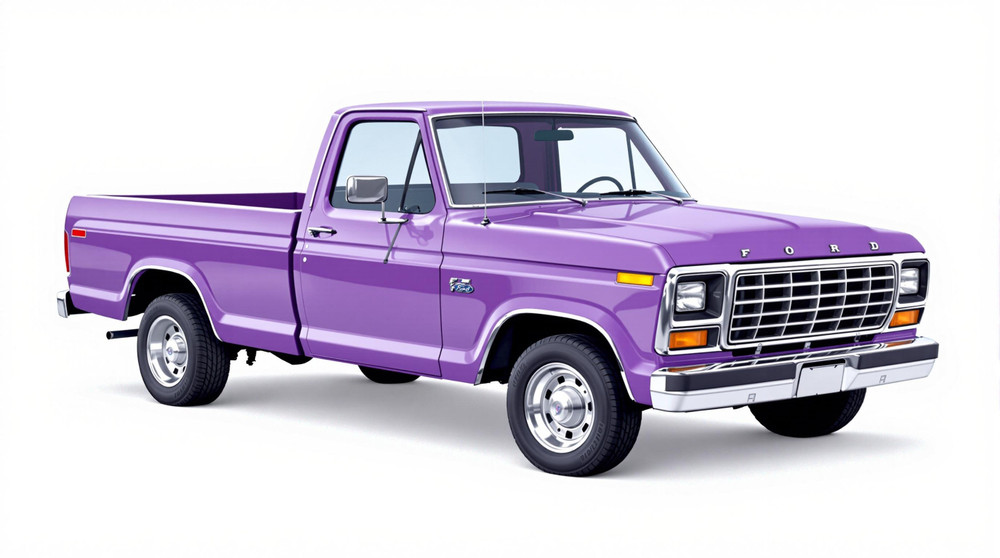
Image of 1981 Ford F-100, Note: These illustrations use artistic license and may differ from actual historical models.
Performance Metrics
Fundamental Metrics
Emotional Appeal
MMP Rating
| Engine Specifications | |
|---|---|
| Engine: | 4.9L 300 Cu. In. I6, 5.0L 302 Cu. In. V8, 5.8L 351 Cu. In. V8 |
| Displacement: | 300-351 Cu. In. |
| Horsepower: | 115-156 HP |
| Torque: | 223-283 lb-ft |
| Compression Ratio: | 8.4:1 - 8.8:1 |
| Ignition System: | Electronic |
| Cooling System: | Liquid-cooled |
| Performance Specifications | |
| 0-60 Time: | 10-12 seconds |
| 1/4 Mile Time: | 17-19 seconds |
| Top Speed: | 85-95 mph |
| Transmission and Drive | |
| Drive Type: | Rear-wheel drive |
| Transmission Type: | 3-speed automatic, 4-speed manual |
| Fuel and Efficiency | |
| Fuel System Type: | Carburetor |
| MPG: | 13-16 MPG |
| Dimensions and Brakes | |
| Brakes: | Front disc, rear drum |
| Wheelbase: | 117.6 inches |
| Weight: | 3,600-4,000 lbs |
Note: Specifications for classic cars are given to the best of our ability, considering the limited and variant data available.
1981 Ford F-100: A Classic Pickup at a Turning Point
The 1981 Ford F-100 is a square-shouldered work truck from a pivotal chapter in Ford history: the first year of the seventh-generation F-Series. Built by Ford Motor Company, it combined traditional pickup toughness with a cleaner, more aerodynamic design and a growing focus on fuel economy. Today, its straightforward mechanicals and unmistakable early-1980s styling make it appealing to both hands-on owners and classic-truck collectors.
The F-100 name dates to Ford’s 1953 model-year truck lineup, when Ford replaced its earlier numeric designations with the F-Series names familiar today. By 1981, the F-100 sat at the lighter end of the half-ton range, below the F-150. It was generally a two-wheel-drive model, while shoppers seeking four-wheel drive typically looked to the F-150 and larger F-Series trucks.
There is a notable milestone attached to the 1981 model year: the F-Series became America’s best-selling vehicle, a position it has held for decades. The F-100 was one member of that much broader truck family, but its practical, approachable character helped define what buyers expected from a Ford pickup.
Boxy Styling, Work-Ready Details
The seventh-generation F-100 traded some of the rounded forms of earlier trucks for a more geometric look. Its squared-off cab, broad hood, upright windshield, and crisp body lines give it the purposeful stance that has become a hallmark of classic 1980s pickups. The front end varies by trim and equipment, but the overall design is unmistakably functional: large glass areas, a wide grille, and a tall, easy-to-read profile.
Buyers could choose a conventional Styleside bed, with smooth outer sides and a full-width tailgate, or a Flareside bed with pronounced rear fenders and a narrower cargo floor. Regular-cab trucks delivered the classic work-truck silhouette. SuperCab models offered extra space behind the front seats, useful for tools, gear, or occasional passengers. Bed length, cab, trim, drivetrain, and equipment combinations varied, so surviving trucks are not all configured alike. The regular-cab Styleside remains the most familiar image of the F-100.
Ford’s palette changed across trims and production runs, with solid work-truck colors alongside more expressive metallic and two-tone combinations. White, red, blue, and earth-toned finishes are common sights on surviving examples. Original paint codes and trim details are worth checking before restoration, since a factory-correct color can add both authenticity and visual appeal.
Inside, the F-100 was built around usefulness rather than luxury. Depending on trim, the cabin could have durable vinyl, cloth inserts, or more decorative upholstery, along with a broad bench seat, simple door panels, and straightforward controls. Ranger and Ranger XLT versions generally offered a more finished appearance than a basic work truck, while the exact equipment depended on the original order. Materials were robust and easy to clean, though not especially plush by modern standards.
Useful Technology for Its Era
The 1981 F-100’s technology was conventional, but that was part of its appeal. A clear instrument panel, familiar switches, and uncomplicated mechanical systems made it easy to understand and service. Available features varied, but could include power steering, power brakes, air conditioning, an AM/FM radio, and automatic transmission. These conveniences were welcome, yet the truck remained a fundamentally mechanical vehicle rather than a computer-controlled one.
One important engineering feature across the F-Series was Ford’s Twin I-Beam front suspension on two-wheel-drive models. It used independent front suspension components designed to combine a more compliant ride than a solid front axle with the durability expected of a working pickup. It is a distinctive part of the driving feel, although worn bushings, alignment issues, or neglected suspension parts can affect how a decades-old example behaves today.
Why the 1981 F-100 Matters
The 1981 redesign reflected a changing truck market. Buyers still wanted payload capacity and durability, but fuel economy, comfort, and everyday drivability were becoming more important. Ford gave the F-Series a more modern shape while keeping the basic formula of a body-on-frame chassis, rear-wheel drive, available manual transmissions, and familiar gasoline engines.
The F-100 also represented a useful middle ground within Ford’s lineup. It offered the size and utility of a full-size pickup without the heavier-duty specifications of larger models. That combination made it a natural choice for small businesses, farms, contractors, and households that needed a truck but did not require maximum towing or payload capacity.
Its lasting influence is visible in the way later pickups balanced work capability with comfort. The 1981 F-100 was not a high-tech revolution, but it belonged to a generation that helped make the pickup an increasingly versatile everyday vehicle. Its design is also a recognizable bridge between the rounded trucks of the 1970s and the sharper, more modern pickups that followed.
Engines, Speed, and Road Manners
Engine availability depended on configuration and market, but common gasoline choices in the 1981 F-Series included Ford’s 4.9-liter inline-six, a 5.0-liter V8, and larger V8 options in portions of the lineup. The 4.9-liter six is especially well regarded for its straightforward construction and low-speed pulling power. V8-equipped trucks deliver a deeper exhaust note and stronger performance, though fuel consumption is typically higher.
Ford did not publish one universal 0-to-60-mph figure or top speed for every F-100. Engine, transmission, axle ratio, cab, bed, condition, and load all make a difference. As a broad real-world estimate, a healthy six-cylinder example may take roughly 15 to 18 seconds to reach 60 mph, while a V8 version may do it in about 12 to 16 seconds. Many could reach approximately 85 to 100 mph under suitable conditions, but these are estimates, not guaranteed factory specifications. The F-100 was designed to haul and work, not to set acceleration records.
On the road, the truck feels direct and mechanical. The steering is heavier and less precise than modern rack-and-pinion systems, and the long hood gives the driver a clear sense of the vehicle’s size. The Twin I-Beam suspension can absorb ordinary road imperfections reasonably well, but an empty pickup may bounce over sharp bumps, especially at the rear. On winding roads, body roll and old-fashioned steering response encourage a measured pace. Crosswinds, worn tires, loose suspension components, and incorrect alignment can make a truck feel less settled.
Start a V8 F-100 and the cabin fills with a familiar low rumble. The inline-six is less theatrical but has a steady, purposeful sound. Either way, the driving experience asks for more participation than a modern truck: the driver works the wheel, listens to the engine, and feels the road through the chassis. That hands-on character is a major part of the truck’s charm.
Living With a Classic Ford Pickup
Owners use 1981 F-100s in several ways. Some remain working pickups for light hauling, farm chores, or property maintenance. Others serve as weekend cruisers, vintage-truck show entries, or restoration projects. They are not typically chosen for modern performance or competition, but a well-built truck can be a dependable local driver when properly maintained.
Mechanical simplicity is a major ownership advantage. Many routine repairs can be handled by an experienced home mechanic with ordinary tools, and parts support for the broader F-Series is strong. Engine, brake, suspension, and service components are generally easier to source than model-specific trim pieces or pristine body panels. Before buying, inspect the frame, cab corners, floor pans, bed, and lower body for rust. Check for oil leaks, cooling-system problems, worn steering and suspension parts, and evidence of poor-quality repairs.
Reliability depends heavily on condition and maintenance. A truck that has spent decades outdoors or been used hard may need substantial work, even if its engine starts readily. Budget for aging rubber components, electrical faults, brake repairs, fuel-system service, and tires that may look acceptable but are past their safe service life. A careful pre-purchase inspection is money well spent.
F-100 Trivia and Common Complaints
The F-100 was part of the F-Series, not a separate line with one fixed specification. That means two trucks carrying the same model-year badge can have very different engines, interiors, beds, and equipment. The F-100 designation also disappeared from the U.S. light-truck lineup after the 1983 model year, as Ford consolidated its half-ton range around the F-150. That relatively short remaining run gives the early-1980s F-100 a distinct place in the model’s history.
There is no widely recognized 1981 F-100 celebrity edition or model-specific speed record to set it apart. Its larger claim to fame is its place in the F-Series story during the year the family became America’s best-selling vehicle. Exact production totals for the F-100 by year, body style, and engine are not readily available in a simple, definitive public count. A reasonable estimate is that production was in the tens of thousands, perhaps around 75,000 to 125,000 for the 1981 F-100, but that is an informed estimate rather than a verified factory figure.
Common criticisms are predictable for a truck of this age. Fuel economy is modest, even for a six-cylinder model, and the cabin lacks the quietness, safety equipment, and comfort of a modern pickup. The ride can be bouncy when unloaded, and rust or decades of wear may turn an inexpensive purchase into an expensive restoration. On the other hand, its simple construction and broad parts availability make many problems easier to address than they would be on a more complex modern vehicle.
Collector Values and Market Outlook
Prices vary sharply with rust, originality, engine, cab, bed, and restoration quality. As a broad U.S. market guide in 2026, a project truck may sell for about $2,000 to $5,000. A usable driver in fair to good condition might bring roughly $6,000 to $12,000. Clean, well-presented examples can reach approximately $15,000 to $25,000, while exceptional restorations or especially desirable configurations may exceed that range. These are approximate asking and sale-price bands, not a formal appraisal.
The 1981 F-100 is generally available, but finding one that is both rust-free and honestly maintained takes more patience. Original trim, a sound body, documented restoration work, and desirable options can raise a truck’s value. Modified examples can be enjoyable, but highly customized builds do not always bring back their full construction cost when sold.
Values have strengthened as buyers have rediscovered square-body-era pickups, though the F-100 usually sits below the most sought-after F-150 and four-wheel-drive versions. Its outlook is best described as steady to gradually appreciating for clean, original examples, with rough projects remaining price-sensitive. Condition matters far more than a speculative production estimate.
The Appeal of the 1981 Ford F-100
The 1981 Ford F-100 brings together a landmark F-Series redesign, honest work-truck engineering, and the approachable character of an early-1980s pickup. It is not fast, luxurious, or especially refined by modern standards, but it is straightforward to understand, rewarding to drive, and practical to maintain. For collectors and enthusiasts, its appeal lies in that balance of history and usability: a classic Ford that still feels ready to turn the key and get to work.
1981 Ford F-100 Catalog of Parts
 1981 Ford F-100 Brake Pedal Pad. 4-3/4" wide X 2-1/4" long-CB 111-NBrake Pedal Pad. 4-3/4" wide X 2-1/4" long. Replaces OEM #'s BC3Z2457B, D3TZ2457A, D3TZ2457B. Each
 1981 Ford F-100 Door Seal (Imported). 154" Long-IS-LM 110Door Seal (Imported). 154" Long. Fits right or left, front and rear doors. Each
 1981 Ford F-100 Flocked Window Channel (Imported). Fits left and right side-IS-WC 6600-23Flocked Window Channel (Imported). Fits left and right side. Each
 1981 Ford F-100 Window sweeper kit. Fits 80-87 Ford Bronco and Truck 2 Door Extended/Standard-WC 6600-12This four piece set includes the inner and outer window felt beltline weatherstrips for each door side window. These strips wipe the side windows when the glass is lowered.
Why Choose Metro?
For over 100 years, Metro Moulded Parts has been the pinnacle of quality in classic car restoration parts. Our commitment to precision and authenticity in every component ensures a perfect fit and an OEM-level appearance.
- Expert Craftsmanship & Quality: Each part is a testament to our dedication to reliability and perfection, crafted from original designs and thoroughly tested.
- Advanced Technology: We use cutting-edge techniques to create flawless, long-lasting parts that surpass others in performance.
- SuperSoft Sponge – The Ultimate Door Seal: Not only are our door seals 30% softer than competitors', but they're also guaranteed to never leak. They effectively reduce wind and road noise, enhancing your classic car's comfort and driving experience.
- Proudly American: Our parts are a product of American craftsmanship, made in the USA with a spirit of excellence and heritage.
- Unrivaled Warranty: We back our products with a 30-year industry-leading warranty, a testament to our confidence in their quality.
Join us in preserving the legacy of classic cars with parts that are crafted for perfection, not just made.