
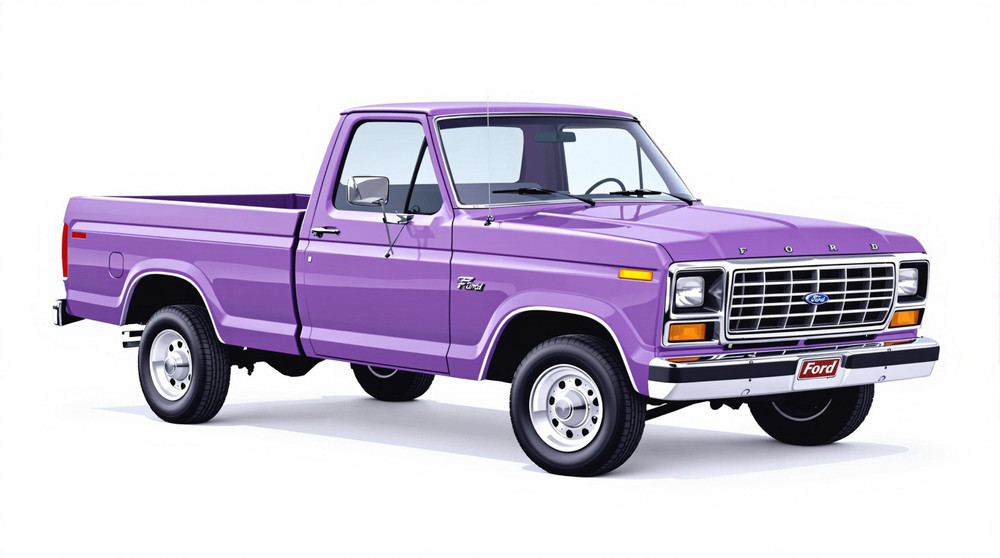
Image of 1981 Ford F-150, Note: These illustrations use artistic license and may differ from actual historical models.
Performance Metrics
Fundamental Metrics
Emotional Appeal
MMP Rating
| Engine Specifications | |
|---|---|
| Engine Options: | 4.9L 300 CID I6, 5.0L 302 CID V8, 5.8L 351 CID V8, 6.6L 400 CID V8 |
| Displacement Range: | 300-400 CID |
| Horsepower Range: | 115-170 HP (approximately) |
| Torque: | 223-315 lb-ft (approximately) |
| Compression Ratio: | 8.0:1 - 8.4:1 (approximately) |
| Ignition System: | Electronic |
| Cooling System: | Liquid-cooled |
| Performance Specifications | |
| 0-60 Time: | 10-15 seconds (approximately) |
| 1/4 Mile Time: | 17-20 seconds (approximately) |
| Top Speed: | 85-95 mph (approximately) |
| Transmission and Drive | |
| Drive Type: | Rear-wheel drive (RWD), Four-wheel drive (4WD) |
| Transmission Type: | 3-speed automatic, 4-speed manual |
| Fuel and Efficiency | |
| Fuel System Type: | Carburetor |
| MPG: | 10-15 mpg (approximately) |
| Dimensions and Brakes | |
| Brakes: | Front disc, rear drum |
| Wheelbase: | 133.0 in (approximately) |
| Weight: | 4,000-5,000 lbs (approximately) |
Note: Specifications for classic cars are given to the best of our ability, considering the limited and variant data available.
1981 Ford F-150: The Square-Shouldered Workhorse
The 1981 Ford F-150 looks ready to get straight to work, with a broad grille, upright cab, and unmistakably squared-off proportions. It belongs to the seventh-generation Ford F-Series, redesigned for 1980, and represents a key moment in the evolution of America’s best-known pickup line: Ford was reshaping its trucks for a new era of fuel-conscious buyers without giving up the toughness that made the F-Series famous.
Ford’s F-Series began in 1948. The F-150 joined the lineup in 1975, positioned between the lighter F-100 and heavier F-250. By the early 1980s, the F-150 had become a popular middle ground for buyers who wanted a useful work truck with more payload capacity than a compact pickup, but did not necessarily need a heavy-duty model.
A notable detail of the 1981 truck is how thoroughly it reflects the shift in priorities around it. Its generation brought a more modern, aerodynamic body and a redesigned chassis, while the familiar body-on-frame construction and available V8 power kept it unmistakably traditional. In other words, Ford’s challenge was not to make the F-150 a different kind of truck. It was to make the classic formula more efficient and contemporary.
Boxy Lines, Practical Cab
The 1981 F-150’s styling is all crisp edges and sturdy-looking sheet metal. A flat hood leads to a wide grille, flanked by rectangular headlamps. The tall windshield, straight beltline, and nearly vertical front end give the truck a commanding profile, while the large wheel openings and prominent bumpers emphasize its utility. The blue Ford oval in the grille became a defining visual feature of the generation.
Buyers could choose a regular cab or the roomier SuperCab, along with a traditional Styleside bed or the separate-fender Flareside bed. The Styleside’s smooth, full-width sides made it the practical, mainstream choice. Flareside models, with their distinctive rear fenders and narrower bed, offered a more old-fashioned look that remains especially appealing to enthusiasts. Both two-wheel-drive and four-wheel-drive versions were available, with equipment and bed choices varying by configuration.
Trim levels included work-oriented Custom models and more generously equipped Ranger and Ranger XLT versions. Exact combinations varied, but buyers could add features such as power steering, power brakes, air conditioning, upgraded interior trim, and an automatic transmission. Period paint palettes included a range of solid colors, from white and red to blues, greens, tans, and darker shades. Two-tone paint was also available on certain configurations. The popular choices today tend to be simple, high-contrast combinations that suit the truck’s clean, angular shape.
Inside, the F-150 favored function over flash. The cabin used durable vinyl and cloth, a straightforward dashboard, large controls, and easy-to-read gauges. Higher trims could bring more comfortable seating and upgraded trim, but this was still a pickup built to be cleaned out and put back to work. The materials were sturdy rather than luxurious, and the upright seating position gave the driver a clear view over the hood.
Technology was modest by modern standards, but useful for its time. Depending on trim and options, buyers could get an automatic transmission, cruise control, AM/FM radio, air conditioning, and power accessories. Engines used carburetion and period emissions equipment rather than today’s engine-management systems. Four-wheel-drive models added a transfer case and, depending on the setup, manual locking hubs, giving owners direct control over the drivetrain.
A New Chapter for the F-Series
The 1980 redesign was a major step in the F-Series’ development. Ford reworked the body and chassis to improve packaging and efficiency, while retaining the traditional ladder frame, solid rear axle, and work-ready construction buyers expected. The cleaner, more squared-off body was not just a styling exercise: it reflected the industry’s response to fuel prices, emissions rules, and changing expectations for everyday vehicles.
The F-150 also helped define the increasingly important light-duty pickup market. It could serve as a farm or construction vehicle during the week and as family transportation on the weekend. That versatility helped distinguish it from both compact pickups and heavier-duty trucks. The 1981 model did not introduce a single breakthrough feature that transformed the industry, but it helped establish the modern full-size pickup as a multipurpose vehicle rather than a tool used only for work.
Its influence is easiest to see in the F-Series’ continued formula: a range of cab and bed configurations, multiple powertrains, two- and four-wheel drive, and trim levels spanning basic work truck to comfortable daily driver. The 1981 F-150 is part of the generation that refined that recipe and gave it the sharper, more modern appearance that many people associate with classic Ford pickups.
Engines, Speed, and Road Manners
Engine availability depended on configuration, drivetrain, and market. Common choices included Ford’s 300-cubic-inch (4.9-liter) inline-six and V8 engines such as the 302-cubic-inch (5.0-liter) and 351-cubic-inch (5.8-liter). Larger V8 options were available in portions of the F-Series range, though not every engine was offered with every F-150 configuration. Most 1981 trucks were carbureted, and output varied with engine, emissions equipment, and calibration.
Performance figures need a little context. These trucks were built for hauling and towing, not quick launches, and gearing, axle ratio, transmission, tire size, and condition all make a difference. As a broad period-style estimate, a six-cylinder truck might take roughly 16 to 20 seconds to reach 60 mph, while a V8 could manage approximately 11 to 16 seconds. Top speed was generally in the neighborhood of 85 to 100 mph, although gearing, load, and mechanical condition could change that substantially. Those are estimates, not a single factory specification for every 1981 F-150.
On the road, the truck feels substantial and mechanical. The inline-six is known for a steady, workmanlike note, while the V8 adds a deeper exhaust rumble and stronger response under load. A manual transmission gives the driver an involved, direct connection to the engine. The automatic is more relaxed in traffic and can make a well-equipped F-150 an easier daily vehicle.
Two-wheel-drive models use Ford’s Twin I-Beam front suspension, a design intended to combine a rugged truck front end with independent wheel movement. It can feel firm and bouncy when the bed is empty, particularly over sharp bumps. The solid rear axle is durable but can hop or skip over rough pavement without cargo in the bed. Four-wheel-drive trucks sit higher and feel more rugged, with the added traction valuable on dirt, snow, and muddy work sites. On a winding road, the F-150’s size and truck suspension are apparent: it is not a sports car, and careful steering inputs suit it better than fast cornering.
Living with a Classic F-150
Today, a 1981 F-150 can be a weekend project, a dependable local runabout, a farm truck, or the centerpiece of a classic-truck collection. A clean, unmodified example can also attract attention at shows, especially in an appealing original color combination. It is less often chosen for serious competition, though period trucks can be adapted for off-road use or motorsport by enthusiasts.
Routine maintenance is refreshingly straightforward for owners comfortable with older vehicles. The engine bay is relatively accessible, and many service jobs can be handled with common tools. Carburetors, ignition components, brakes, steering parts, and suspension pieces are familiar territory for vintage-truck mechanics. Parts support remains strong because Ford produced F-Series trucks in large numbers and many mechanical components were shared across related model years.
Age, rather than basic design, is the main reliability concern. Check the frame and body carefully for rust, particularly around the cab corners, floor, bed, wheel arches, and areas where moisture can collect. Inspect the steering and Twin I-Beam suspension on two-wheel-drive trucks, and check the transfer case, hubs, and front axle on four-wheel-drive versions. A truck that starts easily and drives well still deserves a thorough inspection for worn bushings, tired brakes, old fuel hoses, and previous repairs.
Useful Trivia and Common Complaints
The 1981 F-150 was offered in enough combinations that two trucks from the same model year can feel quite different. A basic two-wheel-drive work truck with a six-cylinder engine is a very different proposition from a four-wheel-drive SuperCab with a V8 and comfort options. That variety is part of the model’s appeal, but it also means buyers should verify a truck’s equipment rather than relying on badges or seller descriptions alone.
There is no well-documented celebrity connection or special speed record that defines the 1981 model. Its bigger claim to fame is its place in the long-running F-Series story. Ford’s pickup line became one of the most successful vehicle families in the United States, and the F-150’s broad mix of work and personal use helped establish the template for the full-size pickup market.
Common criticisms are familiar to anyone who has driven an early-1980s truck: fuel economy is modest, the ride can be choppy when unloaded, and cabin noise and comfort fall short of modern standards. Carbureted engines can also need more attention than contemporary fuel-injected vehicles, especially after long storage or decades of improvised repairs. For many owners, those drawbacks are outweighed by simple mechanicals, sturdy construction, and the pleasure of driving a truck that feels genuinely connected to its machinery.
Collector Value and Availability
The 1981 F-150 is not rare in the broad sense, but condition, configuration, and originality make a huge difference. Ford did not publish an easily verified production total for every F-150 body and equipment combination. A reasonable broad estimate is that roughly 150,000 to 250,000 F-150s may have been built for the U.S. market for the 1981 model year, but that should be treated as an informed estimate rather than a factory-verified figure. Exact figures for a specific cab, bed, engine, or drivetrain are harder to establish.
As a general U.S. market guide, a running but rough project might sell for about $3,000 to $7,000. A usable driver in decent condition often falls around $7,000 to $15,000, while a clean, well-kept example may bring roughly $15,000 to $25,000. High-quality restorations, unusually original trucks, and desirable four-wheel-drive or Flareside configurations can reach $25,000 to $40,000 or more. These are broad estimates, not guaranteed sale prices; regional demand, rust, documentation, and the quality of the restoration can shift values considerably.
Interest in classic pickups has supported values, particularly for clean, original examples. The market is not uniform: ordinary project trucks may remain affordable, while rust-free trucks with desirable specifications have become harder to find and can command a premium. In general, the best-preserved examples have the strongest prospects, while poorly documented modifications and structural rust tend to limit value.
Why the 1981 F-150 Still Matters
The 1981 Ford F-150 combines the practical toughness of an old-school pickup with the cleaner styling and broader appeal of a newer generation. Its range of engines, cabs, beds, and drivetrains made it useful in countless roles, while its simple, serviceable construction keeps it approachable for owners today.
It may not be the fastest or most refined truck of its era, but that was never the point. The 1981 F-150 helped carry Ford’s pickup tradition into a more modern age, and its squared-off silhouette remains a familiar emblem of American truck culture.
1981 Ford F-150 Catalog of Parts
 1981 Ford F-150 Brake Pedal Pad. 4-3/4" wide X 2-1/4" long-CB 111-NBrake Pedal Pad. 4-3/4" wide X 2-1/4" long. Replaces OEM #'s BC3Z2457B, D3TZ2457A, D3TZ2457B. Each
 1981 Ford F-150 Door Seal (Imported). 154" Long-IS-LM 110Door Seal (Imported). 154" Long. Fits right or left, front and rear doors. Each
 1981 Ford F-150 Flocked Window Channel (Imported). Fits left and right side-IS-WC 6600-23Flocked Window Channel (Imported). Fits left and right side. Each
 1981 Ford F-150 Window sweeper kit. Fits 80-87 Ford Bronco and Truck 2 Door Extended/Standard-WC 6600-12This four piece set includes the inner and outer window felt beltline weatherstrips for each door side window. These strips wipe the side windows when the glass is lowered.
Why Choose Metro?
For over 100 years, Metro Moulded Parts has been the pinnacle of quality in classic car restoration parts. Our commitment to precision and authenticity in every component ensures a perfect fit and an OEM-level appearance.
- Expert Craftsmanship & Quality: Each part is a testament to our dedication to reliability and perfection, crafted from original designs and thoroughly tested.
- Advanced Technology: We use cutting-edge techniques to create flawless, long-lasting parts that surpass others in performance.
- SuperSoft Sponge – The Ultimate Door Seal: Not only are our door seals 30% softer than competitors', but they're also guaranteed to never leak. They effectively reduce wind and road noise, enhancing your classic car's comfort and driving experience.
- Proudly American: Our parts are a product of American craftsmanship, made in the USA with a spirit of excellence and heritage.
- Unrivaled Warranty: We back our products with a 30-year industry-leading warranty, a testament to our confidence in their quality.
Join us in preserving the legacy of classic cars with parts that are crafted for perfection, not just made.