
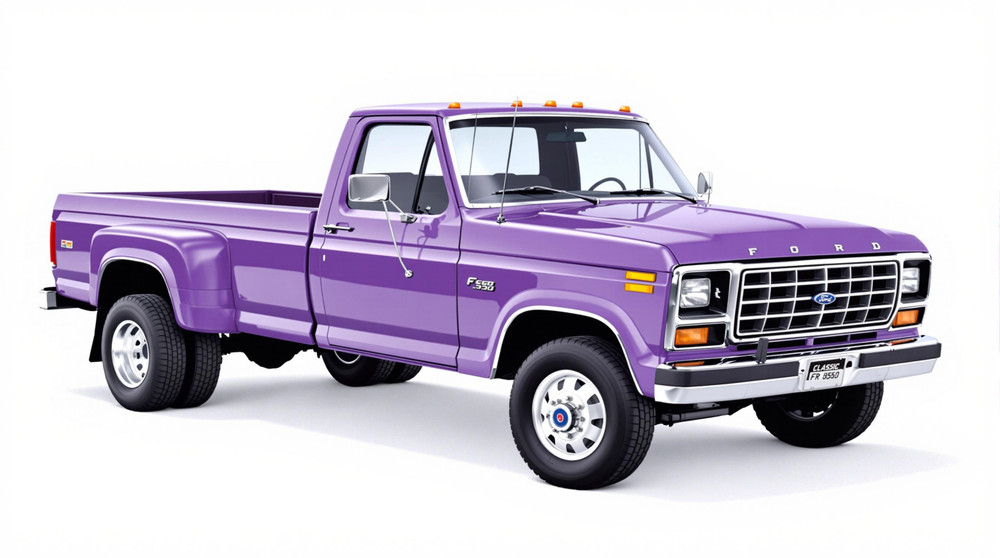
Image of 1981 Ford F-350, Note: These illustrations use artistic license and may differ from actual historical models.
Performance Metrics
Fundamental Metrics
Emotional Appeal
MMP Rating
| Engine Specifications | |
|---|---|
| Engine Options: | 4.9L I6, 5.8L V8, 6.6L V8, 7.5L V8 |
| Displacement Range: | 4.9L - 7.5L |
| Horsepower Range: | 120-225 HP |
| Torque: | 220-350 lb-ft |
| Compression Ratio: | 8.0:1 - 8.4:1 |
| Ignition System: | Distributor ignition |
| Cooling System: | Liquid cooled |
| Performance Specifications | |
| 0-60 Time: | Estimated 10-15 seconds |
| 1/4 Mile Time: | Estimated 18-22 seconds |
| Top Speed: | 85-95 mph |
| Transmission and Drive | |
| Drive Type: | Rear wheel drive |
| Transmission Type: | 3-speed automatic, 4-speed manual |
| Fuel and Efficiency | |
| Fuel System Type: | Carburetor |
| MPG: | Estimated 10-15 mpg |
| Dimensions and Brakes | |
| Brakes: | Front disc, rear drum |
| Wheelbase: | 133-155 inches |
| Weight: | 4,000-5,000 lbs |
Note: Specifications for classic cars are given to the best of our ability, considering the limited and variant data available.
1981 Ford F-350: The One-Ton Workhorse
The 1981 Ford F-350 was built for jobs that asked more of a truck than a light-duty pickup could reasonably give. Part of Ford’s seventh-generation F-Series, introduced for 1980, it combined a squared-off new body with heavy-duty chassis options and the kind of straightforward engineering that made it a familiar sight on farms, construction sites, and highways across America.
Ford Motor Company had spent decades refining its F-Series formula by 1981: offer a truck in a range of sizes, then let buyers tailor it to work or recreation. The F-350 sat near the heavy end of that family, above the F-100 and F-150 and alongside the F-250. Buyers could order a pickup or a chassis ready for a service body, flatbed, or other commercial equipment.
Its timing mattered. The 1980s began amid fuel-economy concerns and changing expectations for trucks. Ford redesigned the F-Series with a more modern, squared-off shape, but the F-350 remained unapologetically practical. One notable bit of context: Ford’s F-Series was already establishing the sales momentum that would make it America’s best-selling truck line, a title it has held for decades.
Square Shoulders and Work-Ready Options
The 1981 F-350 wears the crisp, angular look that defines many trucks of its era. Its upright grille, broad hood, flat sides, and large glass areas give it a purposeful stance, while the tall cab and prominent wheel arches make clear that this is a truck designed around load capacity, not low-slung styling. Depending on configuration, it could ride on single or dual rear wheels, with the dually’s wide rear stance giving it an especially businesslike look.
Ford offered several cab and body combinations, with availability depending on the order and intended use. Buyers could choose a regular cab, an extended SuperCab, or a crew cab, along with a conventional pickup bed or a chassis-cab setup for commercial bodies. Styleside beds delivered the familiar flat-sided pickup profile, while Flareside availability and other configurations varied by model and order. For many owners, the classic regular-cab pickup became the most recognizable version. Crew-cab and dually trucks, however, have particular appeal today because they combine utility with a distinctive heavy-duty presence.
Trim levels and equipment ranged from basic, easy-to-clean work-truck appointments to more comfort-oriented packages. Inside, the cabin was functional rather than luxurious: durable vinyl was common, while cloth and upgraded trim could be ordered on better-equipped examples. The wide bench seat, upright driving position, large controls, and straightforward instrument panel make the truck feel refreshingly direct. Power steering, power brakes, air conditioning, and upgraded radios were among the comfort and convenience options available, depending on configuration.
Paint choices varied by year, trim, and ordering region. Solid work-friendly colors such as white, red, blue, and brown were common sights, with two-tone treatments adding extra visual contrast on better-equipped trucks. White remains one of the most familiar F-350 colors, in part because it suited both fleet service and private ownership. Original color combinations can add interest to a restoration, but condition and correct equipment generally matter more to buyers.
Heavy-Duty Engineering in a Changing Era
The F-350’s importance was less about introducing a flashy new gadget and more about making a broad, adaptable truck range work for a wide variety of owners. The seventh-generation design brought a fresh body and revised packaging, while the one-ton model retained the stout frame, suspension, and axle options needed for demanding work. It could be ordered as a pickup, but its chassis-cab form also made it a platform for vocational vehicles, from utility rigs to delivery and service trucks.
That flexibility helped distinguish the F-Series from vehicles aimed mainly at personal transportation. The F-350 could be a family’s farm truck, a contractor’s daily tool, or the basis for a specialized commercial vehicle. Its lasting influence is visible in the way modern pickups are still sold: as a family of models with multiple cab styles, payload capacities, drivetrains, and upfit possibilities.
Ford’s Twin I-Beam front suspension, a long-running feature on many two-wheel-drive F-Series models, was known for its ability to handle rough work while maintaining independent front-wheel movement. Exact suspension and axle arrangements depended on the truck’s configuration, especially on four-wheel-drive and heavy-duty versions. The F-350 was not built to feel like a car, and its engineering priorities reflected that: strength, serviceability, and carrying capability came first.
Engines, Speed, and the Feel of the Drive
Engine availability depended on drivetrain, equipment, and market, but 1981 F-Series buyers could encounter Ford inline-six and V8 powerplants in the range. The 4.9-liter (300-cubic-inch) inline-six was valued for its straightforward design and useful low-speed torque. V8 choices included engines such as the 5.8-liter (351-cubic-inch) and larger-displacement options, with the 7.5-liter (460-cubic-inch) V8 serving buyers who wanted strong gasoline-powered pulling performance. The exact engine offered in a particular F-350 should be confirmed from its identification tag, documentation, or engine markings.
Manual and automatic transmissions were available, with the specific gearbox depending on engine and configuration. Rear-wheel drive was common, and four-wheel drive was available for buyers who needed traction on worksites, rough roads, or in snow. Axle ratios also made a meaningful difference: a truck set up for towing or hauling could feel very different from one geared for lighter use.
Factory performance figures are not consistent enough across F-350 configurations to give one definitive top speed or 0-to-60 time. As a broad real-world estimate, an unloaded truck with a V8 might reach 60 mph in roughly 12 to 18 seconds, while a six-cylinder or heavily geared work truck could take longer. Depending on engine, gearing, tires, condition, and load, top speed might fall around 80 to 90 mph. Those are estimates, not guaranteed factory specifications, and the F-350 was designed for useful pulling and carrying rather than high-speed performance.
From behind the wheel, the truck feels substantial and mechanical. The engine’s low, steady rumble, the long-travel suspension, and the large steering wheel all reinforce its working-truck character. An unloaded F-350 can feel firm and bouncy over potholes, while a sensible load often settles the suspension and improves its composure. On winding roads, its size, weight, and truck-style steering call for measured inputs. In crosswinds, a tall body or empty bed can be affected more than a passenger car, so careful speed and steering adjustments are part of the experience.
Living With a 1981 F-350
Today, these trucks serve as working classics, restoration projects, weekend haulers, farm vehicles, and show pieces. Some owners still use them for towing or property maintenance, while others preserve a clean original example for local shows. Their appeal comes from being more than a display vehicle: a sound F-350 can still perform useful work, provided its condition and equipment suit the task.
Maintenance is generally approachable for an owner comfortable with older vehicles. The engine bay is relatively accessible, and many routine jobs do not require specialized diagnostic equipment. Ignition, fuel, cooling, brake, and steering systems are familiar territory for classic-truck mechanics. Parts support remains solid for common service items, though original trim, model-specific body pieces, and some heavy-duty components can take more searching.
Age is the main reliability issue. Before buying, inspect the frame, cab mounts, floorboards, bed, and body seams for corrosion. Check the steering and suspension for worn joints, look for brake-system leaks, and confirm that the transmission shifts properly. On a truck that has worked hard, also examine the rear axle, differential, cooling system, and signs of towing-related wear. A well-maintained example can be dependable, but a neglected one-ton truck can turn deferred repairs into an expensive list.
F-350 Facts and Common Criticisms
There was no single famous 1981 F-350 special edition that defines the model. Its unusual and memorable versions tend to be the combinations owners ordered for a specific purpose: crew-cab dual-rear-wheel pickups, four-wheel-drive trucks, and chassis cabs fitted with specialized bodies. The model’s commercial life also means many examples were modified or worked hard, making an untouched truck with clear documentation more interesting to collectors.
There is no widely recognized speed or endurance record associated specifically with the 1981 F-350. Its achievement was practical rather than glamorous: serving as a versatile platform in a truck line that became a fixture of American work and recreation. Nor should every surviving truck be assumed to be factory-original. Flatbeds, service bodies, replacement beds, engine swaps, and other modifications are common, so a careful inspection of the truck’s identity and history is worthwhile.
Common criticisms are easy to understand from a modern perspective. The cabin is loud, fuel consumption can be substantial, and the ride may feel stiff or unsettled when the truck is empty. Braking distances, steering effort, and overall refinement also differ from those of a new pickup. These are not surprises so much as reminders that the F-350 was engineered around load capacity and durability, not car-like comfort.
Collector Value and Availability
There is no reliable public production total for every 1981 F-350 cab, drivetrain, and body combination. As a working estimate rather than an official factory figure, perhaps 20,000 to 35,000 F-350s were built for the North American market that year. The total number of surviving examples is much smaller, but the truck is not exceptionally rare in the broader classic-vehicle market. Work trucks were produced in useful numbers, and many remain in circulation, though clean original examples are harder to find.
As of 2026, rough U.S. market expectations might run from about $4,000 to $10,000 for a project or heavily used truck, and roughly $10,000 to $25,000 for a solid, usable example. A well-restored or unusually desirable truck, such as a clean four-wheel-drive crew cab or dually, can reach approximately $25,000 to $45,000 or more. Exceptional condition, originality, documentation, and a desirable configuration can push a sale higher. These ranges are estimates, and regional demand, rust, mechanical condition, and modifications can shift the price considerably.
Values have generally benefited from growing interest in classic pickups, but the market is selective. Rough work trucks remain relatively affordable, while clean, original, well-documented examples command stronger prices. The best long-term prospects are usually trucks with sound structure, desirable equipment, and a sympathetic restoration rather than heavily altered examples with uncertain histories.
Why the 1981 F-350 Still Matters
The 1981 Ford F-350 captures a point when pickup design was becoming more modern without leaving its work-first roots behind. Its squared styling, range of cab and chassis choices, and heavy-duty engineering made it useful in many roles, from farm duty to commercial service. It is not fast or polished by today’s standards, but that is not the measure that made it valuable.
For enthusiasts, the F-350’s charm is in its honest purpose: a big, repairable truck built to carry, tow, and keep going. Find one with a solid frame and the right configuration, and you have more than a vintage pickup. You have a tangible piece of the American work-truck tradition.
1981 Ford F-350 Catalog of Parts
 1981 Ford F-350 Brake Pedal Pad. 4-3/4" wide X 2-1/4" long-CB 111-NBrake Pedal Pad. 4-3/4" wide X 2-1/4" long. Replaces OEM #'s BC3Z2457B, D3TZ2457A, D3TZ2457B. Each
 1981 Ford F-350 Door Seal (Imported). 154" Long-IS-LM 110Door Seal (Imported). 154" Long. Fits right or left, front and rear doors. Each
 1981 Ford F-350 Flocked Window Channel (Imported). Fits left and right side-IS-WC 6600-23Flocked Window Channel (Imported). Fits left and right side. Each
 1981 Ford F-350 Window sweeper kit. Fits 80-87 Ford Bronco and Truck 2 Door Extended/Standard-WC 6600-12This four piece set includes the inner and outer window felt beltline weatherstrips for each door side window. These strips wipe the side windows when the glass is lowered.
Why Choose Metro?
For over 100 years, Metro Moulded Parts has been the pinnacle of quality in classic car restoration parts. Our commitment to precision and authenticity in every component ensures a perfect fit and an OEM-level appearance.
- Expert Craftsmanship & Quality: Each part is a testament to our dedication to reliability and perfection, crafted from original designs and thoroughly tested.
- Advanced Technology: We use cutting-edge techniques to create flawless, long-lasting parts that surpass others in performance.
- SuperSoft Sponge – The Ultimate Door Seal: Not only are our door seals 30% softer than competitors', but they're also guaranteed to never leak. They effectively reduce wind and road noise, enhancing your classic car's comfort and driving experience.
- Proudly American: Our parts are a product of American craftsmanship, made in the USA with a spirit of excellence and heritage.
- Unrivaled Warranty: We back our products with a 30-year industry-leading warranty, a testament to our confidence in their quality.
Join us in preserving the legacy of classic cars with parts that are crafted for perfection, not just made.